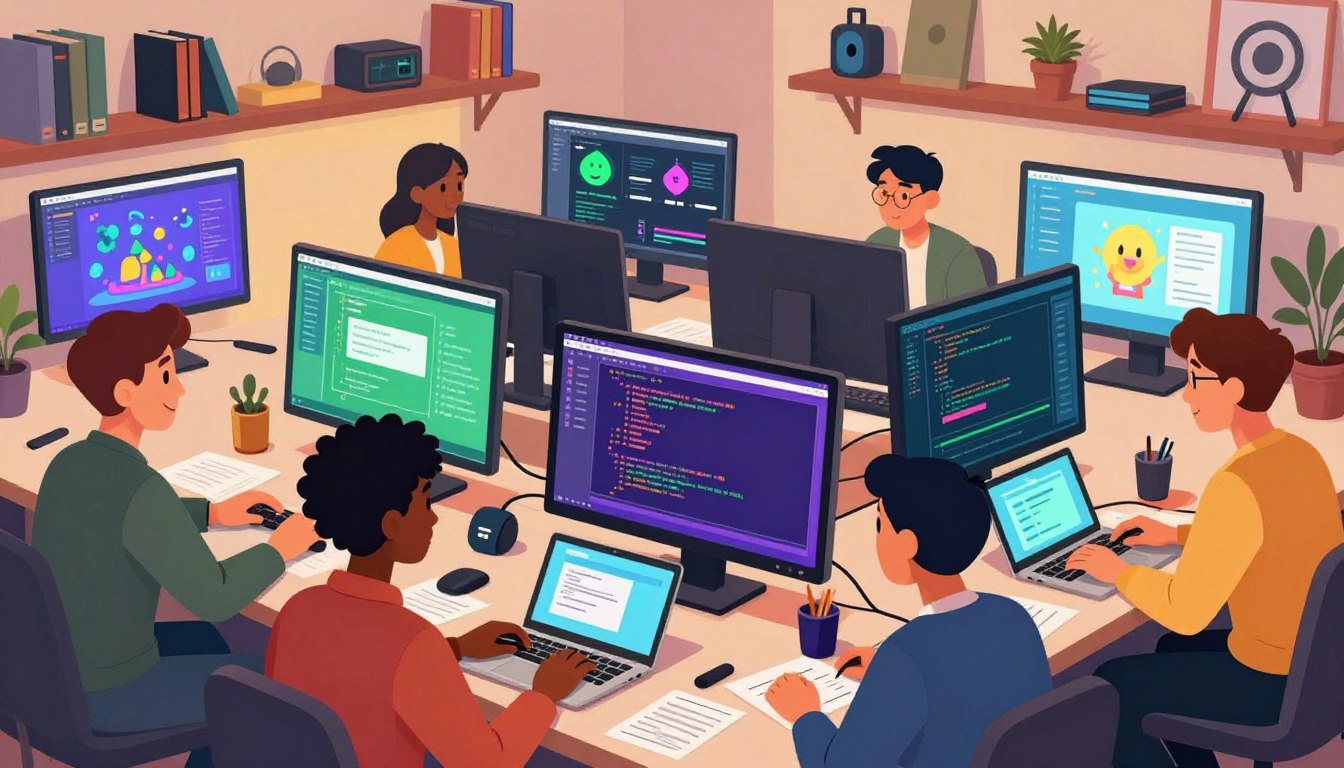
There is a moment when a small idea feels like a turning point. Many makers know that tug: a sketch, a sound, or a line of code that insists on becoming something public. This guide meets that urge with practical direction and creative focus.
At its heart, creative coding uses code to produce expressive outputs—visuals, sound, or interactive systems that blend art and engineering. Open-source tools and tutorials now make it easier to learn HTML, CSS, JavaScript, Processing, and more.
This short guide frames ten vibe-forward pieces you can build to show both technical depth and design sense. Each idea targets clear outcomes: demonstrable skills, neat documentation, and user-facing impact that hiring managers can read quickly.
Readers will leave with scoped ideas, recommended stacks, and a simple plan to move from concept to live demo. The emphasis is pragmatic—use technology thoughtfully, tell the project’s story, and let the work speak for the learning behind it.
Key Takeaways
- Use code to make portfolio work that balances aesthetics and technical rigor.
- Choose ideas that demonstrate clear skills: data, APIs, algorithms, or visual systems.
- Document and demo each piece—stories help reviewers see your impact fast.
- Start small with a clear scope; iterate toward a polished, user-facing result.
- Reference real-world examples to ground inspiration and inform design choices.
What creative coding is and why these projects elevate your portfolio
Programming can do more than solve tasks; it can shape experiences that delight users. This approach uses code to make visual art, sound systems, and motion-driven work rather than only utility apps. Little demos become narratives that show both design sense and technical depth.
From expressive code to digital art: how programming becomes design, music, and motion
Creative coding turns algorithms into generative graphics, interactive sound, and kinetic installations. These works reveal how a maker handles aesthetics, timing, and user input.
Reference pieces—from Land Lines to Learning to See—help map standards for clarity and craft. Entry-level learning paths include W3Schools, YouTube tutorials, LinkedIn Learning, Learnpython.org, Code Academy, and Processing.
Hands-on practice, problem-solving, and credibility: the real-world edge of coding projects
Building real pieces proves problem-solving: scoping, iterating, and measuring user response. Hands-on work shows how one applies data, algorithms, and design to meet user needs.
| Subfield | What it shows | Starter resource |
|---|---|---|
| Generative design | Algorithmic form and type systems | Processing |
| Live performance | Syncing sound and visuals | Live coding tutorials |
| Projection mapping | Spatial interaction and motion | Mapping toolkits |
| ML experiments | Data-driven aesthetics | Intro ML guides |
For extra idea prompts see a compact list of 10+ coding ideas and a discussion on the creative coding mindset. Together, learning and real deliverables make a portfolio that hiring teams read as evidence, not just claims.
Creative Coding Projects: ten vibe ideas that blend art, code, and real-world tech
This list turns playful experiments into tangible demos that hiring teams can evaluate fast. Each entry pairs scope with a clear outcome: what to build, which skills it shows, and one practical tip to ship a working demo.
Generative poster series with algorithms and typography
Build a repeatable pipeline where algorithms drive layout, color, and type rules. Export batches for print and web to prove design rigor and code reusability.
Interactive weather visualizer
Create an app that queries a weather API and maps temperature to color, wind to particle flow, and rain to shader effects. This shows real-time data handling and expressive rendering.
Projection-mapped micro-installation
Use a low-cost projector to map visuals onto household objects. Document calibration steps and playback workflows so viewers can replicate the setup.
Live-coded music performance set
Make a short set where visuals react to BPM and amplitude. Record a run to demonstrate event timing, rehearsal discipline, and stage-ready integration.
ML-powered image sketcher
Train or integrate a model that turns line doodles into satellite-like textures. Focus on inference speed and user control to balance surprise with predictability.
Realtime chat canvas
Use WebSockets so messages become brush strokes or particle events. Multiple users see instant updates; add moderation and snapshots to manage collaboration.
Data-driven “mood” emojis
Collect lightweight user inputs and timing to render expressive pixel emojis. This is a beginner-friendly way to show interactions and stateful UI logic.
Computational embroidery patterns
Leverage PEmbroider or a similar toolkit to convert vector paths and noise fields into stitch-ready files. Export machine formats to bridge code and craft.
Collaborative pixel wall
Enable many users to co-create in the browser, add versioned updates, and show scaling choices. Snapshots and moderation prove system thinking and social design.
Neural style vignette
Prototype explainable visuals that surface attention maps or processing steps. Use this to discuss perception, transparency, and how models transform input.
For further inspiration and a compact set of implementable ideas, see a focused list of additional vibe concepts at 12 vibe coding projects to try.
Tools, languages, and learning paths to build faster and smarter
A practical toolset lets makers move from idea to demo in days, not months. The right combination of language and libraries reduces setup time and keeps focus on what users see and feel.
Starter stack: HTML, CSS, JavaScript, and Processing
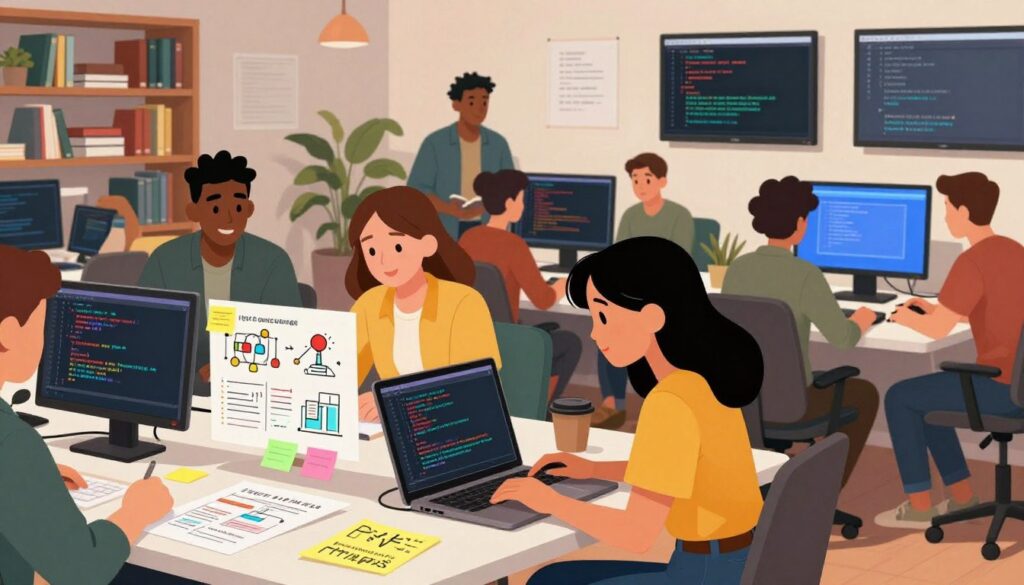
Begin with a pragmatic stack—HTML, CSS, JavaScript, and Processing—to prototype visuals, interactions, and small apps quickly. This stack works across browser and local computer environments, so one build can serve many audiences.
Open learning: W3Schools, YouTube, and LinkedIn Learning
Use open learning ecosystems to close skill gaps fast. Reference-driven tutorials on W3Schools, concise YouTube guides, and structured courses on LinkedIn Learning accelerate targeted learning and timely updates to your toolkit.
Beginner-friendly platforms for STEAM confidence
Classroom-friendly tools like imagi Edu or Learnpython.org turn concepts into playable exercises—scrolling text, mood emojis, or BPM-synced visuals. These small wins build confidence and produce shareable artifacts for portfolios.
- Pair tutorials with mini builds: one idea at a time converts learning into demonstrable skills.
- Adopt version control: document changes so a team or future collaborator can follow development choices.
- Choose libraries by intent: p5.js/Processing for visuals, Three.js for 3D, TensorFlow.js for lightweight ML in the browser.
Treat data as a design material—plan simple schemas and validate inputs so an app remains robust as sources evolve. Ship small, ship often: consistent releases compound competence and add portfolio depth.
Turn your coding projects into portfolio wins that recruiters remember
A concise narrative lets reviewers map your work to real user outcomes. Frame each case study around a clear problem, the approach taken, and measurable impact. This makes algorithms and decisions legible to nontechnical readers and hiring teams.
Show the story: problem, approach, algorithms, and impact on users
Start with one sentence that states the problem and the target user. Follow with a short explanation of the approach and any key algorithms used. End with the effect on users — engagement, time saved, or behavior change.
Ship demos: live links, videos, and repositories with clean READMEs
Always include a live demo, a short walkthrough video, and a repository. Keep README text concise: setup, features, data sources, and known constraints. That reduces friction for reviewers and speeds evaluation.
Tag your skills: languages, frameworks, data sources, and interactions
List languages, libraries, and integrations up front so recruiters map skills to role needs quickly. Note where secure auth, WebSockets, or API design appear in the architecture.
Iterate with feedback: insights, improvements, and versioned updates
Document user testing, key learnings, and a changelog of updates. Capture before/after metrics when possible. Close each case study with next steps and a short roadmap to show momentum.
- Surface trade-offs: diagram architecture and explain challenges.
- Highlight quality: accessibility, performance, and security notes.
- Credit collaborators: clarify your role and team context.
Conclusion
Good portfolios show how code becomes a tool for clear communication and measurable impact.
Turn an idea into a live demo: scope small, ship on time, and document each decision. This way of working builds confidence and keeps learning visible.
Adapt the ten project ideas for home, team, or stage. Blend art and music with technology; even a weather-driven app can highlight thoughtful design and system thinking.
Use tools judiciously, keep READMEs concise, and iterate with user feedback. For a primer on what this approach looks like in practice, see what creative coding is.
Choose a way forward: build one small piece today, ship a demo, and let steady updates make your portfolio a living system that proves skill and intent.
FAQ
What is the goal of the "10 Vibe Coding Projects to Boost Your Portfolio" list?
The list aims to provide ten practical, art-forward ideas that showcase technical skill, design sensibility, and problem-solving. Each entry pairs code with a creative outcome—visuals, sound, interaction, or machine learning—so builders can present measurable impact and clear narratives to recruiters and collaborators.
How does creative coding differ from traditional software development?
Creative coding focuses on expression, experimentation, and real-time feedback. It blends algorithms with art, music, and motion to explore perception and interaction. While it uses many of the same languages and tools as product engineering, the emphasis is on aesthetics, generative systems, and rapid visual iteration.
Which projects from the list are best for beginners?
Beginners should start with projects that have clear inputs and outputs—generative posters, an interactive weather visualizer using public APIs, or a realtime chat canvas. These allow incremental build steps, immediate visual results, and straightforward use of HTML, CSS, and JavaScript or Processing.
What tools and languages are recommended to build these ideas fast?
A starter stack includes HTML, CSS, JavaScript, and Processing (p5.js). Add libraries like D3 for data visuals, Tone.js for sound, and TensorFlow.js for lightweight ML. Use GitHub for version control and Netlify or Vercel for quick deployment.
How can machine learning be integrated without heavy infrastructure?
Use client-side ML libraries (TensorFlow.js, ml5.js) or serverless APIs for image and sketch transformation. Start with pre-trained models for style transfer or pose detection, and limit compute by processing thumbnails or short samples to keep latency low and costs down.
What makes a project portfolio-ready and memorable to recruiters?
A strong portfolio piece tells a concise story: the problem, approach, key algorithms, user impact, and technical trade-offs. Ship a live demo, a short video walkthrough, and a clean README with setup steps and tagged skills—languages, frameworks, data sources, and interaction types.
How should creators document and present iterative updates?
Version your work with clear changelogs and branches on GitHub. Publish release notes that explain improvements, tests, and user feedback. Include before-and-after visuals or short clips to highlight evolution and the reasoning behind each change.
Are there ethical considerations when using user data or ML in these builds?
Yes. Protect privacy by limiting data retention, anonymizing inputs, and clearly disclosing data use. For ML, note model biases, provide opt-outs, and document limitations so users and reviewers understand the system’s boundaries and risks.
What learning resources speed skill growth for these topics?
Combine structured courses (LinkedIn Learning), targeted tutorials (W3Schools for fundamentals), and hands-on videos on YouTube. Join communities—GitHub, Stack Overflow, and Discord groups—to get feedback, collaborate, and find datasets or APIs for experiments.
How can collaborative or multiplayer elements be prototyped quickly?
Prototype with WebSockets or Firebase Realtime Database for low-latency shared state. Focus on simple sync rules and conflict resolution. Start with a limited feature set—shared canvas strokes or a pixel wall—and iterate based on user testing.
What metrics show a project’s success beyond aesthetics?
Track engagement (session length, repeat visits), interaction depth (actions per session), and accessibility metrics. For demonstrable impact, collect qualitative feedback and include performance measurements like frame rate or API latency.
How can one balance artistic intention with technical constraints?
Define design goals and constraints early—target devices, performance budget, and data limits. Prototype the core interaction first, then optimize. Use fallbacks for low-power devices and document the trade-offs made to preserve both vision and usability.
Which platforms are best for sharing demos and reaching recruiters?
Host live demos on Netlify, Vercel, or GitHub Pages. Share polished videos on Vimeo or YouTube and link repositories on GitHub. Use LinkedIn and portfolio sites like Behance or personal domains to provide context and attract professional attention.
How can someone assess which idea fits their goals and timeline?
Evaluate each idea by its learning value, required stack, and expected build time. Choose projects that stretch one new skill per iteration—say ML integration or projection mapping—so progress is visible and manageable within weeks, not months.