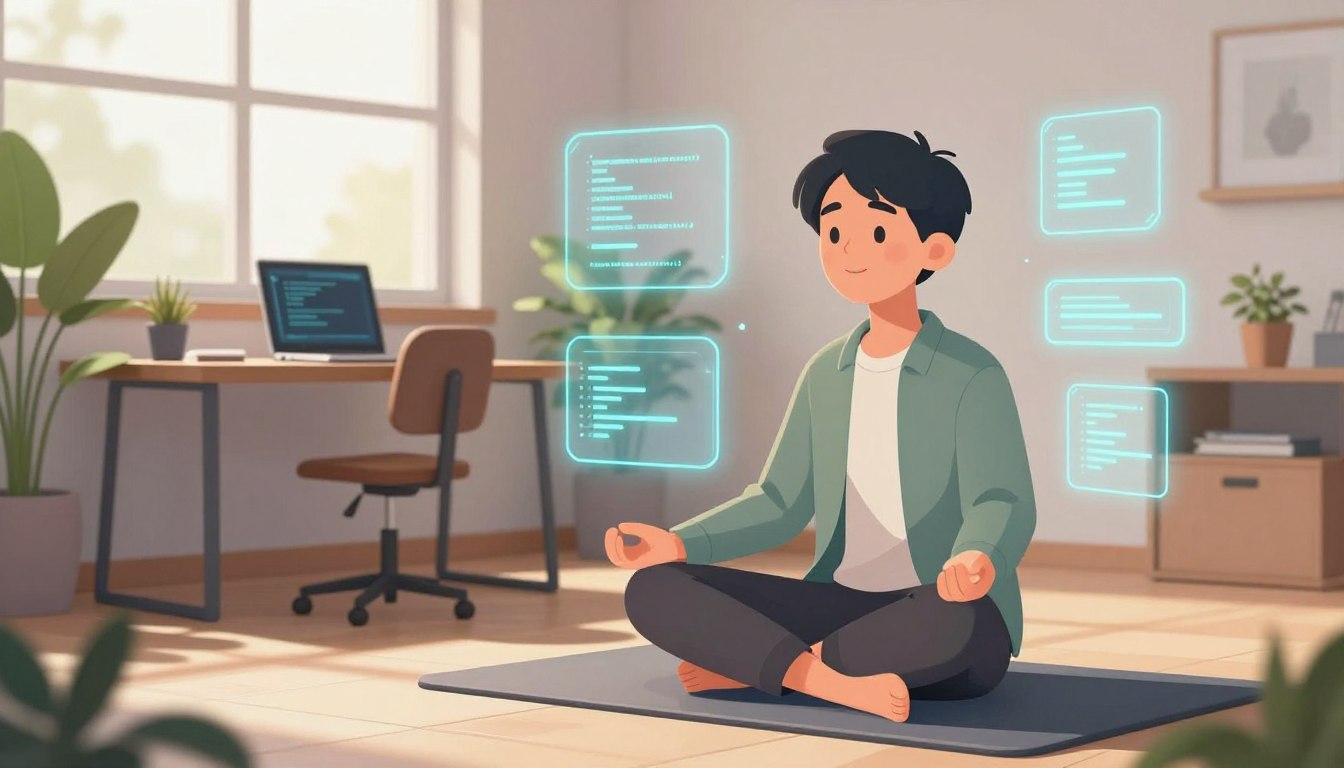
There are moments when a bug feels personal — time slips, thoughts race, and progress stalls. The team watches a stalled build; the developer leans back and searches for calm. This introduction meets that quiet frustration with a clear path.
The guide frames meditation as mental training and mindfulness as present focus that sharpens coding work. Readers learn practical steps to lift focus, reduce stress, and spark insight during development. Evidence shows sustained attention and creative problem-solving improve with regular practice.
Expect concise, science-backed techniques you can try before a sprint, during a debug session, or in a review. These methods protect productivity and grow resilient skills for long-term software projects.
Key Takeaways
- Short meditation breaks boost sustained attention and focus in programming teams.
- Mindful practice enhances insight and divergent thinking for creative problem solving.
- Simple routines can reduce stress and improve productivity during tight sprints.
- The guide offers step-by-step approaches for real software workflows.
- Adopting these habits builds lasting skills for complex tech projects.
What You’ll Learn: A Practical Path to Boost Focus, Creativity, and Productivity
This section maps a practical sequence of habits that sharpen attention, spark creative solutions, and raise output for developers.
Expect clear outcomes: readers gain simple strategies to sharpen focus, unlock creativity, and improve productivity through short meditation sessions plus brief mindful checks tailored for coding work.
Research shows training attention improves cognitive control; developers who adopt these habits report higher focus and productivity. The guidance explains how to embed practice into sprints, reviews, and debugging so gains are reliable and repeatable.
Measurable benefits translate into fewer errors, faster iterations, cleaner software, and better overall well-being. Practical skills covered include intention-setting, structured breaks, present-moment checks, and ways to reduce context switching during development.
- Apply methods in local branches, PR workflows, CI checks — practice meets reality.
- Choose strategies that fit individual styles and team norms to ensure adoption without lost time.
- Track improvements: time-to-fix, review quality, throughput — make benefits visible.
Small, daily habits compound. Over weeks they build durable skills that evolve with projects, helping teams stay creative, focused, and productive.
The Science Behind Mindfulness for Software Development Performance
Recent research links short attention training sessions to measurable gains in developer performance. Multiple controlled studies report clear positive effects on focus, insight problem-solving, and creative thinking that translate to real work.
Positive effects on focus, insight problem-solving, and creativity
A Psychological Science study shows that meditation training improves sustained attention during long tasks. Frontiers in Psychology finds that present-moment practice boosts sudden insight, which helps with debugging flow.
Certain techniques raise divergent thinking, helping teams explore alternate algorithms during design and refactoring. University of Washington research links attention training to better cognitive performance and fewer slips in review cycles.
Reducing stress and anxiety to help prevent burnout
Journal of Psychosomatic Research shows meditation lowers stress and anxiety—protective factors against burnout in tight release cycles. This emotional regulation preserves focus over weeks of work.
- Practical implication: brief sessions before a sprint can improve attention spans and reduce errors.
- Team tip: normalize short breaks; track focus duration, error rates, review outcomes to measure gains.
For hands-on examples and guided practices, see a developer’s experience with short sessions — mindfulness for developers — and a deeper look at flow and productive states: flow state and vibe coding.
Getting Started in Minutes: Core Mindfulness Practices for Developers
Short, desk-friendly routines can realign focus within a few minutes and prepare developers for deep work. These mini-rituals are simple to learn and fit into tight sprints.
Begin with a clear intention: choose one small practice, set a timer, notice changes over days.
Mindful breathing to reset your mind before a tough task
Try a 4-4-4 cycle: inhale four, hold four, exhale four. Do this for 5–10 minutes. The rhythm centers attention and reduces stress. Use it before opening an IDE or a tricky pull request.
Body scan to release tension from long coding sessions
Move awareness from toes to head. Pause at wrists, shoulders, neck. Breathe into each place, soften grip, relax muscles. Ten slow breaths is often enough to reset posture and calm the nervous system.
Loving-kindness to reduce frustration and build patience
Silently repeat short phrases: “May I stay calm; may I be patient.” Then extend them to teammates. This practice shifts emotions toward curiosity during reviews and debugging.
“Even brief routines strengthen the ability to regulate thoughts and maintain clarity under pressure.”
Quick reference
| Practice | Duration | Primary outcome |
|---|---|---|
| Breathing (4-4-4) | 5–10 minutes | Focus, reduced stress |
| Body scan | 3–7 minutes | Posture reset, less tension |
| Loving-kindness | 2–5 minutes | Patience, better teamwork |
- Timing: start with five minutes daily; increase to ten.
- Triggers: before a sprint, after a failed test, post-commit.
- Track: journal brief notes on concentration shifts and overall well-being.
Mindful Coding Blocks: From Sprints to Debugging
Turn work blocks into focused practice: brief rituals that prime attention before opening an editor. This section shows practical strategies to convert sprint time into reliable focus sessions that preserve energy and boost productivity.
Pomodoro with intention: focus sprints and mindful breaks
Structure: 25 minutes of focused coding, 5 minutes of mindful breaks. Set a one-line intention before the sprint—for example: Improve test coverage for parser.
Use the break for breathing or a short body scan rather than app-scrolling. A simple meditation or three deep breaths resets attention and reduces task switching.
Mindful debugging: step-by-step awareness over assumptions
Approach bugs with a beginner’s mind. Slow down, observe inputs and outputs, verify assumptions, and document each step as you test hypotheses.
This stepwise routine reduces loops, lowers rework, and helps teams face challenges with clarity.
Code review mindfulness: curiosity over judgment
Pause before replying to reviews. Favor questions, suggestions, and rationale—ask, suggest, explain. This rubric keeps comments constructive and aligned with intent.
Use measurable cues—a timer or smartwatch buzz—to enforce breaks and clean transitions. End each sprint by noting the next task; start the next by reading that note to regain momentum.
“Short, intentional cycles protect attention and compound into lasting skills.”
Result: regular, intentional blocks preserve focus across the day and make productivity gains repeatable.
Algorithmic Thinking with a Calm Mind
Slow, deliberate reading of a problem reveals its true constraints before the first implementation step.
Read the prompt slowly. Annotate limits, inputs, outputs. Visualize state changes with a sketch or a few notes.
List possible strategies: brute force, greedy, dynamic programming, graph traversal. Evaluate trade-offs without locking to the first idea.
Mindful problem analysis: read, visualize, clarify
Draft small examples and counterexamples to spot edge cases. Use tiny traces to confirm assumptions. This short practice prevents misinterpretation.
Conscious algorithm design: explore approaches without attachment
Score options by time, memory, and code simplicity. Note why an approach wins; capture the decision for later review.
Intentional implementation: line-by-line presence
Work in micro-steps: write a test, implement a slice, assert results. Type with attention. Verify invariants as you go.
“Mindful pauses prevent tunnel vision and make it easier to shift when a better approach appears.”
Practical checklist
| Step | Purpose | Outcome |
|---|---|---|
| Slow read & annotate | Clarify constraints | Fewer misreads |
| Sketch examples | Visualize state | Edge cases exposed |
| List strategies | Compare trade-offs | Better design choice |
| Micro-implement & test | Keep focus | Faster iteration |
Capture reasoning in comments to help teammates during handoffs. Track decision points to sharpen future pattern recognition. For practical guidance on calm problem solving, see the Zen of coding.
Code and Mindfulness
When a developer’s attention stays steady, the work often becomes cleaner and easier to maintain.
Presence strengthens logic: simple routines before a session reduce careless defects and help teams write clearer functions. Short resets between modules stabilize mental energy and make reviews faster.
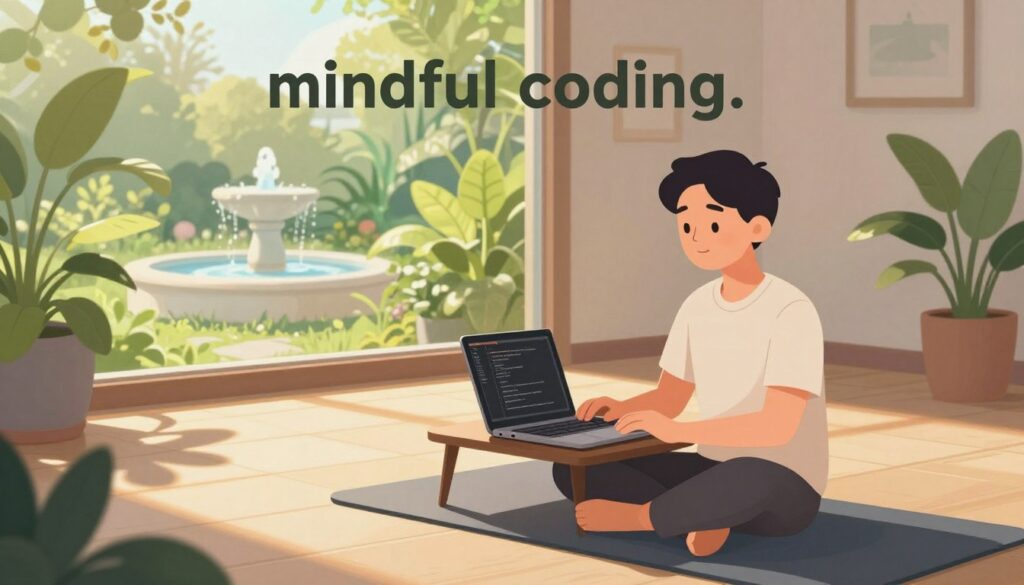
Reduce distractions by silencing notifications and batching email. These small changes protect deep work and raise focus productivity for complex tasks.
Teams can codify short resets into norms—meeting windows, review etiquette, and break policies—to scale benefits beyond any single developer. A quick self-check like “Am I present?” catches drift early.
“Intentional attention aligns intention with the next block of work, lowering error rates and improving throughput.”
- Short routines translate to fewer defects and clearer logic.
- Standardized breaks keep cognitive performance steady across the day.
- Light metrics—bug rate, review turnaround—make gains visible.
| Practice | Action | Measured outcome |
|---|---|---|
| Pre-task reset | Set one-line intention | Faster context entry |
| Distraction control | Mute notifications, batch inbox | Longer focus periods |
| Micro-reset | 60–90s breathing or stretch | Stable energy curve |
For practical design principles that make development feel better, see a short guide on vibe-focused practices: vibe coding principles.
Your Daily Mindful Developer Routine for Remote Work
Start each morning by writing one vivid intention: choose a single outcome for the day and place it where it is visible. Vivid goals are 1.2–1.4x more likely to be achieved, so make the intention specific and measurable.
Set a clear intention and write it down
Write one sentence: the task, the desired result, and why it matters. Keep it short. Post it near the workspace or in a daily note.
Avoid multitasking to protect deep focus time
Context switches reduce throughput by about 40%. Block calendar time for focused work, inbox, meetings, and review slots.
Use do-not-disturb windows for complex tasks and tell teammates the schedule. This preserves attention and raises productivity.
Hydration, movement, and micro-breaks to sustain productivity
Aim for 2.7–3.7 liters of water a day and about 7,000 steps. Use timers or a watch to nudge sip breaks and short walks.
Design a cadence: morning intention, two deep focus blocks, 3–5 minute micro-breaks, then a brief reflection to close loops.
Step outside: nature breaks to reset stress
Ten minutes outside in a local park reduces stress and restores clarity. Keep these breaks short so momentum returns fast.
“Small, consistent actions protect energy, sustain attention, and improve overall well-being.”
Routine at a glance
| Element | Why it matters | Practical tip |
|---|---|---|
| Morning intention | Clarifies tasks | Write one vivid outcome |
| Deep focus blocks | Protects flow | Block 90–120 minutes, DND on |
| Micro-breaks | Prevent fatigue | 3–5 minutes: stretch, breathe |
| Hydration & movement | Sustain energy | Watch reminders; target 7,000 steps |
| Nature break | Reduce stress | 10-minute outdoor walk |
Designing a Mindful Workspace that Supports Focus
An intentional desk setup nudges developers toward fewer interruptions and steadier focus. Small changes to the physical space reduce friction and make restorative pauses automatic.
Declutter physical and digital spaces to reduce anxiety
Clear the desktop and archive unused downloads. A tidy view lowers anxiety and trims cognitive load.
Daily resets—empty cups, closed tabs, archived branches—prevent visual clutter from draining attention.
Create an accessible area for breaks, stretching, or short practice
Reserve a small micro-space: a chair, mat, or cushion. Visible cues like a timer or mat nudge regular breaks.
Use soft lighting, noise control, or instrumental music to mark deep work windows and signal restorative time.
- Ergonomics: adjust chair height, monitor position, external keyboard to reduce body strain.
- Workspace layout: arrange IDE, terminal, and docs to cut window switching.
- Micro-checklist: hydrate, move, breathe—quick steps to sustain focus.
“An environment that supports small, consistent practices makes healthy habits automatic.”
| Action | Purpose | Result |
|---|---|---|
| Declutter desk & desktop | Reduce visual anxiety | Faster context entry |
| Create micro-space | Make breaks frictionless | More regular restorative pauses |
| Ergonomic setup | Lower physical strain | Steady attention, fewer aches |
| Organize tools | Minimize window thrash | Less accidental multitasking |
Practical tip: Treat the space as a teammate. When the environment supports mindful practices, developers and teams gain clearer focus, better software outcomes, and improved overall well-being—similar benefits found in apps like headspace for habit consistency.
Team Strategies: Communication, Empathy, and Psychological Safety
Small communication rituals create space for honest workload conversations that save time later.
Set expectations up front and use regular one-on-ones to surface capacity or burnout signals. Leaders should invite specific disclosures about tasks, timeline risks, and emotional load so adjustments happen early.
Set expectations and use one-on-ones to address capacity and burnout
Make one-on-ones a safe place to name workload pressures and negotiate priorities. Track energy ratings and map assignments to spot overload before it harms velocity.
Active listening, pausing, and reflecting back to build empathy
Teach simple empathy mechanics: pause before replying, reflect what you heard, ask clarifying questions. These steps lower conflict, help reduce errors in reviews, and ease emotions tied to high-stakes feedback.
- Adopt lightweight rituals: weekly intention share, end-of-sprint reflection.
- Document decisions, trade-offs, RFCs to cut rework and reduce stress across projects.
- Use async tools—PR templates, clear task descriptions—to protect deep focus time for coding.
“Psychological safety speeds learning loops, reduces silent failures, and improves software outcomes.”
Result: small, consistent strategies build trust. Over weeks this lowers burnout risk, improves team cohesion, and raises the quality of tech work.
Tools and Apps Like Headspace Calm to Keep You Consistent
A small habit supported by a reliable app scales into steady resilience under pressure.
Start simple: try apps like Headspace Calm for guided meditation sessions designed for focus, short stress relief, or sleep. Five minutes daily is enough to begin; repeated use builds tolerance to spikes in pressure.
Use reminders and streak trackers to form a regular practice. Pair alerts with development triggers—after a commit or before a review—to make sessions seamless. Exported session analytics help correlate minutes with focus productivity and sprint outcomes.
Guided meditations for focus and stress reduction
Choose focus sessions before a sprint block; choose stress-reduction sets after incidents. Voice-guided options lower the entry barrier for beginners and make it easy to get consistent.
Reminders and trackers to build a sustainable practice
- Set a five-minute daily goal; keep it minimal so habit sticks.
- Use category filters: focus, creativity, stress, sleep.
- Try ambient sound or breath pacers for non-voice guidance.
“Tools are scaffolding: they support steady practice that improves focus and overall well-being.”
Advanced Mindfulness for Seasoned Developers
Senior practitioners can use brief centering rituals to reduce reactivity and raise collective design quality.
Mindful pair programming: shared presence and non-reactivity
Start sessions with a one-minute centering breath to align goals. Agree on roles, set a short intention, then alternate tasks every 20–30 minutes.
Pause rules: stop when frustration rises; name the feeling, breathe, then return. This practice helps reduce heated exchanges and keeps focus on the task.
Architecture visualization: open awareness for better design choices
Treat system diagrams as a living map. Trace data flows, note bottlenecks, and hold an open view of alternative paths.
Layered awareness means keeping component intent, contracts, and failure modes in mind while exploring options.
Non-attachment to code to enable cleaner refactoring
Prioritize clarity and business value over ownership. When teams practice non-attachment, refactors happen faster with less friction.
Capture design rationale and trade-offs in a short note after sessions so future changes stay safe and reversible.
“Pre-session centering and post-session debriefs turn reactive habits into deliberate skills.”
- Begin design reviews with a two-minute meditation to reduce bias and open creative space.
- Use short debriefs to surface lessons, not blame; document decisions for team memory.
- Senior developers gain clearer mentorship, stronger decision hygiene, and steadier outcomes.
Practical practices at a glance
| Practice | Action | Primary benefit |
|---|---|---|
| Pair centering | 1–2 minute breath, set roles | Shared focus, fewer conflicts |
| Architecture tracing | Trace flows, list failure modes | Better designs, fewer surprises |
| Non-attachment ritual | One-line rationale, refactor plan | Cleaner refactors, faster change |
| Post-session debrief | 3–5 minute notes on trade-offs | Knowledge capture, safer future work |
Result: these methods reduce cross-functional friction and accelerate convergence on resilient designs. Over time, the practice elevates leadership presence—calm, clear, and effective under pressure.
Conclusion
Here is a concise roadmap to turn short daily practice into measurable gains for developers. The guide shows how mindfulness reduces friction, boosts creativity, and raises productivity in coding work. These simple habits deliver practical benefits for software teams and individual contributors.
Evidence is clear: a study found meditation improves sustained attention and shows positive effects on insight. Short sessions lower stress, sharpen focus, and help people bring clearer thinking to hard problems.
Start small—minutes per day—and build consistency over time. Anchor work with intentions, mindful breaks, and quick reflective closures to protect focus and preserve time for deep work.
Adopt team rituals that foster empathy and psychological safety; track errors, review quality, and cycle time to measure real gains in productivity and overall well-being in software development.
Try one technique today: schedule it, observe the next block of work, then iterate. For a practical starter, see how to use meditation.
FAQ
How can short meditation sessions boost programming creativity?
Short practices—two to ten minutes of focused breathing or a quick body scan—reduce stress and clear mental clutter. This creates space for insight, improves divergent thinking, and helps developers notice novel solutions during design or debugging.
What practical skills will a developer gain from a daily mindful routine?
Developers build sustained attention, better task switching, improved patience during reviews, and reduced reactivity under pressure. These translate into steadier focus during sprints, clearer problem analysis, and more intentional implementation choices.
What does research say about mindfulness improving software development performance?
Evidence links focused awareness to stronger working memory, fewer cognitive biases, and enhanced creative problem-solving. For developers, this often means fewer errors, faster recovery from setbacks, and lower risk of burnout when practiced consistently.
Which beginner practices are most effective for developers short on time?
Mindful breathing to reset before complex tasks, a quick body scan after long sessions to release tension, and brief loving-kindness phrases to reduce frustration. Each takes minutes and fits into breaks between tasks or before meetings.
How can mindful techniques improve debugging and code review?
Mindful debugging encourages step-by-step observation rather than jumping to assumptions, which reduces wasted effort. In reviews, a curious, nonjudgmental stance helps teams give constructive feedback and lowers defensive responses.
How does a calm mind affect algorithmic thinking?
Calm attention helps developers read problems fully, visualize data flows, and compare approaches without attachment. This clarity leads to cleaner algorithm design and fewer revisions during implementation.
How do focused work blocks integrate with mindfulness practices?
Combine Pomodoro-style sprints with an intention-setting moment at the start and a short mindful break after each sprint. This structure protects deep work windows while using pauses to reset attention and reduce cognitive fatigue.
What habits make a daily remote-work routine both productive and sustainable?
Start with a written intention, avoid multitasking, schedule hydration and movement breaks, and step outside briefly for a nature reset. These small habits protect deep focus and support long-term productivity.
How should developers design a workspace to support focused practice?
Declutter physical and digital environments to lower distractions, create a dedicated area for brief breaks or stretching, and keep essential tools within reach. A tidy workspace reduces anxiety and speeds task re-entry.
What team strategies foster psychological safety and mindful communication?
Set clear expectations, hold regular one-on-ones to discuss capacity, and practice active listening—pause, reflect back, and ask clarifying questions. These habits build empathy and reduce miscommunication-related stress.
Which apps are useful for maintaining a consistent practice?
Guided meditation apps such as Headspace and Calm offer focused sessions for attention and stress reduction. Use reminders and tracking features to build a habit; combine app sessions with short, self-guided practices between tasks.
What advanced practices benefit experienced developers and architects?
Mindful pair programming emphasizes shared presence and calm collaboration. Architecture visualization with open awareness supports better design choices. Cultivating non-attachment to code makes refactoring cleaner and less emotionally charged.
How long until benefits appear, and how often should one practice?
Many notice improved focus and reduced stress within days of regular short practice; measurable changes in creativity and resilience often appear after several weeks. Aim for daily micro-practices plus two longer sessions per week for sustained gains.