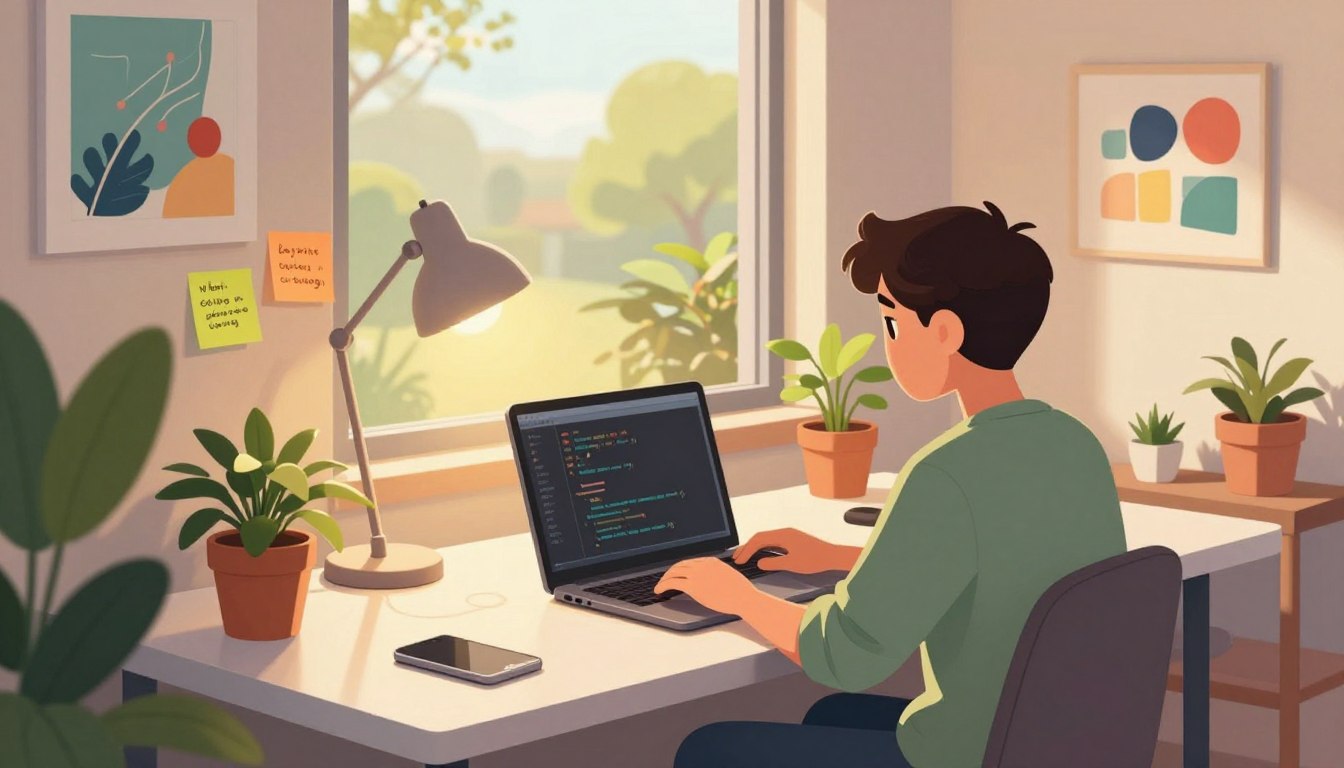
There are moments when a project simply clicks—when the mood, the brief, and the first line of code all point in the same direction. The author understands that small choices shape how a product feels to both builders and users.
This short guide is a playbook for teams who start with natural language to set mood and purpose, then use AI and focused tools to turn that intent into working code today.
Readers will find seven grounded rules, a practical workflow, and simple guardrails that keep momentum high. Expect clear steps: generate an AI README as a north star, pick a minimal client stack, paste current docs to avoid model cutoff, and test often.
For a deeper set of rules and real examples, see a compact guide on vibe coding practices.
Key Takeaways
- Start with a language-first brief to define feel and function.
- Use an AI-written README to lock scope and milestones.
- Prefer a small client stack to speed work and reduce breakage.
- Give AI current docs and clear project rules before it writes code.
- Ship small, test locally, and commit milestones for safety.
Why vibe coding matters today and how to use this Ultimate Guide
This guide translates prompt-first workflows into practical steps teams can use to speed prototyping and reduce rework.
AI-first interfaces have changed how people control software: natural language is now a primary input for shaping product behavior. That shift makes a language-led approach vital for product teams, developers, and designers who want clearer alignment early in the process.
Readers searching for actionable advice want a compact map: definitions, fast rules, ready prompts, and tool recommendations they can apply immediately. The guide delivers exactly that—step-by-step tactics to turn intent into working code while preserving safety and control.
Key changes today: models can draft specs, propose minimal stacks, and generate prototypes. But teams must still verify versions, paste live docs to avoid cutoff, and iterate with screenshots and checkpoints. Shared prompts let cross-functional groups align on tone, constraints, and outcomes earlier than before.
- Ask the model for a plan before it writes code.
- Keep the stack minimal to reduce breakage.
- Use checkpoints and GitHub to preserve safe rollbacks.
| Goal | Action | Outcome |
|---|---|---|
| Clarify intent | Generate an AI-written spec with prompts | Aligned team expectations and fewer reworks |
| Speed prototyping | Request minimal stacks and options | Faster iterations and early user feedback |
| Maintain safety | Version control + local tests | Predictable rollbacks and stable releases |
For a practical companion to these tactics, see a concise implementation guide at vibe coding playbook. Use the checklist in this guide to bookmark prompts and share them with your team for immediate adoption.
Vibe coding defined: from intent to interface
A prompt-led brief shapes both mood and interaction before a single component is built.
Prompt-first design and natural language as the new UI paradigm
Vibe coding is a prompt-first approach where teams describe how a product should look, feel, and behave in plain words. AI turns that language into initial screens, components, and scaffolding code so teams can test ideas rapidly.
How this complements traditional workflows
This method does not replace standard engineering. Instead, it frontloads creative direction so structural work arrives with clearer goals.
Developers still tune performance, run accessibility checks, and review code. The early artifacts act as drafts to validate direction before deeper investment.
Where prompt-first flows shine
It excels at rapid exploration, creative alignment, and non-linear iteration. Stakeholders can compare multiple moods and flows without heavy rework.
- Inclusive inputs let non-technical team members shape the product feel.
- Tools like Figma Make and IDE assistants convert prompts into editable components and code.
- Use prompts as creative specs and generated artifacts as a draft to validate direction.
The seven vibe coding design principles
A compact set of rules helps teams move from intent to testable software with less friction.
Start with a README: ask an assistant to draft requirements, a minimal tech stack, and five milestones. Confirm the plan before any code is written.
Prefer simple stacks: pick client-first libraries (for example, Three.js) and local storage to keep iterations fast and reduce breakage. Avoid servers early.
Plan before code: require options and trade-offs. Use prompts that force the assistant to explain its plan and wait for your confirmation.
Small steps, ruthless tests: make one change at a time, run locally, and capture screenshots for context. Check the console and fix regressions immediately.
Ground the assistant: verify its cutoff, paste authoritative docs (e.g., Tailwind v4), and set project rules in your workspace to prevent duplicate output.
Design for feeling: treat mood, microcopy, and motion as functional inputs to the user experience.
Version control the vibes: use IDE checkpoints and commit milestones to GitHub for clear diffs and safe rollbacks.
| Principle | Action | Benefit |
|---|---|---|
| Vibe PMing | AI README + 5 milestones | Aligned scope, testable steps |
| Simple stack | Client + local storage | Faster iteration, less risk |
| Plan first | Options and confirmations | Clear trade-offs, fewer rewrites |
| Version control | Checkpoints + GitHub | Safe revert, clean history |
vibe coding design principles in action: a practical workflow
A clear, repeatable workflow turns creative prompts into testable software fast.
Prompt → prototype → vibe check → refine → ship
Start with an explicit prompt that captures mood and function. Ask the assistant for a step-by-step plan and confirm it before any code is generated. This keeps control and reduces unnecessary changes.
Next, move quickly from prompt to prototype. Run a structured vibe check with the team: ask targeted questions about tone, clarity, and intuitiveness. Capture feedback and turn it into the next tasks.
Using images, questions, and selective edits to keep control
Use screenshots and short recordings to anchor fixes. Visual evidence helps the assistant propose precise CSS or JS adjustments and cuts back-and-forth time.
Apply selective edits: constrain changes to named files, request diffs, and pick the simplest change you can test immediately. Test locally, inspect the console, and revert to a checkpoint if behavior regresses.
| Phase | Action | Outcome |
|---|---|---|
| Plan | Request a confirmed step-by-step plan from AI | Clear scope and fewer rewrites |
| Prototype | Generate minimal UI and run quick tests | Fast validation in real time |
| Vibe check | Team review with targeted questions | Actionable feedback for next tasks |
| Refine | Selective edits, file-scoped diffs, checkpoints | Safe changes and reliable demos |
Close the loop by committing milestones to GitHub. Ship a small slice, gather user feedback, and feed insights into the next planned step. For example, when adding an enemy AI feature, ask for options from simplest upward, pick the 2nd simplest, and implement one change you can test right away.
Tools that amplify the coding vibe
Practical tools bridge the gap between language-led briefs and production-ready code. These choices speed iteration and keep intent clear across teams.
AI planning and coding companions: using options, rules, and confirmations
Use AI companions as disciplined collaborators. Require a plan first, ask for options with trade-offs, and demand explicit confirmation before any change. Cursor and Windsurf support checkpoints and a “revert to checkpoint” flow that protects work.
Configure Cursor rules to enforce modular output, avoid duplicate code, and do the simplest thing first. Paste authoritative docs (for example Tailwind v4) to avoid knowledge cutoff errors.
Design-to-code accelerators for prompt-first flows
Adopt tools like Figma Make to convert prompts into editable components. Teams can export clean code and refine with selective edits, reducing handoff friction between product and developers.
Version control and checkpoints: GitHub, revert strategies, and cleanups
Standardize version control rituals: commit at milestone completion, branch for risky exploration, and automate checks to guard mainline development. Ask the AI to list duplicate code and redundancies as part of cleanup tasks.
- Use screenshots to give context for CSS/JS fixes so AI suggestions are precise for apps and web views.
- Lean on checkpoints to revert when AI output drifts—prefer small, targeted edits to keep diffs reviewable.
- Keep developers in the loop: treat AI output as drafts that require review and hardening before merge.
From words to working software: concrete examples and prompts
Practical prompts turn a product idea into testable UI and simple, reviewable code.
Use these compact prompts as a template. They keep teams aligned and let an assistant propose the next small step without overreach.
- Planning prompt: “Write a README for [project]; include requirements, minimal stack, and five milestones. Explain your plan first and wait for confirmation before any code.”
- Options prompt: “Propose three approaches to implement [feature], from simplest to most robust. List trade-offs, risks, and testability. Don’t code yet.”
- Simplest-next-step prompt: “Make one change I can test immediately in [file]. Keep the diff small and explain how to verify success.”
- Mood prompt: “Style the UI to feel calm and encouraging; use [color palette], [typography], and [motion] to reinforce the vibe.”
| Prompt type | Example | Expected outcome |
|---|---|---|
| Plan | README with milestones | Clear scope and testable checkpoints |
| Options | 3 approaches, trade-offs | Informed selection and risk view |
| Next step | Small file change | Fast test, small diff, safe rollback |
Teams—designers, developers, and PMs—can adapt these lines of language to guide an assistant. Use screenshots and short notes to help users debug faster and to keep the process focused on measurable outcomes.
Trade-offs and guardrails for sustainable product development
A pragmatic balance between rapid experiments and engineering hygiene prevents costly rewrites.
Rapid prototyping accelerates the path from idea to interface. This approach helps product teams reach early alignment on mood, features, and basic flows.
But fast iterations carry risks. Subjective prompts can create inconsistent results across users and screens. Complex systems still need hands-on engineering to scale and to keep code maintainable.
Pros and cons: speed, subjectivity, scalability, accessibility, performance
Pros: faster discovery, clearer early consensus, and mood-driven clarity for stakeholders.
Cons: inconsistency from subjective prompts, extra effort for accessibility audits, and performance tuning for heavy features.
Avoiding dark patterns and aligning with usability heuristics
Build guardrails that map to Nielsen’s heuristics: visibility of system status, match to real-world language, error prevention, and clear feedback.
Avoid deceptive flows: no hidden opt-outs, forced continuity, or manipulative labels. Jurisdictions now regulate many dark patterns, so keep flows ethical and transparent.
- Make accessibility explicit: contrast checks, focus states, semantic roles, and keyboard navigation as acceptance criteria for every change.
- Protect performance: set budgets (bundle size, render time) and run benchmarks after each feature is added.
- Standardize small-batch changes: test locally, inspect the console, and revert quickly with GitHub checkpoints.
- Treat prompts as specs: record rationale in version control so designers and developers can trace decisions later.
| Area | Practice | Expected outcome |
|---|---|---|
| Speed | Small prototypes + quick vibe checks | Faster validation of product ideas |
| Consistency | Structured prompts + calibration surveys | More predictable user experience |
| Accessibility | Explicit acceptance criteria and audits | Inclusive software for diverse users |
| Performance | Budgets and performance tests after changes | Stable, measurable load and render times |
| Risk management | GitHub commits and checkpoints per milestone | Safe rollbacks and clear change history |
Team workflows: designers, developers, PMs, and stakeholders
When language leads, everyone—from product to engineering—starts with the same map of goals and constraints.
Make prompt authorship a team sport. Designers set mood and interaction goals. Developers flag risks and scope. PMs tie prompts to milestones and timelines.
Replace linear handoffs with shared language: co-write prompts that encode tone, constraints, and test criteria so every role understands the way forward.
Orchestrate safe changes by constraining edits to files, requesting diffs, and using checkpoints plus GitHub. Ask the AI to highlight duplicate code for scheduled cleanup.
- Bring developers in early to verify feasibility and long-term maintenance for apps and software.
- Run short, time-boxed vibe checks with structured questions to surface high-signal feedback.
- Keep context centralized: store prompts, decisions, and rationale alongside code for future contributors.
Maintain rhythm: milestone commits, concise changelogs, and weekly demos where the team reviews feel and function. Measure success by shipped value and user signals—not lines of code.
Measuring the vibe: quality, usability, and user feedback loops
A practical feedback loop links quick prototypes to measurable user outcomes.
Run short, focused checks to capture how users feel and what they do. Ask targeted questions such as “How does this make you feel?” and “What distracts you?” Convert answers into prioritized prompts for the next sprint.
Validate every change locally. Start the app, inspect the browser console for errors, and test edge cases before committing. Tag milestones in version control and log before/after metrics so diffs show real impact.
Use models to explain modules and flag redundancies. Tools like Repomix and a large-context model make architecture visible and speed comprehension for the team.
- Define layers: emotional checks, functional task success, technical console and performance signals.
- Track time-to-prototype and user signals—engagement and task completion—so small experiments show value over time.
- Keep control with small, file-scoped commits and clear rationales for safe rollbacks.
| Measure | How | Outcome |
|---|---|---|
| Emotional | Structured questions and short sessions | Clear qualitative feedback to drive changes |
| Functional | Task success rates and session replays | Objective usability improvements |
| Technical | Console logs, perf budgets, checkpoints | Stable releases and fewer regressions |
| Process | Tagged commits, model summaries, tool reports | Faster handoffs and better system visibility |
Conclusion
Wrap work by converting intent into a compact test the team can verify in hours, not weeks. Begin with clear language: a README, one decisive prompt, and a single measurable change to prove the idea.
Carry the seven rules forward: keep stacks small, require a plan before writing code, use visuals for quick checks, ground AI with fresh docs, and commit milestones to GitHub.
Use the right tools at the right time—Figma Make for prompt-first components, Cursor or Windsurf for safe reverts, and GitHub for durable checkpoints. Measure success with vibe checks, usability metrics, and console tests; treat generated output as a draft that engineers harden.
Start the next project today: draft the README, pick the simplest stack, write one prompt, and ship a small, measurable change. That is how teams turn words into reliable product progress.
FAQ
What does "vibe coding" mean in practical terms?
Vibe coding describes a prompt-first, human-centered approach to building software where intent, tone, and rapid iteration guide technical choices. It pairs natural-language prompts with small, testable code changes, visuals, and rules to produce software that feels cohesive and intentional.
Who benefits most from this approach?
Product teams, startup founders, designers, and engineers benefit most. The method accelerates early exploration, aligns cross-functional stakeholders, and reduces friction when refining user experience—especially for teams using AI assistants, Figma workflows, and Git-based version control.
How does this complement traditional development workflows?
It complements rather than replaces established practices. Teams keep sprints, code reviews, and CI/CD while adding prompt-driven prototypes, visual vibe checks, and focused local tests. This hybrid retains rigor and boosts creative iteration speed.
What are the seven core practices to start with?
Start by clarifying intent and constraints (vibe PMing), simplify the tech stack, plan before coding, work in small steps with local tests and visuals, ground AI with rules and docs, design for feeling and tone, and use version control and checkpoints to track changes.
How do you keep AI behavior predictable and safe?
Ground AI with explicit rules, example screenshots, and reference docs. Use confirmation steps, rate limits, and human-in-the-loop reviews. Maintain clear audit trails in version control and enforce guardrails to avoid dark patterns or unexpected behavior.
Which tools accelerate a prompt-first workflow?
AI copilots for planning and coding, design-to-code tools like Figma Make, and GitHub for checkpoints are core. Complement them with lightweight testing tools, sandboxed runtimes, and collaboration platforms for stakeholder feedback.
How do teams measure whether a change improved the "vibe"?
Use qualitative vibe checks (user interviews, design reactions), quantitative metrics (task success, time-on-task, conversion), and console-level checks for performance and errors. Combine short feedback loops with outcome-based evaluation.
What trade-offs should teams expect?
Expect trade-offs between speed and reproducibility: rapid iteration can increase subjectivity and technical debt if not checkpointed. Balance with accessibility, performance testing, and clear acceptance criteria to ensure long-term sustainability.
Can this approach scale for large products and regulated domains?
Yes—when teams enforce stricter guardrails, review processes, and documentation. Version control, code audits, and compliance checks turn fast iteration into a controlled, auditable workflow suitable for enterprise and regulated environments.
How do you onboard a team to this method?
Start with a focused pilot: pick a small feature, define intent and constraints, run a day-long prompt-to-prototype sprint, and iterate with stakeholders. Document patterns, create templates for prompts and checks, and integrate the practice into sprint rituals.
What example prompts help guide early planning and UI mood?
Use concise prompts that state goals, constraints, and tone—e.g., “Create three simple header variants for a finance app that feel trustworthy, concise, and mobile-first.” Include acceptance criteria and a screenshot or style tokens to ground results.
How often should teams create checkpoints and diffs?
Create checkpoints at every meaningful decision: after planning, after a working prototype, and before production merges. Frequent, small diffs keep history clean and make rollbacks straightforward if a change degrades user experience.