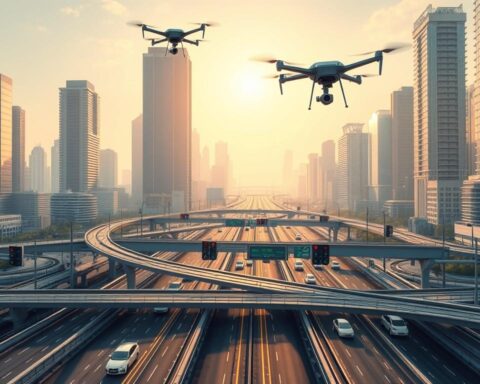
Morning commutes can feel personal—too personal when a jam ruins a day or an emergency response is delayed. Urban leaders see these moments as signals: rising congestion tests legacy infrastructure, and residents demand safer streets. In that pressure, smart cities turn attention to a single thread—how data and technology can reshape everyday movement.
Leaders are shifting from patchwork fixes to unified systems that orchestrate corridors, signals, and transit. This approach treats cities as living networks where coordinated decisions cut delays, boost safety, and lower emissions. The narrative is practical: measurable gains in travel times, incident response, and emissions matter to people and to budgets.
What follows is a clear-eyed guide through the end-to-end ecosystem—how sensors capture data, how control decisions are made, and how measurable outcomes shape a better future for every resident.
Key Takeaways
- Unified strategies turn fragmented assets into coordinated city capabilities.
- Real-time data and systems reduce congestion and improve safety.
- Practical deployments show market momentum and measurable ROI.
- Decision-makers can prioritize travel times, incident response, and emissions.
- Adopting this technology stack transforms constraints into opportunities.
Why Smart-City Traffic Management Needs AI Right Now
Rapid urban growth is pushing many U.S. centers past the limits of fixed signal plans and manual operations.
Population density and rising demand make congestion a daily reality. Cities face longer delays and higher emissions that strain budgets and public patience.
Urban growth, congestion, and emissions: today’s reality in U.S. cities
Traditional, fixed-time control and siloed operations lack the awareness and speed needed for modern transportation complexity. Static plans have narrow visibility windows and slow response cycles.
Real-time data from sensors, cameras, and connected fleets lets systems respond to shifting demand. That shift reduces idle time, cuts emissions, and smooths routes across corridors.
From legacy control to data-driven mobility systems
Cities can extend existing assets while avoiding some large capital projects. Adaptive solutions fuse streams of data to coordinate signals, arterials, and multimodal hubs.
| Objective | Legacy Approach | Data-Driven Outcome |
|---|---|---|
| Reduce delay | Fixed-time cycles | Adaptive signal timing tied to real demand |
| Improve safety | Siloed incident reporting | Faster detection from cameras and analytics |
| Stretch budgets | New builds only | Optimize assets, defer costly projects |
Market momentum supports this transition: the intelligent systems market is projected to reach $27.92B by 2030. Planners should begin with high-impact corridors and scale to citywide orchestration.
Real-Time Traffic Monitoring: Sensors, Cameras, and Computer Vision
A layered sensing strategy lets cities spot problems in minutes, not hours. Short detection windows and clear signals change how operators react. Live feeds and edge inference combine to keep flow steady and people safer.
Data sensors and edge analytics for incident detection and traffic flow
Loop detectors, radar, Bluetooth beacons and video act as complementary sensors. These data sensors stream flow, speed, and occupancy into analytics engines. Edge inference flags lane blockages or sudden slowdowns within seconds, so operators can reroute or retime signals before queues grow.
Computer vision for safety: anomaly and accident detection on roads and sidewalks
Video analytics on roadside cameras and vehicles detect anomalies and accidents. Computer vision reads plates, tracks vehicle and pedestrian patterns, and highlights near-misses. That visibility reduces secondary crashes and improves response times for operations teams.
How crowdsourced mobility data improves route decisions and planning
Crowdsourced data from phones and connected cars fills gaps in fixed sensors. Planners gain granular mobility patterns that show where people actually travel. This insight sharpens capital decisions and makes corridors more walkable and reliable.
| Sensor | Primary Value | Response Time |
|---|---|---|
| Loop detectors | Occupancy and flow | Seconds |
| Radar | Speed and objects | 1–5 seconds |
| Cameras | Anomaly detection, incidents | Seconds |
| Crowdsourced feeds | Route demand, planning | Minutes |
“Layered sensing and privacy-aware aggregation deliver faster response and better planning without sacrificing public trust.”
Smart Traffic Signals and Adaptive Control That Cut Delays and Emissions
Adaptive signal systems reshape intersections so vehicles and pedestrians spend less time waiting.
Pittsburgh’s Surtrac dynamically adjusts signal times to real conditions. The program cut vehicle wait times by about 40% and trimmed emissions by 21%. Reports also note roughly 25% shorter travel duration and one‑third less time at intersections.
Pittsburgh’s results and what they prove
Surtrac shows how analytics on approach volumes, queues, and platoons translate into measurable gains. Continuous rebalancing of green splits, offsets, and phases reduces lost time and smooths departures.
From fixed-time plans to optimized cycles
Fixed schedules cannot react to surges; optimized cycles retime lights to current demand. Los Angeles forecasts density with cameras and sensors to cut journey time by 12%. San Diego layers connected-vehicle data to refine city traffic plans.
| Feature | Fixed-Time | Adaptive Control |
|---|---|---|
| Green split | Static | Continuously rebalanced |
| Coordination | Pre-set offsets | Predictive arterial coordination |
| Incident response | Manual | Automatic recalibration |
“When flow stabilizes at intersections, downstream corridors gain resilience and emissions fall.”
Start with high-impact corridors and scale outward. For a deeper implementation guide, consult this signal deployment guide.
Predictive Analytics for Accident Prevention and Safer Streets
Predictive models turn historical crashes and live conditions into clear signals for where to act next.
Machine learning blends crash history, speed profiles, weather, and roadway context so agencies can surface high-risk areas before incidents occur.
FHWA-aligned analytics estimate expected safety performance and guide practical decisions on countermeasures. Those methods quantify likely benefits from timing changes, access management, or design updates.
Combining rich inputs to flag risk
- Crash logs + traffic volumes reveal chronic hotspots.
- Speed profiles and near‑miss detections from computer vision increase sensitivity to emerging hazards.
- Weather and driver behavior data adjust risk scores in real time.
From insight to staged interventions
Agencies can stage responses: low-cost signal timing and signage first, then access changes, and finally geometric redesign where analytics show persistent risk.
| Input | Primary Output | Operational Action |
|---|---|---|
| Crash history | Baseline risk score | Prioritize locations |
| Near-miss video | Emerging hazard alerts | Short-term timing changes |
| Weather & speed | Dynamic risk adjustment | Targeted advisories |
“Predictive outputs should feed back into standard playbooks so operations treat recurring conditions consistently.”
Models must account for vulnerable road users and underserved neighborhoods to ensure equitable investments. Continuous retraining keeps results accurate as traffic patterns shift, and clear before/after metrics ensure measurable accountability for safety and traffic outcomes.
AI in Public Transportation Management: Demand-Responsive, Reliable, Efficient
Operators now blend live ridership feeds and fleet telemetry to smooth connections and improve on‑time performance.
Transport for London forecasts demand and shifts timetables day‑of, boosting on‑time performance by about 10% and cutting waits near 15% in favorable conditions.
The London Underground pairs smart ticketing with live cameras and machine learning to flag safety risks faster. Boston’s MBTA optimizes bus routes and schedules to raise reliability and lower operating costs.
Predictive maintenance keeps vehicles in service longer and reduces unexpected breakdowns. Prioritized signals and queue jumps further shrink bus delays, amplifying gains from optimized routes.
Results are practical: smoother transfers, fewer crowded trips, and better fiscal efficiency—more frequent service without proportionally higher costs.
“Iterative pilots on high‑variability lines let agencies prove concepts, measure benefits, and scale with confidence.”
IoT-to-AI Workflow: The Data Pipeline Behind Intelligent Traffic Systems
From curbside cameras to cloud collectors, an end-to-end pipeline translates raw feeds into timely interventions.

Urban sensors and data collection feeding prediction engines
Roadside sensors and cameras gather flow, density, speed, and vehicle type. A collection layer normalizes those inputs and timestamps them for quick analysis.
Data sensors stream to a prediction engine that forecasts volume and risk on each corridor. That forecast guides automated control and human decisions.
Optimizing flow: signals, lanes, and congestion alerts
Adaptive signal logic and lane control prioritize movements where speed and progression matter most. Reversible lanes and ramp metering smooth peaks across linked corridors.
Congestion alerts publish to apps and fleet dashboards so drivers and operators reroute before queues form.
Dynamic guidance and environmental benefits
User apps consume real-time data to suggest faster routes and avoid hotspots. GPS tracking improves map accuracy and on-time transit performance.
Reduced idle time and fewer stop-and-go cycles lower fuel use and local emissions—measurable gains where communities breathe closest to roads.
| Pipeline Stage | Primary Inputs | Operational Output |
|---|---|---|
| Edge sensing | Sensors, cameras | Incident flags, speed |
| Collection layer | Normalized feeds | Unified data stream |
| Prediction engine | Historical + real-time data | Density forecasts, timing |
| Control & apps | Forecasts, GPS | Adaptive signals, route updates |
“Standardized interfaces let agencies scale corridors and lights without rebuilding the core system.”
Autonomous Vehicles and V2X: Coordinating with Smart Infrastructure
Connected vehicles and roadside systems now trade instantaneous signals to smooth city corridors and cut sudden stops.
V2X communications let vehicles exchange timing plans and phase states with signals. That sharing supports smoother approaches and fewer hard stops in dense cores.
When vehicle intent and signal status are visible, ambiguity at crosswalks falls and pedestrian safety improves. Cooperative perception on some cars extends line‑of‑sight around corners, reducing conflicts at blind intersections.
How control evolves with connected fleets
- Platooning and coordinated green waves protect throughput on busy arterials.
- Priority requests for transit and emergency vehicle access cut delays without harming overall flow.
- Queue balancing keeps intersections from spilling back into upstream corridors.
Interoperability standards matter: they let different makes and city systems perform reliably together. Investing in roadside units, sensors, and comms yields measurable benefits for human drivers and automated vehicles alike.
“Pilot deployments on select corridors reveal where demand and busier signals justify early scale-up.”
Market Momentum, Privacy, and Equity: Trends and Challenges in U.S. Cities
Market signals and procurement wins show cities are moving from pilots to production at scale. The intelligent traffic management systems market rose to about $12.41B in 2024 and is forecast to hit $27.92B by 2030, validating vendor depth and agency ROI.
Growth outlook and operational validation
Interpretation: rising market value signals operational maturity and repeatable outcomes. Agencies can treat select corridors as proof points before scaling citywide.
Privacy, security, and equitable planning
Core program needs include data minimization, governance, and encryption; these are not optional add‑ons. Cybersecurity and video analytics present clear challenges that require continuous red‑teaming and risk review.
- Adopt transparent retention and anonymization policies.
- Favor procurement that rewards security‑by‑design and measurable results.
- Align cross‑agency planning so solutions improve flow without shifting burdens to vulnerable neighborhoods.
“Publish performance dashboards so residents can see how projects improve travel and safety in their areas.”
AI Use Case – Smart-City Traffic Management
A citywide platform ties together signals, apps, and analytics so operators act from a single source of truth.
Core use: a unified system ingests sensor feeds, optimizes signals, and delivers route guidance to cut travel time and reduce delays on congested corridors.
Practical applications include priority requests at a signal, dynamic lane assignments, and traveler information services that scale across the urban grid. These applications help fleets, transit, and commuters reach destinations faster.
Systems integration is essential: field devices, back‑office software, and operator consoles must share logic and KPIs so decisions are consistent and auditable.
Playbooks matter. Define when the platform shifts phases, issues alerts, or re-optimizes routes. Clear thresholds speed operator response and keep performance predictable.
- Require transparent metrics and decision trails for accountability.
- Support multimodal flows—freight, bikes, buses, and private vehicles—with flexible control rules.
- Design high-uptime lights and graceful fallbacks so service continues when links fail.
Start with targeted corridors, prove value, and scale to a cohesive city network. This blueprint turns disparate assets into coordinated, measurable solutions that improve traffic outcomes and commuter experience.
Conclusion
A clear roadmap turns pilot projects into citywide services that residents notice in daily commutes.
Proven deployments—like Pittsburgh’s Surtrac and TfL’s optimizations—show measurable gains: up to 20% lower travel times, roughly 10% better transit on-time performance, and about 15% shorter waiting times for passengers.
Leaders should prioritize corridors, define KPIs, and iterate cadence by cadence. Shared platforms align agencies, speed decisions, and coordinate lights, lanes, and routes so flow improves across modes.
Design programs for the future: platforms must learn, support emerging vehicles and applications, and adapt as mobility patterns shift. Equity and privacy remain non‑negotiable—direct benefits to underserved areas and protect personal data by design.
The imperative is clear: invest in scalable foundations now so cities can lock in safer streets, steadier flow, and better daily travel for people and cars alike.
FAQ
What is intelligent city traffic management and why does it matter now?
Intelligent city traffic management uses sensors, cameras, and data analytics to optimize vehicle and transit flow. With rapid urban growth, rising congestion, and stricter emissions goals across U.S. cities, real-time control and adaptive signal timing cut delays, improve safety, and lower pollution—making investment timely and practical.
Which data sources power real-time monitoring and incident detection?
Systems combine roadway sensors, video feeds, Bluetooth/Wi‑Fi probes, and crowdsourced mobile telemetry. Edge analytics process camera and sensor inputs for immediate incident alerts, while cloud models aggregate historical feeds for trend analysis and planning.
How do computer vision systems improve street safety?
Computer vision flags anomalies—sudden stops, pedestrian incursions, or crashes—so control centers can dispatch responders and adjust signals. It augments human operators by automating detection on arterials, intersections, and crosswalks, reducing response times and secondary collisions.
Can adaptive signals actually reduce emissions and travel time?
Yes. Adaptive signal control adjusts phase timing based on live flow and queues. Case studies like Pittsburgh’s Surtrac show measurable drops in wait times and idling, which reduces fuel use and tailpipe emissions while improving throughput at busy intersections.
How do predictive models prevent accidents before they happen?
Predictive analytics combine crash history, weather, traffic volumes, and event data to identify high‑risk corridors and time windows. Agencies then deploy targeted countermeasures—timing changes, speed advisories, or increased enforcement—to lower incident probability.
What benefits do transit agencies gain from demand‑responsive operations?
Transit systems use demand forecasting and real‑time tracking to optimize route frequency, allocate vehicles, and improve on‑time performance. Features like smart ticketing and predictive maintenance reduce delays and boost rider satisfaction.
How does the IoT-to-analytics pipeline work in practice?
Urban sensors and roadside devices stream telemetry to edge processors for quick actions. Aggregated data then feeds machine learning engines in the cloud for pattern recognition and long‑term optimization—powering adaptive signals, lane controls, and commuter alerts.
What role do connected vehicles and V2X play with infrastructure?
Vehicle‑to‑everything (V2X) exchanges real‑time speed and location with traffic controllers and other vehicles to smooth platoons and reduce stop‑and‑go behavior. Coordinated signals and V2X can increase corridor capacity and improve safety for mixed traffic.
Are there equity and privacy concerns with data‑driven mobility systems?
Yes. Agencies must balance insights with safeguards: anonymize personal data, secure communications, and ensure underserved neighborhoods receive equal investment. Transparent governance and community engagement are critical to fair outcomes.
What cybersecurity measures are essential for these systems?
Robust encryption, segmented networks, secure firmware updates, and continuous monitoring are essential. Adopting standards from NIST and using threat detection tools protect control systems from tampering and service disruptions.
How do cities measure return on investment for these deployments?
Cities track metrics such as reduced travel time, lower vehicle emissions, fewer crashes, and improved transit reliability. Quantifying user time saved and maintenance cost avoidance helps justify capital and operating expenses.
Which agencies and vendors lead in deploying intelligent flow solutions?
Leading practitioners include U.S. DOT partners and large transit authorities like Transport for London and the Massachusetts Bay Transportation Authority for transit pilots. Vendors range from established traffic engineering firms to specialized analytics providers; selection depends on interoperability and local needs.
How scalable are these systems for midsize U.S. cities?
Very scalable. Modular deployments—starting with key corridors, then expanding sensors and adaptive controllers—allow midsize cities to pilot benefits before citywide rollouts. Cloud platforms and open data standards reduce upfront costs and integration friction.
What are common barriers to adoption and how can agencies overcome them?
Barriers include funding constraints, legacy infrastructure, and workforce skills gaps. Solutions: phased investments, public‑private partnerships, training programs, and using interoperable, standards‑based components to ease integration.
How do dynamic route guidance and commuter apps integrate with city systems?
Commuter apps receive anonymized real‑time feeds from traffic management centers and third‑party mobility providers to offer route suggestions and alerts. Bi‑directional APIs enable apps to inform control centers about emerging conditions and demand shifts.