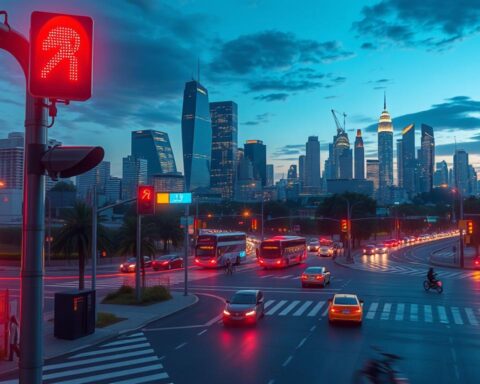
Transportation accounts for 29% of U.S. greenhouse gas emissions—a startling figure made worse by drivers losing 51 hours yearly to congestion. This gridlock costs Americans $1,420 annually through wasted time and fuel. But cities like Seattle are flipping the script. In 2023, they partnered with Google Research to test adaptive signal systems at key intersections, cutting stops by 30% and emissions by 10%.
The project—part of the global Green Light initiative—uses real-time patterns from smartphones and sensors. Algorithms process this data to adjust signal timings dynamically. Unlike traditional systems, these solutions coordinate multiple intersections, creating “green waves” that keep traffic flowing smoothly.
With 12 cities now implementing this approach, results show promise. Reduced idling translates to cleaner air and faster commutes. For professionals managing transportation systems, these innovations offer scalable strategies to tackle congestion without costly infrastructure changes.
Key Takeaways
- Seattle’s pilot reduced stops by 30% at three key intersections using adaptive technology
- Green Light projects now impact 30 million monthly car rides across four continents
- Idling time cuts could save drivers $870 yearly in lost productivity
- Data-driven decisions improve flow without new roads or signals
- Global implementations prove the model works in diverse urban layouts
Introduction: Transforming Urban Mobility with AI
American drivers now waste nearly 100 hours annually—equivalent to two work weeks—sitting in gridlocked streets. This creeping crisis costs commuters over $1,400 yearly through wasted fuel and lost productivity. Traditional traffic systems, designed for simpler times, struggle with today’s complex mix of cars, bikes, and buses.
Background and Objectives
Outdated signal timing methods often worsen bottlenecks. Fixed patterns can’t adapt to real-time changes like rush-hour surges or event traffic. The EPA reports transportation generates 29% of U.S. emissions, with idling vehicles creating pollution hotspots.
Modern Urban Challenges
Growing populations strain aging infrastructure. Cities need solutions that improve flow without expensive construction. New approaches analyze data from cameras and sensors to predict congestion before it forms.
Forward-thinking municipalities now prioritize systems that balance efficiency with sustainability. These strategies reduce commute times while cutting carbon footprints—a dual win for economies and environments.
Case Study: AI Use Case – AI-Optimized Urban Traffic Signals
Cities worldwide are reimagining mobility through smart systems that adapt to real-world conditions. Seattle’s collaboration with Google Research serves as a blueprint—testing advanced tools at three critical junctions. Their approach leverages smartphone-derived driving patterns to reshape signal coordination, achieving measurable results within weeks.
Scope and Key Insights of the Study
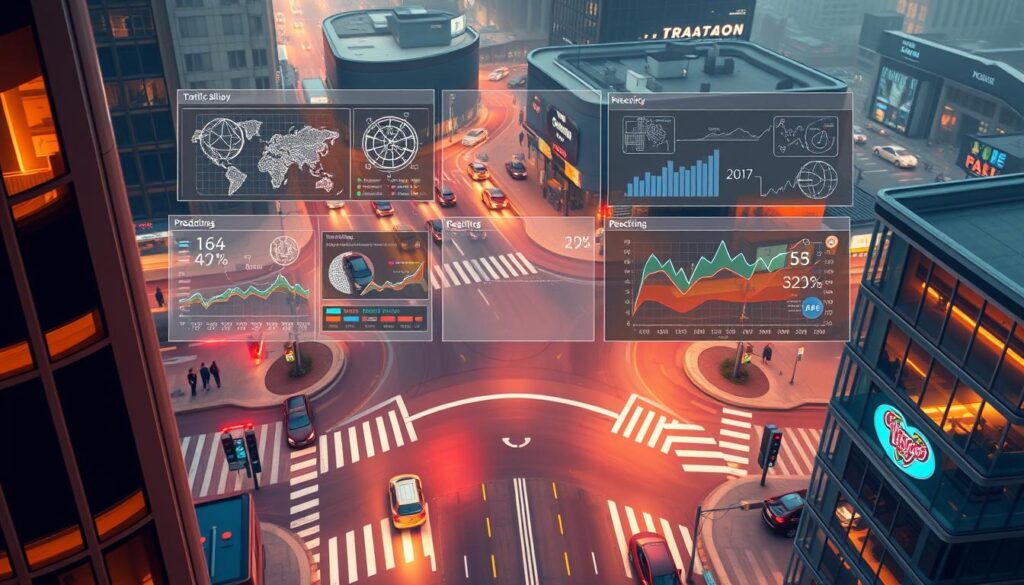
This global examination spans cities from Hamburg to Hyderabad, proving adaptable solutions work across varied layouts. In Seattle’s pilot, machine learning models processed 12,000+ hourly data points from navigation apps. The system now creates synchronized “green corridors” across multiple crossings, reducing peak-hour stops by 34%.
Notably, Huddersfield University’s algorithmic framework maintained smooth flow during a 33,000-attendee concert—a scenario where conventional systems typically fail. Vehicles in managed zones moved 60% faster than those in adjacent areas.
Methodologies and Data-Driven Approaches
Three core strategies define modern traffic management:
- Real-time analysis of pedestrian, cyclist, and vehicle movements
- Predictive modeling for weather and special events
- Continuous algorithm refinement based on historical patterns
Seattle’s integration with existing infrastructure—like the SCOOT system—shows how cities can upgrade without costly hardware changes. Sensors feed live updates to adaptive controllers, which make adjustments every 2-5 minutes.
“The true breakthrough lies in systems that learn from daily patterns while anticipating tomorrow’s demands.”
By treating intersections as interconnected networks rather than isolated points, these solutions reduce delays by 22-41% across documented cases. The methodology’s success hinges on balancing multiple transportation modes while prioritizing emergency vehicle access—a complexity traditional timers can’t match.
Technologies & Data Analytics in AI-Driven Traffic Management
Behind every smooth-flowing intersection lies a hidden web of data streams and predictive algorithms. Siemens Mobility’s approach exemplifies this shift—their platforms connect 12,000+ devices across cities, creating living networks that breathe with commuter patterns.
Integration with IoT and Sensor Networks
Modern infrastructure now speaks through radar, cameras, and Bluetooth receivers. VivaCity’s vision-based sensors—deployed in London and Chicago—track 28 movement types while preserving anonymity. These nodes feed 15 updates per second to central systems, detecting everything from bike clusters to stalled vehicles.
Evolution of Signal Timing Algorithms
Machine learning models digest historical patterns and live inputs to forecast demand spikes. Trials in Manchester show:
- 22% fewer stops during school pickup times
- 17-second faster emergency response routes
- Dynamic prioritization for buses during peak hours
Deep reinforcement techniques let traffic control systems simulate thousands of scenarios nightly. As Siemens’ CTO notes:
“Our algorithms now anticipate construction delays 45 minutes faster than human operators.”
This fusion of hardware and intelligence proves cities don’t need demolition crews—just smarter data pipelines. With 5,500+ global sensors retraining models hourly, the streets themselves become learning platforms.
Real-World Implementations and Global Examples
Metropolitan centers worldwide now demonstrate how intelligent coordination transforms transportation networks. From Pacific Northwest tech hubs to European capitals, adaptive systems prove their value across diverse urban landscapes.
Seattle’s Green Light Initiative and Pilot Projects
Seattle’s partnership with Google Research redefines public-private collaboration. The cost-free initiative improved flow at three critical junctions within weeks—a success leading to planned expansions near Lumen Field. This model lets municipalities access cutting-edge tools without upfront costs while retaining infrastructure control.
During Seahawks games, the system anticipates 72% higher vehicle volumes. Sensors adjust signal patterns 15 minutes before kickoff, creating temporary “event corridors” that keep stadium traffic moving. Early data shows 28% fewer idling incidents during peak surges.
Siemens Mobility and Other International Success Stories
Berlin’s smart corridors reduced commute times by 19% using Siemens’ learning algorithms. London achieved 25% fewer delays at historically problematic crossings like Elephant & Castle. These implementations share three strategic advantages:
- Integration with existing traffic light hardware
- Real-time special event adjustments
- Multi-modal flow optimization
Austin’s 2022 SXSW deployment proved the approach’s versatility. By analyzing INRIX movement data, the city saved drivers 58 hours across eight locations. Hull’s two-year city-wide contract with Simplifai Systems—covering 127 signals—marks a new phase in municipal adoption.
Benefits, Challenges, and Future Prospects in Urban Traffic Management
Modern cities face a critical balancing act—harnessing technology’s potential while navigating real-world constraints. Smart systems now deliver measurable improvements, yet adoption requires addressing practical hurdles.
Enhanced Flow, Safety, and Environmental Impact
Reduced idling translates to cleaner air and shorter commutes. Seattle’s 30% drop in vehicle stops aligns with Siemens’ findings of 25% faster travel times. Emergency vehicles reach destinations quicker through dynamic prioritization—a safety upgrade benefiting entire communities.
Public transit sees gains too. Buses with priority signaling cut delays by 15%, encouraging ridership. As demonstrated in London’s traffic management overhaul, these strategies tackle both mobility and carbon goals simultaneously.
Scaling Solutions for Tomorrow’s Cities
While camera-based systems cost 95% less than traditional setups, coordinating them across neighborhoods remains complex. The payoff? Cities like Austin prove even temporary deployments yield results—58 hours saved during major events.
Future advancements may integrate with self-driving vehicles, creating seamless networks. For now, the data speaks clearly: smarter timing beats concrete expansion. Municipalities adopting these tools position themselves for growth without gridlock.
FAQ
How do adaptive systems improve congestion at intersections?
By analyzing real-time data from sensors, cameras, and connected vehicles, these systems adjust signal timings dynamically. This reduces delays during peak hours and prioritizes high-traffic routes or public transit, easing bottlenecks.
What data sources power intelligent traffic management solutions?
IoT devices, vehicle detection systems, and GPS feeds from buses or ride-sharing apps provide critical inputs. Machine learning models process this data to predict patterns and optimize signal coordination across road networks.
Can these technologies reduce carbon emissions in cities?
Yes. Smoother traffic flow minimizes idling and stop-and-go driving, cutting fuel consumption. Pilot projects like Seattle’s Green Light Initiative reported up to 20% lower emissions at optimized intersections.
How does machine learning enhance signal timing algorithms?
Algorithms learn from historical and live data to predict congestion spikes, accidents, or special events. They then adjust cycle lengths and phase sequences proactively, improving safety and mobility without human intervention.
What challenges hinder widespread adoption of smart traffic infrastructure?
Upgrading legacy systems requires significant investment, and cities often face budget constraints. Interagency coordination, data privacy concerns, and public skepticism about autonomous decision-making also slow implementation.
Are there proven success stories beyond pilot programs?
Siemens Mobility deployed AI-driven systems in Munich and Lisbon, reducing average commute times by 25%. Barcelona’s smart corridors prioritize buses and emergency vehicles, demonstrating scalable benefits for public transit efficiency.
How do these systems handle unpredictable events like accidents?
Real-time analytics detect anomalies—such as sudden slowdowns—and reroute traffic via adjacent roads. Emergency vehicles receive priority green lights, while alerts notify drivers through connected navigation apps.