“By failing to prepare, you are preparing to fail.” — Benjamin Franklin. This reminder frames why focused learning beats endless hours.
FlowScholar.com guides learners toward efficient habits that save time and sharpen recall. Over 280,000 students have adopted this approach and seen measurable gains.
Our platform bundles clear materials, targeted activities, and an intuitive interface. We present strategies that cut wasted effort and boost confidence before exams.
Visit a concise introduction to begin: Start your journey. We believe adding a high-quality digital tool into daily routines creates lasting improvement.
Key Takeaways
- FlowScholar reduces study time by promoting focused methods.
- The platform delivers curated materials to support mastery.
- Adopters report clearer learning paths and better outcomes.
- Simple routines and targeted practice improve retention.
- Explore FlowScholar to start transforming your approach today.
The Evolution of Modern Academic Success
Academic success has moved from paper-driven routines to connected, outcome-focused experiences.
Digital integration has reshaped the academic experience. Learners now rely on targeted practice, quick feedback, and curated content to cut wasted effort.
Sophia’s story illustrates the shift: a Law student who adjusted her study way saw her grade climb from a C to an A+. That jump proves focused habits and new methods yield measurable results.
By concentrating on specific subjects and active review, learners approach exams with more confidence. Platforms that combine practice, adaptive prompts, and clear summaries help make each session count.
“Changing how you prepare changes what you achieve.”
We observe that those who adopt modern practices improve grade point averages and overall academic experience. The evolution of education lets ambitious people leverage better methods and turn effort into real outcomes.
Why You Need a Study Smarter Tool for Students
A focused system turns scattered effort into consistent, measurable progress.
The Limitations of Traditional Methods
Lectures and last-minute revision often leave learners with fragmented notes and long, inefficient hours. That approach increases stress and eats into time that could fuel real understanding.
John, an Economics major, completed all first-year subjects in three months after switching to a targeted workflow. His result shows that better structure beats longer sessions.
Benefits of Digital Integration
Digital tools reduce manual tasks, consolidate materials, and surface the core questions that matter on exams. Access to concise summaries and question-based practice helps maintain focus.
When resources are centralized, learners cut unnecessary hours and improve recall. For an actionable option, try the study smarter tool for students that streamlines notes and practice.
“Focused routines and the right resources convert effort into outcomes.”
- Less busywork; more targeted review.
- Faster mastery of complex subjects.
- Reduced stress and clearer exam prep.
Transforming Your Learning Workflow with AI
The routine of preparing for tests can become efficient and predictable. AI converts raw lecture notes into concise summaries and structured flashcards. That change reduces busywork and increases usable time.
Automating Your Study Materials
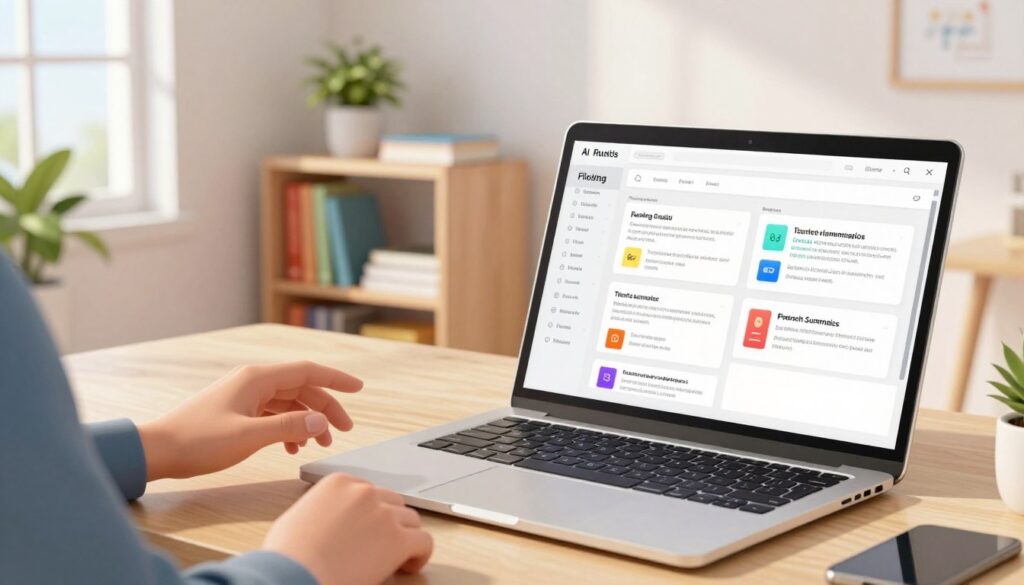
Generate summaries and flashcards in seconds. FlowScholar’s AI reads lecture files and creates clear notes, quizzes, and flashcards so learners spend hours less on formatting and more on review.
The platform includes 32 short, engaging videos that show how to use the AI tutor to answer complex queries. Watch the clips to learn quick workflows and practical tips.
Organize subjects and materials automatically: modules collect related content, tag key concepts, and produce practice quizzes. This helps users focus on mastering topics instead of chasing files.
- Save hours of manual work; concentrate on high-value content.
- Turn lecture notes into searchable summaries and ready-made quizzes.
- Use the AI tutor to handle tricky questions and refine your approach.
“Automation makes preparation predictable: less prep, clearer outcomes.”
Mastering Active Recall and Spaced Repetition
Active recall trains the brain to pull answers from memory instead of rereading notes.
Mastering active recall can deliver up to 95% retention after one week when practiced consistently. Short, focused sessions beat long, passive review; they force retrieval and strengthen memory traces.
FlowScholar’s AI tutor applies spaced repetition automatically. It schedules prompts and converts content into flashcards that challenge recall each session. Combine this with our concise videos to refine timing and technique.
“Repeated retrieval is the fastest path from exposure to lasting memory.”
| Technique | Benefit | Resource |
|---|---|---|
| Active recall | Higher retention in days | Flashcards |
| Spaced repetition | Reduced forgetting over weeks | AI tutor schedule |
| Short quizzes | Faster mastery of content | Instructional videos |
Streamlining Note Taking and Summarization
Organizing lecture content into bite-size summaries changes how learners use their time.
Structuring Your Lecture Notes
Start each lecture with a clear header, three bullet points of core ideas, and one question to test recall. This simple frame turns messy notes into a repeatable workflow.
Michael, a Psychology student, rebuilt his lecture notes this way and reclaimed hours each week. He spends less time searching and more time practicing answers for upcoming exams and tests.

Creating Effective Flashcards
Convert each core idea into a single flashcard that asks a direct question. Keep answers short; aim for one clear fact or process per card.
Active recall drives retention: short review sessions with focused flashcards beat long rereads. Use quick quizzes to flag weak cards and schedule repeats.
- Summaries in seconds make review predictable.
- AI tutor can answer questions to verify notes before exams.
- Organized materials give reliable access to summaries whenever needed.
| Action | Benefit | Time Saved |
|---|---|---|
| Header + 3 bullets per lecture | Faster scanning; clearer topics | 10–20 minutes/session |
| One-question flashcards | Better recall; easier quizzes | 5–15 minutes/review |
| AI verification of notes | Accurate content; fewer errors | Seconds per note |
“Concise notes + targeted flashcards = more retention with less time.”
For tools that speed this workflow, explore the best AI tools to match your needs.
Overcoming Procrastination and Study Stress
Breaking the cycle of delay starts with removing the triggers that steal time.
FlowScholar’s Chrome extension blocks distracting sites so dedicated sessions stay focused. This direct control reduces interruptions and protects valuable study time.
When tabs no longer tempt, anxiety eases. Many users report that using our tools to manage stress makes studying feel calmer and more predictable.
Organizing notes and materials in one place eliminates uncertainty. That structure prevents last-minute panic before exams and keeps progress visible.
We provide practical support: clear routines, gentle reminders, and a minimal interface to keep attention on learning goals. The result is consistent momentum instead of scattered effort.
“Small environmental changes deliver big gains in focus and outcomes.”
- Block distracting sites during focused sessions.
- Store notes and materials together to cut search time.
- Build a repeatable routine that reduces procrastination.
For additional guidance, see further reading to deepen this approach and sustain results.
Collaborative Learning and Peer Support
A learning community expands resources and accelerates problem-solving. This approach turns isolated review into active exchange and clearer outcomes.
Building a Community of Learners
Over 40 million users on Vaia share flashcards and quizzes to boost group progress. Peer-created materials make complex topics easier to tackle.
Members swap notes and pose questions that reveal gaps fast. That feedback loop shortens the path from confusion to clarity.
Our AI tutor helps moderate discussions and standardize high-quality materials. It ensures everyone has access to reliable content and timely answers.
- Share flashcards and quizzes to diversify practice.
- Ask targeted questions and get peer explanations.
- Use collaborative tools to keep materials organized.
| Action | Benefit | How Vaia Helps |
|---|---|---|
| Share flashcards | Broader recall practice | Community library |
| Ask questions | Faster problem resolution | Peer answers + AI tutor |
| Organize materials | Reduced duplication | Tagged folders and search |
“Sharing knowledge is one of the most effective ways to master new subjects.”
Maximizing Your Efficiency with FlowScholar
Efficiency comes from aligning materials, practice, and feedback in a single place.
FlowScholar’s platform bundles flashcards, quizzes, AI tutor support, and concise summaries so learners spend less time chasing files and more time on recall.
A lifetime subscription is available for a one-time fee of $259. That purchase grants long-term access to tools and all course materials across subjects and exams.
Integrate the platform into daily routines and you can save hours each week. Quick video walkthroughs and verified notes make review predictable and boost retention.
- Flashcards and quizzes that adapt to weak areas.
- AI tutor that refines summaries from lecture notes.
- Centralized access to materials and support during tests.
Ready to maximize results? Explore the full range at FlowScholar and read a practical guide on course design at how to create an AI-powered online.
“Small, repeatable workflows deliver measurable gains in retention and confidence.”
Conclusion
,Closing the loop on efficient learning means choosing routines that reward consistency over hours. Small, repeatable actions create steady progress and reduce last-minute pressure.
Adopt practical workflows and AI-driven features to turn daily tasks into high-impact sessions. Use concise summaries, retrieval practice, and scheduled reviews to keep momentum.
Consistency and the right resources unlock mastery across subjects. Begin by exploring platforms that prioritize clarity and well-being; apply one change this week and measure the result.
Commitment to better habits leads to improved grades, less stress, and greater confidence. Start the journey today—progress compounds faster than time spent alone.
FAQ
How does FlowScholar.com help learners study smarter instead of longer?
FlowScholar.com centralizes notes, flashcards, quizzes, and videos so learners spend time on high-impact review rather than on inefficient rereading. The platform uses active recall and spaced repetition to boost retention, offers summaries and question banks to reduce prep hours, and surfaces the most relevant materials for exams and lectures to streamline study time.
What changed in modern academic success compared with past methods?
Modern success emphasizes evidence-based techniques—active recall, spaced practice, and microlearning—over passive review. Digital integration, AI-assisted content, and analytics now let learners track progress, identify weak topics, and adapt schedules in real time, improving long-term retention and exam performance.
Why is a study smarter tool important compared to traditional methods?
Traditional methods rely on long, unfocused sessions and highlight-heavy notes. A focused platform replaces guesswork with structured workflows—automated scheduling, flashcard generation, and targeted quizzes—so learners convert hours into measurable gains and reduce stress before tests.
What are the main limitations of traditional note-taking and review?
Classic methods often produce cluttered notes, inconsistent review timing, and low retrieval practice. Without active testing or spaced intervals, information fades quickly. FlowScholar tackles these gaps with structured summaries, flashcard creation, and reminders that enforce optimal review cycles.
What benefits come from integrating digital tools into learning?
Digital tools provide searchable content, synchronized lecture capture, on-demand flashcards, and analytics that reveal retention trends. Integration saves seconds per lookup, reduces redundancy, and enables adaptive quizzes that prioritize weak areas, delivering better results in less total study time.
How does AI transform a learner’s workflow?
AI automates routine tasks—summarizing lectures, generating practice questions, and converting notes into flashcards—so learners focus on active recall. It personalizes schedules, predicts when to review material, and recommends resources across subjects for efficient mastery.
Can FlowScholar automate study materials from lectures and readings?
Yes. The platform transcribes lectures, extracts key concepts, and creates concise summaries and flashcards. It also produces multiple-choice and open-ended quizzes, cutting the time needed to prepare targeted study materials.
How does the system support active recall and spaced repetition?
FlowScholar schedules reviews based on spaced repetition algorithms and prompts frequent retrieval through quizzes and flashcards. This combination strengthens memory traces and increases retention while reducing total review hours.
What features help with note-taking and summarization?
Features include structured templates for lecture notes, automated highlight extraction, and AI-generated summaries. These tools convert verbose notes into clear outlines and study-ready flashcards, improving clarity and recall.
How should learners structure lecture notes for best results?
Use concise headings, bullet points for key concepts, and record examples or formulas separately. Tag topics by subject and difficulty so the platform can generate targeted flashcards and schedule reviews that match the learner’s goals.
What makes an effective flashcard on FlowScholar?
Strong flashcards test a single concept, use clear prompts, and include context where needed. Combining images, formulas, or short explanations boosts recall. The platform also creates cloze-deletion cards to encourage active retrieval.
How does FlowScholar help overcome procrastination and stress?
It breaks large goals into manageable sessions, offers micro-tasks and reminders, and visualizes progress with analytics. These strategies reduce overwhelm, improve focus, and build momentum through small, consistent wins.
What options exist for collaborative learning and peer support?
Users can share flashcard sets, co-edit summaries, form study groups, and participate in peer quizzes. These collaborative features enable peer feedback, accountability, and the exchange of diverse explanations across subjects.
How can learners build a community of peers on the platform?
FlowScholar supports group spaces where members share resources, host timed practice sessions, and compare progress. Educators and tutors can curate materials, run group quizzes, and mentor peers to accelerate collective mastery.
How does FlowScholar maximize personal efficiency?
By combining automated note processing, adaptive scheduling, and consolidated content (notes, flashcards, quizzes, videos), the platform reduces redundant tasks and directs attention to high-value practice. Users see faster gains with fewer hours invested.
Is FlowScholar suitable for different subjects and exam formats?
Yes. The system adapts to STEM formulas, humanities concepts, language practice, and professional exam formats. It generates subject-appropriate question types and supports multimedia resources to match diverse learning needs.