“Education is the most powerful weapon which you can use to change the world.” — Nelson Mandela.
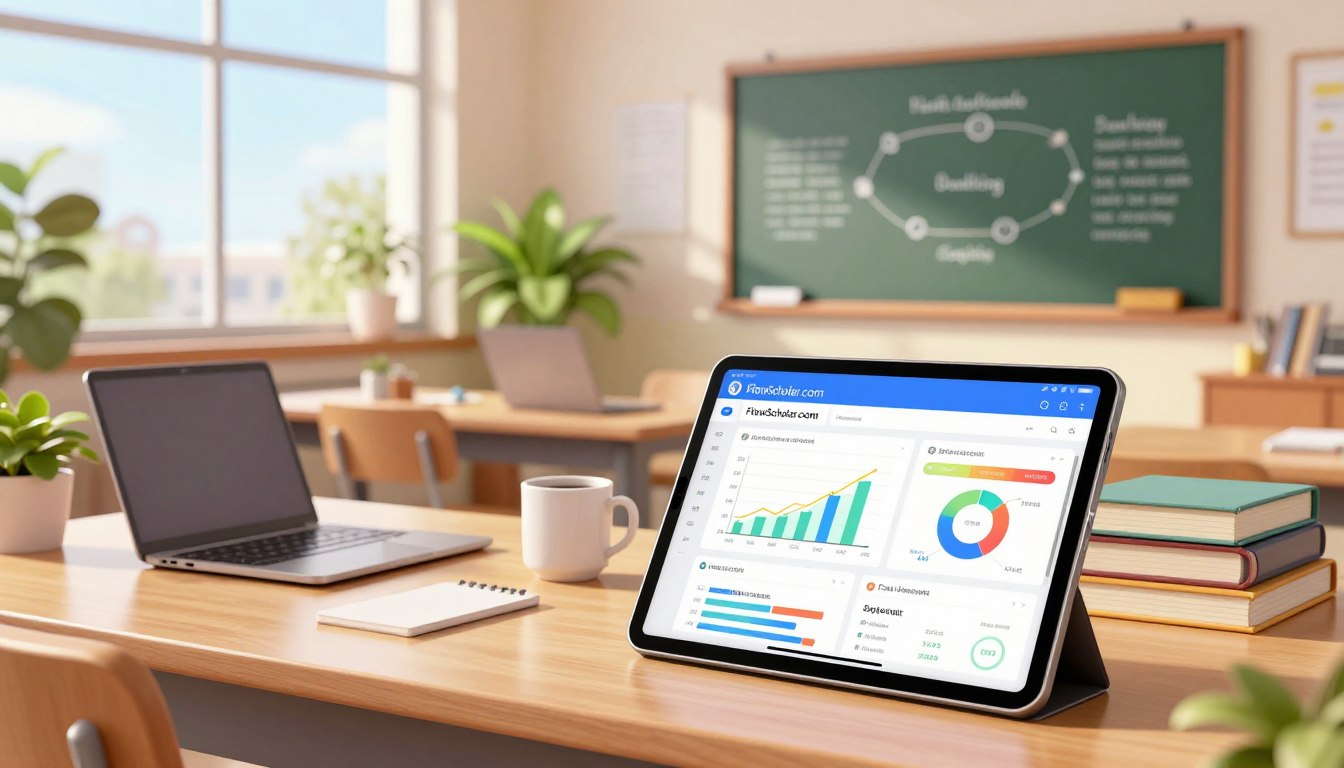
FlowScholar.com offers a clear path for school leaders who face complex choices about technology and teaching. By fall 2024, 48 percent of districts reported they had trained teachers on the use of new generative tools. That shift moved many teams from fear to focused practice.
The platform pairs practical training with policy guidance, helping a district protect student data privacy while expanding access to effective teaching methods. FlowScholar.com collects classroom use cases and real feedback so educators can adopt solutions that fit local needs.
Readers will find guidance on aligning tools with standards, building professional learning cycles, and creating policies that support long-term development. This approach emphasizes equity, teacher confidence, and measurable insights that school leaders can use right away.
Key Takeaways
- Nearly half of districts began teacher training on generative tools by fall 2024.
- FlowScholar.com provides training, policy templates, and classroom use cases.
- Emphasis on data privacy and professional learning supports safe adoption.
- Aligning tools with standards ensures equitable access for students.
- School leaders gain actionable insights to build confidence and sustain change.
The Current Landscape of AI in Education for Districts
Trends are clear and fast-moving. Between fall 2023 and fall 2024 the share of districts offering formal training doubled, with 48% reporting they had trained teachers on the use of AI by fall 2024.
Federal surveys from December 2024 show 59% of U.S. schools had trained some or all teachers. That rise reflects a shift from quick briefings to structured professional development and ongoing support.
- Focus areas: calming teacher anxiety, clarifying capabilities and limits of new tools, and embedding practical classroom use cases.
- Equity gap: low-poverty and high-poverty districts still vary widely in access to training and resources.
- Forward planning: many school district leaders plan expanded training during the 2024–2025 year.
FlowScholar’s approach pairs policy and practical workshops to help district leaders scale support for teachers. Learn about targeted professional development workshops that build confidence and classroom-ready skills.
Why Establishing Clear AI Guidelines Matters
Clear policy guidance gives school leaders a working framework to manage new classroom tools and protect student data.
Only 34–35% of districts currently have formal policy in place. That gap leaves many teachers and students without firm guidance. Without rules, confusion grows around academic integrity and privacy.
Well-crafted policies do three things: set expectations, protect privacy, and communicate with families. When a district publishes a simple, actionable policy, teachers gain confidence to experiment while keeping standards high.
Policies also serve as a parent-facing message. They explain how technology aligns with school goals and how student information is safeguarded. Over the coming year, more leaders should treat policy work as a priority.

| Policy element | Purpose | Expected impact |
|---|---|---|
| Acceptable use | Define classroom boundaries | Reduce misconduct, improve clarity |
| Data privacy | Protect student information | Increase trust with parents |
| Teacher guidance | Show practical classroom steps | Boost teacher confidence |
| Review cycle | Ensure updates each year | Keep policy current with technology |
Strategies for Developing Sustainable AI Policies
A policy that lasts is one shaped by the people who will use it every day. Sustainable policy work blends broad engagement with a plan for ongoing updates.
Engaging diverse stakeholders builds trust and uncovers real needs. Tucson Unified School District formed a task force of over 40 people to draft guidelines that became their district policy. That scale of participation brought teacher voices, parents, and community experts into decisions about classroom use and privacy.
Engaging Diverse Stakeholders
Leaders should invite teachers, school staff, families, and outside experts to give feedback. Surveys, focus groups, and pilot classrooms make the process transparent.
Maintaining Flexibility in Policy
Adopt a living document approach. Arlington Public Schools keeps guidance flexible so updates can occur without full board votes. That model lets teachers access current practices and tools each year.
- Solicit ongoing feedback from many people to refine guidance.
- Embed data privacy and ethical checks into policy development.
- Treat policy as a framework that supports professional learning and classroom support.
For a practical playbook that pairs strategy with templates, consult the district strategy guide. It offers steps leaders can use to draft, test, and maintain policies that protect students while enabling responsible innovation.
Overcoming Barriers to Teacher Training and Adoption
Resistance often masks a need for time, clear purpose, and hands-on practice rather than more presentations.
Addressing teacher fear and anxiety is the first step. Many teachers worry that new tools will replace tried teaching methods. That concern lowers willingness to try new practices.
District leaders reported a do-it-yourself approach: 11 of 14 took on training development when external experts were scarce. That reality calls for simple, practical plans that can be led locally.

Practical actions that work
- Give scheduled time for teachers to experiment; practice builds confidence.
- Offer bite-sized training that ties tools to lesson planning and differentiation.
- Create peer groups where educators share wins and challenges.
| Barrier | Short fix | Expected result |
|---|---|---|
| Fear of change | Safe practice time | Higher volunteer rates for pilots |
| Lack of experts | DIY professional development | Faster rollout, tailored content |
| Competing priorities | Micro-training sessions | Less disruption, steady learning |
| Isolation | Peer coaching | Sustained adoption and improvement |
For leaders who face teacher resistance, see our guide on teacher resistance to learn practical steps to build trust and momentum.
Real Classroom Use Cases for Generative AI
Teachers are using generative workflows to turn rough ideas into polished lessons and assessments quickly.
Early classroom pilots show teachers using tools to brainstorm lesson ideas, draft parent emails, and build grading rubrics. These practices cut routine planning time and give educators more space to focus on students.
Some districts have adopted education-specific platforms like MagicSchool to streamline daily work. District leaders report faster lesson design and clearer differentiation for diverse learners.
As training expands, leaders seek practical insights that transfer across grades and subjects. We recommend showcasing vivid classroom examples to accelerate school-wide adoption.
| Use case | Time saved/week | Typical tools |
|---|---|---|
| Lesson brainstorming and pacing | 90 minutes | MagicSchool, prompt-based editors |
| Parent communication (emails) | 45 minutes | Template generators, draft assistants |
| Grading rubrics and feedback | 120 minutes | Rubric builders, response synthesizers |
| Differentiated content for students | 75 minutes | Adaptive content tools, authoring platforms |
For deeper classroom examples and a practical playbook, see classroom examples and a guide to build GPT-powered educational tools. These resources offer concrete steps to move from curiosity to regular use.
Protecting Student Data and Ensuring Equitable Access
Protecting student information and ensuring fair tool access are core responsibilities for every school leader. Districts must treat privacy and access as linked priorities—both require policy, contracts, and active oversight.
Navigating FERPA and COPPA
Navigating FERPA and COPPA
Vendor contracts should explicitly prohibit using student data to train commercial models. This step helps maintain compliance with FERPA and COPPA.
District legal teams and leaders must review contracts before any classroom use of third-party tools. Clear clauses protect student privacy and reduce future risk.
Monitoring for Algorithmic Bias
Monitoring for Algorithmic Bias
Tools that score or flag student work should be audited regularly. Monitoring helps catch bias that might rely on demographic proxies.
Set review cycles and involve teachers and diversity experts to interpret system outputs. This reduces misclassification and preserves fairness for students.
Closing the Digital Divide
Closing the Digital Divide
Access means more than devices. Connectivity, training, and ongoing support ensure that every classroom can use new tools.
District leaders should prioritize high-poverty and rural schools when allocating resources and bandwidth upgrades.
| Area | Action | Impact |
|---|---|---|
| Vendor contracts | Ban use of student data for commercial model training | Maintains FERPA/COPPA compliance |
| Bias monitoring | Regular audits and stakeholder review | Reduces unfair flags and misclassification |
| Access strategy | Provide devices, connectivity, and training | Improves equitable learning opportunities |
| Family communication | Publish plain-language policies and opt-in details | Builds trust and transparency |
- Vetting tools: Require security reviews before classroom use.
- Transparency: Share clear information with families about data and use.
- Sustainability: Fund connectivity, not just devices, to close the divide.
Leveraging Professional Development to Build Confidence
When professional learning is regular and practical, teachers gain the confidence to adopt new classroom tools effectively.
Ongoing professional development focuses on short, hands-on sessions that respect teacher time. Utah’s program trained 4,500 teachers by naming a dedicated point person to lead training efforts. That structure turned scattered pilots into steady learning.
Peer leadership accelerates adoption. Arlington Public Schools moved from optional sessions last year to mandatory basic training this year. Teacher leaders who master tools mentor colleagues and model classroom use.
Offer bite-sized learning and clear support channels. Short modules let educators experiment at their own pace. Regular check-ins and a help desk create reliable support when challenges arise.
Investing in people alongside technology builds sustainable practice. School leaders should treat training as continuous work—not a one-off event—and create pathways for teachers to refine methods across the year.
- Peer coaching: Teacher leaders guide classroom integration.
- Micro-training: Short modules reduce stress and boost practice.
- Dedicated support: Help channels and check-ins sustain momentum.
How FlowScholar Supports Your District AI Strategy
FlowScholar helps school leaders turn pilots into steady practice by offering a customizable learning environment that maps tools to state standards and lesson plans.
The platform gives district leaders centralized policy controls, privacy settings, and teacher-facing training modules. This keeps systems consistent across schools while preserving teacher autonomy.
Teachers get real-time insights that flag when students need help. Those signals let teachers intervene quickly and tailor follow-up lessons.
- Custom learning paths aligned with standards and local lessons.
- Built-in accessibility to support diverse students and language needs.
- Teacher-controlled tools that maintain rigorous data privacy.
| Feature | Purpose | Impact |
|---|---|---|
| Customizable lessons | Align tools to state standards | Faster teacher adoption; consistent practice |
| Real-time insights | Monitor student progress | Targeted support; reduced learning gaps |
| Privacy controls | Protect student information | Stronger trust with families and staff |
| Accessibility features | Support diverse learners | Improved access and engagement |
Move from pilot to scale: visit FlowScholar.com to explore training, policy templates, and classroom tools that help a school district build a sustainable, year-over-year approach.
Conclusion
Rapid adoption shows school systems are shifting toward tools that boost classroom practice and learning outcomes. Successful rollout pairs clear policy, ongoing professional development, and a strong, actionable support structure.
District leaders must equip teachers with training, time, and tools while guarding student privacy through transparent policies. Equity and careful monitoring keep gains broad and durable.
Follow proven playbooks and trusted platforms to move from pilots to scale. For guidance on responsible rollout and governance, consult this responsible rollout guide.
FAQ
What practical classroom use cases does FlowScholar.com showcase to help districts introduce AI tools?
FlowScholar.com highlights teacher-led lesson examples, student-centered projects, and administrator workflows that demonstrate real-world application. Examples include personalized reading interventions, automated formative assessment feedback, and lesson planning aids that save teacher time while improving instruction. Each case includes implementation steps, required tools, data considerations, and alignment to standards.
How should district leaders approach creating guidelines and policies for adoption?
District leaders should form a cross-functional team—teachers, IT, curriculum specialists, legal counsel, and community representatives—to craft clear, flexible policies. Prioritize student privacy, vendor vetting, consent procedures, and professional learning pathways. Build review cycles so guidelines adapt to new tools, insights from classroom pilots, and evolving state and federal requirements.
What professional development models best build teacher confidence and competence?
Effective models combine short workshops, hands-on coaching, peer learning cohorts, and job-embedded micro-credentials. Start with low-stakes pilots, provide classroom coaching, surface exemplar lessons, and use data to iterate. Blended, ongoing support—rather than one-off sessions—drives sustained adoption and improved instructional practice.
How can districts address teacher concerns about workload, accuracy, and classroom control?
Tackle concerns by offering transparent training on tool limitations, practical workflows that save time, and classroom management strategies. Share evidence from pilots that quantify time savings and student outcomes. Promote teacher agency by involving educators in selection and design decisions, and by creating clear protocols for oversight and quality control.
What are the key legal and privacy considerations districts must manage?
Districts must comply with FERPA, COPPA, state student-data laws, and vendor contract terms. Establish data-minimization practices, require robust security clauses in contracts, and conduct privacy impact assessments. Ensure parental notifications and opt-in/opt-out processes align with local policy and legal guidance.
How do districts identify and mitigate algorithmic bias in tools?
Start by demanding transparency from vendors about training data and validation methods. Pilot tools with diverse student groups and monitor outcomes by subgroup. Use human oversight for high-stakes decisions and create escalation pathways when disparities appear. Regular audits and vendor accountability clauses help sustain equity.
What steps help close the digital divide and ensure equitable access?
Combine device provisioning, reliable broadband initiatives, and accessible software licenses with targeted professional learning for educators in high-need schools. Partner with community organizations and internet providers to expand connectivity. Track access metrics and prioritize resources where gaps are largest.
How can districts maintain flexibility in policy as technology and research evolve?
Adopt modular policies that set core principles—privacy, equity, transparency—while allowing rapid approval pathways for low-risk pilots. Schedule regular policy reviews, maintain a whitelist of approved vendors with tiered approvals, and create a data-use committee that can respond quickly to new evidence or product changes.
What metrics should leaders use to evaluate pilots and scale efforts?
Combine qualitative and quantitative indicators: teacher confidence and time saved, student engagement and formative assessment growth, equity of outcomes across subgroups, compliance with privacy standards, and total cost of ownership. Use short-cycle evaluation to iterate before full-scale rollout.
How does FlowScholar support districts in building an overall strategy?
FlowScholar provides district-ready playbooks, exemplar lesson libraries, professional learning modules, vendor-vetting checklists, and privacy templates. The platform emphasizes sustainable implementation: stakeholder engagement, pilot design, coaching models, and metrics frameworks that align technology use with instructional goals and policy requirements.