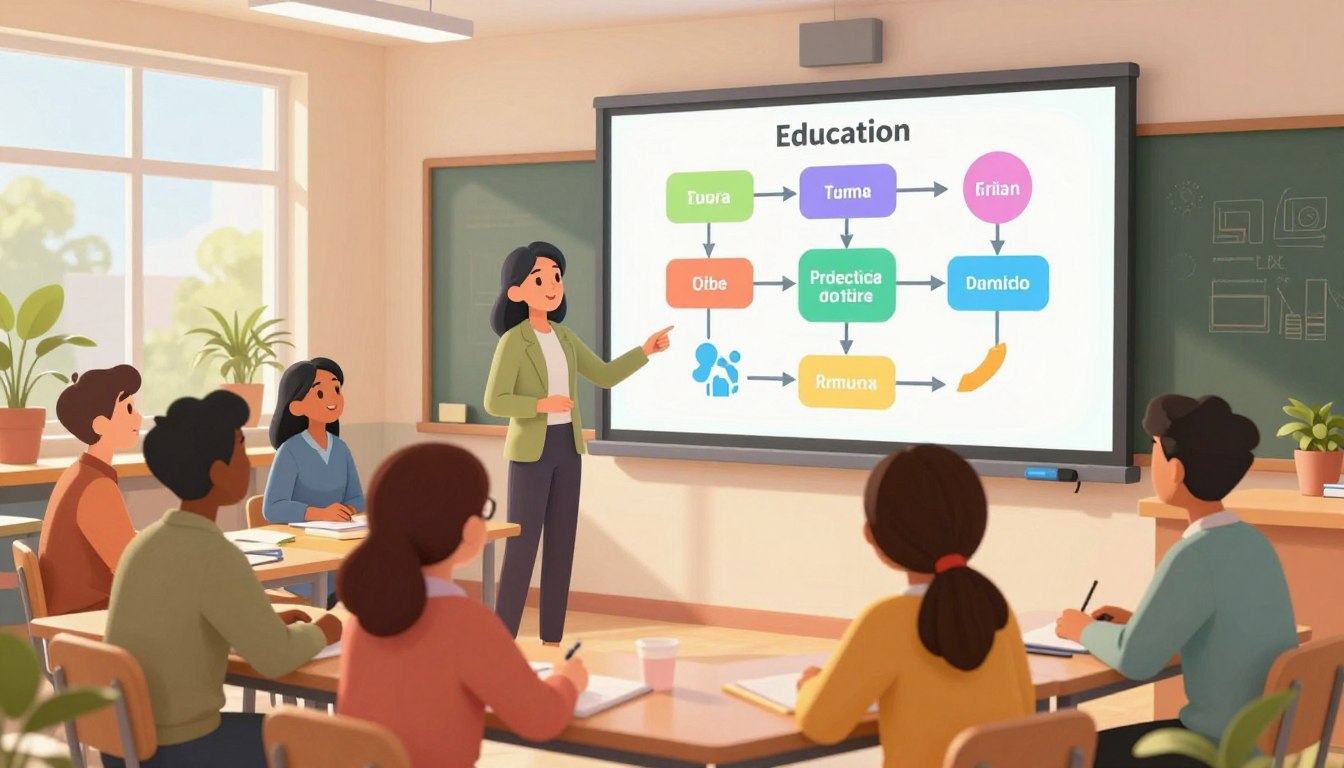
“Education is the most powerful weapon which you can use to change the world.” — Nelson Mandela. That idea guides a measured approach to new technology. FlowScholar.com frames innovation as a tool to uplift students while protecting their privacy and academic integrity.
Nearly half of districts reported that they trained teachers on generative artificial intelligence by fall 2024. FlowScholar.com builds on that momentum with clear guidance for district leaders and teachers.
The platform offers practical resources, data-driven advice, and systems that balance the potential benefits of technology with strong data privacy and security. District leaders will find pathways to implement tools that support teaching and learning while maintaining trust.
Visit FlowScholar.com to learn how the team helps districts develop policies, staff training, and classroom practices that protect student data and promote effective use of artificial intelligence.
Key Takeaways
- 48% of districts had teacher training on generative artificial intelligence by fall 2024.
- FlowScholar.com supplies practical resources and policy guidance for districts.
- Efforts focus on data privacy, academic integrity, and secure systems.
- District leaders gain tools to support teachers and enhance student learning.
- Visit FlowScholar.com to access training, resources, and implementation plans.
The Current Landscape of AI in Education for School Districts
A swift expansion of classroom tools has created urgent needs around staff training and student protections.
Current Adoption Trends
Federal data from December 2024 shows that 59 percent of U.S. schools had trained some or all their teachers on artificial intelligence. That rise followed a 25-point jump in district training between fall 2023 and fall 2024.
These numbers show rapid change: more teachers and students are using advanced tools, and districts must adapt policies and systems to keep pace.
The Growing Need for Support
District leaders now face choices about time, staff work, and equitable access to resources. Many successful districts pair clear training pathways with ongoing feedback loops.
- Prioritize structured training to protect academic integrity and data privacy.
- Allocate time and systems to evaluate tools and manage implementation work.
- Share clear information with teachers and school leaders to reduce the knowledge gap.
For a deeper landscape overview, see this analysis.
Understanding the Potential Benefits of Artificial Intelligence
“When designed and vetted carefully, modern tools can give teachers time back while giving students more targeted feedback.”
Personalized instruction helps learners progress at their own pace. Intelligent tutoring systems adapt tasks to each student’s needs and offer immediate feedback that clarifies mistakes.
Automated grading reduces routine work. That frees teachers to focus on direct teaching and deeper student engagement.
Learning analytics give district leaders clear data to spot gaps early. Schools can target support to students who need extra help and monitor progress over time.
Adaptive platforms adjust content difficulty as learners improve. Chatbots provide round‑the‑clock support for basic questions and resources.
“By pairing tools with strong data privacy and vetting, districts can preserve academic integrity while expanding access to tailored learning.”
- Personalized learning: supports different learning styles.
- Time savings: automated systems reduce administrative work.
- Actionable data: helps leaders allocate support efficiently.
Integration must be strategic: prioritize data privacy, clear practices, and equitable access. District leaders who research and vet tools will better harness these benefits while protecting student information and academic integrity.
Addressing Common Misconceptions About Classroom Technology
It’s common to hear that artificial intelligence will replace teachers, but this misunderstands the role these systems play. Tools are designed to assist educators by handling routine tasks and surfacing insights that help teaching. They do not replace human judgment or relationships that matter most to students.
Oversight matters: humans must check outputs, confirm accuracy, and align content with learning goals. Systems can suggest feedback, but teachers shape final instruction and assessment.
Clear policies reduce fear. District leaders and school leaders should explain how tools support teaching, protect data, and preserve academic integrity. Transparency builds trust with parents and the community.
“Technology should free time for teachers to do the work only humans can do: mentor, assess nuance, and inspire.”
- Emphasize oversight: require human review of generated content and data use.
- Promote integrity: pair tools with policies that discourage misuse and support fair assessment.
- Invest in training: targeted professional development helps teachers adopt tools confidently.
For a practical guide that tackles common concerns, see this misconceptions review.
Why Your District Needs a Formal AI Policy
A formal policy turns uncertain choices about emerging systems into clear steps leaders can follow. It gives teachers, students, and staff a shared framework for responsible use. That clarity reduces guesswork and protects core values like fairness and trust.
Defining Responsible Use
Policy work should demystify artificial intelligence and state when a tool is appropriate. Only Ohio and Tennessee currently mandate comprehensive policies, so many school district leaders are writing their own guides.
Good policy addresses data privacy, academic integrity, and practical classroom uses. It also outlines who reviews tools, how consent is handled, and how updates occur as technology changes.
- Involve school leaders and community members to build trust.
- Provide teachers clear resources and training to implement guidelines.
- Keep the policy flexible so it can adapt to new tools and information.
“A formal policy is not a limit—it is the guardrail that enables safe innovation.”
Strategies for Building Flexible and Durable AI Guidelines
A living policy makes it easy to respond quickly when new capabilities or risks appear.
Start with a modular framework: organize guidance into clear sections that cover teaching, learning, data, privacy, and security. Short, labeled pages help teachers and staff find resources fast.
Use a living document approach like Arlington Public Schools. That model lets leaders update guidance without delaying every change for board votes. The result: staff always see current advice.
Engage a broad group of stakeholders during development. Include teachers, school leaders, technology staff, and parents so the policy stays practical and trusted.
- Create a simple process for updates and regular reviews.
- Balance clear rules with room to adopt new tools quickly.
- Center policy on academic integrity and student safety.
“Treat guidelines as a dynamic resource: review and revise them regularly.”
To explore practical tool ideas, see GPT-powered educational tools that support teachers and learning.
Engaging Stakeholders in the Policy Development Process
Building policy with broad participation produces rules people trust and follow. Tracey Metcalfe Rowley of Tucson Unified formed a task force of more than 40 participants to craft guidelines on artificial intelligence. That example shows how scale and variety of voices matter.
Include teachers, parents, community members, and school leaders early. Add staff from human resources, communications, and nutrition to capture day-to-day realities.
Transparency builds buy‑in. Share drafts, host public forums, and collect feedback in clear, accessible formats. That helps address data privacy and academic integrity concerns before rollout.
- Practical input: teachers and students reveal classroom impacts.
- Operational insight: operations staff identify workflow gaps.
- Community trust: parents and local leaders validate priorities.
“A collaborative process turns policy from a list of rules into a shared vision for safer, smarter use of technology.”
When stakeholders help shape the process, district leaders secure broader support and smoother implementation across schools and learning programs.
The Importance of Data Privacy and Security
Before adopting any tool, leaders should require clear contracts and technical safeguards that limit exposure of student records.
Protecting Student Information
Collecting and processing large volumes of student data demands layered protections. Districts should vet vendors for encryption, access controls, and clear retention policies.
Teachers and staff need concise training on handling sensitive records and spotting risky configurations. Regular audits help catch gaps early and keep practices current.
Compliance with Federal Regulations
Compliance with the Family Educational Rights and Privacy Act (FERPA) is nonnegotiable. Schools that meet FERPA standards reduce legal risk and preserve community trust.
- Vetting: require documentation on data use and subprocessors.
- Protocols: set strict rules for how student data is collected, stored, and deleted.
- Oversight: schedule periodic system audits and vendor reviews.
“A proactive approach to data privacy protects students and strengthens public confidence.”
Navigating the Challenges of Academic Integrity
Maintaining academic honesty requires clear rules, careful assignment design, and regular classroom conversations.
Tools that assist learning can also enable misuse if expectations are unclear. Educators must set explicit boundaries and teach students why honest work matters.
Teachers should design tasks that reveal understanding—short reflections, drafts, and oral checks work well. These approaches reduce the chance that technology simply replaces learning.
Professional development helps teachers spot misuse and adapt assessments. When staff practice common scenarios, they gain confidence to enforce standards.
“Foster a culture where integrity is routine, not an afterthought.”
- Set clear guidelines about acceptable assistance and citation.
- Design resilient assessments that require original thought.
- Communicate openly with students about risks and benefits.
| Challenge | Teacher Action | Outcome |
|---|---|---|
| Unclear expectations | Publish examples and rubrics | Fewer incidents, fair grading |
| Assignment misuse | Use staged submissions | Improved student ownership |
| Staff uncertainty | Offer focused training | Stronger enforcement and support |
Best Practices for Professional Development and Training
Professional development succeeds when it is practical, ongoing, and tied to classroom action.

Designing Bite-Sized Learning
Short modules—weekly newsletters, brief videos, and micro‑workshops—let teachers learn without overload.
These small steps build competence. They also create opportunities for reflection and quick implementation.
Embedding Topics into Existing Sessions
Integrate artificial intelligence topics into regular staff meetings and content-area PD. That keeps momentum without adding extra days.
Embedding helps connect new approaches to current teaching practice and to ongoing goals.
Focusing on Educator Proficiency
Prioritize educator confidence: offer tiered tracks, peer coaching, and targeted follow-ups. Teachers who feel capable will adopt tools more often.
“Ongoing, targeted training beats one-off workshops every time.”
- Mix brief tutorials with hands-on practice.
- Use teacher leaders to model classroom uses.
- Provide clear resources and regular feedback loops.
Overcoming Barriers to Effective AI Implementation
When staff time is limited, rollout plans must be compact, practical, and tied to classroom goals.
Start small: prioritize short, role-specific modules that teachers can use between lessons. This respects competing professional development demands while keeping momentum.
Many leaders have created their own resources when outside experts were unavailable. That DIY approach builds local knowledge but benefits from coaching and shared templates.
Districts should treat pilot phases as experiments—test, collect data, and iterate. Clear communication and steady support reduce staff anxiety and speed adoption.
“Patience and persistence turn trial programs into lasting practices.”
- Build internal capacity: train teacher leaders to coach peers.
- Address equity by pairing devices with connectivity plans.
- Share lessons and templates across schools to scale success.
| Barrier | Practical Fix | Expected Result |
|---|---|---|
| Limited time | Micro‑modules and asynchronous coaching | Higher uptake with less disruption |
| Few external experts | Develop local trainers and reusable guides | Sustainable internal capacity |
| Uneven access | Device loans and hotspot programs | More equitable learning opportunities |
Leaders who center communication, invest in teacher leaders, and measure outcomes create systems that support long-term development. For approaches to managing teacher concern, see a practical review of teacher resistance.
Leveraging Peer Leadership Models for Teacher Buy-in
Trusted peers who share concrete classroom wins make new methods feel achievable and relevant. When colleagues demonstrate practical uses, other staff are more likely to try those approaches.
Peer leadership models work because teachers trust peers who understand daily classroom realities. Short demonstrations—showing how a prompt improved a test question or how a rubric sped grading—make benefits tangible.
Peer-led professional development sessions create a safe place to ask questions and workshop lessons. These gatherings build community and reduce the fear of adopting new technology.
District leadership can scale this by identifying teacher leaders, offering release time, and recognizing contributions. When teachers lead, development is grounded in real practice and local needs. That boosts uptake and makes learning sustainable.
“When peers model small, repeatable wins, adoption spreads naturally — and teachers keep ownership of professional growth.”
- Start small: pilot peer demos during staff meetings.
- Share wins: publicize concrete outcomes and time saved.
- Support leaders: give coaching and modest stipends to teacher facilitators.
Evaluating and Vetting AI Tools for Classroom Use
A rigorous vetting process helps leaders choose classroom tools that protect privacy and deliver clear learning gains.
Establishing Vetting Criteria
Start with a simple rubric that prioritizes student safety and real classroom impact. Arlington Public Schools offers a model: every proposal must meet strict privacy and security standards before review.
Key criteria should include:
- Effectiveness: evidence the tool improves learning outcomes and aligns with curriculum goals.
- Privacy & security: documented compliance with data protection rules and vendor contracts.
- Usability: easy setup for teachers and minimal disruption to existing routines.
- Equity: access across schools and support for students with varied needs.
We recommend a collaborative review panel—IT staff, instructional leaders, teachers, and legal counsel—so decisions are practical and defensible.
“A curated list of approved tools gives teachers confidence and prevents unauthorized systems from risking sensitive data.”
Managing Costs and Resource Allocation
Budget planning that treats implementation and upkeep as equal priorities helps districts avoid surprise costs and stalled rollouts.
Basic tools can cost as little as $25 per month, while larger adaptive platforms may require tens of thousands of dollars. A clear budget must show one-time fees, recurring licenses, and the cost of ongoing maintenance.
Include professional development, technical support, and staff time in any ownership estimate. Training hours and vendor support often drive long-term cost more than the initial purchase.
Leaders should run a total cost of ownership analysis and prioritize pilots that show measurable learning gains. That approach lets decision-makers stop, review results, and scale what works.
- Map one-time versus recurring costs.
- Estimate staff hours for rollout and ongoing support.
- Prioritize high-impact pilots before large purchases.
Explore diverse funding sources—grants, partnerships, and local levies—and keep budget lines transparent to build community trust. For procurement best practices, see FlowScholar’s procurement guidance at procurement guidance.
“Sustainable adoption balances innovation with fiscal responsibility; planning up front saves time and preserves public confidence.”
Promoting Equity in AI Access
Equitable access begins with clear choices about devices, connectivity, and targeted supports that close gaps rather than widen them.
Unequal access can leave some students behind. Thoughtful planning reduces those risks.
Systems that are not monitored may amplify bias and harm marginalized groups. Leaders should review vendor practices, run bias audits, and require transparent data handling.
- Ensure devices and reliable internet reach all homes and learning spaces.
- Provide extra coaching and office hours for students who need support.
- Engage parents and community partners to identify barriers and solutions.
“Success will be measured by whether every learner gains fair access and clear chances to thrive.”
| Barrier | Action | Expected Result |
|---|---|---|
| Missing devices | Device loan programs and inventory tracking | Higher participation across grades |
| Poor connectivity | Hotspot lending and community Wi‑Fi hubs | Consistent remote access |
| Unseen bias | Regular audits and diverse pilot groups | Fairer outcomes for all students |
Recommendation: review tech policies regularly, fund targeted supports, and measure impact so benefits are shared by everyone.
How FlowScholar.com Supports Your District Journey
Districts gain a clear path from pilot to scale with FlowScholar.com’s practical support.
FlowScholar.com offers a concise roadmap that helps leaders adopt new tools responsibly. The platform supplies templates, checklists, and sample policies that save time and reduce guesswork.
Local teams receive step-by-step guidance on vetting, piloting, and scaling. Specialists provide coaching sessions and ready-made training materials to speed staff uptake.
Key services:
- Policy templates and vendor vetting guides.
- Role-based training modules and peer-leader toolkits.
- Implementation checklists, equity reviews, and monitoring plans.

“FlowScholar.com turns complex choices into manageable steps that keep students and staff safe while expanding classroom possibilities.”
Use the short table below to compare core support elements.
| Service | What It Delivers | Expected Result |
|---|---|---|
| Policy & Compliance | Clear templates and vendor checklists | Faster approvals; stronger protections |
| Professional Support | Coaching, modules, and peer leader plans | Higher teacher confidence and uptake |
| Pilot & Scale | Pilot designs, metrics, and rollout plans | Measured impact and smoother expansion |
Get started: Visit FlowScholar.com to explore resources and begin your district journey today. For tailored workshops and seminar design, see teaching skills workshops and seminars.
Conclusion
A deliberate approach pairs clear guardrails with practical steps that staff can use every day.
Responsible use, strong data privacy, and equitable access must guide every phase of adoption. Leaders should pair concise policy with hands-on professional development and peer-led models that make change manageable.
Keep pilots small and measurable. Use feedback loops to refine practice and to protect academic integrity. Remain flexible—update guidance as needs evolve and new evidence appears.
We encourage district leaders to act now: adopt clear rules, invest in training, and lean on available resources to build sustainable, safe systems that benefit all learners. Thank you for joining this effort to shape a thoughtful, practical path forward.
FAQ
How can FlowScholar.com help a district explore artificial intelligence responsibly?
FlowScholar.com provides tailored guidance and professional learning that helps district leaders assess classroom tools, set governance, and train staff. It offers practical frameworks for responsible use, privacy protection, and academic integrity so teams can pilot technologies with clear guardrails and measurable goals.
What are the current adoption trends for classroom intelligence tools?
Many districts are piloting generative and adaptive platforms at the classroom and grade-level. Adoption often starts with teacher-led experiments, expands through peer leadership, and accelerates when districts establish vetting criteria, privacy agreements, and focused professional development.
Why do districts need support to adopt these technologies?
Leaders face gaps in policy, technical capacity, and educator proficiency. Support helps align procurement, data governance, and training—reducing risk while enabling meaningful instructional shifts that save teacher time and personalize learning.
What practical benefits can intelligent tools deliver for students and teachers?
When used deliberately, tools can automate routine tasks, offer targeted feedback, and surface learning insights from assessment data. That frees teachers to design richer lessons, differentiate instruction, and monitor progress more efficiently.
What common misconceptions should districts avoid about classroom technology?
Popular myths include expecting instant transformation without training and assuming tools replace teachers. Reality: success depends on clear goals, continued training, and human oversight to interpret outputs and preserve pedagogy.
Why does a district need a formal policy on these tools?
A formal policy clarifies acceptable use, protects student data, and guides procurement. It ensures equitable access, defines educator responsibilities, and makes compliance with federal laws consistent across schools.
What should “responsible use” include in a district policy?
Responsible use should include data-minimization rules, consent and notification protocols, vetting standards for vendors, teacher training requirements, and processes for monitoring classroom practice and outcomes.
How can districts build guidelines that last amid fast-changing technology?
Focus on principle-based policies—privacy, equity, transparency—and design modular procedures that can be updated. Use pilot programs, regular reviews, and stakeholder feedback to keep guidance current without frequent rewrites.
How should districts engage stakeholders when developing policy?
Involve teachers, parents, IT staff, special educators, and students through focus groups and pilots. Transparent communication, clear FAQs, and opportunities for feedback build trust and surface equity concerns early.
What steps protect student information when using classroom tools?
Require vetted vendor contracts with strong security clauses, limit data collection to what’s necessary, use anonymization when possible, and enforce role-based access. Regular audits and staff training on privacy practices are essential.
How do districts stay compliant with federal privacy regulations?
Align vendor agreements with FERPA and COPPA requirements, maintain records of data flows, and consult legal counsel for contract language. Establishing internal compliance checkpoints helps demonstrate due diligence during audits.
How can districts address academic integrity concerns with these tools?
Redesign assessments to value process over product, teach digital literacy and source-checking, use rubrics that require reflection, and employ detection tools carefully alongside human review to preserve fairness.
What are best practices for professional development and training?
Offer short, focused sessions; embed practice into existing PD; prioritize hands-on coaching; and measure educator proficiency. Blend synchronous workshops with microlearning and job-embedded coaching for sustained adoption.
How can districts design bite-sized learning for educators?
Break content into 10–20 minute modules tied to classroom tasks, provide quick walkthroughs of tools, and supply on-demand resources teachers can access before or after lessons to apply immediately.
How should AI tools be embedded into existing professional learning sessions?
Integrate tool demonstrations into curriculum planning, model lesson designs, and use co-teaching or peer observations to show real classroom applications. Pair theory with classroom examples to reinforce transfer.
What does focusing on educator proficiency involve?
Define clear competency levels, offer scaffolded practice, track progress with simple metrics, and reward mastery through credentialing or recognition. Proficiency emphasizes pedagogical use, not technical novelty.
How can districts overcome common barriers to effective implementation?
Address infrastructure gaps, prioritize affordable pilots, secure leadership buy-in, and use peer-leadership to scale practices. Clear metrics and iterated pilots reduce risk and demonstrate value to stakeholders.
What role do peer leadership models play in teacher buy-in?
Peer leaders—teacher coaches or early adopters—showcase practical uses, mentor colleagues, and build credibility. Their classroom success stories accelerate trust and adoption across schools.
How should districts evaluate and vet tools for classroom use?
Establish vetting criteria covering pedagogy alignment, data practices, accessibility, cost, and interoperability. Run small-scale pilots, gather teacher feedback, and assess impact on learning outcomes before scaling.
What specific vetting criteria should be used?
Criteria should include data security, student privacy protections, pedagogical fit, measurable impact, staff training needs, and vendor support commitments. Use scorecards to compare options objectively.
How can districts manage costs and resource allocation?
Start with targeted pilots, seek consortium purchasing to reduce prices, prioritize tools that replace or streamline tasks, and budget for training and technical support as part of total cost of ownership.
How do districts ensure equitable access to technological tools?
Audit device and connectivity gaps, provide home and in-school solutions, and select platforms that offer offline options or low-bandwidth modes. Include equity metrics in procurement decisions.
What services does FlowScholar.com offer to support district implementation?
FlowScholar.com delivers policy frameworks, vendor-vetting templates, professional learning modules, and coaching. It partners with district teams to design pilots, build capacity, and track outcomes tied to district goals.