
“Education is the kindling of a flame, not the filling of a vessel.” —Socrates.
Every short line can start a sustained change. A single quote can nudge mindset, but habit makes impact last. This section frames a simple rhythm: pause, make visible, take one action. That triad helps a message move from momentary inspiration into measurable practice.
Educators seeking a repeatable reflection routine may find an accelerator in Flowscholar. Flowscholar helps plan prompts, vary tasks for learners, and keep consistency across the year—so words lead to goals, habits, and growth.
Later sections will show a compact micro-curriculum: short prompts that strengthen social-emotional learning and academic skills. For practical exercises and classroom-ready ideas, see a list of activities and strategies at ways to teach kids to use.
Key Takeaways
- Short phrases spark thought; routines make them teachable habits.
- Use a simple three-step daily rhythm: pause, display, act.
- Micro-curriculum links SEL with clearer writing and critical thinking.
- Flowscholar speeds planning and keeps reflection varied and consistent.
- Goals: fewer poster moments, more measurable growth in classroom culture.
Why Daily Quotes Work for Reflection, Mindset, and Character Building
Short, memorable lines work like cognitive magnets during a busy school day. Students recall compact phrases far better than long passages; research summaries suggest roughly a 40% recall advantage for brief, emotionally charged lines.
Sticky words act as portable cues. A single quote fits working memory and resurfaces in moments of stress—conflict, a tough test, or low energy—giving learners a quick anchor for better choices.
Inspiration alone fades by afternoon unless converted into action. Teachers can plan a simple loop: Quote → Context → Action → Reflection. That transforms fleeting motivation into measurable practice.
Habits matter. Habit formation averages about 66 days, so consistency across days builds character like reps build skill. Small, daily reflection pays off: fifteen minutes a day links to a 23% performance gain in ten days.
The payoff is clear: stronger thinking, cleaner writing, calmer classrooms, and steady growth in mindset and life choices. For a ready list of lesson-ready lines, see a short collection of lesson quotes.
How to Use Daily Quotes to Teach Reflection and Character in a Simple Classroom Routine
A three-step rhythm helps a single line move from idea into action. This short routine fits any subject and runs in 3–7 minutes. It gives students repeated practice without stealing instructional time.

Start with a pause
Model silence: have students read the quote, take a slow breath, and hold a ten-second wait. This trains calm thinking and prevents rushed answers.
Add context
Ask: what does the line mean in the text, in this classroom moment, and in life beyond school? Connecting reading to real moments makes the phrase transferable.
From quote to action
Students pick one small behavior for the day—an apology, persistence, or a gratitude note. That choice makes encouragement observable and measurable.
Close the loop with journaling
End with a one-sentence journal entry stating what was tried and what happened. Short, consistent entries build a record of change and help reach classroom goals.
“Pause, display, act” creates a clear path from thinking to practice.
| Routine | Time | Outcome |
|---|---|---|
| Quick rhythm (daily) | 3–7 minutes | Immediate practice; new habit steps |
| Weekly cadence | 5–10 minutes spread | Deeper reflection; trend spotting |
| Teacher workflow | Setup 1–2 minutes | Display, annotate, two questions, journal |
Practical note: Flowscholar streamlines prompts, creates leveled stems, and keeps this routine consistent—explore it at Flowscholar for quick planning.
Daily Quote Activities Students Actually Enjoy (and That Strengthen Critical Thinking)
Simple, student-led exercises make a phrase into a tool for reasoning and choice. The goal is low prep and high cognitive lift: students practice evidence, voice, and perspective through short, repeatable tasks.
Quote journals: learners collect lines that resonate, then write one sentence explaining the why. This builds metacognition and gives teachers a quick formative view of growth.
Character analysis from books and films: pull a line, read surrounding text, and ask what the line reveals about motive and truth. Require citations from the scene to reinforce evidence-based reading.
Interactive discussion and role-play: use turn-and-talk, brief debates, and dialogues where students integrate a line naturally. These activities link words with emotions, perspectives, and difficult moments.
“When students argue for an interpretation, they practice reasoning more than memorization.”
| Activity | Skill Focus | Class Time |
|---|---|---|
| Quote journal | Metacognition; writing | 5–10 min |
| Matching game (author, point) | Context; author voice | 10–15 min |
| Collage & role-play | Perspectives; communication | 15–30 min |
For lesson planning help and workflow tools, see a practical planner at an AI course planning guide. These activities keep quotes as lived tools for learning and growth.
Choosing the Right Quotes for Your Students and Your Goals
Picking the right line aligns the room with a concrete goal and a shared language. Start with the need you see: gratitude after success, perseverance after setback, courage before a big task, or repair after conflict.
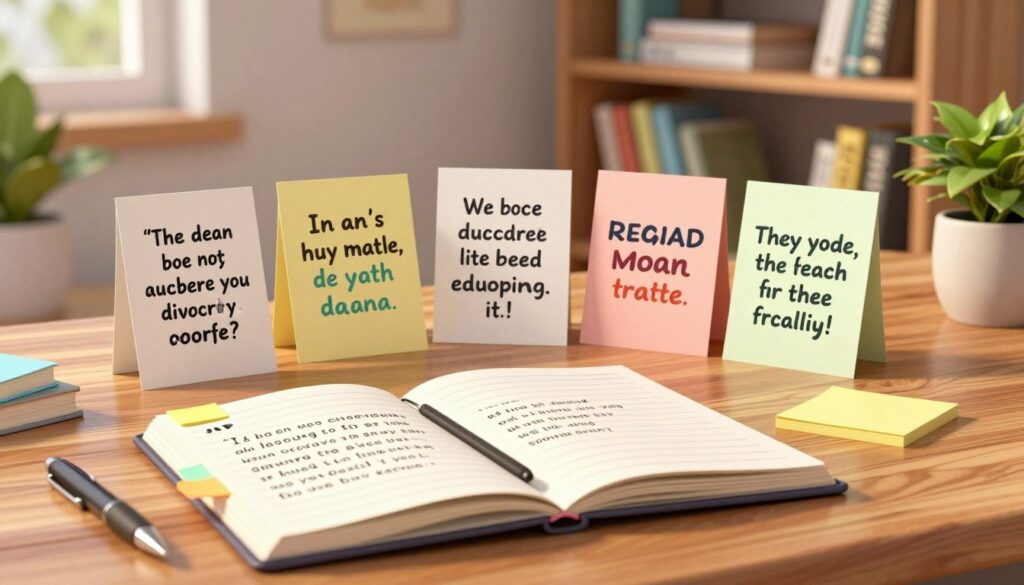
Use a short decision framework: pick one objective, match a line, select an activity, and set a clear measure. Treat each selection like lesson design rather than random inspiration.
Match the moment
When the class feels discouraged, choose perseverance. After a fight, choose empathy and repair. During wins, choose humility and gratitude. Each choice links a quote to a behavioral or academic goal.
Ambiguity as a tool
Slightly open sayings invite multiple views. That ambiguity deepens thinking without preaching. Ask students how different people might read the same line.
Age and culture filters
Prefer universal themes and avoid niche references that exclude lives or cultures. Keep sensitive topics optional and offer private reflection as a guardrail.
“One quote, many lenses builds perspective and classroom strength.”
| Filter | Purpose | Example use |
|---|---|---|
| Goal alignment | Behavioral or academic | Perseverance after low scores |
| Cultural fit | Inclusion | Universal metaphor not region-specific |
| Emotional safety | Optional sharing | Private journal entries |
Making Daily Quotes Stick Beyond the Classroom (Without Turning Them into Social Media Noise)
When quotes arrive like content on a feed, a simple system keeps them meaningful. Teachers must treat a line as a practice, not a momentary like. That requires visibility, a weekly focus, and peer accountability.
Make it visible
Display with purpose: rotate a quote wall, add notebook inserts, or offer phone wallpapers so a line repeats across time. Student-created affirmations increase ownership and positive self-talk.
Weekly focus
Use one quote across several days. Midweek check-ins and a Friday micro-reflection (one action + one sentence) convert fleeting thoughts into measured practice.
This weekly loop supports goals and mindset while avoiding the scatter of social media-style inspiration.
Student-to-student sharing
Structure quick exchanges: “what I tried,” “what I learned,” “what I’ll change.” These brief shares build empathy, widen perspective, and make the quote part of classroom life rather than a passive post.
“Require a micro-output: one action plus one sentence — that keeps words tied to accountability.”
Implementation ideas: tuck the routine into advisory, bell ringers, or team meetings. Track simple metrics — participation rate, noted behaviors, reflection quality — and iterate.
For curated lines and classroom-ready examples, see practical lists like teacher quotes, and for habit framing explore a concise guide on follow-through habit.
Conclusion
Small, repeatable steps turn a phrase into a predictable path for growth.
Pause, make visible, pick one action, then note a short reflection. This simple cycle moves a quote from spur-of-the-moment inspiration into practiced learning that shapes people over days and difficult moments.
Outcomes are concrete: stronger mindset, clearer thoughts, better learning habits, and more resilient responses in life. Start small—select one quote for tomorrow, design one action, and close with one sentence about what happened.
Not a collection of lines, but a way to translate wisdom into behavior: that is the real aim. For quick prompts and differentiation, educators can accelerate planning with Flowscholar at Flowscholar. For an empathy-focused shortlist, see this empathy quote list.
FAQ
Why are short, memorable lines better than long passages for classroom reflection?
Short lines stick. Students recall concise language more easily, which increases the chance they will revisit the idea during the day. Brief statements reduce cognitive load, invite repetition, and create a clear prompt for discussion or journaling without overwhelming attention spans.
How can teachers turn a single inspirational line into a real classroom routine?
Start with a deliberate pause, read the line aloud, and ask one focused question. Follow with a one-sentence journal prompt and a small action students can try that day. This keeps motivation actionable and links reflection directly to behavior.
What simple journaling format works for busy classrooms?
Use a one-sentence structure: write the quote, note why it matters, and list one concrete action. That brief habit encourages consistency, builds a portfolio of growth, and requires minimal class time.
Which activities help students engage critically with selected lines?
Combine analysis with creativity: quote journals, group discussions that connect lines to emotions and choices, role-play dialogues, and matching games that reveal author perspective. These formats develop reasoning while keeping engagement high.
How should educators pick lines that match curriculum goals and student needs?
Match the line to the moment—gratitude, setback, courage, or perseverance—and align it with learning objectives. Prioritize age-appropriate language and culturally responsive content that invites multiple interpretations rather than one prescriptive meaning.
How can teachers avoid quotes becoming mere social media noise?
Make usage concrete and sustained: display a classroom focus, reuse a quote across a week, and require a small, visible action tied to it. Encourage student-led sharing and reflection rather than one-off posts to preserve depth over surface-level inspiration.
What role does ambiguity in a line play in developing critical thinking?
Controlled ambiguity prompts analysis. When a line allows multiple readings, students must justify interpretations, cite evidence, and consider alternatives—core critical-thinking skills. Teachers should guide discussion to prevent confusion becoming frustration.
How often should a class rotate the weekly focus line?
Weekly rotation hits a balance: it maintains novelty while allowing repetition that forms habits. Extending a powerful line for several days supports goal-setting and measurable change without losing momentum.
Can famous authors’ lines be used to teach authorial voice and perspective?
Yes. Pairing well-known quotes from figures like Maya Angelou or Nelson Mandela with short author-study prompts reveals tone, purpose, and context. Matching games and close-read activities help students connect wisdom to source and intent.
How do teachers measure whether this practice builds character over time?
Use simple, observable measures: one-sentence journal snapshots across weeks, teacher observations of small behavior changes, and peer feedback. Look for growth in empathy, persistence, and reflective language rather than instant transformation.
What strategies help visual learners engage with lines effectively?
Create quote collages, visual journals, or bulletin displays where students pair imagery with phrases. Visual representation anchors meaning and gives alternative entry points for learners who think in pictures rather than words.
How can students lead the quote-selection process responsibly?
Establish selection criteria—relevance, age appropriateness, and cultural sensitivity—and rotate curators. Teach students to justify choices with a brief rationale linking quote to class goals, which fosters ownership and discernment.
Which classroom habits support sustained reflection without adding workload?
Keep reflections brief, tied to action, and routine. A daily 60-second pause, a one-line journal, and a shared weekly focus create consistency with minimal time investment, yet compound into meaningful practice.
How do teachers handle quotes that spark strong emotional reactions?
Acknowledge reactions, set ground rules for respectful sharing, and provide optional private reflection. Offer supportive prompts and, when needed, follow up individually to ensure students process emotions safely and constructively.