“You can’t use up creativity. The more you use, the more you have.” — Maya Angelou.
Clarity matters: an effective press release is a concise document that draws media attention and gives families the facts at a glance.
This brief guide sets a single goal: help schools produce a press release journalists can use quickly and that parents understand instantly. It lays out a repeatable framework—headline, dateline, lead with the 5 Ws, supporting body, quotes, clear CTA, boilerplate, and media contact.
Readers will get a copy-and-customize template plus distribution tips to boost coverage and attendance. FlowScholar is introduced here as an Education AI tool that speeds drafting: it tightens headlines, polishes summaries, and preserves school-appropriate tone. A full CTA appears later at https://www.flowscholar.com.
Expect short paragraphs, fast facts, and precise details. The guide covers both pre-event and post-event approaches, and it stresses: avoid vague hype—earn attention with who, what, when, where, why, and a legitimate hook.
Key Takeaways
- Use a strong headline and dateline; lead with the 5 Ws.
- Keep paragraphs short and facts scannable for newsroom time.
- Provide clear contact details and a single call to action.
- Use FlowScholar to speed and refine drafting; CTA later links to flowscholar.com.
- Offer both pre-event and post-event versions to match media needs.
What a School Event Press Release Is and Why It Matters for Media Coverage
A properly formatted event announcement turns school news into usable newsroom content.
Definition and purpose. A school event press release is a formal, publishable announcement written so reporters and editors can convert it into listings, briefs, or features quickly.
Channel comparison. Flyers build on-campus awareness. Social posts spark fast engagement. Press releases are built for third-party pickup and long-term searchability by local outlets and media archives.
When a release makes sense
- New programs, notable guests, or community partnerships;
- Charitable tie-ins, milestones, or events with public relevance;
- When you want third-party validation and archival coverage.
How it helps journalists
Releases reduce newsroom friction by packaging facts, quotes, and context in a predictable format. That predictability lets journalists copy, trim, and publish faster.
“Provide clear date/time/location and registration details—omitting basics is one of the fastest ways to lose coverage.”
| Channel | Best use | Result |
|---|---|---|
| Flyer | On-campus reach | Immediate local engagement |
| Social post | Quick shares and signups | Fast awareness spikes |
| Press release | Third-party pickup and archive | Broader coverage and sponsor interest |
Write journalist-first. Assume the reader knows nothing about your school and use plain English. That professionalism increases the chance of meaningful media coverage and real-world outcomes like higher attendance and community support. FlowScholar can speed drafting while keeping these fundamentals intact.
Choose the Right Event Press Release Type for Your School
Decide on a release type early — public announcements, invitation-only notices, post-event recaps, and staged multi-day updates each serve different goals.
Upcoming open events drive attendance. Use this announcement for fundraisers, performances, STEAM nights, and fairs. Include registration links, date, location, and a simple RSVP line.
Upcoming closed events invite press and influencers. Send targeted invites for ribbon cuttings, VIP visits, or embargoed competitions. Offer press passes and interview windows.
Post-event recaps prove impact. Share attendance numbers, standout quotes, and a curated photo set so outlets can publish after the fact.
Multi-day or recurring events benefit from staged releases: announce, update agenda and speakers, post day-one highlights, then publish a final wrap and save-the-date.
| Type | Best use | Key assets |
|---|---|---|
| Upcoming open | Drive attendance | Registration link, date, schedule |
| Upcoming closed | Invite media | Press passes, embargo notes, interview slots |
| Post-event recap | Document impact | Attendance numbers, quotes, photo set |
| Multi-day/recurring | Ongoing coverage | Staged timeline, daily recaps, save-the-date |
Consistency builds trust: use the same structure across releases so local outlets know what to expect.
Identify the News Hook That Gets Attention
Editors scan dozens of items daily; the right hook makes yours stand out in seconds. A news hook is the exact reason an editor will list your event or write a fuller story.
Priority hooks:
- First-of-its-kind initiatives or new programs with measurable outcomes.
- Recognized guest speakers or industry partners with local draw.
- Documented community impact — service hours, funds raised, or measurable student gains.
Translating value into media language
Frame academic wins as workforce readiness, STEM pathways, arts access, or literacy outcomes. Be specific: name awards, scholarship totals, competition placements, or certification counts.
“Every claim should be backed by a data point, a quote, or a source.”
| Hook Type | What to Provide | Why It Wins Coverage |
|---|---|---|
| First-of-its-kind | Pilot details, partners, measurable goals | Novelty and local relevance |
| Notable guest | Bio, credentials, planned activities | Credibility and audience draw |
| Charitable tie-in | Named beneficiary, fundraising target, how to help | Community impact and clear CTA |
Credibility checklist: cite data, add a succinct quote, and list an attributable source. Avoid slang, hype-heavy words, ALL CAPS, or vague intent statements.
Test your angle: if the headline needs words like exciting or amazing, sharpen the facts. For headline examples that match search intent and editorial needs, see headline examples.
Gather the Essential Event Details Before You Write
Before drafting, collect every factual detail that lets journalists file a usable story without follow-up.

Use this checklist as your pre-writing intake. Missing one W forces reporters to chase answers — and many won’t.
The 5 Ws checklist
- Who: organizing department, student groups, partner nonprofits, sponsors, and notable guests with titles.
- What: format (panel, performance), top activities, and what attendees will see or learn.
- When: day of week, exact date, start/end time, and separate media arrival windows if any.
- Where: full campus address, parking entrance, accessibility notes, and building/room names.
- Why: the news hook — impact, audience, or community relevance.
Ticketing, people, press access, and assets
Include pricing, early-bird deadlines, capacity limits, ID requirements, and a clear registration link (not attachments).
List speakers, student leaders, partners, and sponsor contacts. Note interview opportunities, press passes, and any exclusives.
| Item | Why it matters | Deliverable |
|---|---|---|
| Registration | Prevents confusion and sets expectations | URL, pricing, deadlines |
| Media access | Encourages coverage and clarifies rights | Press pass rules, interview windows |
| Media kit | Speeds accurate reporting | Lightweight link with logos, photos, schedule |
Tip: Provide one contact for press inquiries — name, phone, and email — so outlets can confirm facts quickly.
Write a Strong Headline and Dateline That Match Search Intent
Editors and parents judge headlines in a glance; clarity and keywords win that moment.
The headline serves two roles: it is a media hook and an SEO signal. Make it clear enough for calendar editors while including searchable terms families will type.
Headline formulas that work
- [School Name] Hosts [Event Name] in [City] to Highlight [Theme]
- [Event Name] Brings [Notable Guest/Program] to [School/District]
- [Event Name]: [Short Benefit] — [School Name], [City]
Using keywords naturally
Include the event type (science fair, open house, benefit concert) and the location, but avoid stuffing. Use one clear phrase that matches likely search paths: event name + school name + city + date.
Dateline basics
Place a dateline before the lead: CITY, State — Month Day, Year. This is standard for US releases and signals timeliness.
“Make the title scannable: no jargon, no puns that hide meaning, and no ALL CAPS.”
Micro-checklist: readable title, keyword presence, concise takeaway, correct city/state dateline, and consistent press release template style to speed future drafts.
Craft the Lead Paragraph That Summarizes the Story
The opening must be a single, journalist-ready summary. The ideal lead answers the five Ws in one or two compact sentences so reporters can copy and run with minimal edits.
Fitting the 5 Ws into a tight opening
Use this structure: identify the organizer, name the event, state date/time and location, and give the clear purpose. If the hook is a notable guest or a major student achievement, include it immediately.
Making the purpose clear for your target audience
Tailor the purpose line by audience. Families need simple attendance and access facts. Community partners need relevance and impact. Reporters need the reason it is news.
Be specific, not flashy. Replace vague adjectives with concrete information: “hands-on robotics demos, student showcases, and enrollment resources” says more than “exciting community night.”
“Write one proof point into the opening when available—attendance numbers, years running, or the scope of projects.”
| Lead element | What to include | Example phrase | Why it matters |
|---|---|---|---|
| Organizer | School or department name | Lincoln High School | Establishes source credibility |
| Event basics | Name, date/time, location | STEAM Night — May 5, 6–8 PM, Gym | Enables immediate calendar use |
| Purpose/proof | Clear aim + one data point | Showcases 150 student projects | Gives editors a tangible hook |
Final checks: read the opening aloud, drop jargon, and confirm one contact line is nearby. A tight summary reduces follow-up emails and raises the odds of timely press coverage.
Build the Body Content: Supporting Details, Agenda, and Why It’s News
The body of the press release should translate the lead into usable, time‑stamped details reporters can copy quickly.
Start with what happens: list agenda highlights and exact times so editors can pull calendar items without emailing for clarifications.
- Agenda highlights: 5:30 PM doors open; 6:00 PM student showcase; 7:15 PM keynote by Dr. Maria Lopez, Director of STEM Partnerships.
- Major moments: awards at 6:45 PM; hands-on demos 6–8 PM; press interviews available 5:45–6:15 PM.
Proof points that earn coverage: participation numbers, program growth percentages, scholarship totals, recent competition placements, and partnership outcomes. Name full titles for guests and partners to avoid misattribution.
Micro-storytelling: include one short vignette—student team that built an award-winning robot—and attach the measurable outcome (won regional title, 120 hours community service).
| Body Section | What to include | Why it helps media |
|---|---|---|
| Agenda | Times, locations, speaker names | Quick calendar and cut‑and‑paste copy |
| Proof points | Stats, awards, growth metrics | Credibility and storyhooks |
| Logistics | Parking, press entrance, credential rules | Reduces follow-up and speeds coverage |
“Keep paragraphs short, label facts clearly, and prioritize usable information for press and media outlets.”
For distribution tactics and examples, see this detailed guide that aligns with these content practices.
Add Quotes That Sound Human and Increase Credibility
A well‑placed quote gives your press release emotion and authority. Quotes offer ready‑made lines that reporters can use while adding voices that bring the story to life.
Stack quotes strategically. Aim for one leadership quote (principal), one program quote (teacher or coach), one student quote, and a partner quote when relevant. This mix gives spokespeople, people directly involved, and community partners a chance to explain value from different angles.
Quote prompts that force specificity
- What problem does this event solve for families or students?
- What will visitors see that will surprise them?
- What outcome are students working toward and how is it measured?
Good quotes include tangible details—skills learned, numbers, or community benefit—rather than vague praise. Keep language natural: short sentences, minimal jargon, and a clear point of view.
“Our robotics team built a solar‑powered cart that won the regional fair — it shows hands‑on skills students gain and the community partnerships that support them.”
Student quotes often increase media pickup because they add authenticity and local color. Confirm names, titles, and parental permissions for minors before distribution.
Final tip: Use FlowScholar late in the draft to polish quotes for clarity without losing the speaker’s voice. That preserves human rhythm while improving information and press readiness.
Include Clear Calls to Action and Attendance Info
A concise call to action turns interest into attendance and coverage. Make the CTA the operational heart of your announcement: tell families exactly how to join and tell media exactly how to cover without guessing.
RSVP, registration links, and website placement best practices
Use one primary registration link and place it near the top and again near the end. Keep URLs readable and avoid attachments; link to a single event page that mirrors the release details.
What journalists need: interview requests and media access
Offer explicit media instructions: press credential deadlines, interview windows, arrival time, parking spots, and who will escort reporters on campus. Add: “Media interested in attending or interviewing students/educators should request credentials by [date].”
“Paste the release into an email body and link assets rather than sending large attachments.”
| Action | What to include | Why it matters | Example text |
|---|---|---|---|
| Registration | One URL, ticket price, deadlines | Reduces signup friction | Register at: schoolname.org/event |
| Media access | Credential request, interview windows, escort | Prevents follow-up emails | Request credentials by May 1 via media@email.org |
| Logistics | Parking, check-in, capacity limits | Improves on-site flow | Press enter at Lot B; check in at Gate 2 |
| Assets | Website event page, photo link, contact | Allows verification and pickup | Event page: schoolname.org/event — Contact: media@example.org |
Final tip: a crisp CTA increases both attendance and press pickup because it removes ambiguity for families, outlets, and reporters.
Finish With a Boilerplate and Complete Media Contact Information
Conclude each press release with a two‑to‑four sentence boilerplate that serves as the school’s permanent about paragraph. Keep it factual: mission, grades served, signature programs, community role, and one canonical website link.
Boilerplate guidance
Write the boilerplate so editors can paste it without editing. Avoid vague buzzwords; give concrete programs or outcomes that show impact. Use the same wording across every release to build recognition for the company and its work.
Media contact checklist
- Full name and professional title
- Direct phone and monitored email
- Mailing address and best hours for response
- Secondary contact for day‑of logistics
“Complete contact information prevents delays and improves the odds of timely coverage.”
| Item | What to include | Why it matters |
|---|---|---|
| Boilerplate | Mission, grades, signature programs, website | Brand context for any press pickup |
| Primary contact | Name, title, phone, email, address, hours | Speeds verification and interview scheduling |
| Secondary contact | Name, role, phone | Handles on‑site logistics and urgent requests |
Final note: a clear boilerplate plus precise contact details signals professionalism. Reporters value accuracy; complete information increases repeat coverage and trust.
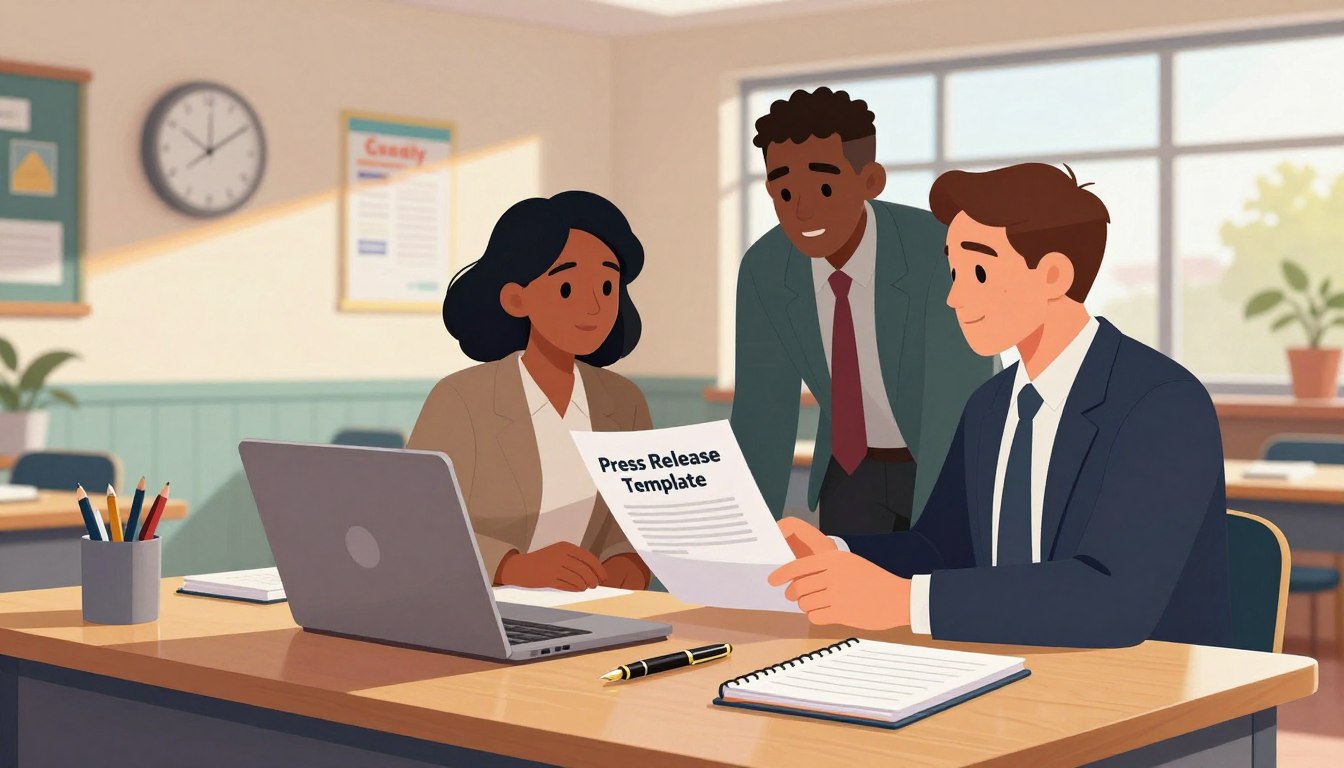
School Event Press Release Template You Can Copy and Customize
Use this fill-in template for a fast, newsroom-ready announcement. Replace bracketed fields, keep sentences short, and confirm every date, time, and location matches the event page.
Fill-in-the-blank press release template
[Headline — include event type + school + city]
[CITY, State — Month Day, Year]
Lead: [Organizer] will host [Event Name] on [Date] at [Location]. The program will [purpose/one proof point].
Body: Agenda highlights: [time — activity]. Proof points: [attendance, awards, partner outcomes]. Logistics: [parking, press entrance, accessibility].
Quote: “[Short quote with outcome or benefit],” said [Name, Title].
Call to action: Register at [URL] — media request: [credentials email] by [date].
Boilerplate: [Two-sentence school description and canonical website]
Media contact: [Name, Title, phone, email]
Optional add-ons
- Schedule block: simple time-stamped list you can paste directly into the release.
- Speaker list: name, title, affiliation — short bios kept to one sentence each.
- Media kit link: single URL to photos, logos, and caption notes (no large attachments).
Example subject lines for emailing outlets
- Media Advisory: [Event Name] at [School] on [Date]
- Calendar Listing: [Event Type] — [School], [City], [Date]
- Photos Available: [Event Name] recap + results
Quick customization tips: swap bracketed fields, keep each sentence under 20 words, and verify times against the event page. Email the announcement as plain text in the message body and include links to the media kit and registration to reduce spam filtering and improve mobile readability.
| Optional Module | Best use | What to include |
|---|---|---|
| Schedule block | Provides immediate calendar copy | Times, short activities, press windows |
| Speaker list | Highlights notable guests | Name, title, one-line bio |
| Media kit | Supports accurate pickup | Single URL with photos, logos, captions |
Tip: place one clear hook in the subject line — notable guest, student achievement, or charitable goal — and keep the phrasing factual and searchable: event type + school + city.
How to Distribute Your Press Release to the Right Journalists and Outlets
Distribution shapes outcomes: a well-targeted outreach often doubles pickup, while a scattershot blast gets ignored.
Start by building a targeted media list based on beat and community. Identify local journalists who cover education, arts, sports, city hall, and neighborhood news. Add community bloggers and calendar editors when relevant.
Segment outreach by event type
Match angle to inbox. Send arts nights to arts editors, STEM competitions to education and tech reporters, and charity drives to community impact writers.
Timing and staged releases
Plan multiple sends: an initial announcement once details are set, an agenda update a few weeks before, a speaker update when confirmed, and a recap within 24–48 hours after. For multi-day events, offer daily recaps with attendance numbers and highlight moments.
Email outreach do’s and don’ts
- Paste the release text into the email body; avoid large attachments.
- Include one clear link to a media kit with photos and captions.
- Use a concise subject line with date and location.
- Limit follow-ups: one brief note within 2–3 business days, then only when there is new information.
“Provide a short photo selection, accurate names and titles, and one direct contact who can respond fast.”
| Step | Why it matters | Action |
|---|---|---|
| Build list | Targets the right outlets | By beat: education, arts, sports, community |
| Segment sends | Increases relevance | Customize pitch by outlet type |
| Staged timing | Keeps momentum | Announcement, agenda, speaker, recap |
| Email best practices | Reduces friction | Paste body, link kit, clear subject |
Use FlowScholar to Draft, Personalize, and Repurpose Your School Press Release Faster
FlowScholar speeds drafting by turning scattered notes into a clear, publishable announcement. It is an education AI tool that keeps facts intact while suggesting tighter headlines, a one‑sentence summary, and a professional tone that matches district voice.
Where AI helps most:
- Generate multiple headline options that include event name and location.
- Tighten the lead into a clean 5‑W summary ready for inbox cut‑and‑paste.
- Smooth tone across quotes and body copy so content reads like the school’s voice.
Use FlowScholar to produce audience variants: one draft for journalists, one for families, and one for sponsors. Each keeps the same facts while changing length, callouts, and links for the target reader.
Repurpose with intention: export the core text as a newsletter blurb, a website announcement, and short social captions that point back to your registration page. AI speeds iteration and keeps messaging consistent across channels.
“AI accelerates drafting and editing, not decision‑making — schools must review for permissions and accuracy before distribution.”
| Step | What FlowScholar does | Outcome |
|---|---|---|
| Input event details | Parses date, location, speakers, assets | Draft with correct facts |
| Generate drafts | Multiple headlines, lead summaries, quote polish | Faster A/B testing for subject lines |
| Export variants | Web copy, newsletter blurb, social captions | Consistent multi-channel content |
| Post-event recap | Create concise summary and photo captions | Quick follow-up coverage and archive |
Workflow (simple): input details → generate draft → refine hook and quotes → export for email and website → publish and create recap. The strategic payoff: faster drafting means more outreach time, better assets, and steady communication across the school calendar.
CTA: Create your school event press release at https://www.flowscholar.com.
Conclusion
,Finish strong: a clear press release that respects reporters’ time wins more pickup than flashy wording. Lead with the hook, answer the five Ws immediately, and include one proof point that reporters can quote.
Make distribution work: target beats, paste the body into email, and link a lightweight media kit. Clean formatting and precise details speed verification and increase local media coverage.
Be operationally disciplined. Confirm dates and one canonical event page, standardize boilerplates and the contact block, and plan an announce–update–recap timeline for longer programs.
Next step: copy the included template, fill the checklist fields, and prep a single media link before outreach. Use FlowScholar for faster drafting, consistent tone, and quick repurposing when deadlines tighten.
Outcome: a press-ready, search-friendly event press release that supports attendance, builds community trust, and improves timely media coverage.
FAQ
What is a school event press release and why does it matter for media coverage?
A school event press release is a concise news notice that communicates an event’s who, what, when, where, and why to journalists and community outlets. It matters because it frames the story, supplies facts and assets reporters need, and increases the chance of earned coverage that reaches parents, local media, and stakeholders.
When should a school choose a press release instead of a flyer or social post?
Use a press release when the event has news value — notable speakers, student achievements, community impact, fundraising milestones, or partnerships. Flyers and social posts work for broad promotion; a release targets reporters and editors who can amplify the story.
How do press releases help journalists cover an event faster?
A well-structured release provides a ready-made story: headline, dateline, lead with the 5 Ws, quotes, supporting facts, and media assets. That saves reporters time and reduces back-and-forth, increasing the likelihood of timely coverage.
What types of school press releases should teams prepare?
Common types include advance announcements to drive attendance, invitation-only notices for press and VIPs, post-event recaps with results and photos, and calendar items for multi-day or recurring programs.
How do you find a news hook that attracts reporters?
Look for firsts, notable guests, measurable impact, student achievements, or community benefits. Emphasize academic value, charitable tie-ins, or partnerships — and avoid fluff, slang, or unsupported claims.
What essential event details must be gathered before writing?
Collect the 5 Ws (who, what, when, where, why), ticketing or registration info, participant names and roles, interview availability and press passes, and media assets such as photos, logos, schedule, and relevant links.
How should headlines and datelines be written for search and editorial clarity?
Use concise formulas that include the event name plus location or theme. Place the city and state in the dateline and include the release date. Use keywords naturally so editors and search find the story without revealing every detail.
What makes an effective lead paragraph?
The lead should fit the 5 Ws into one tight paragraph that explains why the event matters to the target audience. Make the purpose and news angle clear so editors can decide quickly if it’s a fit.
How do you build the body so it supports the news angle?
Use short paragraphs with agenda highlights, attendee experience, proof points (stats, outcomes), and relevance to the community. Add subheads and bullet points for skimmability so reporters can find facts fast.
Who should be quoted in a school press release?
Include human, specific quotes from the principal, teacher lead, student organizer, or a partner representative. Strong quotes explain impact, emotion, or future plans — avoid vague praise.
What calls to action belong in a school release?
Add RSVP or registration links, website pages for tickets or details, and clear instructions for journalists on how to request interviews, press credentials, or photo access.
What belongs in the boilerplate and media contact section?
The boilerplate should be a short school summary: mission, community role, and website. The media contact must include a named person, title, phone number, email, and physical address for follow-up.
Are there ready-to-use templates and examples for school releases?
Yes. Use a fill-in-the-blank release template for announcements, include optional schedule or speaker blocks, and craft subject lines tailored to journalists and local outlets to increase open rates.
How should schools distribute releases to reach the right outlets?
Build a targeted media list by beat and geography, time releases for announcement, speaker reveals, and recaps, and use concise email pitches with links rather than heavy attachments. Follow up politely if needed.
How can an education AI tool speed up press release creation and repurposing?
Tools like FlowScholar can draft headlines, tighten summaries, and adjust tone. They also help repurpose copy for newsletters, website announcements, and social captions while keeping messaging consistent.