
“By failing to prepare, you are preparing to fail.” — Benjamin Franklin.
Collapse here means not a lack of ambition, but a mismatch between goals, available time, and supporting systems. This brief guide frames goal setting as a practical, evidence-informed method for measurable progress.
First, choose aims that match readiness. Then translate those aims into SMART outcomes. Finally, run outcomes through a weekly planning engine that protects focus and momentum—calendar blocks, buffer time, and simple progress tracking.
This approach ties goals to real performance drivers: consistent study behavior, accurate time estimates, and quick recovery from setbacks. It fits U.S. students and high-achieving professionals returning to school who need structure, not extra pressure.
FlowScholar appears as a practical learning layer readers can use to centralize goals, weekly plans, and study resources without adding busywork. Use it as a planner and a light accountability tool as you start this journey.
Key Takeaways
- Define collapse as a systems mismatch, not low ambition.
- Match readiness, set SMART outcomes, then plan weekly.
- Protect focus with calendar blocks and buffer time.
- Track progress and adjust each week for real results.
- FlowScholar can centralize plans and resources without extra work.
Why Academic Goals Collapse and How to Prevent It
Goals often fail when wishful intentions replace clear, observable commitments. Vague intentions like “do better in biology” leave no evidence of progress, so attention drifts and focus fractures across competing priorities.
Specific outcomes turn goal setting into decisions: what deliverable, what standard, and what proof counts. When students name a deliverable, progress becomes measurable and easier to schedule.
Another common failure is overloading a single week. Learners pack study blocks optimistically, then undercount reading, problem sets, and revision time. Missed plans become personal blame instead of a planning error.
Quick fixes
- Use a capacity-first check: list available hours, energy, and real-life constraints.
- Treat motivation as variable—design systems that run when motivation dips.
- Build restart rules and smaller next actions to avoid all-or-nothing avoidance.
“I missed one session, so I might as well skip the week.”
| Common Cause | What Happens | Countermeasure | Outcome |
|---|---|---|---|
| Vague intention | Attention drifts | Define deliverable + evidence | Clear progress |
| Overfilled week | Frequent misses | Estimate hours; plan within capacity | Realistic rhythm |
| Execution friction | Avoidance after setbacks | Prepare materials; schedule short next steps | Faster restarts |
Later sections provide practical countermeasures: choose realistic goals, schedule them like commitments, and track progress weekly to adjust before problems grow.
Use the Stages of Change to Pick Goals You’ll Actually Stick With
Behavior change starts with identifying exactly where study habits break down. The Transtheoretical Model, developed by James Prochaska and Carlo DiClemente in the late 1970s, maps six stages that guide durable change.
Precontemplation and Contemplation
Audit missed deadlines, scattered materials, and uneven attendance. These clues show whether a learner is not ready or is weighing change.
Preparation
Gather syllabus information, exam dates, and resources like tutoring or office hours. Then pick what support will reduce dropout risk and write SMART outcomes.
Action and Maintenance
Move from plan to action with a fixed start ritual and a single next task. Build habits: same start time, weekly planning, and short rewards that protect progress.
Relapse
Treat setbacks as data. Run a quick review: what triggered it, what system failed, and which small restart step rebuilds confidence.
- Quick strategies: stage check, capacity-first steps, and scheduled review for steady progress.
“When change is a system, not a test of will, people recover faster and stay motivated longer.”
Set SMART Goals That Fit Your Academic Life
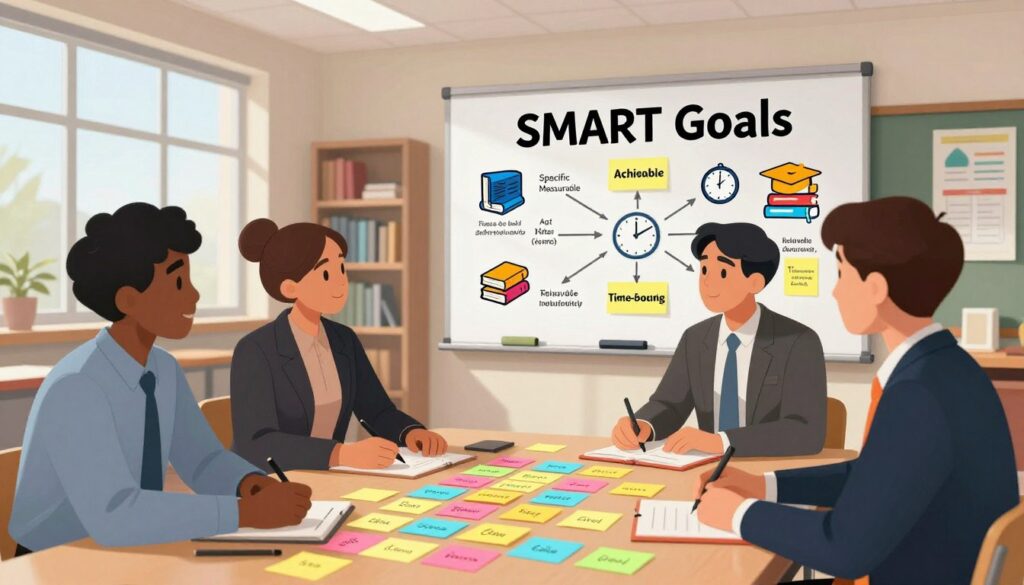
A useful goal names exactly what will change and how progress will be seen each week. SMART goals mean Specific, Measurable, Achievable, Relevant, and Time-based—each lens makes planning practical rather than hopeful.
Specific and measurable
Define success with deliverables: target a quiz score (85%+ on the next two quizzes), complete 20 practice problems per week, or produce a one-page set of review notes after each lecture.
Achievable and relevant
Match targets to current skills, workload, and life demands. A goal that ignores baseline performance or work hours is fragile. Start small: pick the smallest change that moves your grade or confidence.
Time-based planning
Convert a semester aim into month milestones, then weekly tasks. For example: month one — master three core topics; week one — finish two practice sets and review notes twice.
Examples and method
- Maintain scholarship by holding GPA above 3.3 this year with weekly review sessions.
- Prepare for midterms with two spaced-repetition practice sessions per week.
- Use process metrics: study hours completed, practice sets finished, and notes reviewed as early progress signals.
“Monitoring progress increases the likelihood of staying motivated and adjusting approach before problems grow.”
For quick templates and further reading on effective academic planning, see academic goal examples.
The Best Way to Set Academic Goals Using a Weekly Plan
Plan each week as a small project with clear deadlines and single-session tasks. A weekly plan is the collapse-proof bridge between ambition and actual work.
Start with the finish line: map year, semester, or month dates—exams, major assignments, and holiday blocks—so the plan reflects reality.
Break big assignments into one-session tasks
Turn large work into pieces you can finish in one study block: “outline thesis,” “solve 12 practice problems,” or “revise paragraphs 3–5.” Small tasks reduce procrastination.
Use a calendar method
Treat study blocks like appointments: set start and end times, a location, and a clear deliverable. Habit List reminders and calendar alerts keep commitments visible.
Buffer time and pages-per-day
Schedule no-study days and light recovery blocks. For reading, subtract holidays, count available days, then set a pages-per-day target—example: 1,596 pages over ~100 days ≈ 16 pages/day. Missed pages get redistributed so the plan holds.
| Feature | How it works | Benefit |
|---|---|---|
| Finish-line mapping | Mark exams and deadlines on calendar | Realistic month and week planning |
| Session-sized tasks | Break projects into one-block actions | Higher follow-through |
| Pages-per-day rule | Compute available days, set daily target | Predictable steady progress |
For a quick weekly goals template, try this weekly goals template.
Track Progress, Stay Motivated, and Adjust Without Starting Over
Good tracking turns vague effort into clear signals you can act on. Tracking progress converts intention into data. Students then adjust plans without restarting a program.
Simple ways to track progress include calendar reminders for start times, a habit tracker for daily completion, and a short study log that notes task, duration, and outcome quality.
- Reminders prompt start times and reduce procrastination.
- Habit trackers show streaks and gaps in routines.
- Study logs make performance visible—what went well and what needs work.
Weekly review: keep, change, or drop
A weekly review is the decision engine. Keep what reliably produced results. Change blocks that caused friction. Drop tasks that did not move progress.
Missed sessions usually signal one of three fixes: shrink the task, move the block, or gather materials first. Each signal points to a different, practical correction.
Reward small wins and rebuild motivation
Planned, small rewards reinforce action-stage behavior. A short break or a preferred activity after a solid study block restores motivation and reduces the urge to quit after a hard week.
“Progress recorded is progress reinforced.”
How FlowScholar and campus support fit
FlowScholar is an Education AI Tool that centralizes goals, generates study plans, and links learning resources to weekly tasks. Use it to reduce context switching and keep goals aligned with daily work. Try FlowScholar for a streamlined planner and quick reminders: FlowScholar.
If low grades or repeated missed deadlines persist, seek tutoring, coaching, or professor office hours. Many campuses also list formal support and compliance contacts; for example, St. John’s University provides an Office of Equal Opportunity and Compliance for related inquiries.

| Option | How it helps | When to use |
|---|---|---|
| Calendar reminders | Triggers start; reduces delay | When blocks are missed due to forgetfulness |
| Habit tracker | Shows consistency and streaks | When building daily study habits |
| Study log | Records quality and duration | When diagnosing performance gaps |
Practical note: Tracking progress makes adjustments rational, not emotional. For templates on systems over goals, see goals-systems.
Conclusion
A clear finish line and steady weekly actions keep momentum alive. Choose aims that match readiness, translate them into SMART outcomes, then run those outcomes through a weekly plan with short, named tasks.
Vagueness, overcommitment, and all-or-nothing thinking are the usual reasons plans fail. Shrink tasks, protect calendar blocks, and use a quick restart step after a setback instead of blame.
Change works as an iterative process: assess stage, try a small action, track progress, and refine. Use tools like a SMART goals guide and a note on effective planning for templates.
Quick checklist: define the goal, set a measurable target, schedule weekly blocks, track completion, run a weekly review, and adjust rather than quit. For a streamlined way to organize plans and learning resources, explore FlowScholar for focused support.
FAQ
Why do academic goals often collapse within a few weeks?
Goals collapse when they are vague, overloaded, or not tied to daily habits. Students who set broad outcomes—like “do better in class”—skip planning of concrete steps. Overestimating weekly capacity and ignoring buffer time causes missed deadlines. Build clear, time-bound tasks and a habit plan to prevent early drop-off.
How can the stages of change model help pick goals that stick?
The stages—precontemplation, contemplation, preparation, action, maintenance, and relapse—help match goals to current readiness. Use contemplation to identify pain points; preparation to gather resources and craft SMART targets; action to test routines; maintenance to protect habits; and relapse as a learning moment rather than failure. This reduces overwhelm and increases persistence.
What makes a SMART academic goal for a semester?
A SMART goal is specific, measurable, achievable, relevant, and time-based. Example: “Earn a 3.6 GPA this semester by raising my math grade from B- to B+ through two 60-minute weekly practice sessions and biweekly tutor meetings.” It defines success, how progress is measured, and the timeline and supports needed.
How should a student break a big assignment into study sessions?
Start with the deadline and reverse-map milestones: research, outline, first draft, revisions, final proof. Each milestone becomes session-sized tasks—reading one article, drafting 300 words, solving a problem set. Aim for tasks completable in one focused study block to keep momentum and reduce procrastination.
Which calendar method works best for scheduling study time?
Treat study blocks as fixed appointments on a calendar. Use time blocking: assign subjects to consistent slots, include buffer periods, and mark nonwork days. Sync with a digital calendar (Google Calendar or Outlook) and set reminders so study commitments appear as real obligations rather than optional items.
How do you build buffer time and avoid burnout during the semester?
Schedule weekly no-study windows and short daily breaks. Allocate buffer slots after major tasks for unexpected work. Limit daily intense study to sustainable windows (e.g., 3–4 focused blocks). Track workload for a few weeks and reduce load where recurring stress appears.
What is the “pages-per-day” method and when should students use it?
The pages-per-day method divides reading or note-taking into daily targets. For a 300-page textbook over six weeks, set a daily page goal (about 7 pages/day) and pair it with active note practice. Use this for steady progress on large reading lists or cumulative practice problem sets.
Which simple tools help track progress without adding overhead?
Use a habit tracker, a weekly study log, or simple reminders. Tools like Google Sheets, Notion, or a paper planner work; choose what fits habits. Record session length, task completed, and a short note on difficulty—this creates a feedback loop without much admin.
What should a weekly review include?
A weekly review checks completed tasks, missed items, time spent, and emotional energy. Decide what to keep, adjust, or drop. Recalibrate next week’s blocks, set one micro-goal, and note one improvement. This prevents repeating ineffective routines.
How can small rewards sustain motivation through setbacks?
Link rewards to consistent progress—after five focused sessions, take a favorite activity; after a milestone, plan a larger treat. Rewards should be immediate and meaningful yet not undermine goals. They reinforce behavior and shift focus from perfection to steady gains.
When is it time to seek extra support on campus or online?
Seek help when progress stalls for several weeks despite adjustments, when stress impairs functioning, or when content gaps block advancement. Campus tutoring, academic advisors, counseling services, and platforms like Khan Academy or Coursera provide targeted help. Early outreach preserves momentum.
How does FlowScholar help organize goals and study plans?
FlowScholar centralizes goal setting, study calendars, and resource links, turning semester aims into weekly tasks. It offers templates for SMART goals, habit trackers, and progress dashboards so students spend less time planning and more time executing. Integration with calendars and reminders keeps plans active.
What’s the best response after a relapse or major setback?
Treat relapse as data. Review what changed—workload, health, motivation—and identify one manageable adjustment. Restart with a rebuilt routine and a micro-goal for the first week. This reframes setbacks as part of learning rather than a signal to quit.
How often should students update their semester goals?
Revisit goals monthly and after major grading events. Use monthly checks to realign effort with outcomes and weekly reviews to tweak tactics. Frequent adjustments keep goals realistic as life and course demands shift.
What habits most reliably protect academic progress?
Consistent study blocks, short daily reviews, prioritized task lists, and scheduled recovery time form a robust habit mix. Pair these with accountability—study partners or tutors—and regular data collection on time and output to keep progress visible.