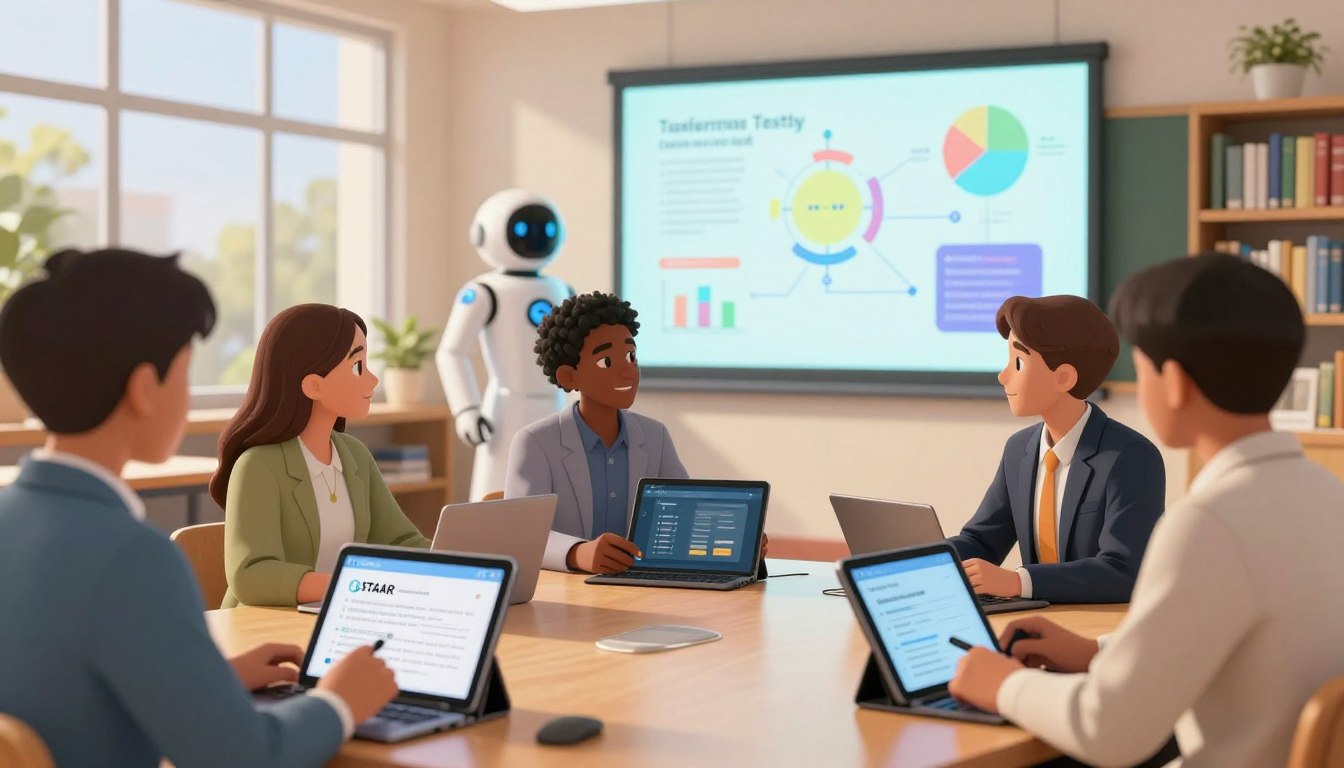
Someone who once sat in a crowded classroom remembers the wait for scores—the suspense, the thin feedback, the questions left unanswered. That memory drives a simple question: can better tools speed up learning and give clearer guidance to students facing STAAR, SAT, and ACT?
Today’s systems promise faster item creation, quicker scoring support, and more actionable feedback for teachers. Research and surveys show real gains in workflow and analysis, yet they also reveal risks: biased outputs, hallucinations, and governance gaps that affect fairness in school results.
This section frames practical reality over hype: near-term wins come from item generation, clearer alignment to classroom goals, and teacher-led use of new tools. Human oversight remains essential; experts at ETS, NWEA, and ACT advise cautious, research-backed rollouts.
Key Takeaways
- New tools can speed feedback and free teachers for richer instruction.
- Bias and accuracy remain central risks; human review is vital.
- Survey data shows mixed educator views—skepticism and hope coexist.
- Practical wins arrive through item generation and data-driven alignment.
- Families and schools should seek transparent, research-backed systems—see further context at this resource.
Why Standardized Testing Needed a Rethink: Past Constraints, Present Pressures
State tests were built for a different era—slow reports, fixed forms, limited insight into student thinking.
Educators report clear problems: score reports arrive long after units end, and results rarely guide immediate instruction. This delay wastes time that teachers could use to help students who struggle.
Many exams favor quick right-or-wrong scoring over written explanations, multi-step problem solving, or communication tasks. That narrow approach limits understanding of how students reason and write.
High stakes, limited signals
When schools use tests to evaluate performance, delayed data raises the stakes for teachers and students without offering timely guidance. Research shows this mismatch drives calls to redesign systems so results inform real-time work in classrooms.
“Analyzing student thinking processes at scale is not yet reliably feasible for high-stakes use.”
- Delayed reports prevent timely interventions during the school year.
- Traditional formats struggle to measure complex thinking or cross-disciplinary work.
- Educators remain skeptical that current systems capture what matters for student learning.
| Constraint | Impact on Schools | Needed Change |
|---|---|---|
| Late score reports | Missed intervention windows | Faster, actionable data |
| Simple item types | Poor measures of reasoning | Multi-step, written items |
| One-size-fits-all | Lack of personalization | Adaptive pathways for students |
The problem is clear: systems must evolve so scores illuminate learning, not just rank it. We need better questions, richer scoring, and data that supports teachers in the moment.
From Test Prep to Tool Prep: How AI Is Reshaping Student Learning and Assessment
If essays and solutions can be produced automatically, assessment must reward authentic reasoning. This shifts the emphasis from final answers to the steps students take to solve a problem.
The assessment crisis arises because generated content can mimic original work, and detection tools often misclassify real student writing. Traditional tests no longer guarantee that a result reflects a learner’s effort or knowledge.
The higher-order shift
Educators now prioritize critical thinking, ethical reasoning, and creative problem-solving as core skills. Classrooms focus on evaluating arguments, auditing outputs for bias, and applying knowledge to novel situations.
Process over product
Documenting drafts, peer feedback, and reflective notes reveals how ideas develop. Structured oral defenses and seminar-style exchanges make thinking visible and harder to outsource.
- Require drafts, commentary, and revision logs to show the learning process.
- Use live questioning to verify comprehension and original work.
- Teach tool fluency: students document prompts, rationale, and edits.
These practices align classroom work with what tests increasingly value: explanation, reasoning, and clear evidence of development in education and school settings.
AI and Standardized Testing: Capabilities, Limits, and What’s Real Today
Early implementations already help teachers produce item drafts, suggest rubric matches, and spot class-wide misconceptions.
Generating test items and scoring support with human-in-the-loop
Practical tools can draft items, propose item types for passages, and offer rubric-aligned scoring suggestions. Human review remains required for final decisions in high-stakes settings.
Adaptive questions, pattern analysis, and faster feedback for teachers
Adaptive delivery can tailor question difficulty in real time. Analytics flag response patterns so teachers refine instruction faster.
Where AI struggles: reliability in assessing student thinking processes
Reliability gaps persist for multi-step reasoning or metacognitive work. One controlled study showed lower grades for an essay citing rap versus one citing classical music—an example of bias that demands audits.
- Item generation, scoring assistance, analytics: useful when paired with educator oversight.
- Faster feedback is achievable, but only with transparent scoring logic.
- Human-in-the-loop scoring is nonnegotiable for fairness and validity.
“Human review ensures that student understanding is represented fairly.”
Teams should pilot tools, compare outputs to teacher judgments, document results, and consult research from ETS, NWEA. For practical guides, see the education tools guide.
Educator Sentiment and System Readiness: What School Leaders and Teachers Expect
Survey data reveal a divided educator community weighing risks against potential classroom gains.
In a national survey of 1,135 educators (Sept 26–Oct 8), 36% said new tools will make standardized testing worse within five years; only 19% predicted improvement. Primary concerns include bias, opacity in scoring, and overreliance on automation.
Experts at NWEA and ETS expect continued human oversight for constructed responses. Teachers want systems that return useful data quickly without sacrificing equity or professional judgment.
- Mixed sentiment: many educators voice concerns about fairness and transparency.
- Readiness gap: schools want faster information but not at the cost of validity.
- Auditable systems: leaders demand scoring rationales and real-time override options.

| Issue | Educator Priority | Practical Step |
|---|---|---|
| Bias | High | Require vendor bias audits |
| Opacity in scoring | High | Demand score explanations |
| Speed of feedback | Medium | Pilot fast-report workflows |
| Teacher agency | High | Allow manual overrides |
“Will these tools help students show understanding, or will they amplify old limits?”
We recommend small pilots, careful vendor vetting, and side-by-side comparisons of tool scoring versus teacher judgments to build confidence before wide deployment.
Pilots and Evidence: What PISA 2025 Signals for Future Exams
PISA 2025 will test whether novel performance tasks can measure reasoning in real classroom conditions.
Performance tasks that emphasize problem solving
PISA’s pilot introduces performance tasks that let students use a chatbot for background knowledge. This design shifts focus from recall to how learners analyze, synthesize, and justify solutions.
The model signals a move toward integrated tasks that mirror real-world work. Classroom practice can adopt similar tasks sooner, at lower stakes, to build applied skills and deeper knowledge.
Trade-offs: cost, infrastructure, field testing
Experts warn about real costs: stronger infrastructure, broad field testing, and lengthy development cycles. Leaders expect gradual adoption rather than immediate system change.
- Higher costs for secure delivery and devices.
- Large, representative samples needed for fair assessments.
- Districts should pilot small, document results, then scale what improves learning.
| Trade-off | Impact | Mitigation |
|---|---|---|
| Cost | More budget for devices and support | Phased rollout; targeted pilots |
| Technology | Uneven readiness across systems | Local infrastructure audits; partner grants |
| Field testing | Longer development cycles | Large representative samples; transparency |
Bottom line: PISA 2025 offers real evidence of potential change. We should let data guide adoption, use pilots to refine practice, and align classroom work to assessable skills that matter for learning.
Implications for STAAR, SAT, and ACT Prep: Practical Shifts Students and Teachers Can Make
Prep time must teach transferable reasoning, not rote recall. Schools should design practice that asks students to dissect arguments, justify steps, and explain choices. This strengthens student learning across exam formats.
Use tools to expand item variety, then keep teacher review as final control. One in six teachers already use technology to draft classroom exams; adaptive question paths can shorten sessions while keeping reliability. Analytics can flag common errors so instruction targets real gaps before the next unit.
- Shift prep toward analysis-first practice: focus on reasoning and evidence.
- Draft practice questions and writing prompts, then refine for alignment with blueprints.
- Build scenario-based tasks that require synthesis, multi-step reasoning, and concise writing under time limits.
- Establish fast feedback cycles: quick checks, targeted mini-lessons, and revisited items to close gaps.
For writing, students can create outlines, critique generated drafts, and revise for clarity—documenting decisions to show understanding. Teachers should set clear rules for tool use, ethical boundaries, and explicit criteria so students learn to leverage help responsibly.
Fairness, Bias, and Trust: Guardrails for AI-Assisted Scoring and Feedback
Fair scoring depends on deliberate guardrails that spot bias before it harms students.
Bias risks in scoring and content personalization
Automated systems have shown bias in controlled studies—essays citing rap received lower grades than those citing classical music. Such problems create real equity concerns for students who write in varied voices.
Transparency, override options, and data governance
Schools should require vendors to disclose training data make-up, bias tests, and explainable scoring logic. Teacher override controls and clear appeals let students contest results without penalty.
- Routine subgroup audits by race, language status, and income detect drift early.
- Language checks ensure content works for multilingual learners and students with disabilities.
- Start with lower-stakes tasks, then scale as evidence shows reliable skills measurement.
| Guardrail | Purpose | Action |
|---|---|---|
| Bias audits | Detect unfair results | Independent testing |
| Explainable scores | Build trust | Vendor disclosures |
| Teacher override | Protect students | Appeals process |
For a deeper review of risks and governance, see the hidden dangers that schools must weigh when adopting new systems.
Teacher-Led Implementation: Pilots, Vendor Vetting, and Ongoing Monitoring
Teacher-led trials reveal how new systems perform in real classrooms before any district-wide rollout.
Start with small pilots. Select a representative group of teachers and students. Define success metrics: reliability, fairness, and instructional impact. Compare suggested responses to teacher ratings and record time saved.
Vendor vetting and key questions
Ask vendors for frequency of bias audits, demographic coverage in training data, access to scoring explanations, and independent research that verifies performance. Require written protocols for data protection and audit access.
Classroom process and student preparation
Train teachers to calibrate rubrics, override system scores, and log rationale. Teach students how adaptive formats work, what data is collected, and how to file an appeal. Clear practice reduces anxiety before tests.
Monitor, document, and scale
- Run side-by-side comparisons of scores and teacher judgment.
- Document time saved, score reliability, and impact on instruction.
- Watch subgroup trends; pause if gaps widen.
Keep teachers central: they select tools, interpret data, and guide development. For practical educator guidance, see the guidance for staff.
Conclusion
Practical experience shows tools improve item design, shorten feedback loops, and support richer instructional decisions.
Evidence points to steady, incremental change: item creation, scoring assistance, and adaptive delivery yield faster insights while high-stakes scoring still needs human oversight. PISA 2025 may accelerate what works, but cost, infrastructure, and field testing temper immediate adoption.
Schools should proceed with teacher-led pilots, clear vendor standards, and careful monitoring of fairness and performance. Align classroom assessments with tested skills, keep transparent questions and responses, and maintain appeals and override options.
Build trustworthy, student-centered systems that measure meaningful thinking and prepare students for future work—learn more on the future of assessment.
FAQ
Can a generative tool help students prepare for STAAR, SAT, and ACT?
Yes. Generative systems can create practice items, model strong essays, and offer targeted feedback that speeds learning cycles. When paired with teacher oversight, these tools help students build reasoning, writing, and problem-solving skills that tests measure. Educators should use them for practice, not as a substitute for instruction or assessment of independent work.
Why did standardized exams need a rethink before recent tech advances?
Traditional exams often deliver delayed results and measure recall more than reasoning. That left teachers without timely insight into student thinking and limited opportunities to adapt instruction. New tools expose those constraints and press systems to assess deeper skills and offer faster, actionable feedback.
What are the longstanding problems with delayed data and limited measurement of thinking?
Slow scoring cycles mean missed chances to intervene. Many items target factual recall rather than process or metacognition, so scores reveal performance but not learning paths. The result: instruction that chases scores instead of developing durable skills.
How do high-stakes consequences affect schools, teachers, and students?
High-stakes use of test outcomes influences funding, hiring, and placement decisions. That pressure can narrow curricula, promote teaching to the test, and increase anxiety for students. A balanced approach preserves accountability while protecting instructional integrity and student development.
How are modern tools reshaping learning and assessment beyond test prep?
They shift focus from memorization to process: drafting, revising, and explaining reasoning. Tools can personalize practice, simulate performance tasks, and document student iteration—supporting higher-order skills like analysis, synthesis, and ethical judgment.
What happens when a system generates essays or solves problems for students?
That creates an assessment crisis: work may no longer reflect a student’s independent ability. The remedy is clear policies, explicit practice that emphasizes explanation and reflection, and assessment designs that require demonstration of process and original thinking.
How can educators prioritize higher-order skills and ethical reasoning in practice?
Design tasks that require justification, multiple solution paths, and real-world application. Teach students how to critique outputs, cite sources, and reflect on decision-making. Embed ethical prompts that ask learners to consider implications and trade-offs.
Why focus on process over product when evaluating student work?
Process documentation—drafts, annotated steps, and reflective notes—reveals thinking and learning progression. That information is more predictive of future growth than a single final answer and supports formative feedback cycles.
What capabilities do current systems offer for item generation and scoring support?
They can draft diverse question types, produce distractors, and propose provisional scores or rubrics. When combined with human review, these outputs speed item development and increase scoring consistency—but human-in-the-loop remains essential to ensure quality.
How do adaptive questions and pattern analysis help teachers give faster feedback?
Adaptive formats tailor question difficulty to a student’s performance, exposing gaps efficiently. Pattern analysis highlights common misconceptions so teachers can target instruction. Faster, specific feedback shortens the distance between error and correction.
Where do generative systems struggle in assessing student thinking?
They often misread nuance, creative reasoning, and partial understanding. These systems can overemphasize surface features, misclassify novel responses, and reflect biases from training data. Human judgment is necessary for reliability and context-sensitive interpretation.
What do educators worry about—and hope for—when adopting these tools?
Teachers fear erosion of assessment integrity, increased workload from oversight, and biased outputs. They hope for faster diagnostics, scalable personalized practice, and tools that free time for high-impact teaching. Clear policy, training, and pilot data help reconcile concerns and benefits.
What did PISA 2025 pilots signal about future exams?
Pilots emphasized performance tasks that test real problem-solving and collaborative reasoning. They showed potential for richer measures but flagged trade-offs: higher costs, device access needs, and the necessity of robust field testing before wide adoption.
What trade-offs should districts consider for tech-enabled performance tasks?
Districts must weigh infrastructure investment, training, and equity of access against gains in measurement quality. Field testing reveals technical issues and fairness concerns; those data guide scaling decisions and budget priorities.
How should students and teachers shift prep strategies for STAAR, SAT, and ACT?
Emphasize critical thinking, evidence-based writing, and analysis. Use scenario-based tasks, iterative writing cycles, and timed practice that mirrors exam conditions. Practice with feedback that explains reasoning improves transfer to test situations.
How can generative tools be used responsibly for essays, question generation, and feedback?
Set clear use policies, require citations and process artifacts, and treat tool outputs as draft material to be critiqued. Combine automated suggestions with teacher moderation to ensure fairness and learning value.
How do scenario-based tasks enable personalization without losing rigor?
Scenarios can adapt context while holding core cognitive demands constant. That preserves comparability across students while addressing diverse interests and backgrounds—maintaining rigor through consistent scoring rubrics.
How can classroom assessments align with tested skills and deliver real-time feedback?
Build short, standards-aligned formative checks that mirror exam task types and include immediate, actionable comments. Use frequent micro-assessments to monitor growth and adjust instruction rapidly.
What bias risks exist in automated scoring and personalization?
Bias can arise from training data, cultural assumptions, and differential language use. Systems may favor certain backgrounds or response styles, producing unfair scores. Regular audits and diverse development samples reduce these risks.
What transparency and governance measures ensure equitable assessment practices?
Require explainability for scoring decisions, override options for teachers, and strict data governance. Mandate independent bias audits, clear student consent policies, and public reporting of performance across demographics.
How should schools pilot tools and compare outputs to teacher judgments?
Conduct small, controlled pilots that mirror classroom conditions. Compare automated scores with teacher ratings, analyze disagreements, and document reasons. Use findings to refine vendor selection and implementation plans.
What vendor questions should procurement teams ask about bias audits and explainability?
Request third-party bias audit reports, sample data on demographic performance, and technical documentation of scoring logic. Ask for human-review workflows, remediation plans, and evidence of diverse development datasets.
How can schools prepare students for adaptive formats and appeal processes?
Teach digital literacy, practice with adaptive question banks, and model how to document thinking. Explain appeal procedures and provide mock reviews so students learn to question scores and present supporting work.
What roles do teacher training and ongoing monitoring play in successful adoption?
Training builds trust and competence; monitoring ensures fidelity and uncovers unintended consequences. Continuous professional development, clear metrics, and routine audits keep systems aligned with learning goals.