There are moments when a product idea feels alive—like it deserves the best chance to grow. Many founders and engineers have sat at that same desk, unsure which tech will protect their time and vision.
This guide speaks to that uncertainty with clear, evidence-based guidance. It shows how a tech stack shapes performance, scalability, and long-term cost. It also explains why proven, “boring” combinations often deliver the most reliable outcomes.
We map budgets, team skills, and compliance into a practical framework that prevents costly pivots. Readers will see how React-to-Supabase fits modern JavaScript approaches while comparing LAMP, ASP.NET, Java, Python, and Ruby on Rails.
The goal: give product leaders a confident path to select the right tech stack for web and app development—grounded in data, real-world uptime, and time-to-market results.
Key Takeaways
- Choosing the right tech stack affects time-to-market and total cost of ownership.
- Proven stacks often win for predictability, maintenance, and talent availability.
- React with Supabase suits rapid JavaScript development and fast MVPs.
- Enterprise projects may favor ASP.NET or Java for compliance and uptime.
- Match budget, team skills, and data needs to avoid mid-project pivots.
What a Tech Stack Is and Why It Matters Today
A deliberate combination of tools defines how fast an idea becomes a dependable application. This section shows the layers that make software run and why those choices shape outcomes.
Frontend, Backend, Database, and Infrastructure at a glance
The tech stack is a layered toolset: frontend for user interface, backend for business logic, database for storing data, and infrastructure to run everything.
Front-end frameworks like React, Angular, or Vue speed interactive web development. Back-end ecosystems — Node.js/Express, Python/Django, Java/Spring Boot — handle APIs and integrations.
Databases (PostgreSQL, MySQL, MongoDB, Redis) decide how data is queried and scaled. Infrastructure — Nginx, Apache, AWS, GCP, CI/CD pipelines — ties the pieces together.
Impact on performance, scalability, and long‑term maintenance
Performance depends on efficient front-end assets and backend concurrency.
Scalability follows database choice and cloud architecture.
Maintenance reflects update cadence, ecosystem maturity, and available talent — all key to predictable costs.
“A clear architecture turns risk into repeatable delivery.”
| Layer | Examples | Primary impact |
|---|---|---|
| Frontend | HTML, CSS, JavaScript; React/Angular/Vue | User experience, load time |
| Backend | Node.js, Python/Django, Java/Spring Boot | API speed, business logic |
| Database | PostgreSQL, MySQL, MongoDB, Redis | Data integrity, query performance |
| Infrastructure | Nginx/Apache, AWS/Azure/GCP, CI/CD | Deployment, uptime, scalability |
- Choose a toolset that matches expected load and team skills.
- Prioritize mature frameworks and proven technologies for long projects.
Buyer’s Guide Foundations: Key Factors for Choosing the Right Tech Stack
Choosing the right tools early saves teams from costly rework and missed deadlines. This buyer’s guide breaks selection into practical factors you can evaluate quickly—scope, people, cost, and risk. Treat the process as a checklist, not a checklist of buzzwords.
Scope, performance expectations, and platform needs
Start by defining the first release: core features, expected traffic, and whether the application targets web, mobile, or both.
Match platform mix to performance goals so the chosen technologies fit the job without overengineering.
Team skills, learning curve, and talent availability
Build around existing strengths: a familiar stack lowers ramp time and cuts risk.
Factor hiring timelines—JavaScript roles tend to fill fastest in the U.S.; .NET and Java can take 3–6 weeks; Python 3–4 weeks.
Cost, licensing, and maintenance over time
Model total cost: licenses, cloud fees, managed services, monitoring, and maintenance add up as you scale.
Use budget guidelines—LAMP for $25K–$75K; .NET/Java for enterprise; MERN-family for startups; Python for data-heavy builds—to set realistic expectations.
Security, compliance, and integration requirements
Bake in security and compliance from day one. Choose technologies with clear defaults and vendor or community support for GDPR, HIPAA, or SOX needs.
Confirm API strategy, CI/CD compatibility, and third-party integrations before committing.
- Define scope and performance first.
- Assess scalability (vertical and horizontal) early.
- Prototype to validate performance and developer velocity.
Stack Choices: A Practical Overview for 2025 and beyond
Practical tech decisions in 2025 favor reliability over novelty when timelines and budgets matter. Teams should weigh hiring speed, ecosystem maturity, and known failure modes. Evidence shows 95% of successful projects used LAMP, ASP.NET, or MEAN, highlighting the value of proven selections.
When “boring” stacks win: proven over trendy
Proven stacks deliver predictable outcomes: faster hiring, mature libraries, and clearer troubleshooting. For budget-focused development, LAMP often cuts hosting costs and accelerates e-commerce or CMS builds.
Matching stacks to use cases: startup, enterprise, AI/data
Enterprises lean on ASP.NET or Java for compliance and deep Microsoft/Java integration. Startups favor MEAN/MERN/MEVN for single-language flows and rapid MVPs—one logistics SaaS launched 40% faster using MERN versus a planned Java build.
Data and AI projects typically center on Python for its libraries and analytics integration. Ruby on Rails can speed prototypes but requires care because hiring pools are tightening. The right tech is the one that maps to constraints: regulations, latency, hiring, and the product roadmap.
“Right-sizing a stack avoids both fragility at scale and wasted engineering effort.”
LAMP Stack for Cost‑Effective Web Applications
LAMP delivers a pragmatic path to stable web applications and faster time to revenue. For many SMBs and content-heavy sites, this combination balances low operating cost with reliable results.
Best use cases: e‑commerce, CMS, budget‑conscious projects
LAMP—Linux, Apache, MySQL, PHP—prioritizes cost efficiency and stability. It fits projects where predictable hosting costs and mature management systems matter most.
Open-source components reduce licensing fees and supply mature plugins for commerce and content. That makes development faster and lowers maintenance risk.
Proven outcomes: uptime, faster loads, and revenue lift
In practice, tuning Apache and MySQL and adopting Laravel conventions produced measurable gains: 99.9% uptime during peak sales, 60% faster page loads, and a six‑figure revenue increase in year one.
“When caching, query optimization, and server configuration are handled correctly, resilience during spikes improves dramatically.”
| Attribute | Why it matters | Typical impact |
|---|---|---|
| Cost | Open-source components lower hosting and license fees | Predictable monthly operating expense |
| Performance | Apache and MySQL tuning; PHP frameworks speed delivery | Faster page loads; better SEO and conversions |
| Community | Large developer pool and mature plugins | Shorter hiring time; easier maintenance |
| Use cases | E‑commerce, CMS, inventory management | Reliable handling of seasonal traffic |
Bottom line: For budget-conscious teams building mission-critical web applications, the lamp stack remains a sensible default. It combines familiar tools, proven technologies, and clear operational patterns to reduce risk and speed time to market.
ASP.NET and the Microsoft Ecosystem for Enterprise Readiness
When mission-critical systems demand strict controls, Microsoft’s ecosystem often becomes the pragmatic center of gravity. ASP.NET Core paired with Azure and SQL Server is purpose-built for enterprise needs. It fits organizations that require strong governance, predictable delivery, and integrated management systems.
Security features, compliance support, and Azure alignment
ASP.NET Core integrates tightly with Azure services, Active Directory, and Microsoft security baselines. That alignment simplifies authentication, secret management, and policy enforcement across many apps.
Built-in controls support SOX, HIPAA, and GDPR through role-based access, encryption standards, and audit trails. SQL Server adds encryption at rest and column-level security for sensitive data.
Performance and reliability improve via runtime optimizations, async patterns, and Azure-managed databases, caching, and observability. One financial platform modernization reported 75% performance gains, 99.9% uptime, and a 50% drop in maintenance costs.
- Vendor-backed tooling and long-term support reduce operational risk and speed incident resolution.
- The Microsoft ecosystem compounds value when Office, Power Platform, and BI integrate with core applications.
“Predictable delivery and simpler audits make this approach a strong fit for regulated business environments.”
Java for Enterprise‑Scale Systems and Stability
When uptime and long-term compatibility matter, Java remains a pragmatic foundation for complex business systems.
Java is an enterprise-proven language with long-term support and strong backward compatibility. Large organizations use it to run core applications that must evolve without breaking the past.
A Fortune 500 supply chain built on Java now manages 500+ locations with 99.99% uptime. That case shows how Java integrates with legacy systems and scales across many sites.
For demanding development needs, the JVM plus Spring Boot, mature ORM, and messaging libraries handle complex transactions and domain logic. Performance tuning and JVM profiling are established practices that reduce risk during peak events.
- Stability and backward compatibility for long-lived applications.
- Robust tooling: build, test, and monitoring across environments.
- Proven scalability patterns—from threads to microservices orchestration.
- Smooth integration with enterprise brokers, databases, and Android ecosystems.
“When governance and longevity matter most, Java offers a conservative, proven path with a vast talent pool.”
In short, Java suits large enterprise development where integration, high throughput, and predictable evolution are priorities.
JavaScript Everywhere: MEAN, MERN, and MEVN for Modern Apps
Modern teams often choose JavaScript end-to-end to speed delivery and cut context switching. One language from client to server simplifies reasoning and reduces handoffs. That improves velocity for web applications and MVPs.
Real‑time apps, SPAs, and rapid MVPs
Real-time features—chat, live dashboards, and notifications—are native to these stacks via WebSockets and event-driven patterns.
A logistics platform using MEAN processed 50,000+ daily transactions and 10,000+ concurrent users. The startup raised $5M and reached 90% user satisfaction.
Angular vs React vs Vue: how to choose
Each framework suits different team needs. The right tech depends on team size, roadmap, and mobile plans.
“JavaScript end-to-end reduces recruiting friction and speeds investor-ready milestones.”
- Angular: opinionated, consistent for large teams.
- React: largest community, strong tooling, easy path to React Native for a mobile app.
- Vue: gentle learning curve; fast prototyping for small teams.
| Framework | Strength | Best fit |
|---|---|---|
| Angular | Structure, enforced patterns | Large teams, complex applications |
| React | Component reuse, ecosystem | Product teams planning mobile apps |
| Vue | Fast ramp, clear syntax | Prototypes and small businesses |
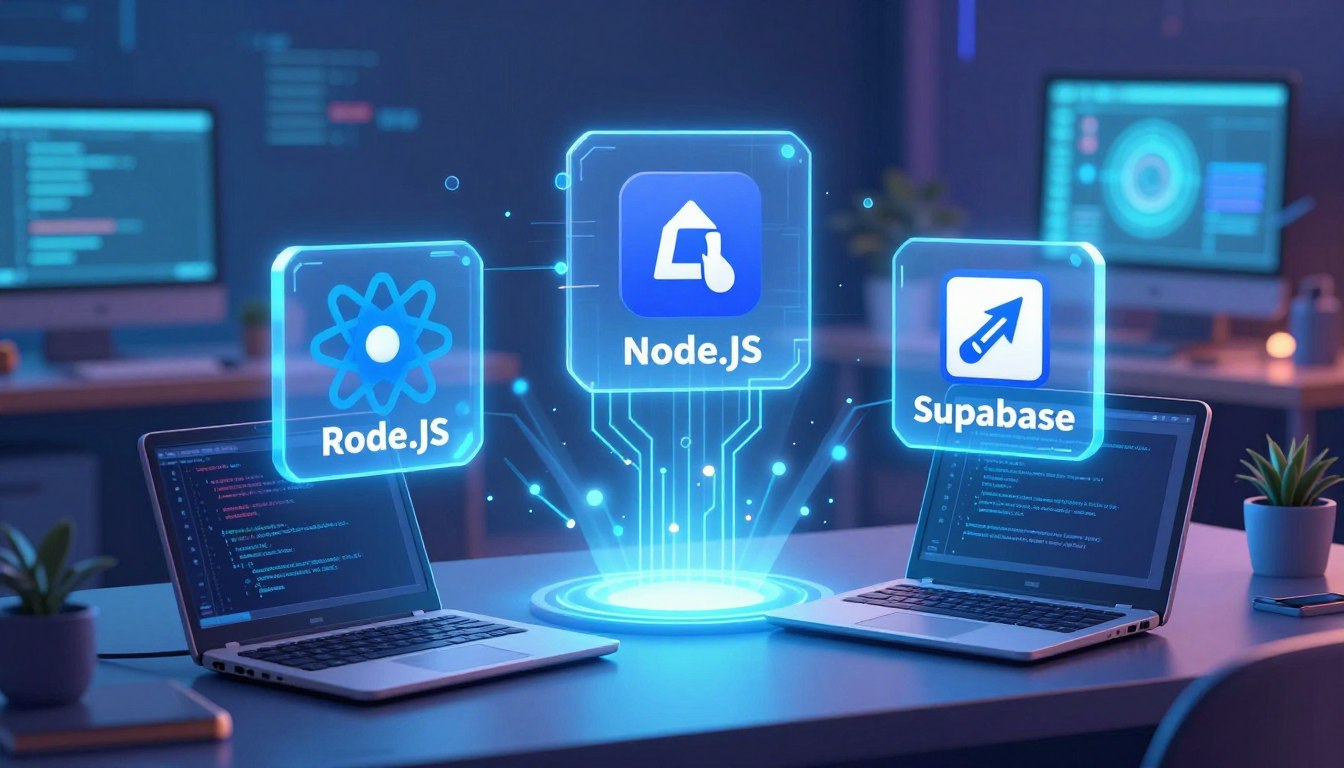
React to Supabase: Modern JavaScript + Postgres‑centric Backends
React paired with a Postgres-first backend reshapes how teams deliver modern web applications. This approach centers SQL power and JSON flexibility while keeping the front end fast and modular.
Where a BaaS fits alongside Node.js, Express, and PostgreSQL
A Backend-as-a-Service (BaaS) can provide ready auth, storage, and real‑time sync over Postgres—cutting weeks from development. Teams often keep Node.js and Express for custom APIs and complex business logic.
- Transactional integrity: Postgres gives reliable transactions and advanced queries for core data.
- Developer velocity: BaaS handles common services so teams focus on product features.
- Hybrid model: Use BaaS for commodity services and Node/Express microservices for performance-critical paths.
Trade‑offs: developer velocity, control, and scalability
Trade-offs matter: vendor-managed features speed early delivery but reduce low-level control and can introduce vendor lock-in.
Cost predictability typically improves at first; later you must plan capacity and pricing tiers carefully.
Security depends on configuration: set auth rules, row-level security, and secrets management correctly when mixing services.
“A clear migration plan protects long-term control while letting teams enjoy early speed.”
Python Stacks for AI/ML and Data‑Heavy Applications
For applications centered on machine learning and analytics, Python’s ecosystem shortens the path to value.
Python leads AI and data development with TensorFlow, PyTorch, scikit‑learn, Pandas, and NumPy. These libraries speed model training, inference, and pipeline orchestration.
Django and Flask serve models and dashboards securely. Teams often pair them with PostgreSQL to keep transactional integrity and analytics in one place.
- Python’s AI/ML ecosystem accelerates data science workflows from exploration to production.
- Django/Flask deliver robust backends for serving models and analytics at scale.
- Pandas and NumPy shorten the path from data exploration to API-driven dashboards.
- Performance improves with vectorized ops, C-extensions, and service decomposition.
- Integrates with warehouses and streaming platforms for batch and near real‑time apps.
“A Python-powered platform cut support tickets by 70% and returned ROI in six months.”
Teams can prototype complex algorithms fast, validate impact, then harden services for production. For web applications that lean on analytics, this tech stack balances developer velocity, maintainability, and measurable business value.
Ruby on Rails: Rapid Prototyping with Hiring Caveats
Ruby on Rails remains a powerful accelerator for teams that need to move from idea to a working product quickly.
Its convention-over-configuration approach and generator tooling reduce boilerplate and speed feature delivery. That clarity helps teams ship prototypes and content-heavy applications fast.
Yet adoption of ruby rails has softened in recent years. Specialized talent is harder to hire and often costs more. For new projects, many organizations weigh python or JavaScript stacks instead to improve hiring velocity.
Maintenance for existing Rails systems still makes sense. When domain knowledge sits with an established team, supporting legacy applications is practical and cost-effective.
“Where specific gems deliver unique value, Rails can outpace alternatives in the first iterations.”
- Rails speeds MVPs and content-driven sites through strong conventions.
- Plan staffing and a clear roadmap if choosing Rails for a new build.
- Design service boundaries and migration blueprints to reduce future friction.
| Factor | When Rails excels | Consideration |
|---|---|---|
| Velocity | Rapid prototypes, CMS, editorial apps | Fast initial delivery; fewer lines of code |
| Talent | Existing Rails teams | Hiring pool has narrowed; salaries trend higher |
| Long-term | Legacy app maintenance | Plan migrations or service splits for future flexibility |
Security Features, Compliance, and Governance by Design
Security should be part of design, not an afterthought during launch. Teams that bake controls into architecture reduce risk and speed approvals.
Built‑in protections across frameworks and cloud services
Prioritize frameworks with secure defaults: CSRF protection, input validation, parameterized queries, and auth scaffolding close common attack vectors.
Enterprise environments gain extra value from ASP.NET and Azure alignment. Role-based access, policy enforcement, and audit-ready controls simplify compliance for SOX, HIPAA, and GDPR.
- Encrypt data in transit and at rest; use managed keys and cloud KMS for secret rotation.
- Adopt least privilege across APIs, services, and databases to reduce blast radius.
- Embed automated checks in CI/CD: dependency scanning, policy gates, and continuous audit trails.
- Standardize logging and monitoring for fast anomaly detection and incident response.
“Governance by design keeps velocity high while ensuring security is an enabler — not a late-stage blocker.”
For web applications handling payments or personal data, map data flows and apply role controls at each touchpoint. When security is built into the tech stack and delivery pipeline, development teams can move faster with confidence.
DevOps, CI/CD, and Cloud Infrastructure Considerations
Continuous delivery practices make hard problems visible early, shortening feedback loops and preventing surprises.
A reliable release pipeline is non‑negotiable. Automate build, test, and deploy with Jenkins, Travis CI, or CircleCI to raise quality and reduce cycle time. Align CI with security gates so the main branch stays deployable.
Choose infrastructure primitives that match the chosen tech stack: containers on managed Kubernetes for microservices; serverless for event-driven flows. Use AWS, Azure, or GCP services to offload databases, caches, and queues and cut operational toil.
- Keep environment parity across dev, staging, and production to remove drift.
- Right-size environments and run load tests early to validate capacity and performance SLOs.
- Centralize logs, metrics, and traces for fast root‑cause analysis.
| Component | Examples | Impact |
|---|---|---|
| Servers | Apache, Nginx, Tomcat, Node.js | Serving and routing application traffic |
| Cloud | AWS, Azure, GCP | Managed services, scalability, cost controls |
| CI/CD | Jenkins, Travis CI, CircleCI | Automated delivery and compliance checks |
Plan realistic milestones: MEAN/MERN MVPs often finish in 2–3 months; LAMP 3–4; Python 4–6; ASP.NET 4–5; Java 5–6. Match delivery time to team size and the chosen software tools to avoid rushed ops work.
“Automate early, observe constantly, and right‑size resources — that triad preserves velocity and reliability.”
Mobile App Stack Decisions: Native iOS/Android vs Cross‑Platform
Mobile projects require aligning hardware access with team velocity and product goals. Choosing the right tech stack early reduces risk and clarifies trade-offs for UX, performance, and delivery.
Native platforms: Swift/SwiftUI and Kotlin/Jetpack Compose
Native iOS and Android deliver full hardware access and tailored UI. Swift with SwiftUI and Kotlin with Jetpack Compose enable high-performance graphics, sensors, and bespoke animations.
Choose native when the product depends on camera, low-latency audio, or advanced background tasks. Native also eases certification and platform-specific optimizations.
Cross‑platform frameworks: React Native and Flutter
React Native and Flutter speed development with shared codebases. They often meet requirements for messaging, social apps, and most MVPs.
React Native pairs well with a React web codebase. For Kotlin-centric teams, consider Kotlin Multiplatform to share logic across mobile and web.
- Hybrid approach: combine cross-platform core with native modules for fidelity.
- Assess team skills, offline needs, and background work before committing.
- Plan mobile CI/CD, app store workflows, and unified analytics early.
“A hybrid model protects velocity while preserving platform-grade experiences.”
| Platform | Strength | Best fit | Drawback |
|---|---|---|---|
| Native iOS (Swift/SwiftUI) | Smooth animations, full Apple APIs | Graphics-heavy, sensor-rich apps | Longer parallel development |
| Native Android (Kotlin/Compose) | Deep hardware access, modern UI | Platform-optimized apps | Separate codebase from iOS |
| React Native | Shared JS code, web synergy | Messaging, social, fast MVPs | Native bridges for some APIs |
| Flutter | Consistent UI via rendering engine | Design‑driven parity across devices | Larger binary size; platform APIs via plugins |
Bottom line: Match the development plan to product goals. For deep hardware integration, pick native. For speed and shared logic, choose cross-platform or a hybrid approach. That way the team ships faster while keeping options to evolve the application.
Serverless and Event‑Driven Options for Lean App Development
For lean teams, moving routine workloads to managed functions speeds time-to-value without adding ops overhead. Serverless platforms let engineers focus on business logic instead of patching and scaling servers.
Event-driven architectures pair well with microservices. They create loosely coupled services that scale horizontally for bursty traffic and async jobs. Typical uses include real-time chat, image processing, and micro-APIs for lightweight endpoints.
Cost often aligns with usage, but discipline matters: uncontrolled functions create sprawl and cold-start surprises. Observability and tracing are essential to follow flows and debug distributed services; instrument metrics and traces from the start.
Security must be explicit—permissions, secrets, and network policies cannot be implicit. Combining serverless with managed databases and messaging produces robust backends with minimal ops.
- Offloads infrastructure so teams accelerate development.
- Good fit for spiky workloads, background tasks, and small API endpoints.
- Prototype quickly, then formalize boundaries, SLAs, and cost controls.
“Start serverless to move fast; then apply structure so the architecture scales predictably.”
Explore practical options like AWS serverless when evaluating your next tech stack for product work.
Decision Framework: Choosing the Right Tech for Your Project
A practical decision framework helps teams convert product goals into actionable technology plans. Use a short, transparent process to align budget, timeline, and talent before committing to a long build.
Budget and project path
Budget guides tech selection. For $25K–$75K, the lamp stack maximizes features per dollar and fits CMS or e‑commerce projects.
Startups aiming for rapid MVPs should plan $50K–$150K and consider MEAN/MERN/MEVN for fast iteration. For AI/data work, budget $75K–$200K and favor Python for its libraries and prototyping speed.
Enterprises should expect $100K+ and lean toward ASP.NET or Java for governance, support, and security features.
Talent market realities in the United States
Hiring speed affects time-to-market. JavaScript developers are the most available; React/Node roles often fill in 2–3 weeks.
PHP/LAMP hires are common and fast; Python and Java take longer—plan 3–6 weeks. Elizabeth R., HR Director at a fintech client, notes:
“JavaScript developers are still the easiest to find and onboard quickly.”
A practical selection method
Score options across key factors: scope, performance, team skills, integration, cost, and time.
- Weight each factor for your business goals.
- Run a 2–4 week validation sprint to de‑risk assumptions.
- Pick a hybrid model: managed services for commodity work and custom services for critical paths.
Bottom line: Use a weighted scorecard and a short validation cycle to choose tech that matches budget, talent, and long‑term support needs. That approach reduces risk and speeds confident execution.
Conclusion
Deciding technology is a strategic move that shapes product speed, cost, and long-term resilience. Use a short scorecard to make the right tech stack decision and keep the process focused on goals, not trends. Practical, evidence-based tech selection guide links real outcomes to a repeatable approach for choosing right.
Favor mature options where maintenance and predictable delivery matter. Proven stack patterns—LAMP for commerce, ASP.NET for regulated systems, JavaScript stacks for fast MVPs—give measurable wins in uptime and performance. For UI and frontend work, the frontend vibe primer shows how integrations speed development and polish.
Finally, codify assumptions with a validation sprint, monitor usage, and evolve components as your application and user needs grow. That discipline turns a one-time choice into durable value for the business and the user.
FAQ
What does "Best Tech Stack for Vibe Coding: From React to Supabase" mean?
It frames a practical approach to building modern web apps: using React for frontend interactivity and Supabase as a Postgres‑centric backend platform. The phrase signals a focus on developer velocity, real‑time features, and scalable hosted services.
What is a tech stack and why does it matter today?
A tech stack is the set of technologies used to build and run an application—frontend, backend, database, and infrastructure. The right combination affects performance, scalability, security, and total cost of ownership, so choosing deliberately reduces future rework and technical debt.
How do frontend, backend, database, and infrastructure interact?
Frontend handles the user interface, the backend implements business logic and APIs, the database stores persistent data, and infrastructure provides hosting, networking, and CI/CD. Each layer must match the app’s needs for latency, consistency, and throughput.
How does the tech stack impact performance and long‑term maintenance?
Choices influence response times, concurrency limits, and how easily teams update features. Mature frameworks and well‑documented databases reduce maintenance overhead; conversely, niche tools may increase costs for hiring and long‑term support.
What key factors should guide a buyer when choosing a tech stack?
Evaluate scope and platform targets, expected traffic and performance needs, team skills and ramp time, licensing and operational costs, plus security and integration requirements. Prioritize the factors that matter most to business outcomes.
How should team skills and talent availability influence the decision?
Favor technologies your team already knows or can learn quickly. Popular ecosystems—JavaScript, Python, Java—offer larger talent pools in the United States and lower hiring friction compared with niche languages.
How do cost, licensing, and maintenance factor into stack selection?
Consider hosting, support, third‑party services, and developer productivity. Open source stacks can lower license fees but may add maintenance work; managed platforms reduce ops burden but add recurring costs.
What security and compliance elements should be evaluated up front?
Check built‑in protections, encryption at rest/in transit, role‑based access, audit logging, and third‑party certifications like SOC 2 or HIPAA if needed. Early alignment prevents expensive retrofits.
When is it better to choose a "boring" proven stack over a trendy one?
For mission‑critical systems, regulated industries, or long product lifecycles, proven stacks win. They deliver predictable performance, mature tooling, and easier hiring—important for enterprise readiness and uptime.
How do you match a stack to a use case—startup, enterprise, or AI/data?
For startups/MVPs choose stacks that maximize speed to market, such as React + Node or Rails. Enterprises need scalability and compliance—Java, .NET, or Azure ecosystems often fit. Data‑heavy and AI projects favor Python, specialized libraries, and robust data platforms.
Is the LAMP stack still a viable choice?
Yes. LAMP remains cost‑effective for e‑commerce, content management, and budget‑conscious projects. It’s proven for uptime and fast page loads when properly optimized and can deliver solid ROI for many web apps.
Why choose ASP.NET and the Microsoft ecosystem for enterprise projects?
ASP.NET integrates tightly with Azure, offers strong security features, and supports enterprise compliance needs. It benefits organizations already invested in Microsoft tooling and identity systems.
When is Java the right choice for a system?
Java is ideal for large, enterprise‑scale systems that demand stability, high concurrency, and long lifecycles. Its mature ecosystem supports complex integrations and predictable performance at scale.
What are the advantages of JavaScript‑centric stacks like MEAN, MERN, or MEVN?
JavaScript everywhere streamlines full‑stack development, accelerates MVPs, and supports real‑time apps and single‑page applications. It improves developer productivity by using a single language across layers.
How to choose between Angular, React, and Vue?
Choose based on app complexity and team expertise. React excels at composable UIs and a vast ecosystem; Angular offers structure for large teams; Vue is approachable with gentle learning curve. Consider community support and hiring availability.
Where does Supabase fit alongside Node.js, Express, and PostgreSQL?
Supabase provides backend as a service built on Postgres, adding auth, real‑time sync, and storage. Pairing it with Node.js/Express offloads common backend plumbing, boosting developer velocity while retaining SQL control.
What trade‑offs come with using BaaS platforms like Supabase?
BaaS speeds development and reduces ops work but limits low‑level control and can create vendor coupling. Plan for exportability and scaling limits when adopting hosted services.
When should teams choose Python stacks for AI and data work?
Use Python when heavy ML, data science, or analytics are core. The ecosystem—TensorFlow, PyTorch, pandas—provides best‑in‑class libraries and community support for model development and data pipelines.
What are the pros and cons of Ruby on Rails for prototyping?
Rails offers rapid prototyping, convention over configuration, and a developer‑friendly experience. However, hiring can be harder in some markets, and performance or scaling may require additional engineering effort as apps grow.
How should teams integrate security, compliance, and governance by design?
Embed threat modeling, secure defaults, encryption, and role‑based access from day one. Use frameworks and cloud services that provide built‑in protections and audit trails to simplify compliance.
What DevOps and CI/CD considerations matter most?
Automate testing, building, and deployment pipelines; use infrastructure as code; monitor performance and alerts. A mature CI/CD practice reduces release risk and speeds iterative delivery.
How to decide between native and cross‑platform mobile approaches?
Choose native Swift/SwiftUI or Kotlin/Jetpack Compose for device‑specific performance and UX. Opt for React Native or Flutter for faster cross‑platform development and shared codebases when time and budget are constrained.
When are serverless and event‑driven models appropriate?
Serverless fits highly variable workloads and lean teams—reducing ops and cost for intermittent traffic. Event‑driven architectures are ideal for asynchronous workflows and microservices that scale independently.
What decision framework helps choose the right tech for a project?
Map requirements to budget, expected traffic, compliance, and time to market. Follow tailored paths for enterprise, startup/MVP, and AI/data projects, and validate choices against talent availability in the United States.