
There are moments when an idea feels like weather: impossible to ignore and quick to change. Many founders remember the first time a simple prompt turned into a working app. That feeling — sudden, hopeful, and urgent — is the start of a new path.
The term vibe coding, coined by andrej karpathy in early 2025, names a shift: people now “see stuff, say stuff, run stuff.” This conversational workflow uses AI to generate functional code from plain language. It compresses time from idea to product and reshapes how teams approach software development.
Readers will learn how this approach repositions coding as a strategic conversation with AI, and how disciplined review keeps quality high. The guide previews two layers: tight code-level iteration and the broader lifecycle that ends with one-click deployment on platforms like Cloud Run.
Key Takeaways
- Vibe coding reframes coding as a guided dialogue with AI to speed ideation and delivery.
- Understanding the term’s origin helps founders act with clarity and timing.
- Two layers—code loop and application lifecycle—set expectations for control and speed.
- One-click deployment streamlines distribution so teams can focus on product and pricing.
- Disciplined testing and ownership turn fast experiments into defensible revenue.
What Is Vibe Coding and Why It Matters Right Now
Plain-language prompts now convert intent into functioning apps, shifting the user’s role from typing syntax to guiding and testing results.
Vibe coding refers to using natural language so AI generates code and prototypes. The term, popularized by Andrej Karpathy in early 2025, spans two modes: quick exploration where users accept outputs as-is, and a responsible approach where humans review, test, and own the final artifact.
The method matters because it compresses time-to-first-prototype. Teams deliver interactive demos faster, gather user feedback sooner, and reduce early costs. Web tools such as Google AI Studio and Firebase Studio speed generation and deployment, while IDE assistants like Gemini Code Assist embed helpers into the professional workflow.
- Describe outcomes in plain language; AI produces the implementation.
- Two practical modes: rapid exploration and reviewed deliverables.
- Blends with traditional programming—use prompt-driven speed for prototyping, engineering rigor for production.
| Characteristic | Rapid prototyping | Responsible delivery |
|---|---|---|
| Role | User guides and accepts output | Developer reviews and tests |
| Risk | Low (experiments) | Higher (production needs governance) |
| Tools | Web builders, one-click deploy | IDE assistants, CI tests |
For teams that want to see examples, explore a short primer on design and process at vibe-coding design principles. The key takeaway: when applied with clear ownership, testing standards, and strategic intent, this way of working becomes a measurable operational advantage.
Core Concepts: From Natural Language to Deployed Apps
A simple prompt can seed an app: the challenge is turning that seed into tested, deployable code. This section explains the spectrum of approaches, how modern models convert plain language into scaffolds, and where human oversight remains essential.
Two practical modes
Pure exploration privileges speed and accepts imperfect output for ideation. Teams iterate fast, learn quickly, and prune ideas with low cost.
Responsible development adds review, test coverage, and maintainability. This mode trades some speed for predictable quality and production readiness.
How language models translate intent
Modern models map prompts to working code by producing scaffolds and components. The practical skill for developers is shaping prompts, setting clear constraints, and enforcing acceptance criteria during each generation pass.
The autonomy slider
Workflows run from human-in-the-loop prompting to agentic systems that coordinate multiple sub-agents for tasks like unit tests and fixes. Agentic platforms can speed throughput, but humans set scope and accept final artifacts.
- Tight loop: prompt → generate → run → observe → refine for rapid convergence.
- Lifecycle checkpoints: blueprint review, security validation, and one-click deploy to managed runtimes (see a Cloud Run primer at what is vibe coding).
- Developer control: specify constraints, verify outputs, and escalate to manual refactor when needed.
When teams combine conversational inputs with disciplined validation, they get deployable software faster—without sacrificing standards.
Designing a Profitable Vibe Coding Business
Founders who monetize rapid prototypes win by linking experiments directly to paying customers. This requires a clear offer, short delivery cycles, and measurable outcomes that matter to users and investors.
Start with three commercial paths: productized apps on subscription, bespoke internal tools, and packaged services for fast validation. Each path maps to different sales motions and margins.
- Productized apps: recurring revenue and predictable growth.
- Custom tools: solve ops bottlenecks and justify higher fees.
- Packaged services: short sprints that validate demand and convert to retainers.
Target high-leverage niches: internal workflow automation, investor-ready demos, and targeted prototypes that unlock early customer feedback. Price against outcomes—time saved, revenue enabled, or risk reduced.
| Offer | Ideal Buyer | Impact |
|---|---|---|
| Productized app | SMB teams | Recurring revenue |
| Custom tool | Ops / Sales | Efficiency gains |
| Prototype service | Founders / Investors | Fast validation |
Operational discipline matters: triage requests, qualify by impact, and run short sprints with human review, basic tests, and a clear handoff. For tactical guidance, see tips for startups.
Tooling Stack and Platforms to Build Faster
A practical stack combines rapid prototyping tools with IDE-integrated assistants to move ideas into production fast. This section maps which platform handles ideation, refinement, and deployment so teams reduce handoffs and rework.
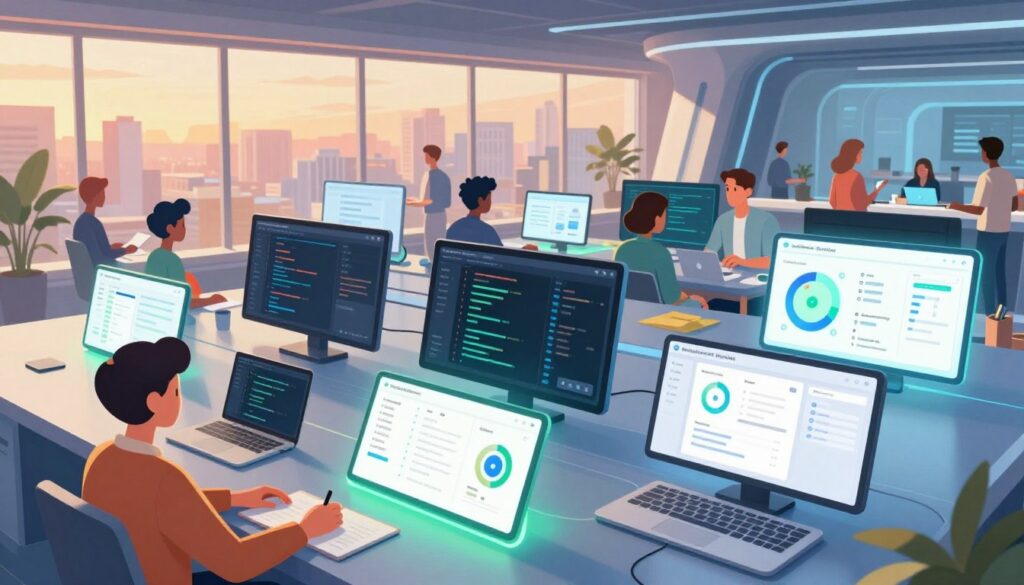
Google AI Studio
Rapid web app generation: describe the app, review a live preview, iterate with prompts, and use one-click Deploy to Cloud Run. AI Studio is ideal for early prototypes that need visible results fast.
Firebase Studio
Firebase Studio adds a blueprint step: feature lists, auth, and database design before prototyping. It publishes production-ready apps to Cloud Run and is suited for applications that require stable backends and scaling.
Gemini Code Assist
Inside VS Code or JetBrains, Gemini generates code, refactors, and writes unit tests. Professionals use it to raise quality and keep generated code maintainable within familiar development environments.
Agentic Platforms
Replit Agent coordinates sub-agents to build, review, and fix programs. Pair agentic builders with IDE tools to parallelize tasks and shorten cycles while preserving human review.
- Practical stack: AI Studio → Firebase Studio → Gemini for polish.
- Document tool ownership, enforce acceptance tests, and keep small pull requests for generated code.
- Deploy to Cloud Run to publish containerized apps with minimal ops overhead.
For a structured workflow example, see a concise guide at structured workflow for vibe coding full‑stack.
From Idea to Launch: A Repeatable Vibe Coding Workflow
A repeatable workflow turns scattered ideas into reliable, testable prototypes fast.
Start with a crisp problem statement and a short prompt that defines success criteria and constraints before any code is generated. This single step frames the entire process and keeps the team aligned.
The tight code-level loop
The loop is simple: prompt, generate, run, observe, refine. Each pass should include objective feedback tied to expected behavior.
Write a minimal test or validation check, run it, and treat the outcome as data. Adjust prompts or small code changes rather than rewriting large sections.
The application lifecycle
Scale the loop into a lifecycle: ideation in AI Studio or Firebase Studio, generation of UI and backend, iterative refinement through prompts, human validation for security and correctness, and one-click deployment to Cloud Run.
| Phase | Goal | Key Metric |
|---|---|---|
| Ideation | Define scope & success | Time to prototype |
| Generation | Produce working code | Pass rate of basic tests |
| Refinement | Improve behavior with feedback | User task completion |
| Validation | Security & correctness | Error rate |
| Deployment | Ship and measure | Usage / retention |
- Use tools deliberately: AI Studio for fast demos, Firebase Studio for production structure, and IDE assistants for code clarity and tests.
- Document the structure of prompts and feedback loops in a playbook so teams repeat success across new ideas.
Enterprise-Readiness: Governance, Security, and Long-Term Viability
Large organizations face unique risks when casual prototypes become mission-critical software.
Accountability starts with defined roles: who approves, who reviews, and who maintains production applications. Clear ownership makes incidents traceable and fixes auditable.
Security, compliance, and accountability for business-critical apps
Enforce permissions and logging: role-based access control and audit trails reduce misuse and meet compliance needs.
Data policies must apply across development and production environments. Add automated checks into the deployment process.
Scaling concerns: performance, integrations, and hidden technical debt
Generated code can hide technical debt. Run static analysis, profiling, and regression tests early to catch brittle patterns.
Integrations fail under load when schemas or auth flows differ. Validate end-to-end paths with realistic traffic before wide rollout.
No-code vs prompt-driven approaches: transparency, maintainability, and control
No-code platforms provide visual structure and governance. Prompt-driven generation offers speed but can obscure implementation details.
The pragmatic way blends both: adopt structured platforms and a documented promotion process—separate environments, change management, and clear rollback steps—to protect mission-critical operations.
- Define approval gates and maintenance owners.
- Enforce RBAC, audit logs, and data handling rules.
- Adopt static tools and performance monitoring early.
- Train users and developers on safe automation boundaries.
Capital Strategy and Investor Readiness for a Vibe Coding Business
Founders must update capital plans to reflect a shift from payroll to usage-driven costs. AI inference and monitoring become recurring expenses as apps gain users. That changes how runway is measured and managed.
Plan for three cost buckets: model inference, observability, and transition engineering. Inference costs rise with traffic; observability spend grows with scale and complexity. Transition budgets fund security reviews and code hardening when prototypes move to production.
New cost curves: AI inference, observability, and transition planning
Predict usage-based spend: model calls per user, caching strategies, and cost per request matter. Track these early so forecasts match reality.
Due diligence focus: QA, scalability plans, and technical debt management
Investors probe testing strategy, regression plans, and how teams document generated code. Show automated test coverage, load plans, and debt-remediation steps.
Concurrent build-and-sell: compressing validation cycles and runway planning
Agentic tools let teams ship demos while selling pilots. That accelerates learning but raises short-term working capital needs—support, onboarding, and marketing arrive sooner.
- Map spend to milestones: prototype → pilot → revenue.
- Quantify experiment costs: cost per demo, conversion to paid pilot, and time to first dollar.
- Communicate controls: code reviews, security audits, and data handling policies.
| Focus | Early Prototype | Pilot / Scale | Investor Signal |
|---|---|---|---|
| Cost Driver | Low infra, high iteration | High inference & observability | Predictable margin path |
| Engineering | Fast generation, quick fixes | Architecture hardening & audits | Clear transition plan |
| Validation | Demo metrics, user interest | Reliability, security, performance | Scalability proof points |
| Financial | Burn tied to tests | Recurring usage costs | Runway linked to conversion |
Position rapid generation as strategic efficiency—not just lower headcount. Back claims with metrics: reduced build time, cost per experiment, and demo-to-paid conversion. For practical design and process guidance, see a primer on interface strategy at frontend vibe: making user interfaces feel.
Conclusion
Close the loop from prompts to production by treating each prototype as a decision, not just a demo.
Vibe coding—as framed by andrej karpathy—offers speed. Pair that speed with repeatable checks: tests, ownership, and clear metrics.
Use the right tools at the right step: quick demos, in-IDE polish, and governed deployment. Keep users in the loop, gather feedback, and refine features fast.
Governance and documentation turn prototypes into trusted applications. For a practical primer on the concept and its risks, see this overview: vibe coding overview.
Deliver fast, validate rigorously, and scale what works—this is the roadmap from ideas to resilient, revenue-generating software.
FAQ
What does "vibe coding" mean and why is it important now?
Vibe coding refers to using natural language and AI models to rapidly translate product intent into working code. It matters now because large language models and new web-based builders let entrepreneurs and developers prototype, validate, and launch apps far faster—reducing time to market and enabling lean experimentation.
What are the two main modes of this workflow?
There are two modes: pure AI-driven generation, where models produce most of the code and assets, and responsible AI-assisted development, which keeps humans in the loop for design, review, and safety. Successful projects often mix both—speed from models plus human oversight for quality and control.
How do large language models turn natural language into working applications?
Models like GPT-family and Google Gemini map intent to code by understanding prompts, applying programming patterns, and generating structured output (code, tests, configs). Integrations with IDEs and CI/CD let that generated output be executed, tested, and iterated quickly.
What is the "autonomy slider" and how should teams use it?
The autonomy slider measures how much control you give agents: from tightly guided, human-reviewed changes to highly agentic automation. Teams should tune the slider based on risk, regulatory needs, and product complexity—low autonomy for sensitive systems, higher autonomy for prototypes.
What monetization paths work best for a vibe-coding business?
Viable paths include productized web apps sold via subscription, bespoke internal tools sold to businesses, consulting and implementation services, and developer-facing platforms. Choosing a path depends on market fit, recurring revenue goals, and how scalable the delivery model is.
Which niches offer high leverage for rapid revenue?
High-leverage niches include internal operations automation, investor demo apps for startups, and rapid validation tools for product-market fit. These areas yield outsized returns because they solve clear pain points and are quick to prototype and deploy.
Which tools speed up building and deployment?
Useful tools include Google AI Studio for fast web app scaffolding and Cloud Run deployment, Firebase Studio for auth and database blueprints, Gemini Code Assist in IDEs for test generation, and platforms like Replit Agent for agentic workflows. Choosing the right stack depends on scale, compliance, and developer familiarity.
How does the tight code-level loop work?
The loop is: write a prompt, generate code, run it, observe behavior, and refine the prompt or code. Short cycles let teams validate features and fix bugs rapidly. Automating tests and using live previews compresses feedback time further.
What are the stages of an application lifecycle in this model?
Typical stages are ideation, generation (prototype), iterative refinement, validation with users or metrics, and deployment to production. Each stage requires different tooling, governance, and quality checks to move safely and efficiently.
How should enterprises manage governance and security for generated code?
Enterprises must implement access controls, code reviews, automated security scans, and observability. Establishing accountability, audit trails, and clear SLAs reduces risk when AI contributes to business-critical systems.
What scaling issues should founders anticipate?
Expect challenges around performance, integrating with legacy systems, and accumulating technical debt from quick prototypes. Plan for observability, testing, and refactoring budgets so prototypes can be hardened when adoption grows.
How does vibe coding compare to no-code platforms?
No-code platforms offer drag-and-drop simplicity but can limit transparency and control. Vibe coding—when combined with code generation—balances speed with maintainability, giving teams clearer source artifacts and finer control over architecture.
What cost considerations matter for investors evaluating these companies?
Investors look at AI inference costs, observability and monitoring budgets, and transition plans from prototype to production. Clear unit economics for inference and a roadmap for reducing operational costs are essential.
What due diligence should investors perform on a vibe-coding startup?
Focus on QA processes, scalability plans, documentation, and technical debt management. Verify test coverage, deployment pipelines, and the team’s ability to replace or augment generated components as the product matures.
How can founders compress validation cycles while preserving runway?
Adopt a build-and-sell approach: ship minimal, revenue-generating features early, gather real user feedback, and iterate. Use prototypes to validate willingness to pay before investing in full-scale engineering.