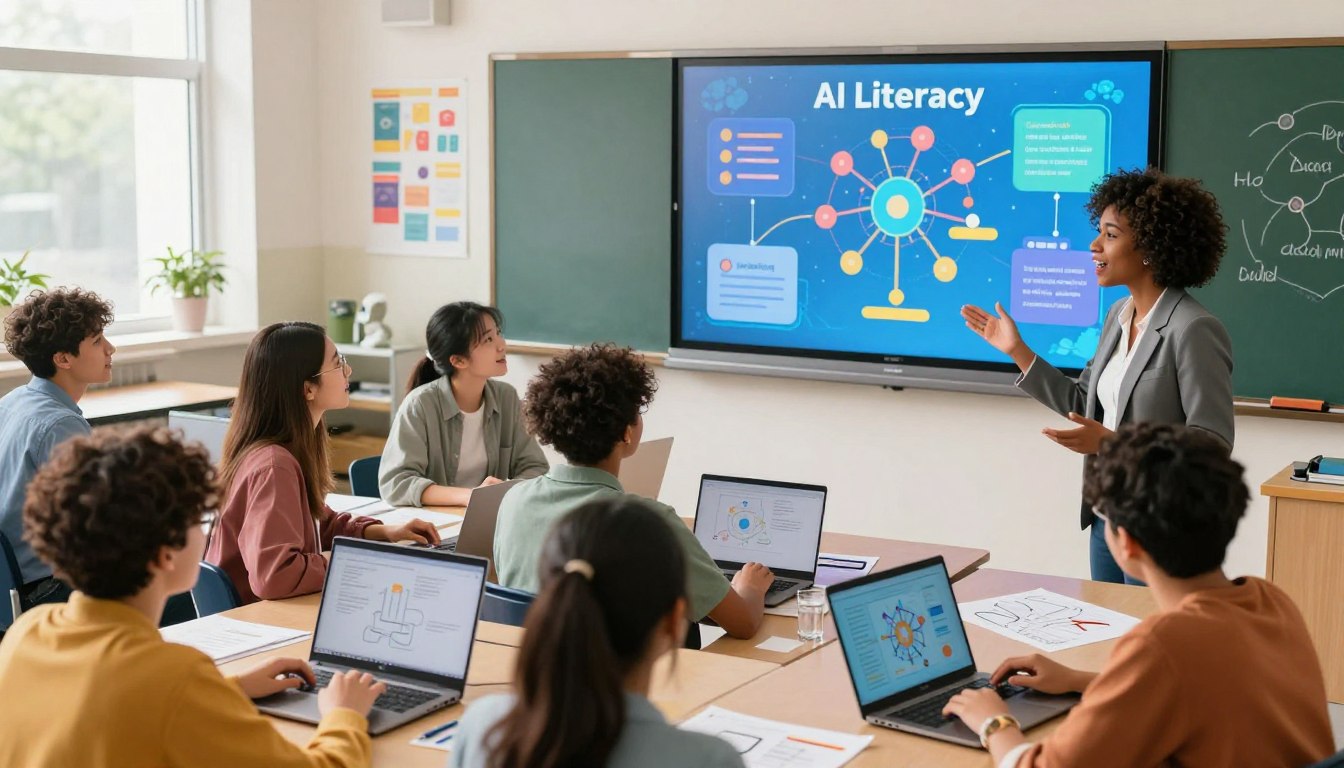
There are moments when a system quietly shifts from pilot to practice, and leaders feel the ground move beneath them. District leaders and classroom teachers now face one of those moments. Schools report rapid uptake: 85% of teachers and 86% of students used new tools in the 2024–25 school year.
The market has scaled fast: $7.57 billion in 2025 and rising projections have turned curiosity into planning. That scale changes decisions—budgeting, governance, and training now matter as much as promise.
This report frames practical choices for institutions. It ties measurable value—54% higher test scores and 10x faster feedback—to real classroom routines. We map adoption signals, risks, and policies so leaders can act with clarity.
Key Takeaways
- Adoption has moved from pilots to operations; districts must plan budgets and governance.
- The market and adoption rates signal expectation, not just experimentation.
- Measured outcomes show clear learning gains and time savings for teachers.
- Successful strategy balances technology with equity, safety, and transparency.
- This report offers a practical compass for district leaders and institutions.
Executive Overview: The State of AI in U.S. Classrooms Right Now
District leaders are now facing a clear operational shift as classroom tools move from pilots to daily practice.
Adoption across schools this year is broad: 85% of teachers and 86% of students report active use. Teachers note clear gains—69% say teaching methods improved, 59% cite more personalized learning, and 55% report extra time for direct student interaction.
Benefits sit beside burdens. Seventy-one percent of teachers say verifying student work adds staff time. Half of students feel less connected to teachers; nearly half of teachers and half of parents see weaker peer ties.
Training and policy gaps are urgent. Fewer than half of teachers and students received training from their institutions. Common gaps: how to use tools effectively (29%), how systems work (25%), and how to check outputs (17%). Only 22% of students got guidance on school policies.
What’s different this year
- Technologies now ship with embedded features, shifting adoption from pilots to infrastructure.
- Leaders must codify policies, direct investments in training, and align systems with instructional goals.
- Priority: protect student connection and measure outcomes—learning, equity, and coherence—before scaling further.
AI in Education Trends 2025: Adoption, Usage, and Classroom Realities
Classroom adoption has moved past curiosity and now shapes daily routines for teachers and students.
Inside K-12: 85% of teachers and 86% of students reported regular use during the year. That level of uptake means schools must treat these systems as instructional infrastructure, not experiments.
Teachers use tools mostly for curriculum and content development (69%), student engagement (50%), professional growth (48%), and grading (45%). These workflows show clear time savings and better scaffolding for differentiated learning.
Students use systems for tutoring (64%) and college or career advice (49%). But many also seek relationship (43%) and mental health (42%) support through school devices—an important boundary issue for institutions.
The report flags practical risks: misuse, overreliance, and off-task behavior. Authenticity checks now add workload—71% of teachers verify student work more often.
- Map classroom use to district goals and train teachers on verification workflows.
- Set clear signposts so students find human support for non-academic needs.
- Prioritize ongoing professional learning so personalized learning aligns with standards.
| Use Case | % of Teachers | Classroom Outcome |
|---|---|---|
| Content & Curriculum | 69% | Faster lesson design, richer materials |
| Engagement & Differentiation | 50% | Improved scaffolds and participation |
| Grading & Feedback | 45% | Quicker feedback cycles, more teacher time |
| Professional Development | 48% | Targeted teacher growth and prompt adaptation |
Market Momentum: From a $7.57B Market in 2025 to a Decade of Acceleration
Market momentum now forces districts to treat smart learning systems as core operational platforms, not optional pilots.
Scale and forecasts: The market reached $7.57B in 2025 and projects to $112.30B by 2034. That rapid expansion signals a long runway for growth and a shifting budget posture across the education sector. Adoption rates—86% across organizations—show how quickly institutions move from trial to routine.
Where growth is fastest and why education leads
Asia-Pacific posts a 48% CAGR, accelerating global product development and cross-border offerings. Education leads because practical wins—content generation, assessment, and feedback—map directly to classroom workflows and deliver near-term value.
Budget priorities for ISDs and institutions
Leaders should ask: which systems strengthen instruction and save teacher time? Prioritize foundational infrastructure—identity, data pipelines, and governance—before adding point tools.
- Shift from pilots to platform budgeting and measure total cost of ownership.
- Use vendor consolidation and shared services to reduce redundancy.
- Pair technology purchases with professional development to turn capability into classroom impact.
For a practical guide to platform selection and vendor reviews, see this learning platform review. The durable outcome is clear: targeted investment in systems and infrastructure yields measurable value, resilience, and accountability.
Learning Impact: Outcomes, Engagement, and Performance Gains
Recent outcome data ties faster feedback loops to stronger gains in test performance and course completion.
Key signals matter: students in enhanced active learning programs posted 54% higher test scores, while assessment systems delivered feedback roughly 10 times faster. Faster cycles let learners correct mistakes before gaps widen.
Engagement rose sharply—measures show up to a 10x boost when classes use quick practice and discussion loops. Personalized learning contributed to up to 30% better outcomes by targeting practice to mastery levels.
Other benefits are concrete: attendance improved by about 12% and course completion climbed near 70% where tailored pathways and timely feedback were in place. Early warning tools, paired with human follow-up, cut dropout rates by roughly 15%.
Practical next steps for leaders and teachers
- Start with formative checks: low-stakes quizzes and quick feedback yield the largest near-term performance gains.
- Focus on structured practice: repeated, scaffolded tasks build mastery and sustain engagement.
- Resource essentials: devices, connectivity, and coaching ensure equitable access to these supports.
Teachers benefit too: faster insights free time for targeted conferences and small-group instruction. This report shows the impact is real—when technology supports strong instruction, learning and performance follow.
Risks, Policies, and Guardrails: Addressing Harms Without Halting Progress
Practical guardrails let schools pursue innovation while limiting harm to students and staff. Districts and institutions must pair ambition with clear rules so progress does not outpace protection.
Connection, critical thinking, and fairness: The human-side risks
Half of students now report feeling less connected to teachers. Nearly half of teachers and parents see weaker peer ties.
Risk to belonging is real: when technology mediates frequent interactions, classroom climate can suffer. Seventy percent of teachers worry that critical thinking and research skills will weaken.
“Monitor school climate and prioritize in-person relationships; social bonds matter for learning.”
Data security, harassment, and bias: Policy gaps schools must close
Harms go beyond plagiarism. Threats include data breaches, tech-fueled harassment, and biased outcomes that unfairly target students.
Fewer than half of teachers and students received institutional training; only 22% of students had school guidance on policies and 17% got risk briefings.
- Publish clear usage policies for students and staff—define boundaries for non-academic queries and well-being referrals.
- Standardize approved tools, require vendor transparency on data practices, and mandate human review for high-stakes work.
- Provide teacher support on prompt design, output verification, and routines that preserve authentic student work.
- Keep policies living: update them with stakeholder input from families, counselors, and classroom educators.
Layered governance works best: classroom norms, school rules, district oversight, and vendor requirements should align on safety and equity. Training must accompany every policy—without it, compliance is only performative.
Training and AI Literacy: Closing Skills Gaps for Teachers and Learners
Many districts now face a mismatch: frequent classroom use but sparse formal training.
Less than half of teachers (48%) and students (48%) received district-provided training or guidance. Only 29% of teachers learned how to use tools effectively, 25% learned how systems work, and 17% learned how to monitor or check outputs.
PD must close that gap. Programs should center classroom workflows—lesson planning, formative assessment, feedback, and accommodations—so training directly improves teacher work and student outcomes.
Building programs that actually work
Effective programs combine short modules with practice cycles. Offer an intro for all staff, role-specific deep dives for coaches, and advanced cohorts to create internal champions.
Teachers need hands-on modules about monitoring and checking systems. Move beyond demos: use classroom scenarios, vendor comparisons, and verification exercises.
Student literacy aligned to school policy
Student guidance must be clear: safe prompting, source checks, citing assistance, and when to seek human support. Pair policy summaries with exemplar assignments so learners know expected work.
From hype to measurable value
Adopt a skills-first approach: map competencies—reasoning with tools, bias awareness, and privacy basics—to development plans. Schedule co-planning, classroom trials, and coaching so new practices stick.
“Make expectations explicit: good use supports thinking, it does not replace it.”
| Focus | Target Group | Outcome |
|---|---|---|
| Introductory PD | All teachers and staff | Shared language and basic skills |
| Role-specific deep dives | Instructional coaches, librarians | Classroom integration and coaching capacity |
| Student literacy modules | Students (grades 6–12) | Safe, policy-aligned use and verification skills |
| Advanced practitioner cohorts | Teacher leaders | Internal champions and model lessons |
Resources matter: curated prompts, exemplar lesson plans, and time for practice turn training into classroom change. When districts align policy, PD, and coaching, learners and teachers both gain.
Data and Analytics Infrastructure: From Engagement Signals to Early Warnings
Districts need a clear data backbone before analytics can change classroom practice.
Start with interoperable systems. Unify SIS, LMS, assessment, and classroom tools so signals become actionable. Clean intake and normalization close gaps that otherwise drown educators in noise.
Early warning models track attendance, participation, grades, and engagement to surface students at risk. Schools using such systems cut dropout risk—improving retention by about 15% when models prompt timely interventions.
Real-time analytics, early warning systems, and retention
Engagement telemetry—speaking time, sentiment, and activity—lets teachers adjust pacing and content while learning is happening. Dashboards should serve educators: clear signals, minimal noise, and direct links to next instructional steps.
Allocating resources with evidence: Building systems that scale
Prioritize infrastructure that supports privacy, governance, and scale so institutions can iterate without replatforming. Start with pilot schools, validate models against outcomes, then expand.
- Close data gaps: fix intake, normalization, and access controls so leaders trust the signals.
- Use evidence: tie staffing, tutoring, and content expansion to measured performance and need.
- Keep humans central: educators interpret signals, maintain context, and ensure interventions are supportive.
“Build responsive operations: move from reports to systems that improve learning with transparency and care.”
Beyond K-12: Hybrid Models, Corporate Training, and Workforce Skills
The post-secondary and corporate sectors are adopting hybrid program designs that connect learning to clear work outcomes. Demand for flexible pathways and shorter credentials is rising as employers seek measurable performance and faster talent pipelines.
Post-secondary shifts: Alternative credentials and flexible pathways
Programs now mix credit-bearing courses with industry credentials so students convert learning into work faster.
Modular content and stackable certificates let learners move at their own pace while institutions track retention and performance.
Corporate learning efficiency and employer demand for skills
Corporate e-learning shows strong market momentum; smarter training lifts learning efficiency and boosts retention.
Employers prioritize workforce skills and digital literacy; many workers say they will retrain to meet employer needs. For lessons that translate to business practice, see this hybrid learning analysis.
Partnerships, green skills, and early childhood innovation
Institutions and firms form partnerships to speed program development and reduce duplication.
Green skills are entering curricula, aligning technology tools with sustainability roles across industry.
Early childhood innovation—backed by public and private resources—offers a chance to embed safe, age-appropriate foundations for later learning and work.
- Design for portability: choose solutions that travel across programs and employer contexts.
- Blend credit + credentials: create pathways that matter to students and employers.
- Invest in partnerships: align curricula with employer needs to improve placement and performance.
“Combine modular learning with verified credentials to turn training into career outcomes.”
For practical career skills development, explore this guide on transforming careers with targeted skills: career skills pathways.
Conclusion
Leaders must convert scattered pilots into cohesive strategies that align policy, training, and systems.
Action now yields measurable results. Finalize district policy, fund professional development, and deploy core data infrastructure so proven classroom practices can scale with teacher support.
Prioritize solutions that boost learning and protect student privacy. Track engagement and retention as primary outcomes. Use market signals and outcome data to justify targeted resource allocation and to mitigate risks.
Connect curriculum to workforce pathways; employers reinforce the value of skills-based development. For a practical guide to higher-education approaches, see this higher education guide.
With clear policy, steady development, and focused resources, institutions can turn potential into real value for students, teachers, and communities—starting now.
FAQ
How are classrooms across ISDs changing with the latest intelligent learning tools?
School districts are shifting from isolated pilots to district-wide deployments. Leaders invest in classroom-ready systems that assist with lesson design, formative assessment, and differentiated practice. Teachers report saved planning time and more targeted instruction; students see quicker feedback and adaptive pathways that match their pace and goals.
What signals show adoption among teachers, students, and districts?
Adoption indicators include widespread classroom use, district procurement of platform subscriptions, and increased training budgets. Surveys show large percentages of educators and learners using generative tools for content creation, tutoring, and assessment support. Infrastructure upgrades—networks, devices, and data systems—also mark serious rollout stages.
What’s different now compared with earlier pilot phases?
The shift is toward scale and sustainability: integrated platforms, standards-aligned content, vendor contracts, and measurable outcomes. Districts prioritize interoperability, privacy controls, and professional development so initiatives move from experimental to systemic.
How prevalent is use inside K–12 classrooms?
Use is widespread across grade bands. Large shares of teachers and students rely on tools for lesson support, tutoring, and automated feedback. That prevalence brings classroom practice closer to personalized learning while creating new needs for policy, training, and oversight.
In what ways do teachers apply these systems daily?
Teachers use them to generate lesson materials, design formative checks, grade routine assignments, and craft individualized practice. This frees time for small-group instruction and student mentoring. Effective use combines teacher judgment with tool outputs rather than replacing instruction.
How are students using tutoring tools, and what risks arise?
Students frequently use tutoring and study-assist features for homework and concept review. Risks include overreliance for non-academic advice, accuracy gaps, and reduced practice of independent problem solving. Clear guidelines and literacy training help students use tools responsibly.
What does the market outlook look like for educational technology this year?
The market shows rapid growth driven by generative content, assessment automation, and learning analytics. Investment concentrates on scalable solutions that demonstrate measurable learning gains and operational efficiencies for districts and institutions.
Where is growth fastest and why do schools lead adoption?
Growth is strongest in adaptive tutoring, content generation, and analytics platforms. Education leads because the sector has clear use cases—personalized instruction and assessment—that deliver measurable ROI for student outcomes and teacher productivity.
With tight budgets, how are ISDs prioritizing spending?
Districts prioritize core infrastructure (connectivity and devices), platforms that integrate with existing systems, and professional development. They favor investments that show quick wins in engagement, retention, or reduced teacher workload.
What learning outcomes are emerging from current deployments?
Early evidence points to higher mastery rates, faster feedback cycles, and increased student engagement. Certain implementations report notable gains in formative assessment scores and completion rates when paired with strong instructional design.
How does personalized learning affect motivation and mastery?
Personalized pathways boost relevance and confidence by matching tasks to readiness levels. When combined with frequent, actionable feedback, students show greater persistence and higher completion of standards-aligned objectives.
What human-side risks should educators watch for?
Key concerns include reduced critical thinking if students accept outputs uncritically, equity gaps from uneven access, and weakened student-teacher relationships if tools replace interaction. Mitigation requires guided use, reflective tasks, and inclusive deployment planning.
Where do policy and security gaps remain?
Data privacy, bias in models, and protections against harassment are common gaps. Districts must update acceptable-use policies, strengthen vendor contracts, and implement monitoring to ensure safety, fairness, and compliance with state and federal rules.
How many educators are trained to use these systems effectively?
Fewer than half receive sustained, practical professional development. Effective programs combine hands-on workshops, coaching, and classroom follow-up to move teachers from experimentation to routine, evidence-based practice.
What should training for student literacy cover?
Literacy programs should teach verification of outputs, ethical use, citation practices, and how to leverage tools for learning rather than shortcuts. Aligning student guidance with school policy ensures safe, productive use.
How can districts monitor value and avoid hype?
Districts should define measurable goals, track learning analytics, run controlled pilots, and evaluate vendor claims against real classroom data. Ongoing audits and teacher feedback close the loop between deployment and impact.
What role do analytics and early warning systems play?
Real-time analytics surface engagement trends, flag at-risk learners, and inform interventions. Early warning systems help allocate tutoring, counseling, and resources before small problems become dropouts.
How should districts allocate resources to scale effective systems?
Invest first in reliable infrastructure, interoperable platforms, and teacher training. Reserve funds for analytics, ongoing licensing, and staff roles that translate data into instruction—ensuring solutions scale without adding administrative burden.
How are post-secondary and corporate learning models evolving?
Higher education and corporate training adopt flexible credentials, micro-credentials, and blended pathways that emphasize skills employers need. Platforms accelerate competency-based learning and employer-aligned assessments.
What skills are employers demanding from graduates?
Employers prioritize digital literacy, problem solving, and applied technical skills. Training programs that combine domain knowledge with practical, tool-based experience increase hireability and workplace readiness.
Where are promising partnerships and innovations emerging?
Collaborations between districts, community colleges, employers, and edtech firms produce apprenticeship pathways, stackable credentials, and early childhood interventions. Green skills and workforce readiness are frequent focus areas.
How can leaders balance innovation with responsibility?
Leaders should set clear goals, embed ethics and equity into procurement, prioritize teacher capacity building, and require evidence of learning gains. Responsible innovation pairs bold experimentation with guardrails and continuous evaluation.