Do you know that feeling when you’re waiting for a package and it’s late? It’s frustrating, right? This article is about finding a better way to get packages to you.
We’re talking about using drones for the last mile of delivery. This is a cool way to use AI. It can make deliveries faster, cleaner, and more reliable.
Let’s look at some examples. Amazon Prime Air and Walmart are already using drones. Domino’s and Wing are testing them too. These companies show how drones can help.
This article will give you the facts. We’ll talk about how drones work and their benefits. You’ll learn about the technology and how it can help businesses.
Key Takeaways
- Autonomous last-mile delivery drones are a concrete AI use case with near-term commercial pilots and growing deployments.
- Automated drone delivery offers speed, contactless service, and possible emissions cuts over diesel vans.
- Leading brands—Amazon Prime Air, Zipline, Wing, Walmart, Domino’s, FedEx—offer real examples and lessons.
- Success depends on good AI navigation, reliable sensors, and following FAA and local rules.
- Readers can expect detailed analysis on tech, metrics, rules, and how to start using drones in the next sections.
Introduction to Autonomous Delivery Drones
Unmanned aerial logistics is changing how we get things delivered in cities. This part explains what makes these drones special. It shows how they work with today’s delivery systems. You’ll learn what they can do for businesses and communities.
What Are Last-Mile Delivery Drones?
Last-mile delivery drones are special flying machines. They carry small packages, food, and even medical supplies right to you. They are electric and fly short distances, usually under 8–10 km.
They can carry about 1–4 kg. For example, the Manna drone family is made for neighborhood deliveries. They can carry around 3.5 kg.
They are used for many things. Like dropping off groceries, food from restaurants, and even medical supplies fast. They also help with marketing by delivering special items to events.
These drones are all about being quick, safe, and reliable. They work well in busy cities and suburbs.
The Role of AI in Autonomous Drones
Artificial intelligence makes these drones smart. They use sensors and cloud systems to make quick decisions. They navigate, avoid obstacles, and find the best routes.
They also learn from their flights. This helps them avoid problems and make better choices. It’s like having a super-smart co-pilot.
AI also helps with battery life and keeping the drone in good shape. This means the drones can fly all day, every day. They find the best way to fly and use less energy.
Current Landscape of Last-Mile Delivery
The world of last-mile delivery is changing fast. More people want things delivered quickly, which shows old systems are not working. Cities are crowded, some places are hard to reach, and there’s not enough workers.
Companies are looking for new ways to make things better. They want to save time, money, and be kind to the planet. They also want to keep deliveries reliable.
Overview of Delivery Challenges
Delivering things to the last mile is hard and expensive. Cities have a lot of traffic, which costs more money and time. Places far from cities are hard to get to because of bad roads.
Workers in the delivery business change jobs a lot. This makes it hard to plan and keep promises. Old ways of doing things limit how much can be done.
Things like batteries and how much you can carry limit how far drones can go. Weather can also make it hard to fly drones safely. People might not like the noise drones make, and there’s no place to take off or land.
Doing things by hand, like planning routes, adds to the problem. It makes things slower and more complicated.
Market Trends and Growth Projections
More money is being put into drones for delivery. Amazon is testing drones in the U.S. with new designs that are quieter. Walmart is working with Zipline and DroneUp to deliver groceries and medicine.
Drone companies like Zipline and Manna Aero are making a lot of deliveries. They are flying a lot and making things faster. People want things delivered quickly, and drones can help.
Studies show drones could make deliveries up to 20 times faster. They could also be better for the planet. Using drones could cut down on pollution and save a lot of energy.
Using drones for delivery is a smart move. Companies that use drones well can change how things are delivered in cities. They will figure out the best routes and make sure drones are safe and ready to go.
Benefits of AI in Delivery Drones
AI is changing how we think about fast and cheap delivery. It uses smart tech and strong hardware. This helps teams save time and money.
Enhanced Efficiency and Speed
AI helps drones fly better, avoiding traffic and tough spots. This makes delivery faster in cities and remote places. Amazon and others aim for quick delivery times.
Real-time sensors and smart flight paths let drones change plans quickly. This is great for avoiding obstacles and weather changes.
Dynamic scheduling means drones are used more and sit idle less. Managers can send drones when needed, making customers happier. This shows how drones can make delivery better.
Cost Reduction and Operational Savings
Using drones saves money on labor and helps with driver shortages. Zipline and Walmart have seen big cost cuts. Predictive maintenance keeps drones running longer.
Smart flying and battery use cut down on energy use. This saves money on frequent deliveries. Long-term, the savings can pay for the drones.
Starting small and planning well is key. Testing drones helps find the best ways to use them. This way, companies can add drones without hurting their main work.
Key Technologies Behind Autonomous Drones
The AI Use Case – Autonomous Last-Mile Delivery Drones uses many technologies. These technologies make drones safe and reliable. They help drones work near people and buildings while meeting goals.
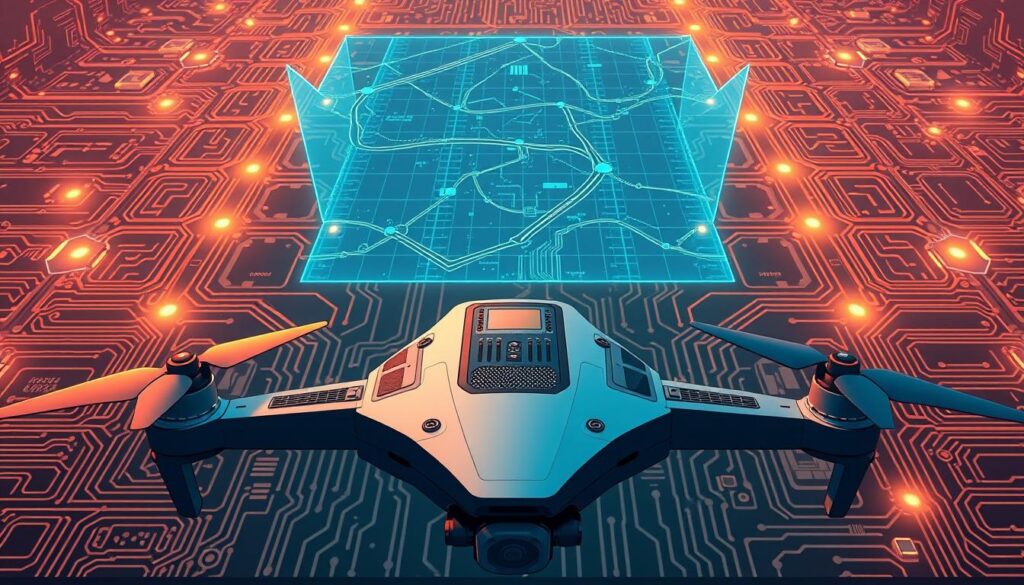
Machine Learning and Navigation Systems
Amazon and Zipline show how machine learning helps drones. They use computer vision to find safe places to land. They also use reinforcement learning to adjust paths in real time.
They use GPS and visual SLAM to find their way. Edge AI helps drones avoid crashes and update their plans. Updates make drones better at flying long distances and in bad weather.
Sensors and Safety Mechanisms
Drones have many sensors to stay safe. They use LiDAR for depth, radar for distance, and cameras for seeing. They also have sensors for close objects, IMUs for balance, and GNSS for location.
They have safety features like geofencing and backup systems. These help drones avoid crashes and land safely. They also have systems to protect wildlife and people.
Batteries are important for drones. AI helps manage them to fly longer. It also stops drones from flying too hot. This makes drones reliable in different conditions.
| Technology | Primary Benefit | Typical Components | Operational Impact |
|---|---|---|---|
| Perception Stack | Robust situational awareness | LiDAR, radar, stereo cameras, ultrasonic | Faster obstacle detection; fewer false positives |
| Navigation & Control | Stable, accurate routing | GNSS, visual SLAM, IMU, edge AI | Maintain course when GPS degrades; adaptive pathing |
| AI Decision Layer | Autonomous responses to dynamic events | Reinforcement learning, computer vision models | Safer autonomous adjustments; continuous learning |
| Safety Systems | Risk mitigation and failover | Parachute systems, redundant flight controllers, geofencing | Reduced crash severity; regulatory alignment |
| Power & Thermal Management | Extended mission life and battery safety | Battery management systems, thermal sensors | Optimized energy use; prevents thermal runaway |
Real-World Applications of Delivery Drones
Delivery drones are moving from labs to everyday use. They help hospitals, stores, and schools. This shows how drones are making a big difference.
Case Studies: Companies Leading the Way
Amazon Prime Air is testing drones in California and Texas. They want to make drones quieter and better for bad weather. They focus on making deliveries safe and fast.
Walmart is working with Zipline and DroneUp to send packages by drone. Zipline has made over 600,000 deliveries. Walmart did about 6,000 drone deliveries in 2022.
Manna Aero has made over 100,000 deliveries in Ireland. Their drones carry 3.5 kg and go up to 80 km/h. They plan to grow in Europe and the U.S.
Flirtey and Domino’s tested drones in New Zealand. They made deliveries safer and faster. Zipline is also making medical deliveries in Africa and the U.S.
Wing is working with DoorDash to deliver meals by drone. They are testing in Virginia and Texas. This helps make deliveries faster and cuts down on traffic.
Various Industries Utilizing Delivery Drones
Healthcare uses drones to quickly send blood and vaccines. This helps in remote areas and during emergencies. It makes care faster and better.
Food and grocery stores use drones for quick delivery. They work with ground robots to meet demand fast. This is great for busy cities.
Emergency teams use drones to send supplies in bad weather. They have special cameras to help find people and see dangers. This makes rescue work safer and faster.
Construction and manufacturing need parts quickly. Drones can deliver these parts fast. This saves time and keeps work going.
Retail uses drones for special events and to surprise customers. Companies like Starship test drones in controlled areas. This helps them learn how to use drones in cities.
These examples show how drones are helping many areas. They show how drones can be safe and useful. They help make things better and faster.
Regulatory Considerations for Drone Delivery
Rules shape how drones are used in the US. Companies must follow federal and local laws. Planning early helps get approval faster.
FAA Regulations and Compliance
The Federal Aviation Administration (FAA) has rules for drones. These include Part 107, waivers for flying out of sight, and type certification. Companies like Amazon Prime Air and Wing follow these rules.
To comply, companies must show their drones are safe. They need to submit safety plans and work with the FAA. They also have to meet noise and privacy rules.
State and Local Regulations Impacting Rollout
States and cities have their own rules for drones. These rules affect where drones can fly and where they can land. They also set limits on noise and where charging stations can go.
Working with local communities helps. Companies like DoorDash and Wing got approval by talking to towns. They showed how drones could help and followed privacy rules.
The rules for drones will change as they become more common. Companies need to plan ahead. They must follow FAA and local rules to avoid delays and gain trust.
Challenges Facing Autonomous Delivery Drones
AI Use Case – Autonomous Last-Mile Delivery Drones aim to be fast and easy. But, they face many problems. These include hardware limits, algorithm gaps, complex airspace, and how people feel about them.
Looking at these challenges helps plan better and talk to the community.
Technical obstacles and navigation limits
Battery life and how much they can carry affect their path. Heavy packages mean they can’t go as far. Also, finding more batteries and keeping them cool is hard.
Weather is a big problem too. Wind, rain, and fog mess up their sensors and how they fly.
Without GPS, drones rely on seeing their way and using many sensors. They need to make quick decisions with small computers. Also, they must avoid crashing in busy areas.
As more drones fly, noise becomes a bigger issue. Managing the air for all drones is hard. Finding safe batteries and keeping them cool is also a challenge.
Social acceptance and community concerns
People worry about drones watching them, packages falling, and disturbing animals. Bad news about drones makes them even more skeptical.
Building trust is key. Being open about safety and showing drones can be quiet helps. Clear rules and seeing drones in action makes people feel better.
Seeing drones in action by trusted brands helps. Campus tests show drones can be useful. For more on AI and drones, check this link: AI impact on autonomous last-mile delivery.
| Challenge | Impact on Operations | Mitigation |
|---|---|---|
| Battery and payload limits | Reduced range; fewer deliveries per charge | Lightweight materials; optimized routing; battery supply diversification |
| Adverse weather | Higher mission abort rates; sensor degradation | All-weather airframes; sensor fusion; adaptive flight control |
| GPS-denied areas | Navigation failures; mission delays | Visual SLAM; redundant IMUs; terrain-aware mapping |
| Edge computing limits | Slower decision times; constrained models | Hardware acceleration; model compression; tiered cloud-edge stacks |
| Airspace coordination | Collision risk; regulatory barriers | UTM adoption; standardized protocols; operator collaboration |
| Public perception | Community resistance; policy pushback | Transparent pilots; privacy safeguards; noise mitigation |
| Security threats | Adversarial attacks; spoofing | Robust model testing; secure comms; anomaly detection |
| Noise and wildlife impact | Complaints; ecological disturbance | Quieter propeller design; restricted flight corridors |
| Regulatory transparency | Slow certification; limited approvals | Explainable AI; safety cases; third-party validation |
Future Outlook for Autonomous Delivery Drones
The next decade will show which techs work and which don’t. We’ll see better power systems, airframes, and brains for drones. These changes will make drones more reliable and cheaper.
Innovations on the horizon include better batteries, quieter flying, and stronger airframes. Drones will fly farther and more precisely. They’ll also use 5G and IoT for better coordination.
Parcel lockers and small hubs will be key for delivery. Cities will test drone lanes and systems for safe flying. These steps will make drone delivery more common and useful.
Innovations on the Horizon
Drones will carry more without using more energy. This will help in healthcare and fast delivery. They’ll also have robotic arms for delicate items.
AI will help drones find the best routes. This will save time and energy. See more at this report.
Predictions for Market Adoption
First, drones will fly in special areas like campuses and suburbs. Big names like Amazon and Walmart will lead the way. They’ll start with drones for fast delivery.
Healthcare and grocery delivery will show drones’ value first. As drones become more common, they’ll be cheaper. They’ll help vans and bikes, not replace them.
Adoption depends on tech, public support, and rules. When these are ready, drones will change how we deliver things.
Conclusion: The Next Steps for Industry Players
The AI Use Case – Autonomous Last-Mile Delivery Drones is getting real. Start with small tests in safe places like campuses or rural areas. Then, move to busier spots once everything works well.
Using drones with special hubs and lockers can help a lot. This makes sending packages in cities easier.
Focus on areas where drones can really help, like sending medical stuff or food fast. Make sure drones are safe and people like them. Use smart tech to keep costs down and drones working longer.
Look for partners in tech, logistics, and retail. Companies like Amazon and Walmart are good to watch. Working with energy and health groups can help too. Check out this overview for more info: navigating the next wave.
Drone delivery is promising but needs careful planning. Test drones wisely and grow based on what works. With smart plans and teamwork, drones can change how we get packages.
FAQ
What are autonomous last-mile delivery drones and which use cases do they serve?
Autonomous last-mile delivery drones are special flying machines. They carry things like food, medicine, and small items to people. They are electric and fly short distances, like 8–10 km.
They can carry up to 4 kg. They are great for fast delivery of important things. This includes medical supplies, groceries, and urgent parts.
How does artificial intelligence enable autonomous drone delivery?
AI helps drones fly by itself. It uses sensors and cameras to see and avoid things. It also plans the best route and manages energy.
AI makes decisions on its own. It uses special techniques to do this. This lets drones fly safely and efficiently.
Which companies are leading commercial pilots and scaled deployments?
Companies like Amazon Prime Air and Walmart are leading the way. Zipline is known for medical deliveries. Manna Aero focuses on fast food delivery.
Wing works with DoorDash. Domino’s is testing drones with SkyDrop. FedEx is exploring new ways to use drones.
What operational benefits do AI-driven drones provide?
Drones fly faster and more reliably than cars. They can deliver things in under 30 minutes. This is great for urgent needs.
They also save money and reduce pollution. Drones are best for short, frequent deliveries.
What are the primary technical constraints for drone deliveries?
Drones face challenges like battery life and weather. They need to avoid obstacles and fly safely. They also need to work well with other drones.
There are also safety concerns with batteries. But, drones can overcome these with the right technology.
What sensors and safety systems are used to reduce risk?
Drones use LiDAR, radar, and cameras to see around them. They also have backup systems for safety. This includes parachutes and controlled landings.
AI helps drones avoid obstacles. This makes flying safer for everyone.
How do regulations affect commercial drone delivery rollout in the U.S.?
The FAA sets rules for drones in the U.S. Companies need special permits for certain flights. This includes flying beyond what the pilot can see.
Amazon, Zipline, and Wing operate under these rules. They show how drones can be used safely.
Do state and local rules complicate drone deployments?
Yes, local laws can make it harder to use drones. They affect where drones can fly and how loud they can be. Companies need to work with local governments.
This helps drones to be accepted by the community. It also makes sure drones follow local rules.
What real-world performance metrics should operators track?
Companies should watch how fast drones deliver and how much it costs. They should also track how reliable drones are. This includes how often drones need to be fixed.
They should also look at how much energy drones use. This helps them save money and be more efficient.
How do drones compare to ground vehicles on emissions and energy use?
Drones are often better for the environment than cars. They use less energy and produce fewer emissions. This is true for short, frequent deliveries.
But, it depends on how far drones fly and how often. Drones are best for short trips.
What industries stand to gain most from drone logistics?
Healthcare, quick commerce, and emergency services can benefit a lot. Drones can deliver fast and safely. This is important for urgent needs.
Construction and retail can also use drones. They are good for delivering parts and marketing products.
How can operators manage public perception and privacy concerns?
Companies should be open with the community. They should explain how drones work and why they are safe. They should also reduce noise.
Showing drones in action helps. Regular updates on safety also help build trust.
What technical innovations are likely to accelerate adoption?
Better batteries and quieter drones will help. So will more advanced AI for flying. This will make drones more useful.
Improvements in carrying more and flying in bad weather will also help. This will open up more areas for drones.
What deployment strategies best position businesses for success?
Start small and focus on areas where drones can make a big difference. Work with experts in drones and AI. Talk to the FAA and local governments early.
Engage with the community and set clear goals. Use data to improve and grow responsibly.
Which partnerships matter most for scaling drone delivery?
Partnerships with drone makers, AI companies, and logistics firms are key. Working with the FAA and local governments is also important. This helps drones to be used more widely.
Collaborating with energy and healthcare companies can also help. This opens up new areas for drones.
Are drone deliveries cost-effective today, and when will they reach parity with ground fleets?
Drones can be cost-effective in some cases. They are good for short, urgent deliveries. This saves money and is better for the environment.
But, it depends on how far drones fly and how often. As drones become more common, they will be more cost-effective.
What are the main safety certifications or approvals companies must secure?
Companies need to follow FAA rules. This includes getting special permits for certain flights. They also need to show that drones are safe.
This includes having backup systems and following community safety guidelines. This ensures drones can be used safely.
How does AI contribute to maintenance and fleet reliability?
AI helps predict when drones need maintenance. It looks at how drones are used and how they perform. This helps drones to fly more often.
AI also helps plan drone flights. This makes sure drones are used efficiently. This saves money and keeps drones flying.
What are practical next steps for a logistics or retail firm exploring drone delivery?
Start with a small pilot in a good area. This could be healthcare or quick commerce. Work with drone experts and the FAA.
Engage with the community and set clear goals. Use data to improve and grow responsibly.