
“The only way to do great work is to love what you do.” — Steve Jobs. This idea frames a simple truth: passion alone does not persuade; structure and strategy do. A powerful script guides a viewer from curiosity to action.
On January 23, 2025, industry experts noted that a well-crafted video script moves viewers through every funnel stage. Understanding the psychology behind audience attention helps teams create content that answers pain points and highlights product value.
By focusing on the right elements—hook, benefits, pacing, and clear message—businesses can write an effective video that builds awareness and drives sales. Start today: review current content, refine your hook, and use tools like a script generator guide to speed the process.
Key Takeaways
- Strategy matters: A clear structure converts curiosity into action.
- Audience first: Tailor messages to pain, needs, and desired outcomes.
- Hook and benefits: Early attention and obvious value boost retention.
- Measure and refine: Analyze scripts and pacing to improve results over time.
- Use tools wisely: Templates and generators save time while keeping consistency.
The Psychology Behind High-Converting Video Scripts
Emotions drive choices; successful video scripts tap those feelings quickly and clearly.
Understanding Emotional Triggers
Emotional triggers are the bridge between a message and action. When a script addresses a real problem, the audience feels seen. That recognition makes a proposed solution more believable and useful.
Appeal to common feelings—relief, pride, curiosity—and pair them with a concrete benefit. This approach helps viewers move from interest to trust without friction.
Authentic stories turn a product or service into a human moment. A short, honest anecdote can make marketing messages memorable and persuasive.
We recommend structuring a short script that names the problem, shows the solution, and ends with a clear message. This pattern helps content feel both strategic and sincere.
“Connecting with feelings is not manipulation; it is the beginning of meaningful communication.”
- Address a specific problem to increase relevance.
- Use real details to build credibility.
- Keep the message simple so viewers can act.
Defining Your Target Audience and Core Message
Start by pinpointing who benefits most from your product and what they truly need. Identifying an ideal customer persona is the first step to creating a script that converts viewers into loyal customers.
When the team maps audience needs, the core message becomes precise. A clear message highlights product features and the specific solution your product service delivers.
Define one measurable goal for the content: awareness, leads, or sales. Use simple tools and a repeatable process to test which message prompts action and drives visitors to your website.
For example, a business selling to professionals demands a different tone and structure than one targeting students. Tailor the script so viewers see the problem and the solution within the first 10 seconds.
We help analyze product details and audience signals so the final video script speaks directly to the people most likely to buy.
Essential Elements of Every Successful Script
A script’s opening few seconds decide if a viewer stays or scrolls past. Crafting those moments is the first essential element of strong content.
The Power of the Hook
The hook must grab attention in under three seconds. Start by naming a clear pain or problem so the audience feels seen.
Then, promise a concise benefit. A focused video script ties that benefit directly to your product and the viewer’s life.
End the opening with a simple call to action. Guide the viewer to the next step and keep the message tight to save time and sustain attention.
| Element | Purpose | Time |
|---|---|---|
| Hook | Capture attention and state pain | 0–3 sec |
| Benefit | Show value and solution | 3–15 sec |
| Call to Action | Drive clear action and next step | Last 5 sec |
“Every element should work together to make the solution feel obvious.”
Mapping Your Script to the Sales Funnel
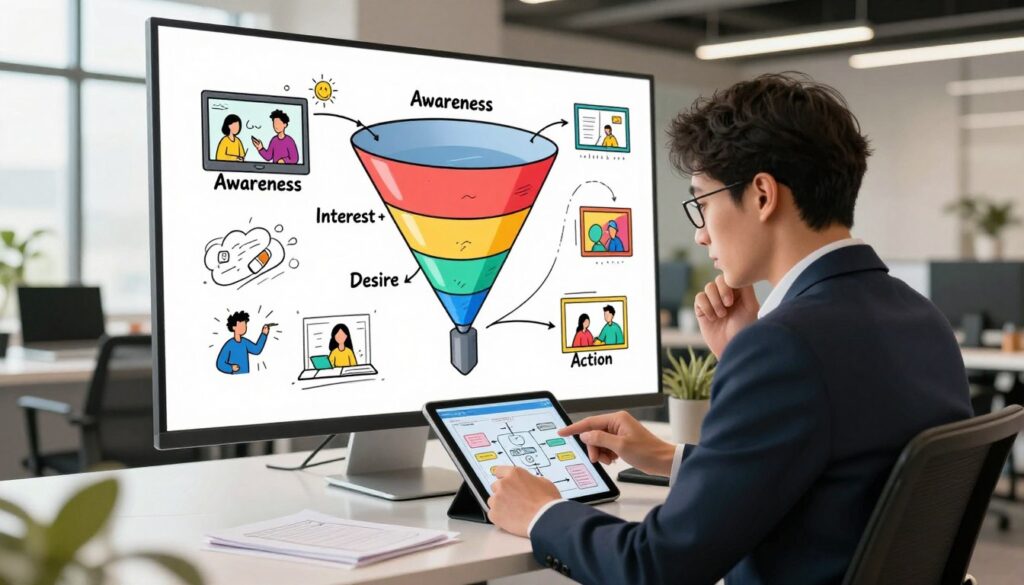
A purposeful script meets the viewer where they are in the buying journey and guides the next step. Mapping message, tone, and length to funnel stages increases relevance and improves conversion.
Awareness Stage
At this point the goal is simple: grab attention. Use a sharp hook that names a common problem and introduces the business in seconds.
Short ads—30–60 seconds—work best to hold attention on social platforms and drive viewers to learn more.
Consideration Stage
Here, the script delivers clear information about the product service and features. Show benefits and answer common questions.
Offer a tangible example, such as a 5-day training program, to move prospects closer to a decision.
Decision Stage
The final script must prompt action: a strong call to action that points to a landing page or sign-up on your website.
We provide the tools and structure so teams can craft videos that guide customers through each step. A consistent approach highlights value and turns interest into sales.
Proven Frameworks for Engaging Video Content
When structure meets storytelling, complicated products become simple choices for an interested audience.
Breakthrough frameworks—like the breakthrough script—help teams explain complex solutions with clarity. The Vira-Shield example shows how a clear message can demonstrate a product that filters 99% of airborne particles.
Good content follows a logical flow: hook, problem, solution, proof, and action. Each step guides viewers toward one intentional next move.
“A focused script removes noise so the solution stands out.”
Our analysis shows these frameworks help marketing teams create videos that stand out. They remove fluff and make the product value obvious.
- Explain the problem fast.
- Show the solution with proof.
- End with a clear action for viewers.
| Framework | Primary Goal | Runtime |
|---|---|---|
| Breakthrough Script | Explain complex product value | 30–60 sec |
| Problem-Solution-Proof | Build trust and urgency | 45–90 sec |
| Demonstration + CTA | Drive direct action | 15–30 sec |
For a practical guide to building this kind of framework, see a framework for creating engaging video.
Leveraging a Content Generator for Faster Production
Automating parts of the writing process frees creative teams to focus on the strategy that moves audiences to act.
Scriptos.ai is a platform designed to speed the path from idea to finished script. It gives teams practical tools to produce clear video scripts with less friction and less time spent on routine writing.
Why use a content generator? It standardizes tone, helps solve an audience problem quickly, and keeps the product message consistent across marketing videos.
- Streamline the writing process and save time on production.
- Keep every video on message so each action ties to business goals.
- Use the platform’s templates and tools to scale quality without extra headcount.
We recommend integrating Scriptos.ai into your workflow and pairing it with analytics and editorial review. For teams tracking industry updates, see this recent exchange update for context on distribution platforms.
“A good tool reduces busywork so strategy takes center stage.”
Techniques to Keep Viewers Watching Until the End
Keeping attention to the end starts with rhythm—how scenes, sound, and cuts move the viewer forward. A short plan before production keeps each moment purposeful.
Pacing and Visual Cues
Lead with a strong hook: open with a surprising fact that ties to the problem. For example, mention the heart beats over 3 billion times to spark curiosity and frame the product story.
- Keep scenes short; change visuals every 3–7 seconds to hold attention.
- Use on-screen text and motion to reinforce the next step and call to action.
- Structure the script so each step answers a likely viewer question and points to the solution.
- Layer proof—demo, testimonial, data—so value builds toward the final action.
We recommend testing cuts and cues across platforms and reviewing engagement metrics. For practical tactics to boost playtime, see this guide to increase video engagement and tips to monetize with AI avatars.
Common Mistakes That Kill Your Conversion Rates
A weak opening or unclear message often costs more than views—it costs customers.
Many video efforts fail when the script doesn’t address the audience’s pain. A poor hook means viewers scroll past. A muddled message leaves the product service unclear and the next step unknown.

Where teams trip up: they overload information, skip a clear call to action, or ignore the target goal for the piece. Too many features and not enough benefits confuse buyers.
For example, leaving out a simple 20% off coupon or a direct CTA can prevent viewers from taking action. Small tweaks—one clear offer, one step to take—often lifts sales dramatically.
We help teams find these leaks. Our approach reviews structure, message, and placement so each element guides customers through awareness and decision stages toward the website or checkout.
“Fix the hook, simplify the message, and design every scene to solve a problem.”
Integrating Scriptos AI into Your Workflow
When a tool focuses on both tone and structure, teams deliver clearer messages to their audience. Integrating https://www.scriptos.ai into a production pipeline reduces routine work and speeds the path from brief to final video.
Scriptos.ai is a platform built for businesses that need consistent, reliable script output. The service offers templates, editing tools, and alignment features so every video stays on brand.
Teams use the product to solve a common problem: uneven tone and long revision cycles. The solution standardizes structure, keeps the core message focused, and tracks alignment with sales goals.
- Faster drafts: reduce writing time and shorten review loops.
- Consistent tone: maintain one voice across campaign assets.
- Sales alignment: map each video script to a clear call to action.
We recommend exploring Scriptos.ai to see how its features support creative teams and improve production metrics. Start with one campaign and measure impact on time-to-publish and sales lift.
Conclusion
The last lines of a script decide whether curious viewers become customers. Close with a clear promise: name the problem, show the product benefit, and point to a single next step.
When teams focus on the right feature and a crisp message, a video script connects with the audience and prompts action today. Each effective video begins with a plan and ends with a compelling solution the viewer can follow.
We encourage you to apply these strategies to refine your scripts and improve marketing results. A well-crafted script is one of the best products you can invest in to grow and reach new customers.
Start writing your next video script with confidence—solve a real problem and guide viewers to act.
FAQ
What psychological elements make a script persuasive?
Persuasive scripts tap emotional triggers—social proof, scarcity, pain and relief—and combine them with clear benefits. They frame the viewer’s problem, show empathy, and present a credible solution. Storytelling and specific outcomes increase memorability and encourage action.
How do emotional triggers differ from logical arguments in a script?
Emotional triggers drive immediate engagement—curiosity, fear, desire—while logical arguments build rationale and justify decisions. Effective content blends both: lead with emotion to capture attention, then layer facts, features, and proof to convert.
What role does authenticity play in building trust?
Authenticity reduces skepticism. Real customer examples, transparent pricing, and honest limitations create credibility. Viewers trust messages that feel human and consistent across channels, which boosts conversions and long-term loyalty.
How do you define a target audience for a campaign?
Define the target by demographics, behaviors, pain points, and desired outcomes. Use customer interviews, analytics, and market research to form a concise buyer persona. That focus guides tone, offers, and the core message for better relevance.
What is a core message and how specific should it be?
The core message is the single idea the viewer should remember—what you solve and for whom. Keep it specific, benefit-driven, and repeat it subtly through the script so it anchors recall and action.
What are the essential elements every successful script needs?
Every effective script includes a compelling hook, clear problem statement, emotional resonance, credibility signals (testimonials or data), a simple offer, and a direct call to action. Arrange these to guide the viewer logically and emotionally.
How important is the hook and how long should it be?
The hook is critical—it determines whether viewers keep watching. Aim for the first 3–8 seconds to promise value or trigger curiosity. Make it bold, benefit-focused, and directly relevant to the audience’s need.
How should scripts align with the sales funnel stages?
Match content to intent: awareness content raises problems and interest; consideration content compares solutions and builds trust; decision content emphasizes offers, urgency, and next steps. Tailor tone, depth, and CTAs accordingly.
What differs between awareness and consideration scripts?
Awareness scripts educate and provoke interest without heavy selling—focus on insights and relatable pain. Consideration scripts deliver proof, comparisons, and deeper benefits to help prospects evaluate options.
What should decision-stage scripts emphasize?
Decision scripts highlight the offer, risk reversal (guarantees), social proof, and a clear, simple call to action. They remove friction and create a sense of timely opportunity to convert viewers into customers.
Which frameworks reliably structure engaging content?
Time-tested frameworks include Problem-Agitate-Solve (PAS), Story-Problem-Solution, and AIDA (Attention-Interest-Desire-Action). Each provides a clear path from hook to conversion and can be adapted by platform and audience.
How can a content generator speed up production without losing quality?
Generators automate outlines, iterate variations, and produce draft copy faster. Use them to test angles, create consistent messaging, and free time for creative direction and refinement. Always edit outputs to align with brand voice and facts.
What techniques keep viewers watching to the end?
Maintain momentum with varied pacing, visual cues, and frequent micro-rewards (teasers, reveals). Use concise language, purposeful cuts, and on-screen graphics to sustain attention and reduce drop-off.
How do pacing and visual cues work together in scripts?
Pacing sets rhythm—short sentences and rapid edits convey urgency; longer beats build trust. Visual cues (cuts, motion, text overlays) reinforce spoken points and guide the eye, increasing comprehension and retention.
What common mistakes reduce conversion rates?
Typical errors include weak hooks, unclear offers, overloading information, ignoring audience intent, and poor calls to action. Fixing these—streamlining message, adding proof, and clarifying next steps—improves results quickly.
How should teams integrate AI tools like Scriptos into workflows?
Use AI for ideation, outline drafting, and A/B variations, while humans handle strategy, brand voice, and final edits. Establish review steps, guardrails for factual accuracy, and templates so the tool amplifies productivity without diluting quality.
What metrics indicate a script is performing well?
Track view-through rate, click-through rate, conversion rate, and engagement duration. Combine quantitative metrics with qualitative feedback—comments, heatmaps, and user testing—to refine messaging and maximize impact.