“It always seems impossible until it’s done.” — Nelson Mandela.
The guide opens as a practical, time-aware blueprint for students juggling school, work, and family. It promises a clear 30-day plan that favors steady retention over last-minute memorization.
The calendar described here breaks each day into focused learning, practice questions, review, and buffer time. Readers in the U.S.—high schoolers, college attendees, and adult learners—will find a scalable approach: short daily sessions and longer weekend blocks where needed.
FlowScholar can speed the process by turning scattered exam topics into actionable tasks; visit FlowScholar to convert your schedule faster. For habit tips on consistent study and morning routines, see practical notes at Miloriano.
Key Takeaways
- This is a realistic, outcome-driven 30-day plan that fits work and life.
- Daily structure blends content, practice, review, and recovery time.
- Consistency beats intensity: small daily wins build durable retention.
- FlowScholar offers an optional fast path to convert topics into tasks.
- Track scores, error logs, and pacing to measure real progress by test day.
Why a study schedule beats cramming for exams
Planning replaces panic. A steady study schedule converts vague goals into clear, daily steps that actually get done. That shift alone reduces the mental load and frees energy for learning.
“Short, repeated practice builds durable skill better than one long session of memorization.”
How a calendar reduces overwhelm and improves retention
A thoughtful schedule breaks large content into chunks assigned to each day and week. This makes progress visible and lowers the chance of last-minute cramming, which favors short-term recognition over durable recall.
Structured plans support spaced repetition, active recall, and timely feedback from practice. Those cognitive wins mean more learning with fewer total hours.
Using structure to stay motivated and accountable on busy days
When work is pre-decided, students spend less time choosing what to do and more time executing. A schedule creates a default action—cutting decision fatigue and reducing procrastination.
- Missed days are predictable: the plan shows how to recover without panic.
- Buffers and swaps keep the plan flexible, not rigid.
- Small wins—daily tasks, weekly recaps, better practice scores—fuel motivation.
For a practical model of a realistic study schedule, see the best study schedule used by many test takers.
Collect what you need to study before you plan your days
Before you assign days, clarify the scope. Planning fails when the scope is vague. No one can build a schedule without defining the battlefield—what will actually be tested.
De-vague method: replace “study Math” with chapters, subtopics, and question types. Example: algebra systems, geometry theorems, or data interpretation. That shift turns vague intent into usable content and tasks.
Minimum inputs to gather
- Exam dates and allowed materials
- Topic list and weighting by unit
- Known weak areas and past low-scoring question types
Create an input prompt that captures dates, units, and priority
Use a concise prompt that lists each exam, date, and topics. Example prompt:
“I have a Chemistry Final on December 15th: Stoichiometry, Thermodynamics, Kinetics, Equilibrium, Acids/Bases. History Final on December 17th: World War II.”
Convert each chapter into daily tasks: read notes, watch a lesson, do 20 practice problems, log errors, and redo misses. Prioritize units with higher weight or those that cost the most points historically.
| Chapter | Concrete Tasks | Priority |
|---|---|---|
| Stoichiometry | Read notes; 20 practice problems; error log | High |
| Thermodynamics | Watch lesson; summarize concepts; 15 problems | Medium |
| World War II (History) | Timeline review; primary source read; 10 practice questions | High |
Speed up setup: FlowScholar can ingest your prompt and output a structured list of daily tasks and a calendar-ready plan. Readers who want the prompt→plan workflow can explore https://www.flowscholar.com to reduce planning time and keep things organized.
Pick a realistic daily time block that fits school, work, and life
Pick a daily block that you can actually protect amid school, work, and life responsibilities. A reliable window beats occasional marathon efforts: consistency compounds across weeks.
Aim for focused study sessions around 52 minutes
Research shows people hit strong focus for roughly 52 minutes. Use that as an anchor: short enough to match a crowded schedule, long enough for deep progress.
Short bursts vs longer blocks: choosing what works
Short bursts fit high-friction days: commute gaps, lunch breaks, or brief evenings. Reserve longer blocks on weekends for full practice tests and cumulative review.
Best times of day to study
No single best hour—choose when alert. Morning works for many; lunch breaks offer predictability; late night gives quiet. Pick what repeats.
- Structure a 52-minute session: 5 minutes set-up; 35–40 minutes deep work; 7–10 minutes active recall and next-step notes.
- If you can’t protect 60+ minutes, default to 30–52 minutes; stack multiple sessions to reach target hours.
- Build one non-negotiable daily slot, then add optional sessions when life allows.
| Scenario | Recommended Block | When to Use |
|---|---|---|
| Busy school day | 30–52 minutes | Commute gaps, lunch |
| Work shifts or family duties | Two 40-minute sessions | Before/after shifts |
| Weekend review | 2–4 hours with breaks | Full practice and review |
Get support so your study time is protected
Small, defended blocks of time make study sessions dependable—even during busy weeks. Start by asking people around you for clear help: family, roommates, or your boss can be allies. A short, protected session often beats waiting for the perfect day.
Set boundaries with simple scripts. Say: “I need 52 minutes without interruptions—can you hold questions until then?” Use that line with friends, coworkers, and housemates. Put the slot on a shared calendar so others see the block.

Practical controls and signals
- Phone: enable Do Not Disturb, app limits, or place the device in another room.
- Signals: headphones, a door sign, or studying in a library reduce drop-ins.
- Escalation: if interruptions persist, relocate sessions, shorten them, or split into two focused blocks while keeping the schedule.
Use a study buddy
Accountability can be quiet co-working. The buddy may read or do homework while you focus. They do not need the same subject; mutual presence improves follow-through.
“Protected, consistent sessions reduce last-minute panic and lower total time needed to reach the same score gains.”
| Problem | Action | Result |
|---|---|---|
| Interruptions at home | Shared calendar + door sign | Fewer drop-ins; steady sessions |
| Phone distractions | Do Not Disturb + app limits | Longer focus stretches |
| No private space | Library or co-working session | Protected time and better concentration |
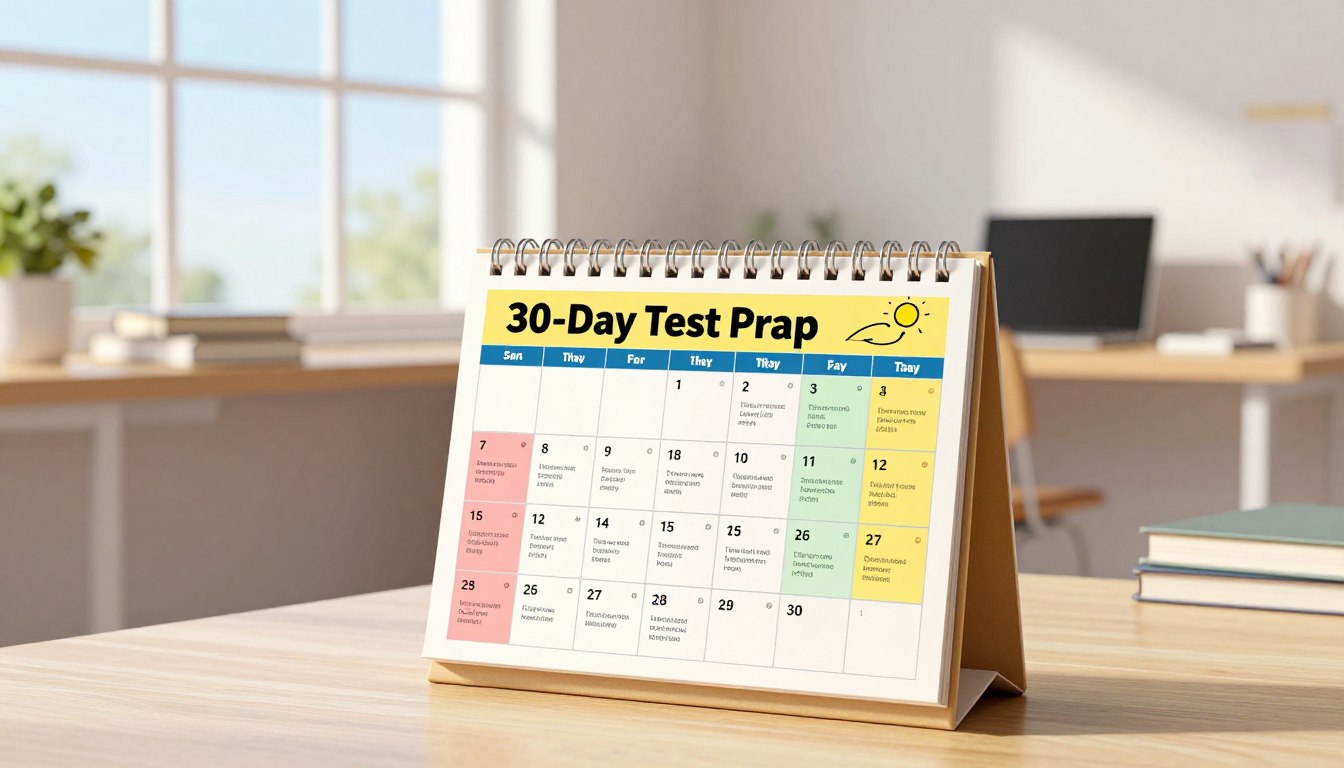
A 30-Day Test Prep Calendar for Busy Students</h2>
Define success in numbers and tasks—then build every day backward from that endpoint.
Set your goal score and describe what “done” looks like: a target score range, section accuracy (for example 80%+ in math), a minimum number of timed sets, and at least two full practice tests completed under simulated conditions.
Use backward planning to map exam dates into weeks. Anchor the fixed exam first, then allocate content weeks, practice weeks, and final review weeks so high-weight units are not left to the last days.
Assign topics to days
Pick either a paper planner or a digital calendar with recurring sessions and reminders. Assign one primary task per day (learn or practice) plus one micro-review task (error log or flashcards).
Build review and buffers
- Include 2–4 catch-up blocks across the month and at least one full rest day to avoid burnout.
- Use a simple workload rule: one main task + one quick review each day.
- On overbooked days, convert the main task to a 10–20 minute review rather than skipping it.
- List exam goals and fixed dates.
- Backward-plan weeks: content → practice → review.
- Assign topics to days; add reminders and recurring events.
Speed tip: FlowScholar can convert goals, dates, and topic lists into an editable calendar and adjust the plan when life changes. Explore https://www.flowscholar.com to generate the calendar fast and keep tasks clear as the month gets busy.
“Concrete goals plus backward planning turn vague intent into daily action.”
Design your weekly rhythm so every day has a clear focus
Designing a weekly rhythm gives your month structure so every session has purpose. This rhythm is the control system that keeps a 30-day plan realistic: repeatable patterns beat constant reinvention.
Content learning days: notes, lessons, and concept mastery
On learning days, aim for concept mastery. Keep clean notes and create one-page summaries.
Explain the idea out loud without notes, then verify with problems. If you can teach it, you understand it.
Practice question days: accuracy first, then speed
Practice days focus on questions. Follow the accuracy-then-speed rule: earn correctness before adding timers.
Track errors and repeat missed question types until accuracy improves. Only then layer timing to increase pace.
Weekly recap: fix weak spots with targeted review
End each week with a short recap. Review the error log and pick 2–3 weak topics for next week’s mini-sessions.
This modular approach helps busy students swap day types when life interrupts rather than abandoning the plan.
“Part-by-part improvement builds steady confidence and predictable score gains.”
- Why it works: The rhythm reduces decision fatigue and preserves study minutes.
- How to swap: Move the missed day forward; keep the weekly pattern intact.
Make practice tests and practice questions non-negotiable
Regular, timed practice exposes the real limits of pacing and stamina—facts that content review alone will not reveal. In a tight month, structured practice turns unknowns into measurable work.
When to take full-length practice tests
Place three full runs across the month: an early diagnostic, a mid-month simulated run, and a final timed run under exam-like rules. These checkpoints show trajectory and highlight endurance issues.
- If time is limited, split a full test into two sessions—preserve section timing and rest rules.
- Use the mid-point test to reassign study priorities for the final weeks.
How to review missed questions and turn them into new tasks
Adopt a strict error workflow: categorize each miss (concept, careless, timing, misread), write a short fix, then add one scheduled task to address it.
- Log the error with tags and a one-line correction.
- Create a follow-up task on the calendar for that week.
- Retest the same question type in the next session to confirm the fix.
Section timing and pacing drills for test-day confidence
Use short timed sets—10–20 questions—to train pace and reduce rush. Track accuracy, seconds per question, and repeat-miss rate.
Measure progress: trend accuracy, average time per question, and error-repeat percentage. Review consistently—points are earned in the review, not just during exposure.
Adjust your plan for the ACT and other standardized test changes
Updates to exam formats should trigger a quick review of any active study plan. The calendar must match what will be scored on test day; otherwise time is wasted and confidence drops.
What changed: Starting April 2025 for the digital ACT and September 2025 for the paper ACT, the Science section became optional. If a student opts out of Science, remove those blocks from the schedule and reassign the time.
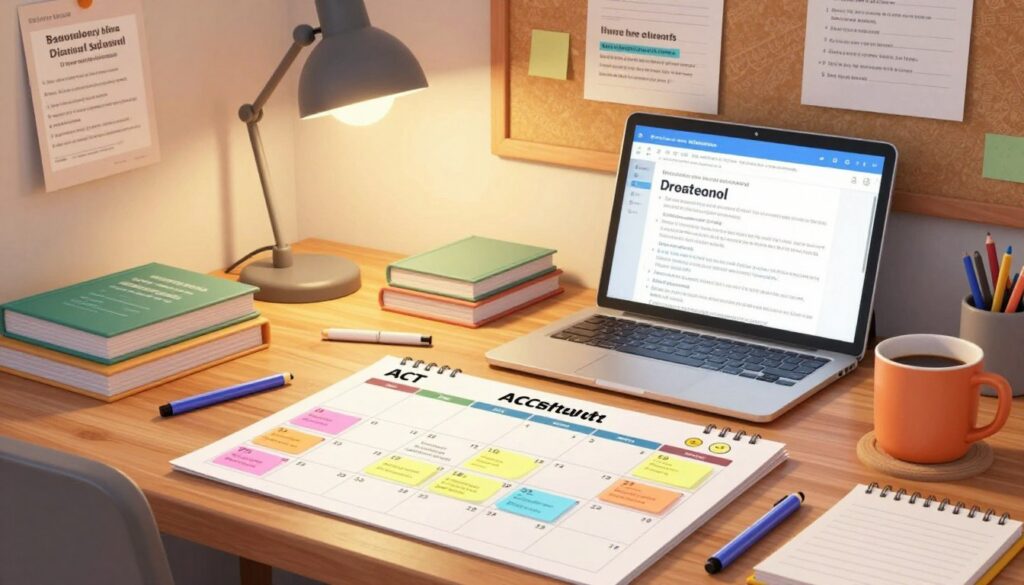
ACT Science becoming optional: how to adapt your study schedule
If Science will not count, skip Science study blocks and reallocate them to higher-impact areas. Do this responsibly: add targeted practice questions, pacing drills, and timed passages to core sections rather than only increasing passive review.
Choosing sections based on your test format and score goals
Decide which sections to take by aligning with score goals, college requirements, and personal strengths. Then plan backward: set weekly targets, pick practice-test cadence, and lock in the topics that move your score most.
- Confirm the exact test format and registration details early to avoid last-minute rebuilds.
- Reallocate time to English, Math, or Reading with extra timed practice and error logging.
- When other exams change sections or weights, update the weekly rhythm and practice-test schedule to reflect new scoring realities.
“A modern prep plan is a living document—adapt it to changes, then execute with focused tasks.”
For a practical section-specific study approach, see this concise ACT study guide: ACT study plan.
Stay consistent with simple tracking and habit tactics
Small, visible habits often outwork raw willpower—tracking turns intention into momentum. Use lightweight signals that make progress obvious and reduce the work of deciding what to do each day.
Use “don’t break the chain” to protect your daily streak. Mark a large X on a wall calendar or tap an app each time you complete a study session. The growing chain becomes a behavioral lever: people avoid breaking visible progress.
Practical tracking options
- Paper calendar on the wall—low friction and highly visible.
- Habit app with reminders and streak counts.
- Digital calendar completion checks for automated records.
What to do when you miss a day without derailing the month
Do not double up the next day. Instead follow a simple two-step reset:
- Complete a minimum viable study task today (10–20 minutes counts).
- Reschedule the missed task into your next buffer slot or move it to a short, defined catch-up session later that week.
Guardrails against perfectionism: return quickly after a miss. Consistency grows with repetition; after a few weeks of the same scheduled time, the routine becomes automatic and less costly emotionally.
“Short sessions still count—this plan is built for busy lives, not ideal conditions.”
Track progress and protect your schedule. For practical tips on turning small streaks into long-term habits, see follow-through and make it a daily.
Conclusion
Close the month by turning decisions into small, repeatable actions that build momentum toward exam day. Define the exam scope, pick realistic daily time blocks, protect sessions, and maintain a weekly rhythm that balances learning and practice.
This simple system reduces overwhelm and makes progress measurable. It fits school, work, and life by including buffers and review days as essentials, not extras.
Today’s task: write your input prompt with dates, topics, and priorities, then schedule week one. Keep practice questions, full practice runs, and structured review as non-negotiables.
Perfection is not the goal; repeatable progress is. To turn inputs into a clear 30-day plan faster, explore FlowScholar at FlowScholar. For a practical study timetable template, see this study time table.
FAQ
How does a study schedule beat last-minute cramming?
A planned schedule spaces learning, which strengthens memory and reduces stress. Breaking content into daily tasks turns big goals into manageable steps, increases focus during sessions, and improves long-term retention compared with overnight studying.
How do I turn “study Math” into clear, actionable tasks?
Identify the exam topics, list chapters or standards, and create specific tasks: read one chapter, complete a problem set, or review formula sheets. Tag each task with a priority and estimated time so days become concrete work items, not vague intentions.
What’s the best daily time block when juggling school, work, and life?
Choose a consistent block that fits your existing routine—morning before classes, a lunch break, or an evening slot. Aim for one focused block around 50–60 minutes, then schedule short recovery and review slots that match your energy and obligations.
Why are 52-minute focused sessions recommended?
Sessions around 50–55 minutes align with sustained attention and allow for meaningful practice without burnout. They balance depth and recovery: long enough for progress, short enough to keep concentration high and integrate short breaks.
Should I use short bursts or longer study blocks?
Use a mix. Short bursts (25–30 minutes) are ideal for review and high-frequency repetition. Longer blocks (50–90 minutes) suit deep learning, problem solving, or practice tests. Match block length to task complexity and daily commitments.
When are the best times of day to study?
Morning sessions work well for concept learning and retention. Midday blocks fit busy schedules and allow review between commitments. Evening study can be effective for practice questions and consolidation—choose times when alertness and distraction levels are lowest.
How do I protect study time with roommates, family, and phones?
Communicate clear boundaries: set a visible sign, agree on quiet hours, and schedule sessions in shared calendars. Turn off notifications or use focus modes on your phone. Small rituals—like a dedicated study playlist—signal intent and reduce interruptions.
Can a study buddy really improve follow-through?
Yes. A partner provides accountability, helps compare approaches, and can run quick peer reviews. Pair on specific goals—shared practice sessions, timed drills, or end-of-week recaps—to boost consistency and motivation.
How should I set my goal score and define “done”?
Set a target score that aligns with program or college requirements. Define “done” for each topic: mastery could mean explaining a concept, completing a set number of practice questions at 80%+ accuracy, or hitting timed section goals. Make outcomes measurable and time-bound.
What’s the best way to backward-plan from exam dates?
Map the exam date, count available days, and allocate blocks for learning, practice, review, and simulated tests. Place major milestones—first full practice, mid-plan checkpoint, final review week—and add buffer days for catch-up and rest.
How many topics should be assigned to a single day?
Limit each day to a few focused topics: one new concept area, one practice set, and one short review. This keeps daily workload realistic and preserves deep practice. Use lighter days for cumulative review or missed material.
How often should review and rest days appear in the plan?
Build at least one full rest or light-review day per week and schedule periodic cumulative review every 4–7 days. Include catch-up buffers after heavy practice or simulated tests to prevent burnout and consolidate gains.
What should a weekly rhythm look like?
Structure weeks with clear roles: content learning days for new material, dedicated practice question days, and a weekly recap that targets weak spots. Consistent roles help focus effort and speed recovery from missed sessions.
When should full-length practice tests be scheduled in a 30-day plan?
Take a baseline full test early to identify gaps, a mid-plan test to measure progress, and a final simulated test 3–7 days before the exam. Space these to allow analysis and targeted remediation after each attempt.
How do I review missed questions effectively?
Treat each missed question as a micro-project: identify the error type, restudy the concept, do similar problems, and add the topic to future review days. Track recurring mistakes and convert them into prioritized tasks.
How should pacing drills be integrated for test-day confidence?
Practice sections under timed conditions regularly, then analyze pacing: where time was lost, which question types caused slowdowns, and strategies to improve. Simulate test conditions at least twice to build stamina and time management skills.
How to adapt the plan for ACT changes like optional Science?
Reassess priorities: if Science is optional for the target score, reduce dedicated hours and reallocate them to higher-impact sections. Still include diagnostic practice so the option is informed by performance, not assumption.
How do you choose which sections to prioritize based on format and goals?
Use baseline scores and target improvements to allocate time: invest more hours where score gains are most attainable. Consider section weight, personal strengths, and university requirements when assigning study focus.
What tracking methods help maintain consistency?
Use a simple habit tracker, calendar blocks, or apps like Google Calendar and Todoist to log sessions. “Don’t break the chain” visual streaks and brief end-of-day notes help maintain momentum and reveal patterns over time.
What to do if a day is missed without derailing the plan?
Reassess priorities: trim lower-impact tasks, shift one session to a buffer day, or combine small tasks across subsequent days. Maintain the streak mindset—resume the next scheduled session and avoid compensatory all-night cramming.
How many hours per day are realistic for someone balancing work and school?
For tight schedules, 1–2 focused hours per day can yield strong gains with consistent practice. When time allows, increase to 3–4 hours with mixed blocks. Quality and focus matter more than raw hours—use deliberate practice techniques.
How should mornings be used versus evenings?
Reserve mornings for new concepts and heavy cognitive tasks when the mind is fresh. Use evenings for review, practice questions, and consolidation. Match task difficulty to energy cycles to maximize learning efficiency.
Which tools help assign topics to days efficiently?
Use digital calendars (Google Calendar), planners, or study apps (Notion, Trello) to map topics to dates, attach resources, and set reminders. Templates that include review and buffer slots streamline assignment and prevent overload.
Are short daily reviews worth scheduling every day?
Yes. Brief nightly reviews (10–20 minutes) reinforce learning, surface weak areas, and make the next day’s session more productive. Small, frequent reviews boost retention far more than occasional marathon sessions.