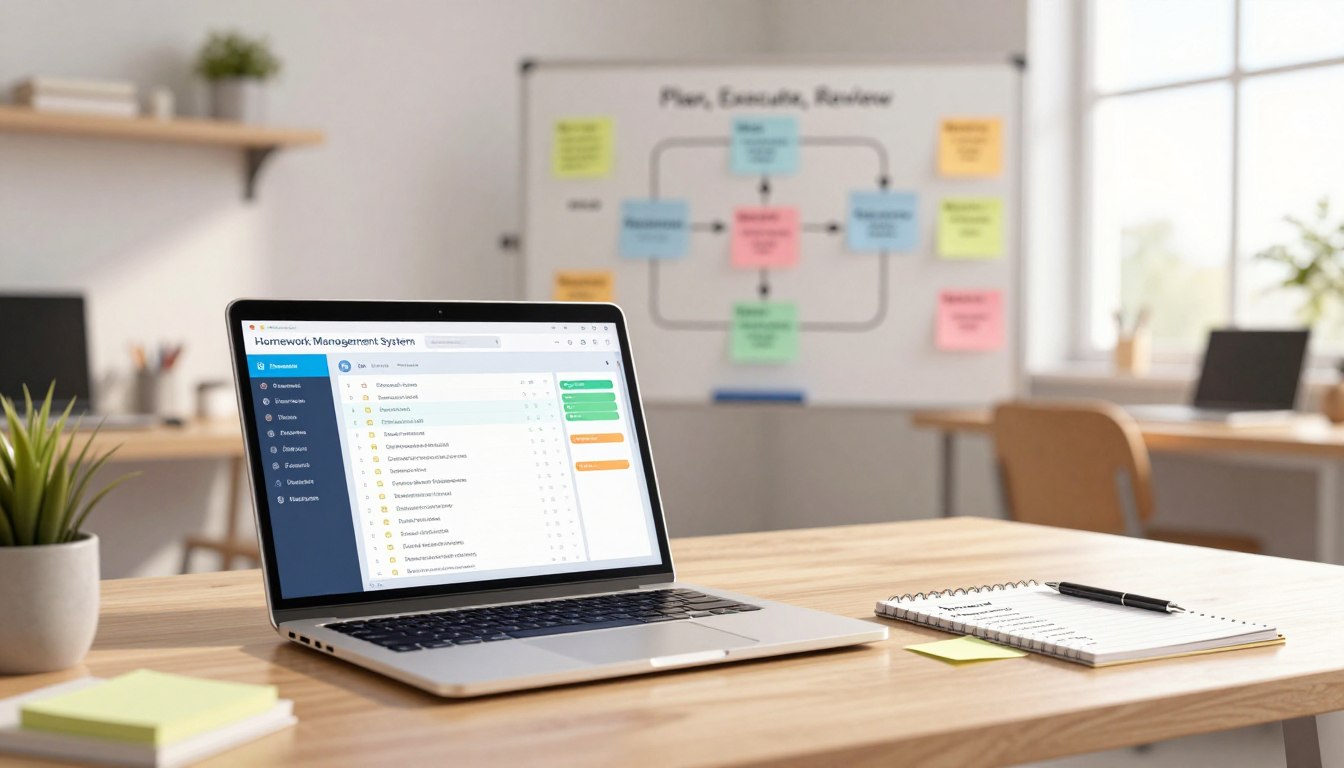
As Carol Dweck once said, “The key is not to improve by one percent, but to improve by repeating the process.” This mindset is at the heart of the FlowScholar Homework System, a revolutionary approach to homework management that transforms how students approach academic tasks.
The FlowScholar Homework System introduces a cyclical methodology that emphasizes deliberate planning, focused execution, and thoughtful review. By leveraging advanced educational AI technology, this system helps students develop sustainable homework habits that improve both efficiency and comprehension.
By adopting this structured yet flexible framework, students can develop metacognitive skills that transfer across subjects and prepare them for higher-level academic challenges. For more information on how AI is transforming education, visit Miloriano’s article on building GPT-powered educational.
Key Takeaways
- The FlowScholar Homework System introduces a revolutionary approach to homework management.
- This system addresses fundamental challenges students face with homework.
- It leverages advanced educational AI technology to improve efficiency and comprehension.
- Students develop metacognitive skills that transfer across subjects.
- The system prepares students for higher-level academic challenges.
Understanding the FlowScholar Homework System
The FlowScholar Homework System is revolutionizing the way students approach their assignments by integrating cognitive science into practical time management techniques. This comprehensive system is designed to transform homework from a passive completion task into an active learning process.
What Makes FlowScholar Different
FlowScholar differentiates itself from conventional homework tools by integrating cognitive science principles with practical time management techniques to create a comprehensive system. This approach is grounded in educational psychology research, showing that metacognitive processes significantly improve knowledge retention and application. By engaging students before, during, and after assignment work, FlowScholar fosters a deeper understanding of the material.
The system’s AI-powered platform adapts to individual learning patterns over time, offering personalized recommendations based on a student’s unique workflow and subject-specific challenges. This adaptability ensures that each homework session becomes not just about completing tasks but about becoming a more effective learner overall.
The Science Behind the Plan-Execute-Review Loop
The Plan-Execute-Review loop is a methodology that emphasizes thinking and explaining a problem before implementation. This exercise is crucial to assess understanding of the challenge. With recent advancements in LLMs and agentic AI, a similar experience can be replicated with AI assistance. The initial setup involves setting expectations and having quality standards.
By following this loop, students develop metacognitive skills that are essential for effective learning. The cyclical nature of the system creates a continuous improvement loop, where each homework session contributes to overall learning success.
Why Traditional Homework Management Fails
## Why Traditional Homework Management Fails (300 words)
The traditional homework management approach often falls short because it focuses exclusively on task completion rather than the quality of learning and understanding that occurs during the process. Many students struggle with prioritization, often spending excessive time on less important assignments while neglecting those that contribute more significantly to their learning and grades.
### Common Homework Struggles for Students (150 words)
Students commonly face challenges in managing their homework due to several factors. These include a lack of prioritization, where they spend too much time on less critical assignments. Insufficient review is another issue, as many students complete tasks without reflecting on what they’ve learned. Poor time management also plays a role, as students often fail to allocate their time effectively across different assignments and subjects.
### The Missing Link in Homework Productivity (150 words)
The missing link in homework productivity is typically the absence of a structured review process. Most students do not have a systematic approach to reviewing what they’ve learned, which is crucial for reinforcing their understanding and improving their approach to future assignments. A structured homework management system should help students prioritize tasks, review their progress, and manage their time more effectively. By adopting such a system, students can enhance their productivity and achieve better learning outcomes.
The Planning Phase: Setting Yourself Up for Success
A thoughtful planning phase can significantly enhance a student’s ability to manage assignments. The planning phase forms the foundation of the FlowScholar Homework System, requiring students to thoughtfully analyze and organize their assignments before diving into execution.
Effective planning involves several key steps, starting with prioritizing assignments using the Eisenhower Method.
Prioritizing Assignments Using the Eisenhower Method
The Eisenhower Method, inspired by Dwight D. Eisenhower’s quote, “I have two kinds of problems, the urgent and the important. The urgent are not important, and the important are never urgent,” is a decision-making tool that categorizes tasks into four quadrants based on their urgency and importance. This method helps students prioritize tasks effectively, focusing on important and urgent tasks first. By using the Eisenhower Matrix, students can differentiate between tasks that are truly important and those that are merely urgent, thus optimizing their study time.
Creating Effective Study Blocks in Your Schedule
Creating effective study blocks involves more than just allocating time; it requires strategic placement of different types of homework tasks based on energy levels and concentration patterns throughout the day. Students should identify their most productive times and schedule challenging tasks accordingly. By doing so, they can maximize their productivity and retention. For instance, using the FlowScholar Education AI Tool, students can analyze their study patterns and optimize their schedule for better outcomes.
Setting Clear, Achievable Homework Goals
Setting clear, achievable homework goals means breaking down larger assignments into specific, measurable steps that can be realistically accomplished within designated time frames. This approach not only makes the task less daunting but also provides a sense of success as each step is completed. By setting precise goals, students can maintain focus and motivation, ultimately leading to greater success in their academic endeavors.
By implementing these strategies, students can make the most of their study time and achieve their academic goals.
Planning Tools and Techniques in FlowScholar
Effective planning is the backbone of academic success, and FlowScholar’s tools are designed to make this process seamless. By utilizing FlowScholar, students can create structured plans for various assignments, ensuring they stay on track and manage their time efficiently.
Digital Planning Features
FlowScholar’s digital planning features are comprehensive and user-friendly. The platform offers customizable templates for different assignment types, allowing students to quickly create structured plans for essays, problem sets, and research projects. Additionally, the intelligent task breakdown functionality automatically suggests logical steps for completing complex assignments based on the assignment type and due date. This feature saves students a significant amount of time in the planning process.
The platform’s visual planning interface uses color-coding and priority indicators to help students instantly recognize which tasks require immediate attention and which can be scheduled for later work sessions. This visual aid enhances productivity and ensures that students make the most of their study time.
Integrating FlowScholar with Your Existing Systems
One of FlowScholar’s key strengths is its ability to integrate with existing systems, including calendar systems, learning management platforms, and productivity tools. This integration creates a seamless workflow across all academic and personal planning systems
By syncing FlowScholar with your existing systems, you can ensure that all your tasks and assignments are organized in one place, making it easier to manage your time and stay on top of your work. This integration also helps in avoiding listing down the same tasks in multiple places, thus reducing confusion and increasing productivity.
Try FlowScholar today and experience the power of effective planning!
The Execution Phase: Focused Work Sessions
The execution phase is where planning meets action, requiring students to create an environment conducive to productivity. This stage is critical in the FlowScholar Homework System, as it’s where students put their plans into practice and work on their assignments.
Creating Distraction-Free Study Environments
Creating a distraction-free study environment is essential for maintaining focus during homework sessions. This involves both physical space optimization and digital focus tools. FlowScholar helps students monitor and maintain their study environments throughout work sessions, ensuring they stay on track. To achieve this, students can use tools like website blockers and apps that help them stay focused. By minimizing distractions, students can make sure they’re using their time efficiently.

The Pomodoro Technique for Homework Completion
The Pomodoro Technique is a valuable tool integrated into FlowScholar, allowing students to work in focused sprints of 25-30 minutes followed by short breaks. This technique is scientifically proven to maintain high levels of concentration over extended study periods. By using this technique, students can break down their tasks into manageable chunks, making it easier to stay focused and avoid burnout. As students work in these focused sprints, they can feel like they’re making progress, which helps to maintain motivation.
Overcoming Execution Roadblocks
Despite the best plans, roadblocks can occur during the execution phase. FlowScholar’s system includes built-in mechanisms to overcome common issues such as unclear instructions, knowledge gaps, or motivation problems. The system provides just-in-time resources and adaptive support to help students overcome these challenges. By identifying when a student is struggling or losing focus, FlowScholar offers timely interventions to get them back on track without breaking the flow of work. This ensures that students can continue to use their plan effectively, making adjustments as needed to stay on course.
FlowScholar Homework System: Plan, Execute, Review—On Repeat in Action
The effectiveness of the FlowScholar system is best demonstrated through real-world examples. By examining how the Plan-Execute-Review loop functions in different academic contexts, we can appreciate its versatility and impact.
Case Study: Math Homework Management
In managing math homework, the FlowScholar system proves particularly effective. Here’s how it works:
- During the planning phase, students break down complex problem sets into manageable parts, identifying areas where they need additional practice.
- In the execution phase, they focus on solving these problems, using targeted practice to address knowledge gaps.
- The review phase allows students to analyze their mistakes, understand where they went wrong, and adjust their approach for future assignments.
This iterative process not only improves understanding but also builds confidence in tackling challenging math problems. By using FlowScholar, students can transform their approach to homework, making it a more efficient and effective process.
Case Study: Long-Term Research Projects
For long-term research projects, FlowScholar’s iterative approach is equally beneficial. The system helps students:
- Create a detailed plan with milestones and deadlines.
- Execute their research in focused work sessions, regularly reviewing their progress.
- Adjust their strategy based on insights gained during the review phase, ensuring they stay on track.
By following this structured yet flexible approach, students can avoid procrastination and produce high-quality work. The FlowScholar system adapts to the needs of different projects, providing a tailored framework for success.
Both case studies demonstrate the power of the FlowScholar system in enhancing homework management across various academic disciplines. By implementing the Plan-Execute-Review loop, students can achieve significant improvements in their productivity and understanding.
The Review Phase: Learning from Your Process
The review phase is a critical component of the FlowScholar Homework System, transforming homework from a one-time task into a continuous learning opportunity. By systematically analyzing both the process and the outcome, students can identify areas for improvement and develop more effective study habits.
Effective Self-Assessment Strategies
Effective self-assessment is at the heart of the review phase. It involves reflecting on the homework process to identify strengths, weaknesses, and areas for improvement. FlowScholar guides students through reflective questions that help them analyze their work product and study approach, enabling them to make informed adjustments for future homework sessions.
Using FlowScholar’s Analytics to Track Progress
FlowScholar’s analytics dashboard provides a visual representation of productivity patterns, accuracy rates, and time management efficiency. This data gives students concrete insights into their homework performance, helping them identify recurring challenges and make connections between different assignments and subjects. By tracking their progress, students can refine their study strategies and improve their overall academic performance.
Making Adjustments Based on Performance Data
FlowScholar’s recommendation engine suggests specific modifications to planning and execution strategies based on individual learning patterns. By analyzing performance data, students can identify areas where they need to improve and make targeted adjustments to their study habits. This data-driven approach enables students to optimize their homework process, leading to better results and increased confidence.
By incorporating these strategies into their homework routine, students can maximize their learning potential and achieve greater academic success. The review phase is an essential part of the FlowScholar Homework System, and by leveraging its features, students can take their learning to the next level.
The Power of Repetition: Building the Homework Loop
The true potential of the FlowScholar homework system is unlocked through consistent application and repetition. As students continue to use the Plan-Execute-Review loop, it becomes an internalized process, making homework management more efficient over time.
By internalizing this loop, students can focus more on the content of their work rather than the process, leading to improved productivity and reduced stress. The FlowScholar system is designed to be flexible and adaptive, allowing students to adjust their approach as needed while maintaining the core loop structure.
Creating Sustainable Homework Habits
Creating sustainable homework habits involves consistency in applying the FlowScholar system across different subjects and assignment types. As students repeat the Plan-Execute-Review process, it becomes second nature, reducing the mental effort required to manage homework. The neurological benefits of repetition include the formation of stronger neural pathways that make planning, focused execution, and thoughtful review increasingly automatic and efficient over times.
For instance, a student using FlowScholar for math homework can develop a habit of breaking down complex problems into manageable steps, making it easier to tackle similar problems in the future. To learn more about how FlowScholar can be integrated into daily routines, visit https://www.flowscholar.com.
Adapting Your System as Courses Change
As courses change throughout an academic career, the FlowScholar system’s flexibility allows for adjustments in specific techniques while maintaining the core loop structure. This ensures continuity in homework management despite evolving academic demands. By adapting the system to meet new challenges, students can continue to improve their productivity and learning outcomes.
For example, as students progress from one course to another, they can refine their approach by analyzing their performance data, as discussed in the Plan-Execute-Review process. This enables them to make informed changes to their homework routine, ensuring they remain effective and efficient in their work.
Managing Multiple Subjects with FlowScholar
FlowScholar is designed to help students manage multiple subjects simultaneously. Its cross-subject dashboard provides a holistic view of all academic responsibilities, allowing for deep dives into subject-specific workflows when needed.
Balancing different types of assignments becomes more intuitive with FlowScholar’s intelligent scheduling. The system distributes various homework categories (reading, problem-solving, writing, research) optimally throughout the week, ensuring that students can manage their workload effectively.
Balancing Different Types of Assignments
With FlowScholar, students can prioritize their assignments based on the type and deadline. The system recognizes that different subjects require different approaches, making it easier to manage multiple subjects.
For example, mathematics homework might require more focused study sessions, while literature assignments might involve more reading and analysis. FlowScholar’s subject-specific strategies help students make the most of their study time.
Subject-Specific Strategies
FlowScholar’s resource allocation features help students make informed decisions about how to distribute their time and energy across different subjects. The system takes into account course requirements, personal learning goals, and current performance metrics, helping students achieve their academic goals.
Time Management Personalities and FlowScholar Adaptations
Understanding individual time management personalities is crucial for effective learning. FlowScholar recognizes that people approach time differently, and it’s essential to align your study habits with your personal rhythm. By acknowledging and adapting to these differences, students can maximize their productivity and achieve better academic results.
The Early Bird Approach
The Early Bird adaptation is designed for proactive planners who prefer to tackle tasks early. FlowScholar’s extended forecasting tools and satisfaction-tracking features reward consistent early completion of tasks, helping students stay on top of their assignments.
The Balancing Act Strategy
For individuals who need to juggle multiple responsibilities, FlowScholar offers equilibrium monitoring. This feature helps maintain an optimal distribution of effort across academic, social, and personal tasks, ensuring that no single aspect is neglected.
The Pressure Cooker Method
The Pressure Cooker adaptation acknowledges that some students work best under deadline pressure. FlowScholar builds in safeguards and quality-control measures to ensure that last-minute work doesn’t compromise learning outcomes, providing a safety net for those who thrive in high-pressure situations.
The Improviser Technique
For students with spontaneous work styles, FlowScholar provides flexible frameworks and just-in-time resources. This approach supports quality work even when following non-traditional timelines, allowing improvisers to produce their best work without being constrained by rigid structures.
By understanding and leveraging these different time management personalities, FlowScholar helps students tailor their study habits to their unique needs, enhancing their overall learning experience and academic performance. With FlowScholar, students can develop a personalized approach to time management that suits their individual style, leading to greater productivity and success.

Overcoming Procrastination with the FlowScholar System
FlowScholar addresses procrastination head-on by providing analytical and behavioral interventions tailored to individual needs. Procrastination represents one of the most significant barriers to effective homework management, and understanding how to overcome it is crucial for academic success.
Identifying Your Procrastination Triggers
The FlowScholar System helps students identify personal procrastination triggers through pattern recognition that correlates delayed task initiation with specific assignment types, subjects, times of day, or emotional states. By understanding these triggers, students can develop targeted strategies to overcome them. For instance, if a student consistently procrastinates on math homework in the evening, the system might suggest alternative times or approaches to make the task more manageable.
According to a study available on academic procrastination, understanding the root causes of procrastination is essential for developing effective countermeasures. FlowScholar’s procrastination dashboard visualizes the actual cost of delay in terms of reduced quality, increased stress, and diminished learning outcomes, creating powerful motivation for behavior change.
Building Anti-Procrastination Routines
Building anti-procrastination routines involves creating environmental and psychological conditions that make starting homework easier than avoiding it. FlowScholar facilitates this process through customized pre-work rituals and micro-goal functionality, which breaks seemingly overwhelming assignments into small initial steps. As Steven Pressfield once said, “The most important thing is to begin. The next most important thing is to continue.” By making the first step as simple as possible, FlowScholar helps students build momentum and overcome the inertia that often underlies procrastination.
By leveraging these features, students can develop a sustainable habit of starting their homework without delay, leading to improved time management and reduced stress. The key is to make the initial step so straightforward that it feels almost effortless, thereby creating a positive feedback loop that reinforces productive behavior over time.
Advanced FlowScholar Techniques for College Success
Advanced FlowScholar techniques extend beyond basic homework management, supporting sophisticated academic challenges encountered in higher education settings. By integrating research and writing workflows, students can create seamless processes between information gathering, synthesis, outlining, drafting, and revision.
Integrating Research and Writing Workflows
FlowScholar’s research-writing integration enables students to manage their research process more effectively. It tracks sources throughout the research, automatically formatting them according to the required academic style. This feature eliminates one of the most tedious aspects of college-level writing.
Group Project Management
The group project management features in FlowScholar allow multiple users to coordinate their individual Plan-Execute-Review loops within a shared project space. This maintains individual accountability while ensuring collective progress. Advanced analytics provide insights into learning patterns, helping students make strategic decisions about their academic paths.
Measuring Your Homework Efficiency and Results
The FlowScholar system empowers students to assess their homework efficiency and results, leading to data-driven improvements. By leveraging FlowScholar’s analytics capabilities, students can transform subjective impressions about their productivity into objective data. This data guides continuous improvement in academic performance, helping students make the most of their study time.
Short-term vs. Long-term Success Metrics
FlowScholar distinguishes between short-term metrics such as assignment completion, grade outcomes, and time efficiency, and long-term indicators like knowledge retention, skill development, and stress reduction. By tracking both, students gain a comprehensive view of their homework effectiveness. For example, a student might excel in completing assignments quickly (short-term) but struggle with retaining information over time (long-term). The system’s longitudinal tracking allows students to correlate specific planning and execution strategies with both immediate and delayed outcomes, revealing which approaches yield sustainable results.
Using FlowScholar Data to Improve Study Habits
Using FlowScholar data to improve study habits involves identifying both strengths to leverage and weaknesses to address. By analyzing performance data, students can create a personalized optimization strategy based on actual performance rather than generic advice. For instance, a student might discover that their most productive time of day is morning, or that breaking tasks into smaller blocks enhances their focus. Advanced visualization tools make complex performance data accessible and actionable, helping students make evidence-based decisions about how to allocate their limited time and cognitive resources across competing academic priorities.
Conclusion: Making the FlowScholar System Work for You
The FlowScholar Homework System offers a proactive approach to managing academic tasks, leading to better results. By adopting the Plan-Execute-Review loop, students can significantly enhance their productivity and reduce stress. This system represents a paradigm shift in how students approach their homework, moving from reactive completion to proactive management.
Successful implementation of the FlowScholar System requires personalization—adapting the core principles to individual learning styles, academic requirements, and time management personalities. The system’s flexibility allows it to evolve with students throughout their academic journey, from basic homework management in early education to sophisticated research and writing workflows in higher education.
Students who fully embrace the FlowScholar approach typically report not only improved grades but also reduced academic stress, greater confidence in their abilities, and more enjoyment of the learning process. To achieve these results, it’s essential to make the most of the system’s features, such as creating effective study blocks, prioritizing tasks, and using data to inform adjustments.
To begin transforming your homework experience with FlowScholar, visit https://www.flowscholar.com to create your personalized account and start building your Plan-Execute-Review loop today. By doing so, you’ll be taking the first step towards achieving academic success and developing sustainable study habits that will serve you well throughout your educational journey.
FAQ
How does the FlowScholar system help with time management?
The FlowScholar system aids in effective time management by allowing users to prioritize tasks, allocate specific time blocks for different activities, and track progress. This structured approach enables individuals to make the most of their time, ensuring that they stay on top of their assignments and study commitments.
Can FlowScholar be used for different types of assignments?
Yes, FlowScholar is designed to be versatile and can be used for various types of assignments, including math homework, research projects, and group work. Its flexibility allows users to adapt the system to their specific needs, making it a valuable tool for managing diverse academic tasks.
How does the review phase contribute to the learning process?
The review phase is crucial as it allows users to assess their performance, identify areas for improvement, and adjust their study habits accordingly. By regularly reviewing their progress, individuals can refine their approach, leading to more effective learning and better outcomes.
Is FlowScholar suitable for students with different learning styles?
FlowScholar is designed to be adaptable, allowing users to tailor the system to their individual learning styles. Whether you’re an early bird, a pressure cooker, or an improviser, FlowScholar provides the flexibility to accommodate different approaches, ensuring that it can be a valuable tool for a wide range of students.
How can FlowScholar help in overcoming procrastination?
FlowScholar helps in overcoming procrastination by breaking down tasks into manageable steps, setting clear goals, and establishing a routine. By creating a structured plan and tracking progress, users can stay motivated and focused, reducing the likelihood of procrastination.
Can FlowScholar be integrated with existing productivity systems?
Yes, FlowScholar is designed to be compatible with various productivity systems, allowing users to integrate it with their existing tools and workflows. This compatibility ensures a seamless transition and enables users to leverage the strengths of both FlowScholar and their current productivity methods.