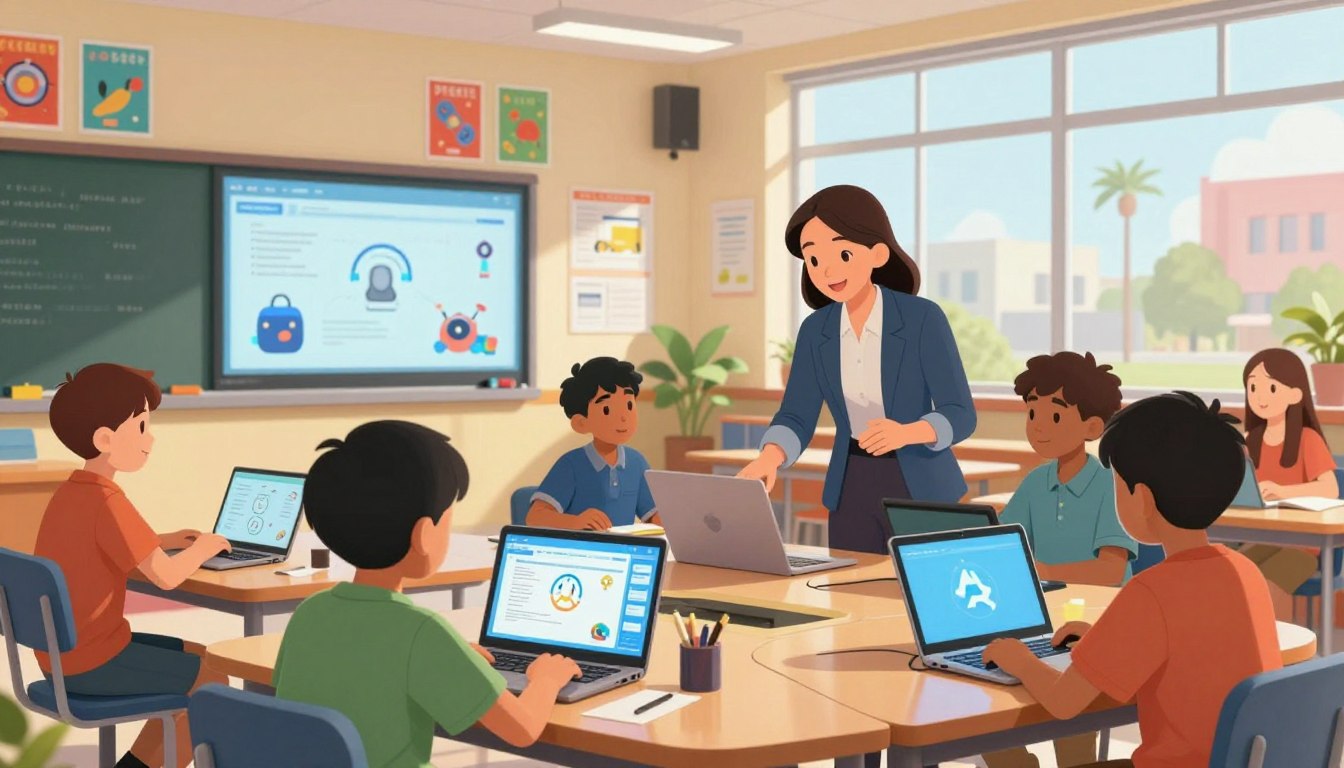
There is a quiet urgency in many North Texas hallways: teachers arrive early, parents watch schedules, and leaders weigh a single question — how to make every minute count for students.
The district-level push in Dallas and nearby systems is both practical and personal. Dallas ISD has launched a grant-backed middle school math initiative that offers personalized feedback and real-time guidance to teachers, while keeping equity front and center.
These pilots are not about gadgets; they are about time returned to teachers and clearer signals for student growth. Programs this year aim to set baselines, track outcomes, and scale what works.
Readers who want deeper context can review a recent case study and policy discussion on successful implementations in Texas: Texas pilot insights.
Key Takeaways
- North Texas districts are piloting practical, equity-focused programs this year.
- Dallas ISD’s grant supports personalized math feedback and teacher PD.
- Leaders focus on measurable student outcomes, not hype.
- Successful pilots aim to free teacher time for high-value instruction.
- Stakeholders will watch fidelity, adoption, and performance indicators.
North Texas schools accelerate artificial intelligence in the classroom
North Texas classrooms are shifting fast as districts adopt targeted tools to support teaching and learning.
Practical needs — not novelty — are driving the move. Schools aim to close feedback gaps for students and return valuable time to teachers. Early pilots focus on immediate feedback loops, clearer differentiation, and smarter use of the school day.
Districts follow strict vetting and training so technology aligns with instructional goals and privacy standards. Cedar Hill has led with vetted tools and staff development. Dallas is combining grant support and partnerships to scale math supports.
“The goal is to give teachers timely insights and students chances to iterate, reflect, and improve,”
| Benefit | Classroom Effect | District Action |
|---|---|---|
| Faster feedback | Students revise work in real time | Tool vetting and training |
| Targeted instruction | Teachers spot misconceptions sooner | Standardized PD and guidance |
| Reduced routine load | More time for higher-order teaching | Grant-backed pilots and partnerships |
- Implementation centers on transparency with families.
- Classroom cycles move from static tasks to dynamic learning pathways.
- Parallel district pilots create a practical lab for shared best practices.
Dallas ISD launches AI for middle school math with Educate Texas and TI Foundation
A new Dallas partnership aims to translate philanthropic dollars into day-to-day math support for teachers and students.

Dallas secured a $1.7 million Texas Instruments Foundation grant to deploy an artificial intelligence tool that supports middle school math instruction at scale. The district is partnering with Educate Texas to pilot programs that focus on rigorous algebraic thinking and measurable outcomes.
Personalized feedback to strengthen algebraic thinking
The tool provides targeted feedback that helps each student progress through core concepts essential for later success in high school courses. It surfaces misconceptions early so teachers can intervene before gaps widen.
Teacher effectiveness and professional development
Teachers receive real-time guidance and ongoing professional development to sustain strong instructional moves. District leaders pair training with clear success metrics to ensure classroom practice and outcomes improve together.
“We’re ready to innovate and build teacher confidence,”
- Equity and access: Training and rollout are designed so all campuses benefit.
- Partnerships: Educate Texas and the TI Foundation position Dallas as a thought partner for scalable programs.
Cedar Hill ISD shows how teachers use AI tools for immediate, personalized feedback
Cedar Hill presents a practical blueprint for safe, classroom-centered implementation.
Dr. Charlotte Ford demonstrated Snorkl in a live lesson. The program guides students through steps without giving answers. That design keeps focus on problem solving and skill building.
Inside the math classroom: stepwise guidance, not shortcuts
Snorkl acts as a prompt engine: it offers targeted hints so students can revise work. Teachers maintain authority and decide next moves.
Beyond math: vetted tools for broader learning
The district vets apps like Canva and Google Gemini before rollout. Approved tools extend creativity, research, and formative checks across subjects.
Safety and responsibility: policy, training, and teacher roles
Cedar Hill pairs strict vetting with focused professional development. Teachers learn to fold tool feedback into lesson flows and prompt student reflection.
| Focus | Classroom Impact | District Action |
|---|---|---|
| Immediate feedback | Students revise steps in real time | Vetting and training |
| Teacher capacity | More time for small-group work | Guided PD and norms |
| Safety | Protected student data and aligned instruction | Approved app list and monitoring |
The result: classroom practice, district policy, and professional learning align so teachers can focus on deeper feedback while students get consistent process coaching. This model keeps human judgment central and scales practical work across school districts.
ISDs Using AI Across North Texas: Trends to Watch
In schools across the region, pilots are moving beyond hype toward concrete goals: faster feedback and reduced teacher work.
District leaders are aligning pilots with clear outcomes. They aim to cut repetitive tasks so teachers can focus on high-value instruction. Early results show quicker classroom feedback helps students revise work and build confidence.
Reducing teacher workload while improving classroom feedback loops
Programs prioritize vetted tools that guide students step-by-step without giving answers. Cedar Hill’s model preserves teacher judgment while speeding feedback cycles.
From “cheating” concerns to inquiry-based learning and revision culture
Leaders reframe worries about misuse into opportunities for deeper inquiry. Teachers prompt students to analyze errors, compare approaches, and iterate toward mastery.
- Shared goals: districts set measurable targets for student progress and teacher time saved.
- Classroom practice: tools surface patterns; teachers coach reasoning and reflection.
- Scale: collaboration across campuses smooths procurement, PD, and rollout.
“When feedback flows faster, teachers target instruction more precisely and students gain steady learning momentum.”
For local reporting on early pilots and outcomes, see this North Texas pilot report.
What it means for students and teachers next school year
The year ahead will show whether early experiments deliver steady math gains and reclaimed teacher time.
Districts will move from pilots to measured practice. Over the next year, districts will formalize metrics that tie new tools to math proficiency, with a sharp focus on algebraic thinking and problem solving.
Measuring impact: math proficiency, teacher confidence, and time-on-task
Success will look like steady growth in proficiency and clearer signals for instruction. Dallas plans professional development for all teachers so classroom technology yields constructive suggestions that raise student comprehension.
Teacher confidence will be a leading indicator. PD that builds fluency with classroom tools and interpretation of insights will link directly to stronger implementation.
- Students’ time-on-task and quality of practice will be tracked to spot increases in productive struggle.
- District reporting will connect middle school gains to readiness for advanced high school pathways.
- Workflow studies will check whether teachers reclaim minutes for feedback, conferencing, and small-group work.
“When professional learning, clear metrics, and data governance align, the year can yield both stronger results and less routine work.”
Leaders will publish playbooks and case studies so peers can adapt what works. For wider context and reporting, see this local reporting and practical guides on teaching skills.
Conclusion
A practical shift is underway across school districts that centers teachers while sharpening student supports. North Texas models show how a school can pair clear goals with responsible intelligence-driven programs to improve instruction where it matters.
Dallas’s grant-backed initiative and Cedar Hill’s classroom demonstrations prove a simple point: a well-vetted tool plus strong training yields measurable gains. District leaders who set metrics, protect privacy, and fund professional learning create room for steady progress.
The path forward is disciplined and promising: treat intelligence as a means to better learning, invest in teachers, protect students, and measure what matters. With that focus, programs can scale fairly and lift outcomes across the district and beyond.
FAQ
What Texas school districts are piloting artificial intelligence programs in K-12 classrooms?
Several North Texas districts — including Dallas ISD and Cedar Hill ISD — have launched pilot programs that integrate AI-driven tools into math and broader classroom instruction. These pilots often involve partnerships with foundations, universities, and edtech vendors to test tools for personalized learning, feedback, and teacher support.
How is Dallas ISD implementing AI for middle school math?
Dallas ISD partnered with Educate Texas and the Texas Instruments Foundation on a grant-backed initiative. The program uses technology to deliver targeted algebra practice, give personalized feedback, and provide teachers with real-time guidance that supports continuous professional development and improves instructional decisions.
What role did the Texas Instruments Foundation play in the Dallas initiative?
The Texas Instruments Foundation contributed significant grant funding to scale the pilot — reported at
FAQ
What Texas school districts are piloting artificial intelligence programs in K-12 classrooms?
Several North Texas districts — including Dallas ISD and Cedar Hill ISD — have launched pilot programs that integrate AI-driven tools into math and broader classroom instruction. These pilots often involve partnerships with foundations, universities, and edtech vendors to test tools for personalized learning, feedback, and teacher support.
How is Dallas ISD implementing AI for middle school math?
Dallas ISD partnered with Educate Texas and the Texas Instruments Foundation on a grant-backed initiative. The program uses technology to deliver targeted algebra practice, give personalized feedback, and provide teachers with real-time guidance that supports continuous professional development and improves instructional decisions.
What role did the Texas Instruments Foundation play in the Dallas initiative?
The Texas Instruments Foundation contributed significant grant funding to scale the pilot — reported at $1.7 million — enabling district-wide deployment, teacher training, and evaluation of tools designed to strengthen algebraic thinking and student outcomes.
How do AI tools provide personalized feedback without replacing teachers?
Modern classroom tools analyze student steps and offer hints or scaffolds rather than answers. For example, some platforms guide students through algebraic reasoning while preserving teacher-led discussion. Districts emphasize vetted tools, teacher training, and policies that maintain the educator’s central role.
What examples show how teachers use AI tools for real-time, personalized feedback?
In Cedar Hill ISD, teachers use classroom software that tracks work-in-progress and suggests next steps. One math tool helps students reflect on solution steps, while other vetted platforms like Canva and Google Gemini support project creation and research, enabling immediate formative feedback and differentiated instruction.
How are districts ensuring safety, equity, and responsible use of these technologies?
Districts conduct vendor vetting, privacy reviews, and staff training. They set clear usage policies, monitor outcomes for equity, and choose tools that support access for all learners. The goal is to make technology an equalizer rather than a source of disparity.
Do these programs reduce teacher workload or add more tasks?
Properly implemented tools reduce routine grading and give faster feedback, freeing teachers for targeted instruction and planning. However, initial rollout requires investment in training and integration. Over time, many districts report improved feedback loops and reduced administrative burden.
How do schools address concerns that AI encourages cheating or shortcuts?
Districts shift classroom culture toward inquiry, revision, and process-focused learning. Teachers design assignments that require reasoning and reflection. Tools are configured to support formative practice rather than provide final answers, and assessment policies adapt to preserve academic integrity.
What metrics are districts using to measure impact next school year?
Districts track math proficiency, growth metrics, time-on-task, and teacher confidence. They use mixed methods: quantitative achievement data and qualitative feedback from teachers and students to evaluate whether tools improve learning outcomes and instructional practice.
How can other districts start their own pilot programs?
Successful pilots begin with clear goals, partnerships with foundations or universities, a vendor vetting process, and phased rollouts that prioritize teacher training. Start small, measure early indicators, and scale based on evidence and stakeholder feedback.
.7 million — enabling district-wide deployment, teacher training, and evaluation of tools designed to strengthen algebraic thinking and student outcomes.
How do AI tools provide personalized feedback without replacing teachers?
Modern classroom tools analyze student steps and offer hints or scaffolds rather than answers. For example, some platforms guide students through algebraic reasoning while preserving teacher-led discussion. Districts emphasize vetted tools, teacher training, and policies that maintain the educator’s central role.
What examples show how teachers use AI tools for real-time, personalized feedback?
In Cedar Hill ISD, teachers use classroom software that tracks work-in-progress and suggests next steps. One math tool helps students reflect on solution steps, while other vetted platforms like Canva and Google Gemini support project creation and research, enabling immediate formative feedback and differentiated instruction.
How are districts ensuring safety, equity, and responsible use of these technologies?
Districts conduct vendor vetting, privacy reviews, and staff training. They set clear usage policies, monitor outcomes for equity, and choose tools that support access for all learners. The goal is to make technology an equalizer rather than a source of disparity.
Do these programs reduce teacher workload or add more tasks?
Properly implemented tools reduce routine grading and give faster feedback, freeing teachers for targeted instruction and planning. However, initial rollout requires investment in training and integration. Over time, many districts report improved feedback loops and reduced administrative burden.
How do schools address concerns that AI encourages cheating or shortcuts?
Districts shift classroom culture toward inquiry, revision, and process-focused learning. Teachers design assignments that require reasoning and reflection. Tools are configured to support formative practice rather than provide final answers, and assessment policies adapt to preserve academic integrity.
What metrics are districts using to measure impact next school year?
Districts track math proficiency, growth metrics, time-on-task, and teacher confidence. They use mixed methods: quantitative achievement data and qualitative feedback from teachers and students to evaluate whether tools improve learning outcomes and instructional practice.
How can other districts start their own pilot programs?
Successful pilots begin with clear goals, partnerships with foundations or universities, a vendor vetting process, and phased rollouts that prioritize teacher training. Start small, measure early indicators, and scale based on evidence and stakeholder feedback.