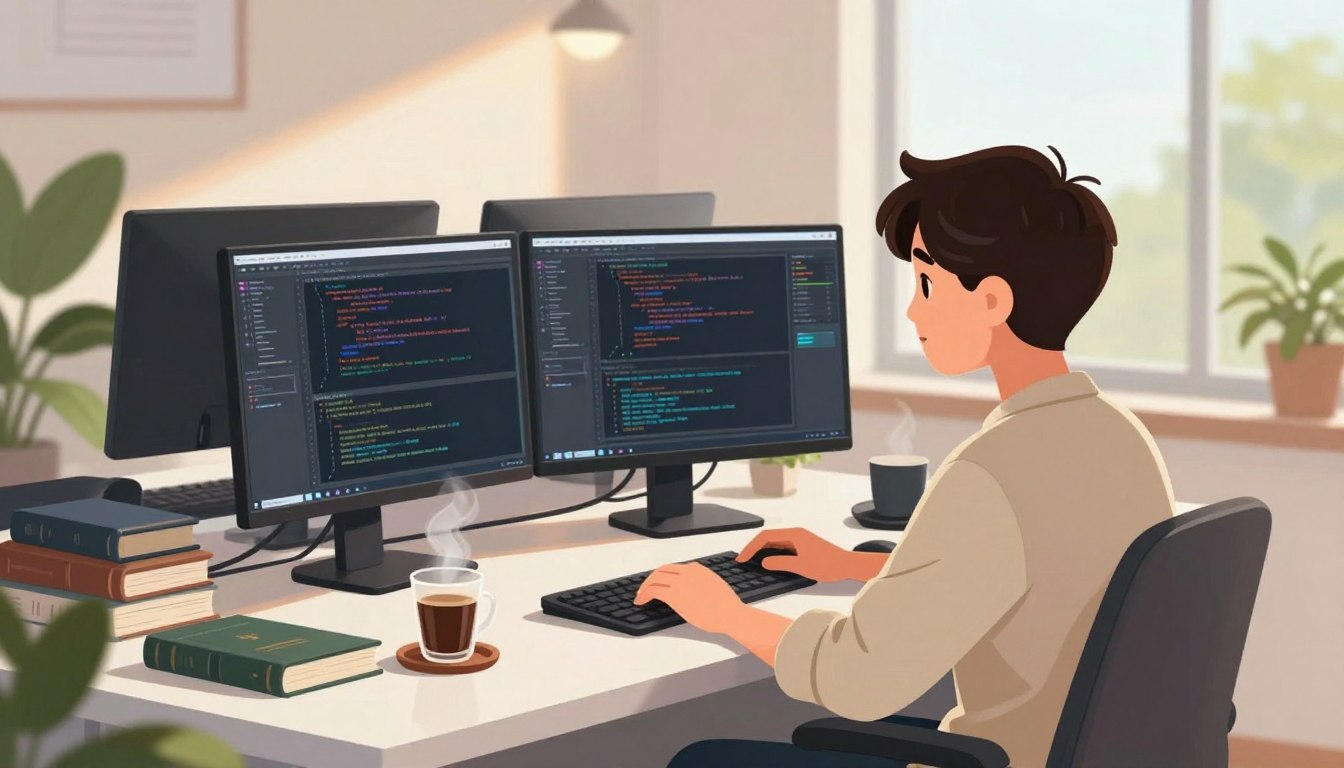
There are days when code clicks and days when every interruption steals momentum. This introduction meets the reader where they feel that loss and offers a clear path back to deep focus. It frames flow as a learnable practice tied to real outcomes: higher productivity, better quality, and faster delivery.
Research and practitioner voices—like GitHub’s Jonathan Carter and Idan Gazit—call this immersion a creative shift. Evidence links better collaboration to cleaner, faster code and faster deployments. Modern teams face rising complexity across languages and clouds; protected focus becomes a business advantage.
This guide explains the concept and the experience behind sustained concentration. It gives a practical roadmap: environment, process, and habits that create more opportunities during the day to enter that state on purpose. We pair strategy with step-by-step practices so readers can act and measure gains immediately.
Key Takeaways
- Flow is learnable: with the right environment and habits, it becomes repeatable.
- Protected focus leads to measurable gains in productivity and code quality.
- Collaboration mechanics—PRs, comments, issues—support deeper work and novel solutions.
- Minimizing interruptions matters: regaining focus often takes about 23 minutes.
- Teams that engineer environments for concentration win in speed and security.
What Flow Is and Why It Matters for Developers Today
Mihaly Csikszentmihalyi framed a psychological condition where challenge meets skill and time behaves strangely. That concept maps to modern engineering: clear goals, immediate feedback, and sustained focus make complex work feel productive and rewarding.
From Csikszentmihalyi’s research to modern software engineering
Csikszentmihalyi identified nine dimensions that define this mental condition: balance of challenge and ability, total concentration, clear goals, immediate feedback, transformed time, intrinsic reward, effortlessness, loss of self-consciousness, and sense of control.
Evidence-based benefits: faster delivery, higher quality, greater satisfaction
Studies show that when developers enter a flow state they deliver higher quality code and ship faster. McKinsey notes only about 41% of the workday is productive deep work.
“Teams that optimize environments complete projects roughly 37% faster.”
Practical impact: streamlined pull requests, fast feedback loops, and clear tasks reduce context switches and boost team velocity. The payoff shows in better test coverage, improved security, and higher developer satisfaction.
| Dimension | Engineering Signal | Impact |
|---|---|---|
| Clear goals | Defined tickets and acceptance criteria | Faster convergence on solutions |
| Immediate feedback | CI tests, code review comments | Higher code quality |
| Challenge-ability balance | Tasks matched to skill levels | Better motivation and satisfaction |
Flow State for Developers: Core Principles That Trigger It
Precise goals, rapid validation, and matched difficulty create the conditions where deep coding becomes routine.

Clear goals and fast feedback in the development process
Clear goals make each task feel like a small experiment. When tests run quickly and reviews return fast, progress is obvious.
Quick feedback—CI results, short reviews, or pairing—keeps momentum and reduces rework.
Balancing challenge and skill to avoid boredom or anxiety
Work should match ability: too easy leads to boredom; too hard causes stress. Adjust scope or add support to restore balance.
If a task is dull, raise the challenge or clarify outcomes to re-engage curiosity and drive.
Deep concentration without interruptions and a sense of control
Protected blocks of time and team norms help preserve focus. A clear plan and ownership give developers a sense of control.
When interruptions fall, recovery costs time—so prioritize uninterrupted work windows.
Collaborative flow: comments, pull requests, and shared context
Shared context via comments and pull requests lowers coordination cost. Collaboration tools let teams keep alignment without breaking momentum.
Teams that standardize architecture and ticket clarity let execution feel like confident iteration.
- Impact on quality: tighter feedback loops reduce defects and speed progress.
- Practical test: if stress rises, reduce scope; if boredom grows, increase challenge.
| Principle | Engineering Signal | Practical Action |
|---|---|---|
| Clear goals | Well-scoped tickets, acceptance criteria | Break tasks into measurable steps |
| Immediate feedback | Fast tests, timely reviews | Automate CI and set review SLAs |
| Balanced challenge | Task difficulty aligned with skill | Adjust scope; add pairing or mentoring |
| Collaborative context | Clear PRs and documented architecture | Use comments and shared docs to preserve momentum |
Read practical guides on optimizing these mechanics in software teams at flow software development.
Diagnose the Blockers: Interruptions, Slow Feedback, and Cognitive Load
Small disruptions compound into long recovery windows that derail meaningful engineering work.
The cost is measurable: UC Irvine finds a single interruption often costs about 23 minutes to regain focus. Stanford research shows heavy context switching can cut productivity by up to 40% in high-interruption environments.
Recovery varies by task: quick fixes can take 10–15 minutes; features 15–25 minutes; architecture 25–45; security up to 60 minutes. These minutes add up and reshape the day.
Modern disruptions and attention leaks
Meetings, Slack pings, phone alerts, and infinite-content apps create steady interruptions. Even brief notifications fragment context and force rebuilding of mental models.
Poor documentation and information hunting are hidden interruptions. Searching for answers shifts attention before coding begins.
Slow tools, builds, and reviews that stall momentum
When tools take more than ten seconds to respond, thought falters. Slow builds, delayed reviews, and sluggish deployments lengthen feedback loops and create queues that block progress.
Diagnose with data and fix systemically
- Measure meeting load and notification volume.
- Track tool latency and CI review times.
- Map recovery minutes by task type to quantify lost time.
These problems are systemic—not personal. Teams that diagnose blockers with data unlock outsized gains in productivity and a better path to sustained flow. Learn practical fixes in our guide on how flow state and vibe coding.
Personal Practices to Enter and Sustain Flow at Work
Small, deliberate rituals and clear time blocks help people slip into deeper productive work. These habits reduce friction and make sustained focus predictable across the day.
Time blocking, focus hours, and batching communication
Protect deep work by reserving focus hours and batching messages. Check email and Slack in two or three windows to cut context switches.
Block the calendar for single tasks and treat those hours as non-negotiable work periods.
Monotasking, pre-flow rituals, and scheduled breaks
Replace multitasking with monotasking: pick one task, outline steps, and set a short ritual—clearing tabs or a two-minute breathing reset—before you begin.
Schedule short, deliberate breaks to maintain energy and long runs to build momentum.
Notification management and ergonomic comfort
Snooze Slack and phone notifications; put the phone in another room if needed. Thoughtful notification management reduces small distractions that add up.
Invest in noise-canceling headphones, an ergonomic setup, and steady energy habits to lower friction and boost satisfaction.
When stuck: pairing and information prep
Pair programming or narrating your idea can unblock progress. Tools like GitHub Copilot act as a fast feedback partner.
Prepare information ahead: clarify goals, gather references, and outline tasks so you run fewer searches mid-work.
“Simple routines and fewer interruptions create reliable windows of deep concentration.”
- Use time blocking and batch checks to manage communication.
- Adopt monotasking and a brief pre-work ritual.
- Snooze notifications and optimize comfort to protect focus.
- Pair or use rapid-feedback tools when stuck; draw on books like Stolen Focus and Make Time.
Team and Leadership Moves that Multiply Flow Across Engineering
Leaders who design systems that protect uninterrupted time unlock repeatable gains in productivity across engineering teams. This begins with a DevEx-first culture that grants autonomy and sets clear outcomes.
DevEx-first culture: autonomy, clear outcomes, and fulfilling challenges
Granting ownership and clear goals lets engineers plan deep work and measure progress.
Autonomy reduces handoffs. Defined outcomes guide priorities and create meaningful opportunities to concentrate.
Cluster meetings, avoid unplanned work, and batch help requests
Cluster meetings into blocks so teams keep long, protected work windows. Make unplanned work visible and triaged.
Batch help requests and set async-first norms. This cuts context switches and preserves momentum across the team.
Accelerate feedback loops with pair/mob programming and fast tests
Pair and mob programming provide immediate feedback and shared context. Fast local tests catch defects before reviews slow progress.
Short feedback loops raise productivity and reduce rework. Teams that optimize these practices see faster delivery and higher retention.
- Standardize interruptions: set clear rules for urgent vs. asynchronous communication.
- Instrument the system: track meeting load, queue time, and review latency to spot bottlenecks.
- Simplify workflows: consistent conventions and single-path processes lower cognitive load for developers.
| Action | Signal | Short-term Benefit | Business Impact |
|---|---|---|---|
| Clustered meetings | Blocked calendars | Long focus windows | Faster feature completion |
| Pair/mob programming | Shared sessions | Immediate feedback | Lower defect rates |
| Batch help requests | Fewer interrupts | Reduced context switching | Higher developer satisfaction |
| Metrics & coaching | Review latency & meeting load | Targeted fixes | 37% faster project delivery |
“Designing teams and systems around protected work produces measurable gains in delivery and morale.”
Leaders should tie these improvements to business progress so teams see clear return. Read a practical case study on modern team models in this piece about tooling and team design: coding with HyperGPT.
Engineer the Environment: Tooling, Codebase, and Automation for Focus
A reliable engineering environment removes small frictions so teams spend more time coding deeply.
Standardize setup: make every development environment reproducible. Aim for a single command to pull, build, and run the project; fewer steps mean less lost time and clearer progress.
Containerization and automated provisioning
Use containers and Infrastructure as Code so system differences vanish. Automated provisioning prevents setup drift and keeps each machine consistent.
Organize the codebase
Structure code into modular, discoverable packages. Clear naming, consistent patterns, and solid docs speed comprehension and protect quality under pressure.
Cut tool sprawl and consolidate platforms
Reduce switches between apps. Consolidated platforms and single-sign-on keep attention on code instead of hopping systems.
Automate repetitive tasks and instrument feedback
Automate builds, tests, formatting, and deployments so feedback arrives fast. Local signals in seconds sustain momentum and reduce rework.
- Single-command workflows: faster onboarding, fewer blockers.
- IaC + containers: consistent system setups across the team.
- Modular code: discoverability and easier maintenance.
- Automated pipelines: quick feedback and higher code quality.
Treat environment reliability as an engineering priority: small latencies accumulate into lost time. Teams that optimize these systems often see major gains in productive coding time and faster project delivery. Read a related case study on developer experience at developer flow state.
Conclusion
Design deliberately.
Designing time and tools deliberately turns scattered work into predictable progress.
Teams that protect long blocks, cut meetings, and speed feedback convert brief deep minutes into steady productivity. Research shows a single interruption can cost about 23 minutes, yet optimized environments deliver up to 37% faster project completion and near 40% gains in productive coding time.
Measure focus time, recovery minutes, review latency, and code quality. Choose one bottleneck, apply a targeted fix, and repeat.
The next opportunity is simple: start small, track impact, and scale what works. Read a practical guide to flow states to learn tactical steps and sustain gains.
FAQ
What does achieving flow while coding mean and why should developers aim for it?
Achieving a deep, sustained focus during coding means working with clear goals, immediate feedback, and minimal interruptions. Developers who reach this state deliver features faster, produce fewer bugs, and report higher job satisfaction. Organizations benefit through improved velocity, better quality, and lower churn.
How does Mihaly Csikszentmihalyi’s research apply to modern software teams?
Csikszentmihalyi’s core idea—matching challenge to skill and providing clear feedback—maps directly to engineering work. In software, that looks like well-scoped tasks, rapid CI feedback, meaningful metrics, and opportunities for skill growth so engineers remain engaged rather than bored or anxious.
Which measurable benefits come from enabling uninterrupted deep work?
Empirical benefits include faster delivery cycles, higher code quality, fewer regressions, and improved developer morale. Reduced context switching lowers cognitive load and can cut task completion time substantially—often turning fragmented days into meaningful progress.
What are the biggest blockers that prevent developers from getting into flow?
Top blockers include frequent meetings, chat notifications (Slack), task switching, slow builds or tests, delayed code reviews, and unclear priorities. These create cognitive fragmentation and force long recovery times after each interruption.
How long does it typically take to return to focused work after an interruption?
Research on context switching suggests average recovery windows around 23 minutes, though complexity increases that time. Minimizing interruptions and batching communication preserves those minutes for productive development.
What personal practices reliably help engineers enter and sustain focus?
Practical habits include time blocking or focus hours, single-tasking, short pre-work rituals, scheduled breaks, and muting notifications during deep sessions. Ergonomics—good chair, headphones, and lighting—also support longer, higher-quality focus periods.
How should teams organize meetings and communication to support focus?
Adopt clustered meetings, designated help-request windows, and rules that avoid impromptu work. Use asynchronous tools for status and design decisions, and reserve real-time time for high-value collaboration. This reduces unexpected context switches.
What leadership moves multiply sustained focus across an engineering org?
Leaders should prioritize developer experience: grant autonomy, define clear outcomes, limit unplanned work, and invest in fast feedback loops. Encourage pair programming and rapid testing to spread knowledge and speed reviews.
Which tooling and automation changes most improve developer flow?
Single-command dev environments, containerized setups, Infrastructure as Code, and automated provisioning remove setup friction. Automating builds, tests, formatting, and deployments minimizes busywork and keeps attention on design and logic.
How can codebase organization support concentration and reduce cognitive load?
Maintain modular, consistent structure, clear documentation, and discoverable interfaces. Smaller modules and consistent patterns make reasoning easier and cut time spent hunting for context or understanding unfamiliar systems.
What are effective strategies to speed up feedback from code reviews and CI?
Set SLAs for review turnaround, implement automated linters and tests to catch issues early, and use smaller pull requests to shorten review time. Prioritize fast CI pipelines—parallelized tests and incremental builds reduce wait times.
How should teams manage notifications and chat to avoid constant disruption?
Create notification policies: snooze channels during focus hours, use status indicators, and funnel urgent alerts through dedicated escalation paths. Encourage asynchronous updates and reserve chat for coordination rather than deep problem solving.
Can collaborative practices like pair or mob programming improve flow?
Yes. When done intentionally, pair and mob sessions create shared context, accelerate feedback, and reduce rework. They also spread knowledge and make onboarding to complex areas faster, which sustains collective focus.
What quick wins can engineering teams implement this week?
Start by declaring focus blocks, piloting no-meeting days, enforcing small PR sizes, and enabling a fast CI run for main branches. Tackle one slow build or flaky test—fixing a single pain point often yields outsized gains in momentum.