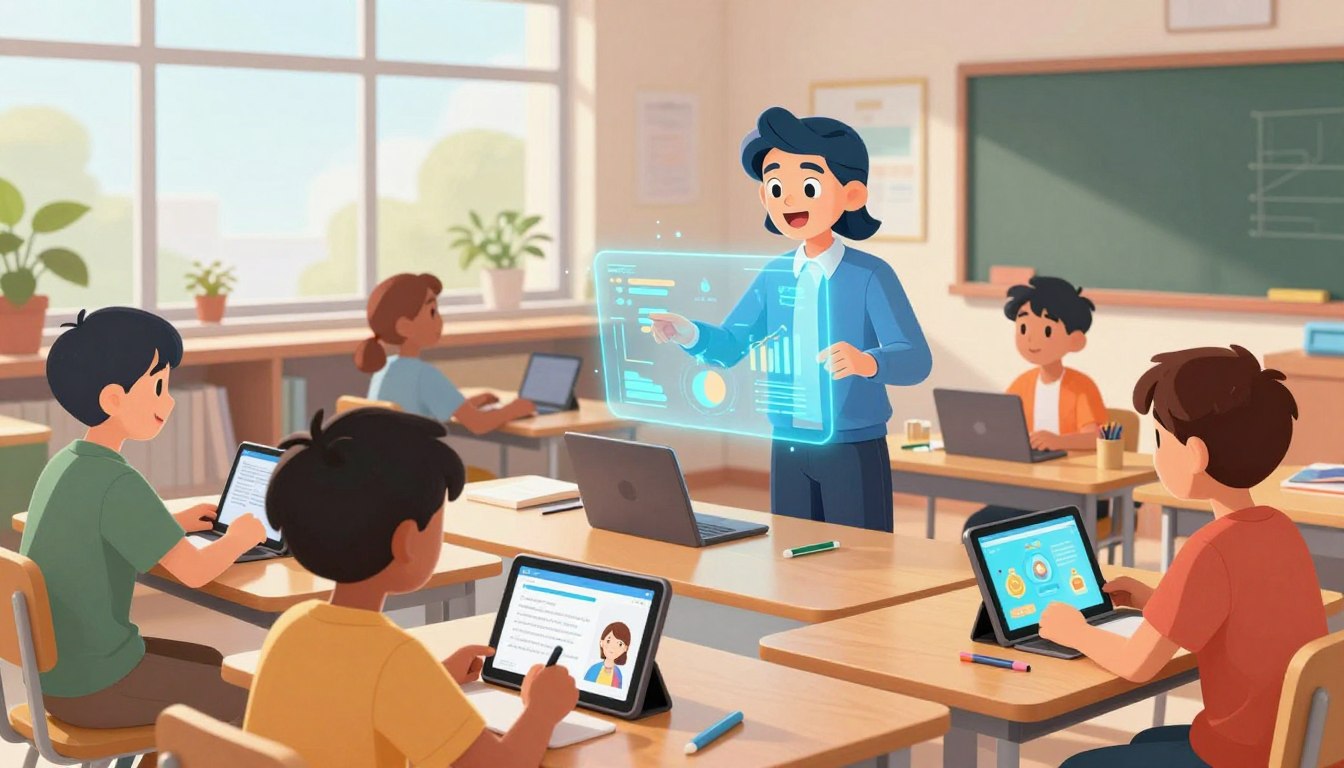
There are moments when a teacher sees a student’s eyes light up — and everything clicks. That spark is the goal of modern education: to meet each learner where they are and lift what they can do next.
The present shift is measurable. Over 47% of learning management systems are set to be powered by advanced systems within three years, and adaptive programs report large gains in test scores. These trends show how technology can make instruction more responsive and actionable for students.
This section frames why the change matters now: improved outcomes, clearer signals from student data, and platforms that scale tailored experiences. Readers will get a practical, evidence-based view of how artificial intelligence reshapes the role of institutions and teachers — without replacing human judgment.
We preview definitions, models, ethics, and implementation steps so leaders can act with confidence. For deeper clinical context on performance and assessment, see this evidence review.
Key Takeaways
- Adaptive platforms are driving measurable gains in student outcomes.
- Tools transform institutional roles from uniform delivery to tailored experiences.
- Student-level signals enable precise intervention and support.
- Adoption is accelerating across K–12 and higher education markets.
- Implementation balances data-driven insights with educator judgment.
Why Personalized AI Learning Matters Right Now
Higher education is moving from pilots to strategy as campuses set clear priorities for digital transformation.
Students want flexible, digital-first experiences that adapt to their schedules and needs. At the same time, institutions rank engagement and trusted data among top priorities. These aligned pressures make this moment an operational inflection point.
Present-day demand: student expectations and institutional priorities
EDUCAUSE found 57% of colleges will prioritize AI in 2025, up from 49% the year before. IDC/Workday reports show digital acceleration (52%), student engagement (50%), and trusted data and insights (49%) as leading objectives.
“Campuses now seek tools that scale quality instruction while preserving academic integrity.”
Informational intent: what readers will learn in this guide
This guide converts raw metrics into actionable practice. Readers will get frameworks to match technology to learning goals, save instructor time, and measure impact with clear insights.
| Priority | Share (%) | Action |
|---|---|---|
| Digital acceleration | 52 | Modernize platforms and workflows |
| Student engagement | 50 | Deploy adaptive pathways and feedback |
| Trusted data & insights | 49 | Improve analytics and governance |
Next steps: choose specific use cases, define workflows, and measure results. For a practical example of adaptive platforms, review this adaptive platforms case study.
Defining Personalized AI Learning
Instruction that adapts to each student’s pace can turn classroom data into actionable next steps.
From one-size-fits-all to adaptive, data-informed instruction:
Personalized learning concentrates on a learner’s goals, talents, and concerns. It aligns instruction to pacing and mastery so students receive tasks that match their needs.
Models analyze patterns in student work to adjust content difficulty and order. This creates dynamic pathways and near-continuous recalibration of assessments and materials.
How it works in practice
- Clarity: Define mastery, competencies, and success criteria.
- Signals: Use recommender engines and predictive signals to guide instruction.
- Cycles: Recalibrate content and assessments as students progress.
| Component | Role | Outcome |
|---|---|---|
| Adaptive models | Analyze performance patterns | Better sequencing of tasks |
| Dynamic content | Adjust difficulty and scaffolds | Improved engagement and mastery |
| Educator oversight | Set criteria and interpret signals | Pedagogy remains central |
Viewed as an assistive layer, this approach preserves human judgment while building knowledge through targeted practice. For a practical example of adaptive platforms, see the adaptive platforms case study.
How AI Tailors Learning Experiences: Data, Models, and Real-Time Feedback
Systems now turn classroom signals into action, shaping what each student sees next.
Student data signals: engagement, performance, and preferences
Platforms ingest time on task, correctness, attempt patterns, and stated preferences. These data feed models that estimate mastery and highlight areas needing support.
Adaptive learning systems and content recommendations
Adaptive engines sequence tasks and adjust difficulty in real time. Content recommendations span video, simulations, and text so students can use formats that fit their ability and style.
“Adaptive approaches have been linked to a 62% increase in test scores.”
Real-time insights, instant feedback, and timely interventions
Cognitive tutoring systems simulate one-on-one guidance, changing explanations as performance changes. Predictive analytics flags risk early and triggers targeted interventions before setbacks occur.
- Dashboards surface insights for educators and prompt just-in-time support.
- Chatbots supplement instruction with instant, accurate guidance.
- The net effect: a responsive system that directs support to the right areas at the right moment.
Adoption Trends in U.S. Education
Adoption across U.S. campuses has moved from experimental pilots into institution-wide strategy.
EDUCAUSE reports 57% of higher education institutions will prioritize AI in 2025, up from 49% the year before. This shift reflects pressure to modernize student experiences and improve measurable results.
EDUCAUSE momentum and institutional priorities
Digital acceleration (52%), student engagement (50%), and trusted data and insights (49%) top campus priorities. Institutions now link new systems to goals like retention, performance, and improved services.
Market trajectories: platforms and production use
Over 47% of learning management platforms are expected to be intelligent within three years. Predictive capabilities are in production at 64% of schools, and more than 55% run generative tools in workflows.
| Metric | Share (%) | Implication |
|---|---|---|
| Prioritizing AI (EDUCAUSE) | 57 | Strategy-level adoption across campuses |
| Digital acceleration priority | 52 | Modernize platforms and workflows |
| LMS AI-powered projection | 47 | Systems become intelligent by default |
| Predictive in production | 64 | Data-driven interventions at scale |
| Generative tools in workflows | 55+ | Content and advising augmentation |
- U.S. higher education is moving from pilots to institutional implementation.
- Leaders that align technology with student outcomes see faster, sustainable gains.
Core Benefits: Engagement, Progress, and Outcomes
When pathways adapt to a student’s pace, progress becomes measurable and sustained. Adaptive systems tailor task difficulty and pacing to match ability, so practice builds mastery rather than frustration.
Adaptive pathways and improved test scores
Adaptive learning pathways align tasks to ability, creating steady progress and better outcomes. One study found a 62% increase in test scores for participating students, showing clear performance gains.
Ownership and motivation through personalization
Students gain ownership when content maps to mastery milestones. Real-time feedback and micro-interventions help learners course-correct quickly, saving time and keeping motivation high.
- Adaptive pathways match task difficulty to ability and support steady progress.
- Real-time feedback and targeted interventions prevent setbacks and conserve time.
- Educators use insights to focus teaching on high-impact areas.
- Continuous practice with appropriate supports strengthens knowledge and skills.
Net effect: higher engagement, clearer progress, and measurable score gains that translate into better long-term development for students and stronger instructional impact for educators.
Platforms and Tools Powering Personalized Learning
Today’s education platforms act like on-demand tutors, turning daily work into clear next steps for students.
Knewton and DreamBox: adaptive content and pacing
Knewton functions like a digital tutor, helping students build study plans and stay motivated. It recommends material based on performance and preferences so each learner sees the right content at the right time.
DreamBox analyzes both performance and mindset. The system suggests activities that match ability and boosts engagement, which can lead to measurable gains in scores and progress.
SchoolAI in classrooms: saving time, boosting feedback, and targeting needs
SchoolAI equips teachers with tools that save time and surface actionable insights. Educators report instant help for students, higher grammar scores, and stronger confidence.
“Teachers get time back for targeted instruction while students receive help when they need it most.”
- Platforms automate routine work so teachers focus on instruction and interventions.
- Dashboards provide system-level visibility to coordinate support across classes.
- Personalized recommendations and capabilities encourage learners to engage with fitting material.
Personalized AI Learning
When instruction matches a student’s current skill, progress becomes steady and visible.
Adaptive systems adjust both speed and complexity to a student’s proficiency. This creates individualized pathways that focus effort where it matters most.
Aligning content difficulty with student ability
Systems calibrate sequences so tasks are neither too easy nor too hard. That balance sustains a productive challenge and improves persistence.
Student-facing dashboards make progress visible, which helps motivation and self-regulation. Educators can set mastery thresholds to keep rigor aligned with course goals.
- Clear pathways reduce confusion and let students focus on understanding and application.
- Calibrated sequences improve persistence and reduce frustration.
- Adjustable thresholds let teachers match standards while preserving challenge.
Outcome: steady growth, fewer setbacks, and more meaningful engagement with core content. For a deeper view of the role of AI in shaping tailored instruction, see the role of AI in personalized.
Accessibility and Inclusion: Equitable Learning for All
Making curricula accessible requires both adaptable formats and deliberate infrastructure planning. Equity is not an add‑on; it is a design principle that shapes how systems deliver content and support students.

Text-to-speech, translation, and multimodal content
Text-to-speech and advanced NLP help students with reading or visual challenges access the same materials as their peers.
Translation and multimodal formats — audio, captions, and interactive visuals — widen reach for multilingual learners and diversify how ideas are presented.
When platforms adapt presentation and pacing, learners receive materials that match their ability and needs without lowering standards.
Supporting diverse learners and reducing barriers
Educators use inclusive tools to reduce language, sensory, and processing barriers. This supports skill development and confidence across areas of study.
Plans must address the digital divide: devices, bandwidth, and assistive tech are part of equitable access. Without them, gains remain uneven.
Privacy-aware practices are essential when systems use sensitive data to offer accommodations. Transparency and consent protect student information while enabling meaningful support.
- Tools enhance accessibility with formats matched to student needs and ability.
- Systems adapt pacing so diverse learners access material equitably.
- Accessible course assets expand participation and preserve rigor.
Data, Privacy, and Ethical AI in the Classroom
Classroom technology brings benefits only if trust and transparency guide how data is handled.
Responsible use of student data requires clear consent, purpose limitation, and public documentation. Schools should list what each system collects and explain how that information shapes instruction.
Privacy-by-design matters: minimize collection, encrypt records, and restrict access. These steps reduce risk and preserve student rights.
Mitigating algorithmic bias and ensuring fairness
Algorithms can reinforce inequities unless audited regularly. Continuous reviews detect drift and disparate impact across groups.
“Human oversight ensures automated recommendations match educational goals.”
- Document data flows and decisions tied to systems.
- Run equity reviews and correct model bias.
- Define governance: retention, incident response, and accountability.
- Communicate openly with families and students to build trust.
| Risk | Safeguard | Outcome |
|---|---|---|
| Excessive data collection | Data minimization policies | Reduced exposure of sensitive student data |
| Undetected bias | Regular audits and equity reviews | Fairer results across demographics |
| Unauthorized access | Encryption and access controls | Improved privacy and compliance |
The Evolving Role of Educators in AI-Enabled Instruction
When tools take on administrative burden, teachers spend more time guiding small groups and fostering deeper thinking.
Educators report tangible shifts in daily work. Sara Elder notes tools save time for interventions, feedback, analysis, and instructional adjustments. Principals like Leroy Dixon link reduced burnout to deeper engagement in classrooms.
Teachers also see better, real-time help that supports growth rather than simple corrections — a point Chrissy Roe emphasizes.
From administrative tasks to high-impact teaching and mentoring
Key shifts:
- Routine work declines so educators can invest time in targeted instruction and mentoring.
- Tools surface actionable insights that guide feedback and small-group work tailored to student needs.
- Teachers adopt a coaching role—building skills, metacognition, and mindset while systems handle rote tasks.
Professional development follows suit: emphasis moves to data literacy, prompt design, and ethical use of tools. Collaboration increases as staff share exemplars and intervention strategies informed by system insights.
“The role evolves from content delivery to orchestration of meaningful, student-centered experiences.”
| Change | Impact on time | Outcome for students |
|---|---|---|
| Automated grading & reporting | Less clerical work | More time for targeted instruction |
| Real-time supports | Faster pivots in instruction | Timely help when students need it |
| Insight dashboards | Quicker analysis | Focused feedback and growth |
For a broader view on how teaching roles change with modern systems, see the evolving role of educators.
Designing AI-Ready Curriculum and Learning Experiences
Curriculum design must move from static syllabi to flexible pathways that show clear mastery.
Start with competencies: define mastery thresholds and align assessments to observable knowledge and skills. That clarity guides content selection and pacing for students.
Competency-based models, pacing, and mastery
Hybrid and competency-based models let learners progress at their own pace. Institutions use data and analytics to track performance and optimize experiences.
Effective design maps content and practice to competencies. Systems sequence materials, surface recommendations, and flag where reinforcement or acceleration is needed.
- Embed formative checks so instruction adapts continuously to student evidence.
- Leverage platforms for on-demand access and multimodal content to support diverse learners.
- Include preferences and project recommendations without diluting rigor.
Implementation matters: ensure accessibility, metadata tagging, and content versioning for quality. Professional development equips teams to curate, evaluate, and iterate curriculum aligned to models and capabilities.
Implementation Roadmap: From Pilot to Scale
Begin with narrow, high-impact pilots that align tightly to strategic goals and measurable outcomes. A focused approach shows real value quickly and reduces risk when systems expand across campus.
Selecting use cases, tools, and workflows
Start small: choose one clear use case—early-warning analytics or adaptive practice—that maps to retention or mastery goals.
Select a tool that integrates with existing systems to cut implementation time and avoid duplicate work. Define simple workflows for data intake, review cycles, and how insights change instruction.
Change management, training, and governance
Train staff on ethical use and on interpreting recommendations. Clarify roles so teachers, data teams, and IT know who owns each step.
- Set success metrics up front: engagement, progress, and performance.
- Pilot with real classrooms; measure results before scaling.
- Establish governance that sets ownership, risk controls, and escalation paths.
- Plan for ongoing support and iterate using educator and student feedback.
Practical note: case examples like SchoolAI demonstrate how smart systems can save teacher time and focus interventions where students need them most. Implementation succeeds when pilots prove clear gains and teams commit to steady, measured scale.
Measuring Impact: Progress, Performance, and Engagement
Measuring impact requires clear signals that link day-to-day activity with long-term outcomes.
Real-time analytics, early-warning indicators, and ROI
Define leading indicators — attendance, task completion, and mastery checks — that predict progress in real time. These signals let teams spot at-risk students before grades fall.
Use analytics dashboards to monitor systems-level trends and to pinpoint where interventions raise performance. Dashboards should surface both quantitative data and instructor insight.
Track progress toward competency milestones and link changes in content sequencing to measurable gains. Adaptive programs have reported a 62% improvement in test scores in some implementations.
- Quantify ROI by connecting deployments to scores, retention, and course completion.
- Balance metrics with qualitative feedback from students and instructors to refine approaches.
- Set data cadences — weekly reviews and term retrospectives — to sustain continuous improvement.
- Ensure equity: monitor subgroup outcomes to prevent widening gaps and close the loop by adjusting instruction and supports.
Challenges and How to Address Them
Reliable infrastructure and clean data are the twin foundations of equitable, effective systems.
Many districts still face a digital divide: some students lack devices or sufficient bandwidth, which risks uneven outcomes. Addressing basic access is therefore essential before scaling tools into classrooms.
Digital divide, access, and infrastructure
Fund devices and connectivity: allocate budgets for devices, hotspots, and assistive technology so every student can join instruction.
Plan for peak demand: size networks and servers for busy times to avoid outages and slowdowns that interrupt lessons.
Data quality, model drift, and continuous improvement
High-quality inputs make recommendations reliable. Standardize data fields, add validation rules, and require educator review to catch errors early.
Monitor models for drift across areas and cohorts; recalibrate when patterns shift. Build feedback loops that let students and staff report problems quickly.
- Allocate regular time for maintenance and updates to preserve reliability and trust.
- Conduct periodic equity checks so interventions reach learners who need them most.
- Document lessons learned to guide iterative improvement and governance.
| Challenge | Action | Outcome |
|---|---|---|
| Device and bandwidth gaps | Provide funded devices and subsidized connectivity | More consistent student participation |
| Peak-time bottlenecks | Scale infrastructure and test load | Fewer disruptions during instruction |
| Poor data quality | Standardize inputs and educator validation | More accurate recommendations and reporting |
| Model drift and bias | Regular audits and recalibration | Fairer results across demographics |
What’s Next: Predictive, Interpretive, and Generative AI in Education
Forecasting tools now spot trouble before grades drop, turning reactive support into routine practice. Predictive systems are already in production at about 64% of institutions. Over 55% integrate generative tools into workflows, while EDUCAUSE shows 57% of campuses prioritizing this technology in 2025.
Emerging capabilities and balanced human–machine collaboration
Predictive models will sharpen forecasts of risk and opportunity, enabling proactive supports at scale. They flag students who need help and free educators to focus on high-impact instruction.
Interpretive systems turn raw data into clear insights that guide curricular decisions and operations. Dashboards and explainable models help teams act with confidence.
Generative intelligence speeds content creation and iteration, reducing work for faculty while keeping quality under educator review.
- Human oversight is central: educators set goals, validate outputs, and protect academic integrity.
- Implementation is a change journey—governance must ensure safety, transparency, and fairness.
- Advances expand capabilities, but equal focus on access keeps benefits equitable.
- Analytics maturity will link classroom learning to workforce performance and development.
“Strategic experimentation—tied to outcomes—keeps innovation purposeful and student-centered.”
Practical next step: pilot predictive features with clear success metrics, pair interpretive tools with educator review, and govern generative output to preserve standards and inclusion.
Conclusion
The evidence now supports scaling targeted systems that tie daily activity to long-term knowledge growth. EDUCAUSE prioritization (57%), reports of 62% score gains, and near-60% K–12 uptake show strong momentum in modern education. These figures point to durable change, not a short-term trend.
Well-designed, personalized learning shifts practice toward precision and measurable progress. The best implementations keep educators central while using intelligent tools to surface insights and save time for instruction. Leaders can act now: set clear goals, pick focused use cases, and measure results.
When ethics and equity guide scale, institutions convert promise into real gains for students and broaden access to knowledge for every learner.
FAQ
How does AI customize education for a student’s individual needs?
Modern adaptive systems collect signals—engagement, assessment results, response times, and stated preferences—and use models to adjust content, pacing, and feedback in real time. The result: tailored pathways that meet each learner where they are, increase relevance, and focus practice on gaps rather than repeating mastered material.
Why does personalized AI-based learning matter right now?
Student expectations and institutional priorities have shifted toward flexible, data-driven instruction. Institutions need scalable solutions that boost outcomes, reduce teacher workload, and support accountability. This guide explains how systems deliver measurable gains and operational efficiencies.
What does "adaptive, data-informed instruction" actually mean?
It means moving away from one-size-fits-all lessons to instruction guided by ongoing data. Systems analyze performance and engagement to recommend content, adjust difficulty, and schedule reviews—so instruction adapts continuously to learner needs.
What student data signals power real-time personalization?
Key signals include quiz and assignment scores, time on task, clickstream behavior, topic mastery, and learner preferences. When combined, these inputs let platforms detect struggle early and trigger targeted supports or enrichment.
How do adaptive learning systems and content recommendations work?
Systems use algorithms—rule-based or statistical—to map student profiles to content modules. They sequence lessons, vary difficulty, and suggest resources. Over time, recommendations refine as the system learns which interventions improve performance.
How fast are real-time insights and interventions delivered?
Many platforms provide immediate formative feedback after activities and flag risk indicators within a single session. Teachers receive dashboards with early-warning signals so they can intervene promptly rather than waiting for term-end grades.
What are current U.S. adoption trends for these technologies?
Adoption is accelerating across K–12 and higher education. Surveys from organizations like EDUCAUSE show a majority of institutions prioritizing AI capabilities. LMS integrations and dedicated adaptive platforms are driving market momentum.
Which outcomes improve when instruction is tailored?
Schools report higher engagement, reduced remediation needs, and gains in test scores and course completion. Personalized pathways promote ownership of learning, which boosts motivation and retention.
What platforms are commonly used to deliver adaptive content?
Recognized solutions include adaptive engines and specialist platforms that integrate with learning management systems. These tools provide diagnostic assessments, individualized practice, and teacher-facing analytics to streamline instruction.
How does the system align content difficulty with student ability?
Diagnostic checks and continual performance data place learners on competency maps. Systems then present materials just beyond current mastery to encourage growth while avoiding frustration—an application of the “zone of proximal development.”
How do these tools support accessibility and inclusion?
Effective platforms include text-to-speech, captioning, language translation, and multimodal content to accommodate diverse learners. They also enable differentiated pacing and alternative assessments to reduce barriers.
What safeguards protect student data and privacy?
Responsible implementations follow privacy laws, encrypt data, apply strict access controls, and provide transparency about data use. Clear consent models and governance policies ensure data supports instruction without compromising privacy.
How is algorithmic bias mitigated in classroom systems?
Developers audit models for disparate impacts, use diverse training data, and implement fairness checks. Schools should demand transparency, vendor accountability, and ongoing evaluation to detect and correct bias.
How does AI change the educator’s role?
Automation reduces routine tasks—grading, progress tracking—so teachers can focus on high-impact work: mentoring, designing complex instruction, and interpreting insights to guide interventions.
What does an AI-ready curriculum look like?
It emphasizes competency-based progression, modular resources, and clear learning objectives. Such curricula allow systems to measure mastery and adjust pacing, supporting personalized pathways and mastery learning.
How should institutions move from pilot projects to full-scale adoption?
Start with focused use cases, select interoperable tools, and define success metrics. Invest in professional development, change management, and governance to scale effectively and sustainably.
What metrics measure the impact of personalized systems?
Track progress with real-time analytics: mastery rates, growth percentiles, engagement, retention, and ROI indicators. Early-warning metrics and cohort comparisons reveal the interventions that drive results.
What common challenges arise during implementation?
Challenges include the digital divide, inconsistent data quality, model drift, and infrastructure gaps. Address these with equitable access plans, ongoing data governance, and iterative improvement cycles.
What future capabilities are emerging in education technology?
Predictive analytics, richer interpretive tools, and generative content are evolving. The most effective future models will blend machine intelligence with teacher judgment to enhance decision-making rather than replace it.