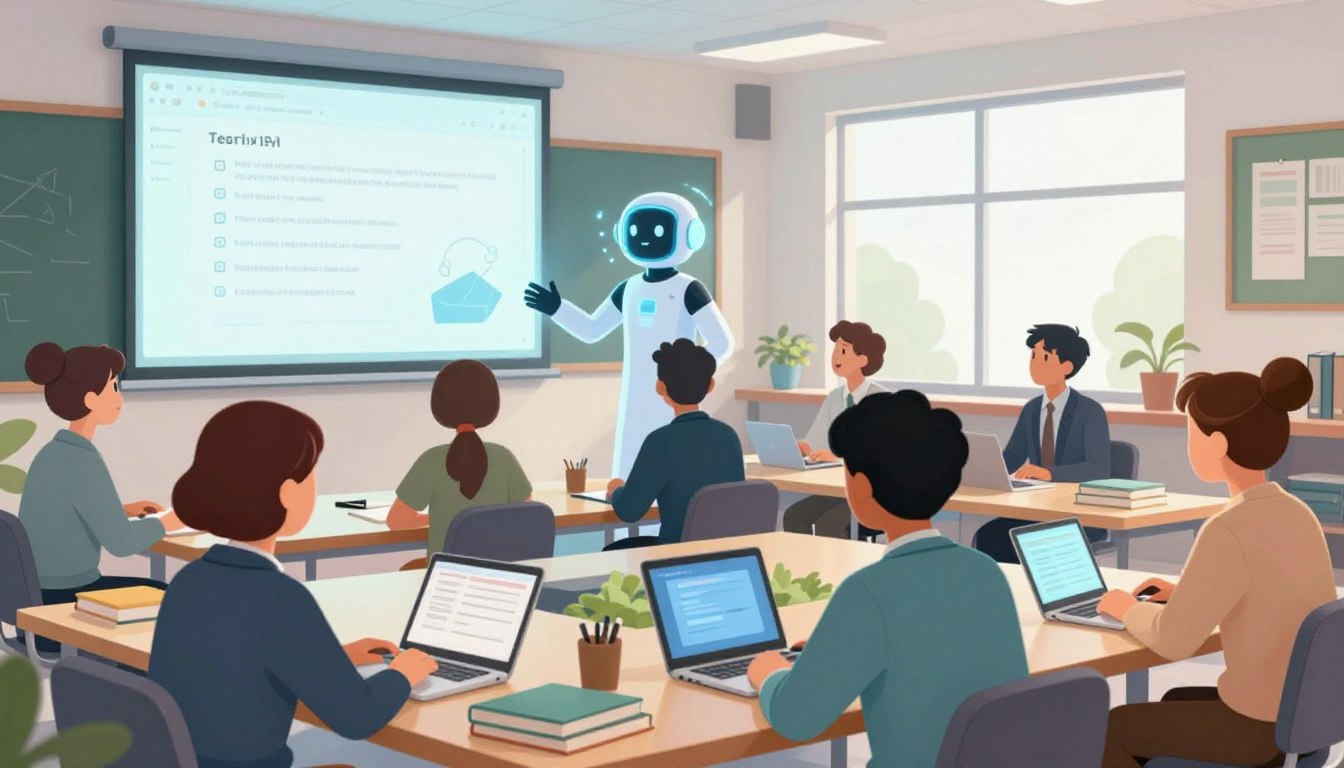
Many readers arrive here with a knot in their chest—a mix of hope and worry about final exams. The author knows this feeling: late nights, practice tests, the quiet weight of possibility. This piece speaks directly to students and those who guide them.
Research shows the traditional paper-and-pencil model still shapes high-stakes assessment. Educators report mixed views: some fear rising challenges, others see chance for improvement. New pilots such as PISA 2025 hint at a shift toward measuring reasoning, not just right answers.
This article maps what changes in 2025, what stays steady, and where schools should watch next. It also shows practical ways technology can speed scoring, generate items, and personalize practice—without overselling results. Readers will gain a clear, evidence-informed view of risks, opportunity, and steps for mindful adoption.
Key Takeaways
- Students face both hope and uncertainty as exams evolve.
- Current models still favor paper formats; pilots test new approaches.
- Tools can speed scoring and tailor practice, but limits remain.
- Research and practitioner views help balance risk with opportunity.
- Schools should pilot responsibly, prioritizing fairness and clarity.
Why AI matters now for standardized tests like STAAR, SAT, and ACT
Schools now face a gap between when students take tests and when useful results arrive. Teachers often get state-level data months later—too late to adapt lessons within the same unit. Over half of educators say current exams fail to measure the skills students need.
Modern tools shorten that time between response and insight. Rapid item production and assisted scoring can surface common writing gaps—weak topic sentences or missing conclusions—so instruction targets real needs.
Adaptive delivery changes the student experience. Personalized questions match current mastery, which reduces frustration for some students and boredom for others. Fewer items can still preserve reliability while saving classroom minutes.
- Faster feedback: compresses cycles so instruction adjusts during a unit.
- Class trends: tools reveal recurring errors early for focused reteach.
- Scalable support: systems draft questions and suggest rubric-aligned scores for human review.
Near-term value lies in augmenting existing assessment systems, not replacing them. For more critique on risks and limits, see the big problem with using AI for.
Where today’s assessments fall short—and what needs to change
Many educators find that powerful evidence arrives too late to guide daily instruction. State reports often land after the school year ends, so teachers cannot use results to reteach within the same unit. This delay weakens the practical value of assessment for student learning.
Slow turnaround
When data arrives after instruction has moved on
Teachers commonly wait until the next year for state-level data. That gap means lost opportunities for targeted help and wasted time for students who need timely feedback.
Slow reporting erodes the value of assessment: by the time results arrive, teachers have moved on and students have left the window for focused reteaching.
Narrow measures
Multiple-choice limits on knowledge, skills, and thinking
Multiple-choice formats favor quick scoring over depth. They miss partial-credit reasoning and multi-step thinking that teachers see in class.
ETS experts note future systems might credit multi-step logic even when final answers are wrong, but those methods are not ready for high-stakes use.
Research and practitioner feedback show 57% of educators believe current tests fail to measure what students truly need. Bias adds another concern: a controlled experiment found lower scores for an essay mentioning “rap music” versus the same essay citing “classical music.”

| Problem | Evidence | Impact on classroom |
|---|---|---|
| Slow reporting | State results often arrive after the year ends | Missed reteaching window; limited instructional use |
| Narrow item types | Multiple-choice limits partial-credit reasoning | Hidden gaps in higher-order skills; weaker feedback |
| Scoring bias | Experiment showed cultural reference affected essay scores | Threats to fairness; undermines trust in systems |
- Faster turnaround, varied item types, and transparent scoring are essential.
- Schools should prioritize methods that honor reasoning, not just final answers.
- Educators need data that links directly to classroom practice and learning goals.
What AI can realistically do for assessments today
Classroom-ready platforms now help teachers produce aligned assessment items faster than before. They can draft questions from a passage, suggest passages to match an item type, and present varied distractors for human refinement.
Personalization frames the same skill—fractions, for example—in contexts like baking or sports to engage different students. That makes assessments more relevant without sacrificing standards, though true fairness requires costly field tests.
Assisted scoring and richer feedback
Systems offer rubric-based suggestions that surface common patterns in responses. Teachers review those suggestions; human judgment stays central for high-stakes essays and performance work.
Adaptive questioning to save time and reveal gaps
- Item generation: drafts speed creation while humans ensure clarity and equity.
- Adaptive delivery: reaches reliable ability estimates with fewer questions, protecting instructional time.
- Analytics: flag shaky knowledge—recurring errors in evidence use or reasoning—to guide small-group instruction.
Practical boundaries remain: teachers should use these tools as starting points, keep calibration protocols, and rely on human review for critical scores. For classroom examples and deeper use cases, see adaptive learning platforms.
AI and Standardized Testing: Emerging pilots and near-term trends
New international pilots are using conversational prompts to expose how students plan, test, and revise solutions.
PISA 2025 will include chatbot-supported tasks that let a bot handle basic content queries so the exam can probe strategy, iteration, and justification. The goal is to see how a student approaches problem solving, not only whether they reach the right answer.
ACT experts warn large-scale performance tasks need vast data, heavy tech capacity, and lengthy field development. Costs, proctoring, bandwidth, and accessibility pose real challenges for states and schools.
“Pilots show promise, but scaling interactive tasks requires transparent validity evidence and careful field testing.”
Near-term trends
- Modular innovations: scenario items with limited interactivity.
- Better analytics to link responses to classroom instruction.
- Gradual adoption: classroom assessments will evolve faster than high-stakes exams.
| Aspect | Promise | Trade-offs |
|---|---|---|
| PISA chatbot tasks | Reveal planning, iteration, justification | Needs validation, infrastructure |
| Richer performance work | Deeper evidence of student ability | High cost; extensive field tests |
| Classroom tools | Faster classroom feedback, aligned work | Requires teacher training; vendor vetting |
For a critical view on risks and bias in automated assessment use, see this reinforcing bias critique.
Risks, reliability, and bias: Safeguards educators must demand
Even well-intentioned tech can introduce unfair patterns into grading unless safeguards exist. Schools must treat reliability as a condition, not an afterthought.
Bias in scoring and prompts
Bias can enter through prompts, training data, or scoring models. A controlled comparison found an essay that mentioned “rap music” scored lower than the same essay mentioning “classical music.”
That example shows how cultural references shift outcomes. Vendors should publish third-party studies and demographic performance breakouts.
Hallucinations and transparency
Some models produce confident but unsupported outputs. These hallucinations harm trust when systems lack clear sourcing.
Human oversight is non‑negotiable. NWEA and others stress human-in-the-loop scoring for high‑stakes work so educators can validate odd responses and override scores.
Educator sentiment and practical safeguards
Survey data shows 36% of educators expect testing to worsen in five years; 19% expect improvement. That split argues for cautious rollouts.
- Require vendor audits, bias bounties, and fairness stress tests.
- Demand clear data governance for student records and retention.
- Build assessment literacy so educators interpret results wisely.
For principles to guide adoption, see the five principles for use.
Practical pathways for schools: Teacher-led AI assessment done right
Effective school plans begin with clear vendor questions and small, representative pilots. Schools should center teachers in every step so classroom practice guides system design.
Vetting vendors for fairness, data practices, and override controls
Ask vendors how often they audit for demographic bias, which groups appear in training data, and whether raw scoring explanations are reviewable. Require explicit teacher override controls so human judgment can correct odd scores.
Start small: Pilots, side-by-side scoring, and demographic monitoring
Pilot with representative students. Compare the tool’s suggestions with calibrated teacher scoring. Document discrepancies and refine rubrics before scaling.
Establish simple override protocols and run regular demographic outcome reviews to guard equity. Use tools to assist accessibility—reading level checks, translations, and format fixes—while keeping teacher validation central.
Classroom-first trajectory: Faster gains in teacher-made assessments
Classroom assessments yield faster instructional gains than high-stakes exams. One in six teachers already use tools to develop classroom tests; expanding that practice delivers practical feedback faster.
Define success metrics upfront: turnaround time, reliability against teacher judgments, equity indicators, and impact on student learning. Review these quarterly and convert pilot learnings into shared templates, scoring guides, and playbooks.
- Require bias audits, score explainability, and override controls from vendors.
- Design small pilots with side-by-side scoring and representative samples.
- Set governance routines: demographic monitoring and incident reporting.
- Build student readiness with practice sessions and device support.
| Step | Action | Goal |
|---|---|---|
| Vetting | Audit frequency, training-data disclosure | Reduce bias |
| Pilots | Side-by-side scoring, representative samples | Validate reliability |
| Governance | Demographic reviews, override rules | Protect equity |
Conclusion
Change will arrive incrementally, focused on tools that speed insight and protect fairness.
Near-term gains will come from scenario tasks, selective personalization, faster feedback loops, and human-in-the-loop scoring for consequential work.
Large simulation-rich systems remain unlikely soon in K–12 due to cost, validation needs, and technical limits. Classroom-first adoption will yield faster wins: better aligned practice, clearer essay feedback, and timely reports that save teacher time.
Practical steps include transparent scoring, routine bias checks, strong teacher development, and shared playbooks so each student can show ability with confidence.
For a broader look at the future of assessment, see this analysis on the future of assessment.
FAQ
Can artificial tools help students prepare for STAAR, SAT, and ACT?
Yes. Intelligent learning platforms can deliver tailored practice, simulate test conditions, and identify weak skills quickly. When paired with teacher guidance, these tools speed preparation, personalize study plans, and provide real-time feedback that boosts confidence and performance.
Why do such tools matter now for exams like STAAR, SAT, and ACT?
Testing stakes remain high while classroom time is constrained. New instructional technologies bridge gaps by offering personalized practice outside class, faster data for teachers, and flexible formats that reflect how students learn today. That combination makes prep more efficient and equitable.
How do today’s assessments fall short?
Many large-scale exams return results long after instruction ends, which limits usefulness. Multiple-choice formats also compress complex reasoning into narrow items, masking deeper skills like analysis, synthesis, and problem solving.
What problems arise from slow turnaround of test data?
When performance reports arrive late, teachers cannot adjust lessons for the same cohort. Instruction moves forward while insights lag, reducing the tests’ value as tools for immediate improvement and tailored remediation.
How do narrow measures like multiple-choice limit evaluation?
Closed-response items prioritize recall and recognition over creative reasoning and written expression. This narrows what educators can assess, leaving out communication, project work, and applied problem solving essential for college and career readiness.
What can these technologies realistically do for assessments today?
They can generate high-quality items faster, personalize practice to student interests and levels, assist scoring for open responses, and deliver actionable feedback teachers can use immediately to adjust instruction.
How does faster item generation and personalization help students?
Rapid item creation allows more varied practice and helps teachers target gaps. Personalization increases engagement by aligning prompts to student experiences, which raises motivation and produces more valid measures of ability.
Can assisted scoring deliver useful feedback for educators?
Assisted scoring can flag patterns, quantify rubric alignment, and surface misconceptions at scale. When used alongside human review, it shortens grading cycles and supplies teachers with diagnostic comments they can act on.
What is adaptive questioning and why does it matter?
Adaptive questioning adjusts difficulty in real time based on responses, pinpointing a student’s level and reducing wasted time on tasks that are too easy or too hard. This approach uncovers precise skill gaps and improves efficiency.
What pilots and trends are emerging in testing with these technologies?
Large international efforts and district pilots are testing chatbot-supported tasks, richer performance activities, and blended scoring models. These experiments explore how new formats measure complex reasoning and collaboration.
What is changing with PISA 2025 and similar studies?
Some global assessments now include interactive, chat-supported tasks to evaluate problem solving and digital literacy. These items aim to reflect authentic skills but require careful design and robust scoring systems.
What promise and trade-offs come with richer performance tasks?
Performance tasks better capture applied skills and creativity. However, they demand more scoring resources, stronger rubrics, and technology that preserves validity, which raises implementation costs and complexity.
What risks and reliability concerns should educators watch?
Major risks include biased scoring, opaque decision-making, and inaccurate content generation. Systems can inherit cultural and demographic biases or produce misleading outputs, so safeguards and transparency are essential.
How can bias emerge in scoring and prompts?
Bias can appear through culturally specific references, unrepresentative training data, or prompts that favor particular language styles. That leads to unfair results for students from diverse backgrounds unless vendors prioritize fairness.
What are hallucinations and why is transparency vital?
Hallucinations are incorrect or fabricated outputs produced by models. Because systems may generate plausible but false content, human oversight and explainable scoring rules are necessary to maintain trust and accuracy.
How do educators feel about these changes?
Sentiment is mixed: a portion of educators expect testing quality to decline, while others anticipate improvements. This split underscores the need for careful piloting, professional development, and stakeholder engagement.
What practical safeguards should schools demand from vendors?
Schools should require transparent algorithms, bias audits, strong data privacy practices, mechanisms for human override, and clear reporting on validity and reliability. Contractual protections must support ongoing evaluation.
How should districts start when adopting new assessment tools?
Start small: run pilots, compare automated and human scores side-by-side, and monitor outcomes by demographic groups. Use iterative feedback loops to refine implementation before scaling to high-stakes contexts.
Where will early gains appear first in schools?
The fastest benefits will show in teacher-created assessments and classroom use—short-cycle checks, formative tasks, and targeted practice—rather than in immediate overhaul of high-stakes exams.