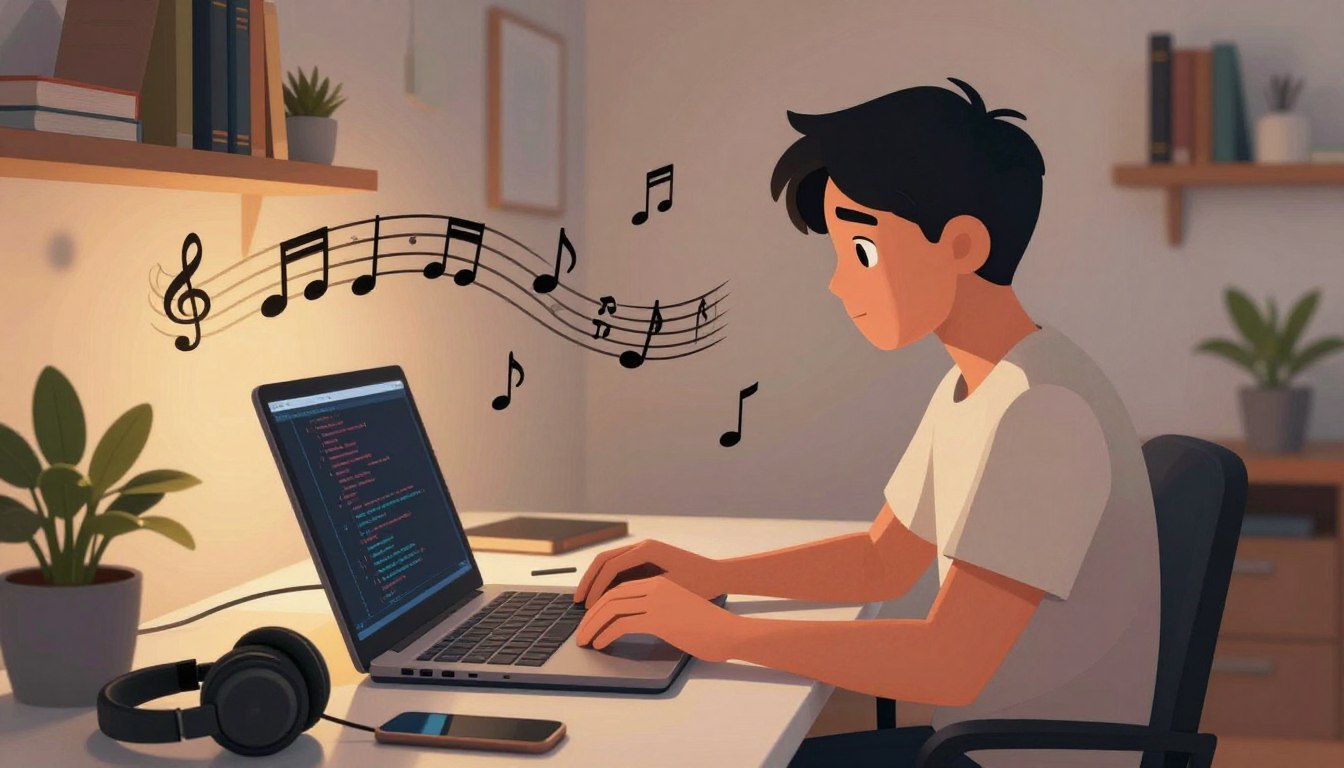
There are moments when a single track unlocks hours of focused work. A programmer remembers late nights when familiar themes carved a quiet path through complex problems. Those nights showed how rhythm can steady the brain and help sustain effort over long time.
Observers have long linked musicians to developers: both use technical tools, shift between detail and big-picture thinking, then return to craft with renewed clarity. Experts like Rob Birdwell and Carl Franklin described this overlap; their views show practical habits that support deep work.
This article frames how sound can be chosen intentionally to protect attention, reduce cognitive load, and make work sessions more reliable. For a concise review of research and trends, see a focused summary at the effects of music while coding.
Key Takeaways
- Deliberate playlists help preserve focus during long sessions.
- Limited vocals and steady pacing reduce working-memory drain.
- Musicians’ habits mirror strong programmer practices.
- Sound is a tool: use it with rituals to enter focus blocks.
- Choices range from cinematic scores to ambient textures.
Why Music Matters When You Code
Sound directs attention. Chris Achard notes that limited vocals reduce word-level distraction, letting the inner voice run reasoning tasks without contest.
Familiar tracks work better over long stretches. When people use known themes, the brain avoids novelty checks and keeps focus for longer time blocks.
Tempo is a practical lever. Too slow drains energy; too fast raises stress. A steady, moderate pulse provides forward motion without jitter.
“Long-form scores and game soundtracks are built to sustain engagement; they minimize playlist management during deep sessions.”
Practical tips: pre-build long playlists, match energy to the task, and use scores from cinematic or video game sources that run for hours.
| Factor | Effect on Focus | Recommended Kind |
|---|---|---|
| Vocals | Competes with working memory | Instrumental, minimal lyrics |
| Familiarity | Less novelty; sustained attention | Known film or game scores |
| Tempo | Sets arousal; steady pace aids flow | Moderate, non-intense beats |
- Use the right sound as part of mental ergonomics.
- Decide the task first — debugging vs. architecture — then choose the soundtrack.
Beats, the Brain, and Deep Work: The Science Behind Staying in the Zone
The right auditory backdrop primes the brain to maintain long stretches of focused problem solving.
Simple rules make a big difference. Limited vocals keep the phonological loop free for logic tasks. Familiar tracks lower novelty checks, so attention stays on the task.
Limited vocals, fewer distractions: how lyrics compete with working memory
Lyrics force the brain to parse language. That processing competes with inner narration used for reasoning.
Prefer instrumental pieces to protect working memory and reduce interruptions.
Tempo and pacing: finding the sweet spot between too slow and too intense
Tempo sets arousal. A steady mid-tempo sustains alertness without stress.
Too slow invites mind-wandering; too fast causes rushed choices. Aim for predictable pulses that match task tempo.
Familiar tracks vs. novelty: leveraging predictability for flow
Predictable sequences let the brain conserve effort. Developers report being in the zone more often with known scores.
Long films or game albums work well because they minimize playlist decisions and keep a coherent emotional arc.
- Entrains cadence: steady beats help time read-think-implement cycles.
- Guard the zone: use full albums to avoid interruptions.
- Build a taxonomy: tag sets for heads-down work versus planning.
| Factor | Effect | Recommended kind |
|---|---|---|
| Vocals | Competes with verbal working memory | Instrumental scores |
| Tempo | Controls arousal and pacing | Mid-tempo, steady beats |
| Familiarity | Reduces novelty-driven distraction | Known film or video game albums |
From Guitar Riffs to Clean Code: Parallels Between Musicians and Programmers
Practice shapes attention: hours with an instrument train the same mental muscles a programmer uses during long builds. Rob Birdwell noted that music and software blend collaboration with individual craft; tools and notation ask for interpretation beyond what appears on the page.
Carl Franklin emphasized the same shift: instrumentalists zoom into technical repetition, then step back to the whole piece. That habit maps directly to how programmers switch between focused fixes and system-level design.
“Great players slow passages to master micro-techniques, then reassemble the work—developers follow the same loop with functions and modules.”
Instrumentalists’ focus: zooming in and out like a seasoned programmer
Instrument practice builds sustained focus. People spend hours on small units until the move becomes fluent. The same precision helps a programmer refine a routine until it reads like a clear sentence.
Self‑expression and the art of development: code as a creative medium
Code carries intent beyond syntax. Naming, structure, and patterns tell a story; this is where the art of development appears. Constraints guide creativity, and quality shows as clarity and emotional resonance for users.
- Practice hones attention: micro-repetition leads to macro fluency.
- The guitar analogy: slow the passage, fix the detail, reassemble the whole.
- Collaboration matters: timing and listening make teams perform well.
| Domain | Skill Parallel | Practical Result |
|---|---|---|
| Instrument practice | Micro-drills to fluency | Faster, reliable execution |
| Programming workflows | Unit work then integration | Cleaner modules and architecture |
| Tools | Amps & interfaces vs. build pipelines | Better ergonomics and fewer friction points |
Collaboration unites ensembles and engineering teams: timing, handoffs, and feedback loops determine how well things land in production or performance.
For discussion among practitioner communities, see the musician-programmers discussion for real-world perspectives from both sides.
Coding and Music: Playlists and Soundscapes That Keep You in the Game
Selecting the right sonic palette creates a predictable frame that supports long stretches of focus. Choose sets that match task intensity and planned session length.
Movie soundtracks for momentum
Interstellar and Lord of the Rings offer long, evolving textures that sustain multi-hour work blocks. Use them when a steady emotional arc helps push through complex tasks.
Video game scores built for immersion
Scores from Final Fantasy and Outpost 2 are designed to keep attention aligned with a mission. These video game albums avoid lyrics and maintain cognitive flow for focused implementation work.
Electronic study beats
Choose steady, non-spiking electronic tracks for propulsion that stays in the background. They work well for repetitive tasks or long review sessions.
Orchestral power sessions, lounge, and ambience
Try full concerts like Beethoven 9 to segment work by movement. For invisible background, pick lounge, jazz, or ambient chillout to warm the room without stealing focus.
- Simulate social energy with coffee shop ambience during afternoon slumps.
- Pre-build a curated playlist by task type to start coding immediately; use the end of a set as a natural break.
For a ready set of suggestions and a practical curated playlist, explore recommended collections that match focus intervals and task goals.
Building with Sound: Tools, Languages, and Creative Workflows
Treat the workstation as an instrument: small experiments shape expressive systems. Jason Riggs frames this by using tools like ChucK and by judging projects on whether they sound musical.
Turning code into playable tools
Explore environments such as ChucK for sample-accurate timing and real-time control. These platforms let developers make synthesis and sequencing live, which speeds learning and sparks invention.
From web to native
Audio projects span many languages. Web languages and Rails can host browser instruments. Python, C/C++, and Swift serve DSP, plugins, and mobile apps. Prototype fast, then port latency-critical parts to native code.
Rituals that respect the brain
Define routines: reserve high-energy hours for hard programming tasks and pair them with reliable playlists. Version-control patches and presets so creative work compounds over time.
| Area | Typical languages | Best use |
|---|---|---|
| Browser instruments | Web languages, Rails | Rapid prototyping, wide access |
| DSP & Plugins | C/C++, Swift | Low-latency performance |
| Research & Scripts | Python | Fast iteration, analysis |
Conclusion
, A consistent sound ritual primes attention and makes deep work repeatable.
This post shows simple, practical things: pick instrumental, familiar, mid-tempo tracks to protect focus while writing code. Use cinematic or game scores, steady electronic sets, or ambient textures for different tasks and session lengths.
Practitioners such as Rob Birdwell and Carl Franklin find clear parallels between practice on stage and the habits of programming. Jason Riggs shows how tools like ChucK and common languages turn the computer into an expressive instrument.
Codify your approach: curate playlists, set session time, log results. Over months, the right way of using sound becomes a reliable tool that conserves effort and raises output.
FAQ
How do beats and background sound influence a programmer’s focus?
Rhythmic tracks and ambient soundscapes can regulate arousal and attention, helping developers enter deep work. Low-vocal or instrumental pieces reduce verbal interference with working memory, so tasks that demand syntax recall and logic flow become easier. Choose steady tempos and familiar patterns to minimize novelty that breaks concentration.
Which types of music best support sustained coding sessions?
Instrumental soundtracks, electronic “study” beats, orchestral scores, and ambient or lounge music offer unobtrusive texture that sustains momentum. Video game and film scores are designed to enhance focus without drawing attention; they provide pacing and emotional lift that map well to iterative development and debugging cycles.
Are vocals always detrimental to programming work?
Not always, but lyrics often compete with verbal working memory, making language-heavy tasks harder. Limited-vocal tracks or songs in unfamiliar languages cut that interference. For creative architects or pair programmers, light vocal tracks can boost morale; for complex algorithmic tasks, mute vocals or use instrumental alternatives.
How does tempo affect cognitive performance during development?
Tempo sets internal pacing. Slow tempos can calm anxiety and aid careful reading; mid-range tempos (around 60–90 BPM) often support steady productivity; fast, intense beats may boost energy but risk rushing decisions. Match tempo to task: methodical review gets slower tracks, feature sprints benefit from upbeat rhythms.
Should developers rotate familiar playlists or seek new tracks?
Familiar playlists reduce unpredictability and free cognitive bandwidth, which helps repetitive or detail-oriented work. Novel tracks can spark creativity during brainstorming or prototyping. Alternate between predictability for deep maintenance work and novelty for ideation sessions.
Can musicians and programmers share productive habits?
Yes. Both disciplines use deliberate practice, iterative refinement, and chunking of complex material. Instrumentalists’ focus—zooming between micro technique and macro form—mirrors code reviews and architecture thinking. Treat code as an expressive medium: version control and refactoring are analogous to score revisions.
What tools and languages are common in audio-focused development?
Music-centric environments like ChucK, SuperCollider, and Max/MSP enable live sound coding. For production and integration, web languages (JavaScript, HTML5 audio), Rails, Python, C/C++, and Swift support plugins, apps, and native audio processing. Choose depending on latency needs, platform, and ecosystem.
How can one build a daily routine that blends practice, development, and listening?
Create rituals: warm-up with short focused sessions, set playlist categories for task types, and use timed sprints (Pomodoro) with matching soundscapes. Reserve novel tracks for creative blocks and familiar lists for heavy coding. Consistent cues—same playlist, same start routine—condition the brain to enter productive states faster.
Are there recommended soundtracks for specific programming tasks?
Yes. Use cinematic scores for long-form architecture work, video game soundtracks for steady-focus tasks, electronic study beats for bug fixing, and ambient or coffee-shop ambience when subtle social energy helps creativity. Tailor choices to personal response rather than rigid rules.
How do environmental ambiences like coffee-shop noise compare to music for focus?
Coffee-shop ambience provides low-level social energy without direct distraction; it can boost motivation and reduce isolation. For some, it replaces music altogether. Test both: ambience suits collaborative ideation and shallow work, while instrumental tracks better support deep, solitary coding.