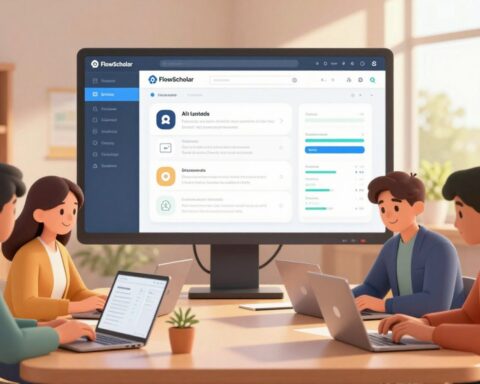
There are moments when a single lesson changes a career path or a student’s confidence. We have seen teams and classrooms find faster mastery when instruction adapts to what each person needs.
The shift from one-size-fits-all to targeted learning experiences is not abstract; it is practical and measurable. Adaptive learning platforms personalize content, pace, and assessments to close knowledge gaps and speed time to proficiency.
Market momentum underlines the point: demand for scalable personalization is rising fast. Leaders should evaluate vendors that embed training into daily flow, support STEM labs, or deliver microlearning paths.
We will outline how these tools work, which platforms excel, and which features drive impact. The goal: help organizations pick solutions that match learner needs and clear performance goals. For a detailed vendor overview, see this short guide on adaptive learning platforms.
Key Takeaways
- Personalization matters: Tailored content boosts mastery and retention.
- Proven benefits: Faster time to proficiency and clearer performance lift.
- Market momentum: Rapid growth signals a strategic moment to act.
- Choose by context: Select platform features that match cohorts and goals.
- Data drives impact: Learner profiles and performance analytics enable better outcomes.
Why Adaptive Learning Matters Now for U.S. Students and L&D Teams
Diverse baselines in classrooms and workplaces make single-track courses increasingly impractical. Instruction that adapts to individual needs speeds progress and clarifies impact.
From one-size-fits-all to personalized learning paths
Personalized learning paths guide each learner to the right content at the right moment. This raises completion rates and deepens knowledge retention.
Training teams can sequence courses and assessments to match competency frameworks. That reduces wasted time and targets real skills gaps.
Market momentum in 2025: rising demand for scalable personalization
The market is expanding rapidly: projections show growth from USD 2.87B in 2024 to USD 4.39B in 2025 — a 52.7% year‑over‑year jump. That pace signals urgency for institutions and enterprises to standardize on an adaptive learning platform.
Decision-makers should prioritize metrics that prove value: time to proficiency, assessment mastery, and performance aligned to academic or business goals. Platforms must integrate with existing tech stacks and support governance, authoring, and instructor workflows.
How AI Powers Personalized Learning Experiences
Personalized learning depends on three linked components: profile inputs, behavioral signals, and performance traces. Systems ingest profile tags, quiz results, and clickstreams to form an evolving learner model.
Adaptivity factors include demographics, prior course grades, mastery status, and time-on-task. These inputs become actionable data that the platform maps to rules and probabilistic models.

Adaptive responses: pathways and feedback
Dynamic sequencing routes learners past mastered modules and resurfaces weak topics. Real-time feedback appears as hints, corrective guidance, and confidence checks that reduce rework.
Assessment intelligence
Assessments shift difficulty and vary item types to probe depth. Targeted probes confirm level and surface gaps so instructors can focus coaching where it matters.
| Component | Inputs | Platform Response |
|---|---|---|
| Profile | Tags, prior scores, competencies | Personalized starting points |
| Performance | Quiz accuracy, mastery flags | Difficulty adjustment; route changes |
| Behavior | Time-on-task, navigation | Hints, pacing changes, nudges |
Transparent models—rules plus statistical learning—recommend next steps while leaving instructors in control. Practical analytics include attempt patterns, mastery maps, and time-on-task, which link to outcomes and guide content strategy.
For a deeper look at how this technology is changing education, see a focused primer on adaptive learning and platform impact.
Product Roundup: Leading Adaptive Learning Platforms and What They Do Best
Decision-makers should view vendors through the lens of where and how learners engage. This shortlist maps strengths to outcomes so teams can match needs to measurable goals.
Workplace-first options
Whatfix embeds in-app guidance and personalized flows that keep training inside daily workflows. Its Self Help and analytics surface gaps while employees work.
360Learning supports collaborative authoring and generative controls that speed course creation and expert reviews. It suits teams that need rapid content iteration.
Realizeit powers 1:1 pathways at scale — onboarding, reskilling, and compliance — with progression intelligence that tracks mastery level.
Academic and specialized tools
Knewton Alta (Wiley) focuses on STEM mastery with personalized study plans and real-time feedback. Pearson Interactive Labs delivers virtual lab simulations and instant post-lab analysis for hands-on skills.
Engines, integrators, and microlearning
Adaptemy integrates via xAPI to add adaptive assessments and curriculum maps inside existing systems without replacing core software.
OttoLearn uses spaced repetition and gamification to deliver bite-size microlearning that boosts recall and reduces refresh cycles.
Notable differentiators include in-app guidance, generative authoring controls, virtual lab simulations, and progression analytics. Match these features to your content libraries, tech stack, and measurable outcomes such as time-to-proficiency or error reduction.
- User and admin experience: intuitive authoring, simple integrations, and analytics that roll up to managers and L&D leaders.
- Technology maturity: xAPI streams, item banks, and recommendation engines sustain adaptive loops.
- Selection process: shortlists should align current content and learner profiles to reduce migration complexity.
Features That Matter: Matching Platform Capabilities to Your Learning Goals
Choosing the right features narrows the gap between strategy and measurable results. A focused set of capabilities speeds creation, personalizes pathways, and proves progress.
Content creation at pace: prompt-controlled authoring
Prompt-controlled authoring lets subject-matter experts produce courses faster while keeping tone, inclusivity, and checks consistent. Tools like 360Learning enable SMEs to reduce authoring time and preserve quality through governed review cycles.
Skills-based recommendations and suggested enrollments
Skill graphs and recommendation engines route learners to targeted modules. That routing triggers timely enrollments and reduces manual admin.
Analytics that prove progress: completion, proficiency, and lift
Dashboards should show completion rates, proficiency gains, time to proficiency, and links to performance indicators. Align tagging and item banks early so data maps to competencies and closes knowledge gaps quickly.
- Role-based targeting: segment users to deliver relevant experiences without heavy admin.
- Microlearning: bite-sized practice reinforces concepts between longer courses.
- Pilots & governance: run small tests to refine prompts, calibrate difficulty, and set metadata standards.
For a practical walk-through on rapid course creation, see this course creation guide.
AI Use Case – Adaptive Learning Platforms for Students: Benefits and Impact
Modern classroom tools craft paths that meet each learner where they are. These systems turn broad courses into targeted learning experiences that increase relevance and motivation.
Personalized learning paths and higher engagement
Personalized learning paths guide learners to content that matches their skill level. That boosts engagement, raises completion, and delivers clear benefits to instructors and institutions.
Time savings through automation and just-in-time support
Automation trims routine tasks: sequencing, nudges, and in-app guidance cut rework and shorten time to mastery. Instructors spend less time on basics and more on coaching.
Closing knowledge gaps with adaptive assessments and microlearning
Adaptive assessments calibrate difficulty to each learner’s level and reveal precise gaps. Microlearning reinforces weak areas with short, spaced practice that cements knowledge.
“Real-time personalization helps learners know what to do next, and gives instructors evidence to act.”
- Core benefits: more relevant courses, higher completion, stronger mastery.
- Faster progress through automated sequencing and just-in-time support.
- Targeted remediation: assessments pinpoint gaps and enable focused coaching.
- Microlearning sustains retention between larger modules.
When a learning platform aligns content to competencies, measurable impact follows: fewer errors, improved performance, and dashboards that track progress over time. For a practical guide to vendor selection, see our adaptive learning platform guide.
Buyer’s Guide: How to Choose and Implement the Right Adaptive Learning Platform
Picking the right system begins with a clear checklist that ties technical fit to measurable outcomes. Decision-makers should weigh integrations, security, admin experience, and the quality of adaptive assessment and analytics.
Evaluation checklist
- Integrations: LMS/LXP, HRIS, SSO and xAPI streams to build accurate learner profiles.
- Security & privacy: SOC 2, GDPR, HIPAA where relevant.
- Scalability & admin UX: author workflows, item banking, and low admin tasks at scale.
- Assessment & analytics: adaptive engines, reporting flexibility, and action-ready data.
Implementation roadmap
Start with a pilot cohort to validate fit and calibrate difficulty. Connect data sources early and set baseline metrics.
Map content to competencies so the system can target gaps and guide progress across courses and skills.
Governance and metrics
Define roles, review cadence, and change management to sustain quality. Track time to proficiency, completion, knowledge-check accuracy, performance lift, and ROI.
Measure what matters: baseline metrics plus ongoing analytics turn trials into scaled adoption.
Conclusion
A focused rollout—one high-impact course, measured tightly—delivers quick wins that build confidence and scale.
The case is clear: market momentum, proven benefits, and mature platforms make adaptive learning a strategic priority. Choose a learning platform that matches goals, prioritize must-have features, and validate fit through a pilot.
Emphasize time to proficiency, visible progress, and performance impact to keep stakeholders aligned. Pair technology with governance, content creation workflows, and instructor support to lock in results.
Use micro-strategies—just-in-time guidance, targeted course updates, continuous calibration—to sustain gains. Start with one course, measure insights, then scale. Thoughtful application improves training quality, lifts performance, and reduces instructor effort.
Act now: codify requirements, engage vendors, and capture quick wins that compound into long-term impact.
FAQ
What makes personalized learning paths more effective than traditional courses?
Personalized learning paths tailor content, pacing, and assessment to an individual’s profile and performance. By sequencing modules based on prior knowledge and behavior data, platforms increase engagement and retention while reducing time to proficiency. This approach ties course content to clear skills outcomes and measurable performance improvements.
How do adaptive systems determine the right next step for a learner?
Systems combine learner profiles, performance metrics, and real-time interaction data to select and sequence content. Algorithms detect gaps via adaptive assessments, then adjust difficulty or recommend microlearning nuggets, simulations, or coaching. The result is a dynamic pathway that responds to progress and predicts future needs.
Which platforms are strongest for workplace training versus academic use?
Workplace-first solutions like Whatfix and 360Learning emphasize in-app guidance, rapid content creation, and integrations with enterprise systems. Academic or STEM-focused tools such as Knewton Alta and Pearson Interactive Labs offer deeper courseware, assessment intelligence, and discipline-specific labs. Choose by alignment to learning objectives, integrations, and admin experience.
Can generative tools speed up course creation without sacrificing quality?
Yes. Prompt-controlled authoring and generative content accelerate development by producing drafts, question banks, and microlearning modules. The best practice pairs automation with human review to ensure pedagogical soundness, accurate skills mapping, and consistent brand voice across learning objects.
How do platforms measure learning impact and ROI?
Effective platforms surface analytics on completion rates, proficiency gains, time to proficiency, and performance lift. Linking learning outcomes to business metrics—productivity, error rates, or sales—provides a clearer ROI. Look for dashboards that support cohort comparisons and trend analysis.
What integrations should buyers prioritize during evaluation?
Prioritize LMS and HRIS connectivity, single sign-on, xAPI or LRS support for rich activity data, and content repositories. Security, scalability, and admin UX are crucial. Seamless integration with talent systems enables skills-based recommendations and enrollment automation.
How can organizations ensure a successful implementation?
Start with a pilot cohort to validate data foundations, content mapping, and learner experience. Build governance around data quality and change management. Define short-cycle metrics—engagement, completion, early proficiency—then iterate content and algorithms based on analytics.
What role does microlearning play in closing knowledge gaps?
Microlearning delivers focused, bite-sized content that suits just-in-time support and spaced repetition. When paired with adaptive assessments, it targets specific gaps and reinforces retention. This approach also reduces cognitive load and fits into daily workflows.
Are there privacy or security concerns with data-driven personalization?
Yes. Platforms must comply with FERPA, COPPA, and applicable state privacy laws for student data, and follow enterprise security standards for workplace deployments. Buyers should vet data governance, consent models, and anonymization practices to protect learners and the organization.
How do recommendation engines decide which courses to suggest?
Recommendation engines use skills taxonomies, past performance, role profiles, and career pathways to suggest targeted enrollments. When combined with analytics, they prioritize learning that closes measurable gaps or advances critical competencies for teams and individuals.
Can adaptive platforms support hands-on labs and simulations?
Many platforms integrate virtual labs, simulations, and interactive assessments to evaluate applied skills. These experiences feed assessment intelligence, enabling the system to adjust difficulty and recommend remediation or enrichment based on demonstrated competence.
What differentiates microlearning specialists from broader platforms?
Microlearning specialists focus on spaced practice, gamification, and short-form content optimized for retention. Broader platforms may offer those features plus courseware, authoring, and enterprise integrations. Select based on whether the priority is retention tactics or end-to-end learning management.
How important is explainability in adaptive decision-making?
Explainability builds learner trust and supports governance. Platforms that surface why a pathway or recommendation was chosen—showing competency gaps and evidence—help administrators validate results and learners understand progression.
What are common pitfalls when scaling personalization?
Pitfalls include poor data quality, insufficient content mapping, lack of governance, and overreliance on automation without instructional oversight. Address these by establishing data standards, integrating content with clear skills frameworks, and maintaining human review loops.
How do organizations balance automation with instructional design expertise?
Combine generative tools for efficiency with instructional designers for pedagogy. Use templates and prompt libraries to standardize outputs, then apply human evaluation to align content with learning objectives, assessment validity, and engagement strategies.