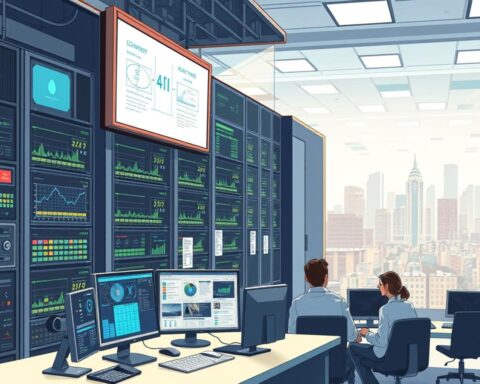
One Monday, a healthcare provider’s services slowed down. They saw how network issues affected patient care. This made them realize that quick fixes cost a lot.
This AI Use Case turns this problem into an advantage. It uses Network-Traffic Prediction for Capacity Planning. This way, teams can predict needs, reduce downtime, and plan upgrades better.
They use Predictive Analytics and machine learning. This makes planning decisions based on data, not guesses.
The goal is simple: make networks better, fix problems faster, and cut down on tickets. Leaders like Juniper/Mist AI, Datadog, and Dynatrace have seen big improvements. They’ve cut down trouble tickets and on-site visits a lot.
This section guides you on how to optimize network capacity. You’ll learn about algorithms, data pipelines, and real successes. It also talks about the challenges of making Predictive Analytics work for you.
Key Takeaways
- AI Use Case: Predictive Analytics can shift capacity work from reactive to proactive.
- Network-Traffic Prediction for Capacity Planning improves performance and reduces MTTR.
- Network Capacity Optimization delivers fewer trouble tickets and smarter procurement timing.
- Real-world vendors—Juniper/Mist, Datadog, Dynatrace—show measurable operational gains.
- The article will outline practical steps, tools, and common challenges for implementation.
Introduction to AI in Network Management
Artificial Intelligence is changing how we manage networks. It turns guesswork into smart planning. Teams get quick insights on demand and usage.
Importance of Capacity Planning
Capacity planning tracks demand and growth. It schedules upgrades to avoid problems. With more remote work, cloud use, and growth, we can’t just guess.
Planners often add 20–30% extra to handle spikes. They review monthly to spot trends. Bad planning can cause outages and lose customers.
Overview of Network-Traffic Prediction
Network-Traffic Prediction uses data for better planning. It forecasts bandwidth and tracks usage. It also analyzes speed and latency.
Forecasting uses past data and models. Real-time monitoring gives alerts. This keeps systems running smoothly.
Benefits of AI Integration
AI makes forecasts better and finds hidden patterns. It spots anomalies and predicts failures. It also automates settings and finds security threats.
Tools like Juniper Mist and Datadog help. They reduce problems and improve performance. This leads to better planning and fewer surprises.
How AI Enhances Network-Traffic Prediction
AI changes how we predict and manage network needs. It mixes model forecasts with live data. This gives us better insights for quick and long-term plans.
Machine Learning Algorithms Used
Time-series forecasting is key. LSTM networks are great at learning over time. Self-attention and transformers help understand different flows.
Classification models use special features to predict. This helps identify IoT devices and detect attacks.
Companies like Dynatrace and Datadog use AI for quick problem-solving. They combine different signals for better insights.
Data Collection Techniques
Good models need many types of data. This includes PCAPs, NetFlow, and SNMP. Each adds to the model’s understanding.
Aggregating data helps classify packets and flows. Labeled data is key for improving model accuracy.
Privacy and bandwidth guide how we collect data. Running models locally saves privacy and bandwidth. CableLabs shows how to do this effectively.
Real-time Analysis Capabilities
Streaming analytics find problems fast. They trigger quick actions and automated fixes. Datadog Watchdog shows how to be quick and agile.
Edge and CPE deployments help monitor the network. They keep watching even when the cloud is down.
Combining live data with predictions helps us act fast. This mix gives us the insights we need for smart decisions.
Key Benefits of Network-Traffic Prediction
Traffic Forecasting gives teams a clear view of demand before it arrives. Predictive signals let operators plan upgrades and avoid last-minute purchases. This approach improves decision-making and supports Network Capacity Optimization.
Improved Resource Allocation
Forecasting lets teams target upgrades to specific sites or services. Scenario modeling helps plan for new launches or migrations. This way, teams can avoid rushed procurement.
Real-world tools show the benefits. Dynatrace helped BARBRI scale Azure during exam peaks. This shows how measured Resource Allocation reduces risk and supports smoother rollouts.
Enhanced Performance and Reliability
Predictive models detect issues before they affect users. This leads to lower mean time to repair and fewer service interruptions. Automated troubleshooting features from Juniper and Mist have cut trouble tickets and on-site visits.
Measuring more than bandwidth is key. Packet loss, jitter, and application-level KPIs reveal user experience problems. These metrics help validate capacity decisions and make networks more resilient.
Cost Efficiency in Network Operations
Accurate Traffic Forecasting reduces emergency upgrades and costly charges. Better plans mean fewer surprise expenses and less wasted bandwidth. Linking forecasts to execution slashes administrative burden and speeds delivery of capacity.
Case evidence supports the point: Datadog’s tooling lowered MTTR and helped Toyota avoid lost production time. Streamlined processes saved other enterprises substantial sums. This mix of visibility and action drives measurable Cost Efficiency.
Challenges in Implementing AI for Network-Traffic Prediction
Using AI for network-traffic prediction is promising. It can help reduce traffic jams and improve planning. But, teams face real challenges before these models work well.
Data Privacy Concerns
Sharing packet captures or detailed flows to the cloud raises privacy worries. Rules and customers want strict privacy controls. To meet these, teams must anonymize data and label it carefully.
Edge or CPE inference helps by keeping raw data local. Yet, logs and aggregated features need careful handling too.
Technical Skill Requirements
Teams need more than one skill to use AI. They must have skills in data engineering, MLOps, model validation, and understanding routing and QoS. Vendors like Juniper, Datadog, and Dynatrace offer tools that help.
But, engineers must fine-tune models and check them against real events.
Integration with Legacy Systems
Old systems can slow down integration. Legacy tools often lack modern APIs, making it hard to use AI. This requires a careful plan and clear metrics mapping.
To tackle this, teams should anonymize data, train staff, and start with easy domains. Services that link planning to action can help speed up results.
For more on privacy and prediction, see this study on AI for traffic analysis: research overview.
| Challenge | Typical Impact | Mitigation |
|---|---|---|
| Data Privacy Concerns | Regulatory fines, customer distrust, limited data sharing | Anonymization, on-premises inference, strict retention policies |
| Technical Skill Requirements | Longer deployment, model drift, misaligned forecasts | Training programs, hire MLOps talent, vendor tooling for ops |
| Integration with Legacy Systems | Incomplete inputs, automation gaps, inconsistent metrics | Phased integration, API wrappers, normalization layers |
| AI Implementation Challenges | Bias, poor generalization, slow ROI | Robust validation, diverse datasets, human oversight |
| Network Monitoring | Blind spots, delayed alerts, fragmented telemetry | Unified collectors, real-time streaming, standardized schemas |
Case Studies: Successful Implementations
This section looks at real-world examples of AI in network operations. These examples show how AI can improve network management. They highlight how AI can make a big difference.
Major Telecom Company Solutions
Juniper Networks used AI to fix problems in automated warehouses. They solved VLAN and DHCP issues. This made operations smoother.
Cisco’s AI helped REWE Group fix problems faster. IT teams could focus on new projects. This made work more efficient.
Enterprise Network Optimizations
Toyota Motor North America used Datadog Watchdog to fix AGV issues. This cut down repair time by 80%. It saved a lot of time and money.
BARBRI used Dynatrace Davis for Azure migration. It helped keep services running smoothly. This was important during busy times.
LivePerson used AI to keep services up and running. It checked over two million metrics every 30 seconds. This ensured quick responses and high uptime.
Academic Research Outcomes
CableLabs NetLLM turned packet captures into useful data. It used special layers and techniques to improve accuracy. Early tests showed over 90% success rate.
Researchers focused on models that work well on devices. They also worked on keeping data safe. This could lead to even better AI in the future.
Studies show AI works best when it’s integrated with monitoring tools. Models that work on devices protect privacy. A mix of AI and human checks is the most reliable.
Tools and Technologies for Network-Traffic Prediction
Modern capacity planning uses many tools. These tools turn raw data into clear signals. Teams pick tools for training, showing data, and watching it all the time.

AI and ML Frameworks
Long short-term memory networks are good for flow sequences. Transformers and self-attention are getting popular for smart predictions. Packet embedding turns PCAP records into model-ready vectors.
Production pipelines use these vectors for forecasts. Vendor engines make it easy to start: Dynatrace Davis, Datadog Watchdog, and Juniper Mist are examples. Research is looking into packet transformers and combining packet data with logs for better insights.
Data Visualization
Dashboards need to show model output clearly. Dynatrace, Datadog, and Azure Monitor have good views. They show packet loss, jitter, and throughput.
They also predict capacity shortfalls. Synthetic tests help teams check traffic scenarios before they happen. Visual layers should make it easy to see predictions and details.
Network Monitoring Solutions
Top monitoring vendors use AI for faster detection. Dynatrace, Datadog, and others have different strengths. They offer automated topology, flow analysis, and more.
Look for anomaly detection, predictive analytics, and easy cloud integration. Managed services can help fill gaps. Meter Connect offers full-stack integration and support.
| Capability | Representative Tools | Why It Matters |
|---|---|---|
| Sequence Modeling | LSTM, Transformer libraries (PyTorch, TensorFlow) | Captures temporal patterns for Traffic Forecasting Tools and surge detection |
| Vendor AI Engines | Dynatrace Davis, Datadog Watchdog, Juniper Mist | Speeds deployment with built-in Predictive Analytics Tools and root-cause |
| Visualization Platforms | Dynatrace, Datadog, Azure Monitor, Grafana | Turns model output into operational dashboards for quick action |
| Monitoring Suites | Cisco DNA Center, LogicMonitor, Auvik, NinjaOne, Anodot | Provides flow, packet, and topology data for training AI and ML Frameworks |
| Managed Integration | Meter Connect and similar managed services | Delivers procurement, installation, and SLAs so teams can focus on insights |
Future Trends in AI and Network-Traffic Prediction
AI is changing how we plan networks. It’s moving from simple rules to understanding packet flows like language. This change is part of the Evolution of AI Technologies.
It helps find problems faster and gives clear advice. Engineers at CableLabs and big companies are working on new models. These models mix different data to explain and fix issues.
The next step in AI is using smaller models. These models work on devices near users to protect privacy. They also make networks faster by reducing delays.
Evolution of AI Technologies
Old models needed big training. Now, we have smaller models for quick fixes. Companies like Cisco and Juniper are making agents for devices. These agents fix common problems and send summaries for bigger trends.
Network Demand Predictions
More people working from home and streaming videos will increase network use. AI will help predict this growth. It will adjust network capacity for big events or new products.
Traffic Forecasting Trends
AI will focus on keeping networks fast for work. It will send alerts for real problems, not just noise. This helps fix issues before they affect users.
Edge Computing
Edge Computing will make networks safer and faster. Local agents can act quickly without waiting for the cloud. This keeps services running during cloud problems.
Edge and cloud working together will become common. Edge agents will act fast, while cloud controllers plan for the future. This mix helps networks adapt to changing needs.
As these trends come together, AI will predict network traffic better. Networks will learn from local actions and global data. They will adjust to meet business needs.
Best Practices for Implementing AI-Based Solutions
Starting with clear goals is key. Teams need targets like reducing repair time or cutting trouble tickets. Make sure forecasts match business events like new product launches.
Set up triggers and upgrade rules. Connect these to workflows and plans for action. Use simple metrics like packet loss and application KPIs to improve user experience.
Working together helps. Network teams, app owners, and others should talk and plan together. Pick a leader for planning to make roles clear.
Use tools together for one truth. For example, Dynatrace and Azure Monitor can help. Start small, test one site, and then grow.
Keep learning to keep models sharp. Use feedback loops to check forecasts against real data. Update models with new data to get better over time.
Test plans with synthetic tests and exercises. This checks failover and capacity. Regular reviews help improve plans and policies.
Roll out AI in phases. Start with high-value use cases. Remember, systems need time to get better. Choose trusted tech and open platforms for future data sharing.
For more on using AI for planning, check out this guide.
Conclusion: The Future of AI in Capacity Planning
AI helps predict network traffic. This is a big win for planning network capacity. Companies like Juniper and Cisco use AI to forecast traffic and find problems fast.
They make decisions quickly and save money. This is because AI turns data into useful information. It helps them make smart choices.
Success comes from good forecasting and checking AI’s work. It’s also about making upgrades smoothly. This way, they avoid big problems and save money.
For more info, check out this industry paper. It talks about how AI helps with network planning.
Companies should start small and grow slowly. They need to work together and use AI wisely. This means using AI for quick tasks and cloud for long-term planning.
They should also plan for problems and use AI to help. This way, they can fix issues before they happen. It makes their network strong and ready for growth.
FAQ
What is the primary objective of using AI for network-traffic prediction in capacity planning?
The main goal is to use AI and predictive analytics. This helps forecast network demand. It also reduces downtime and aligns upgrades with business needs.
This means turning data into actions for better network performance. It avoids wasting money on too much capacity.
Why does capacity planning matter now more than before?
Hybrid work and cloud migrations have changed things. Now, planning is more important than ever. It helps avoid wasting money and ensures networks work well.
Having a 20–30% buffer and reviewing monthly helps. It lets networks handle spikes and trends.
How does traffic forecasting differ from real-time network monitoring?
Forecasting uses past trends and models to predict future needs. It plans for upgrades. Real-time monitoring catches immediate issues.
Both are important. Forecasting plans for the future, while monitoring fixes now.
What measurable benefits have vendors reported from AI-driven network operations?
Vendors say AI has brought big improvements. Juniper/Mist AI reports up to 90% fewer trouble tickets. Datadog saw a big drop in MTTR at Toyota.
Dynatrace’s Davis helped BARBRI scale Azure and find important insights.
Which machine learning algorithms are commonly used for traffic prediction and anomaly detection?
Time-series models and LSTM networks are often used. They help predict traffic and find unusual patterns. Transformer components and hybrid models also play a role.
Research shows packet-to-embedding approaches work well. They help classify and detect attacks.
What telemetry sources are required to build robust forecasting models?
You need PCAPs, flow telemetry, and device metrics. Also, application metrics, cloud-monitoring inputs, and synthetic test results are important. Combining different layers improves accuracy.
How can organizations protect privacy while collecting packet and flow data for models?
Use on-prem or CPE inference to keep data local. Anonymize and label data carefully. Use retention and access controls. Minimize what you capture.
Lightweight models reduce bandwidth and exposure. They keep analysis valuable.
Can AI systems operate in real time at the edge, and why does that matter?
Yes, AI can work at the edge. It keeps data private and reduces bandwidth. It also works when the cloud is down.
Edge AI lets you fix problems quickly. Cloud systems handle bigger tasks.
How do AI forecasts improve resource allocation and procurement timing?
AI forecasts help pinpoint where you need more capacity. This means you can upgrade just what’s needed. Scenario modeling helps plan for new regions.
This reduces waste and makes sure you’re ready for business needs.
Beyond bandwidth, which metrics should planners monitor to validate capacity decisions?
Watch packet loss, jitter, latency, throughput, and app KPIs. These show how well users experience your network. They help you make better choices.
What measurable benefits have vendors reported from AI-driven network operations?
Vendors see big gains. Juniper/Mist AI cuts trouble tickets and fixes faster. Datadog and Dynatrace also report big improvements.
Which machine learning algorithms are commonly used for traffic prediction and anomaly detection?
Time-series models and LSTM networks are often used. They help predict traffic and find unusual patterns. Transformer components and hybrid models also play a role.
Research shows packet-to-embedding approaches work well. They help classify and detect attacks.
What telemetry sources are required to build robust forecasting models?
You need PCAPs, flow telemetry, and device metrics. Also, application metrics, cloud-monitoring inputs, and synthetic test results are important. Combining different layers improves accuracy.
How can organizations protect privacy while collecting packet and flow data for models?
Use on-prem or CPE inference to keep data local. Anonymize and label data carefully. Use retention and access controls. Minimize what you capture.
Lightweight models reduce bandwidth and exposure. They keep analysis valuable.
Can AI systems operate in real time at the edge, and why does that matter?
Yes, AI can work at the edge. It keeps data private and reduces bandwidth. It also works when the cloud is down.
Edge AI lets you fix problems quickly. Cloud systems handle bigger tasks.
How do AI forecasts improve resource allocation and procurement timing?
AI forecasts help pinpoint where you need more capacity. This means you can upgrade just what’s needed. Scenario modeling helps plan for new regions.
This reduces waste and makes sure you’re ready for business needs.
Beyond bandwidth, which metrics should planners monitor to validate capacity decisions?
Watch packet loss, jitter, latency, throughput, and app KPIs. These show how well users experience your network. They help you make better choices.
What measurable benefits have vendors reported from AI-driven network operations?
Vendors see big gains. Juniper/Mist AI cuts trouble tickets and fixes faster. Datadog and Dynatrace also report big improvements.
Which machine learning algorithms are commonly used for traffic prediction and anomaly detection?
Time-series models and LSTM networks are often used. They help predict traffic and find unusual patterns. Transformer components and hybrid models also play a role.
Research shows packet-to-embedding approaches work well. They help classify and detect attacks.
What telemetry sources are required to build robust forecasting models?
You need PCAPs, flow telemetry, and device metrics. Also, application metrics, cloud-monitoring inputs, and synthetic test results are important. Combining different layers improves accuracy.
How can organizations protect privacy while collecting packet and flow data for models?
Use on-prem or CPE inference to keep data local. Anonymize and label data carefully. Use retention and access controls. Minimize what you capture.
Lightweight models reduce bandwidth and exposure. They keep analysis valuable.
Can AI systems operate in real time at the edge, and why does that matter?
Yes, AI can work at the edge. It keeps data private and reduces bandwidth. It also works when the cloud is down.
Edge AI lets you fix problems quickly. Cloud systems handle bigger tasks.
How do AI forecasts improve resource allocation and procurement timing?
AI forecasts help pinpoint where you need more capacity. This means you can upgrade just what’s needed. Scenario modeling helps plan for new regions.
This reduces waste and makes sure you’re ready for business needs.
Beyond bandwidth, which metrics should planners monitor to validate capacity decisions?
Watch packet loss, jitter, latency, throughput, and app KPIs. These show how well users experience your network. They help you make better choices.
What measurable benefits have vendors reported from AI-driven network operations?
Vendors see big gains. Juniper/Mist AI cuts trouble tickets and fixes faster. Datadog and Dynatrace also report big improvements.
Which machine learning algorithms are commonly used for traffic prediction and anomaly detection?
Time-series models and LSTM networks are often used. They help predict traffic and find unusual patterns. Transformer components and hybrid models also play a role.
Research shows packet-to-embedding approaches work well. They help classify and detect attacks.
What telemetry sources are required to build robust forecasting models?
You need PCAPs, flow telemetry, and device metrics. Also, application metrics, cloud-monitoring inputs, and synthetic test results are important. Combining different layers improves accuracy.
How can organizations protect privacy while collecting packet and flow data for models?
Use on-prem or CPE inference to keep data local. Anonymize and label data carefully. Use retention and access controls. Minimize what you capture.
Lightweight models reduce bandwidth and exposure. They keep analysis valuable.
Can AI systems operate in real time at the edge, and why does that matter?
Yes, AI can work at the edge. It keeps data private and reduces bandwidth. It also works when the cloud is down.
Edge AI lets you fix problems quickly. Cloud systems handle bigger tasks.
How do AI forecasts improve resource allocation and procurement timing?
AI forecasts help pinpoint where you need more capacity. This means you can upgrade just what’s needed. Scenario modeling helps plan for new regions.
This reduces waste and makes sure you’re ready for business needs.
Beyond bandwidth, which metrics should planners monitor to validate capacity decisions?
Watch packet loss, jitter, latency, throughput, and app KPIs. These show how well users experience your network. They help you make better choices.
What measurable benefits have vendors reported from AI-driven network operations?
Vendors see big gains. Juniper/Mist AI cuts trouble tickets and fixes faster. Datadog and Dynatrace also report big improvements.
Which machine learning algorithms are commonly used for traffic prediction and anomaly detection?
Time-series models and LSTM networks are often used. They help predict traffic and find unusual patterns. Transformer components and hybrid models also play a role.
Research shows packet-to-embedding approaches work well. They help classify and detect attacks.
What telemetry sources are required to build robust forecasting models?
You need PCAPs, flow telemetry, and device metrics. Also, application metrics, cloud-monitoring inputs, and synthetic test results are important. Combining different layers improves accuracy.
How can organizations protect privacy while collecting packet and flow data for models?
Use on-prem or CPE inference to keep data local. Anonymize and label data carefully. Use retention and access controls. Minimize what you capture.
Lightweight models reduce bandwidth and exposure. They keep analysis valuable.
Can AI systems operate in real time at the edge, and why does that matter?
Yes, AI can work at the edge. It keeps data private and reduces bandwidth. It also works when the cloud is down.
Edge AI lets you fix problems quickly. Cloud systems handle bigger tasks.
How do AI forecasts improve resource allocation and procurement timing?
AI forecasts help pinpoint where you need more capacity. This means you can upgrade just what’s needed. Scenario modeling helps plan for new regions.
This reduces waste and makes sure you’re ready for business needs.
Beyond bandwidth, which metrics should planners monitor to validate capacity decisions?
Watch packet loss, jitter, latency, throughput, and app KPIs. These show how well users experience your network. They help you make better choices.
What measurable benefits have vendors reported from AI-driven network operations?
Vendors see big gains. Juniper/Mist AI cuts trouble tickets and fixes faster. Datadog and Dynatrace also report big improvements.
Which machine learning algorithms are commonly used for traffic prediction and anomaly detection?
Time-series models and LSTM networks are often used. They help predict traffic and find unusual patterns. Transformer components and hybrid models also play a role.
Research shows packet-to-embedding approaches work well. They help classify and detect attacks.
What telemetry sources are required to build robust forecasting models?
You need PCAPs, flow telemetry, and device metrics. Also, application metrics, cloud-monitoring inputs, and synthetic test results are important. Combining different layers improves accuracy.
How can organizations protect privacy while collecting packet and flow data for models?
Use on-prem or CPE inference to keep data local. Anonymize and label data carefully. Use retention and access controls. Minimize what you capture.
Lightweight models reduce bandwidth and exposure. They keep analysis valuable.
Can AI systems operate in real time at the edge, and why does that matter?
Yes, AI can work at the edge. It keeps data private and reduces bandwidth. It also works when the cloud is down.
Edge AI lets you fix problems quickly. Cloud systems handle bigger tasks.
How do AI forecasts improve resource allocation and procurement timing?
AI forecasts help pinpoint where you need more capacity. This means you can upgrade just what’s needed. Scenario modeling helps plan for new regions.
This reduces waste and makes sure you’re ready for business needs.
Beyond bandwidth, which metrics should planners monitor to validate capacity decisions?
Watch packet loss, jitter, latency, throughput, and app KPIs. These show how well users experience your network. They help you make better choices.
What measurable benefits have vendors reported from AI-driven network operations?
Vendors see big gains. Juniper/Mist AI cuts trouble tickets and fixes faster. Datadog and Dynatrace also report big improvements.
Which machine learning algorithms are commonly used for traffic prediction and anomaly detection?
Time-series models and LSTM networks are often used. They help predict traffic and find unusual patterns. Transformer components and hybrid models also play a role.
Research shows packet-to-embedding approaches work well. They help classify and detect attacks.
What telemetry sources are required to build robust forecasting models?
You need PCAPs, flow telemetry, and device metrics. Also, application metrics, cloud-monitoring inputs, and synthetic test results are important. Combining different layers improves accuracy.
How can organizations protect privacy while collecting packet and flow data for models?
Use on-prem or CPE inference to keep data local. Anonymize and label data carefully. Use retention and access controls. Minimize what you capture.
Lightweight models reduce bandwidth and exposure. They keep analysis valuable.
Can AI systems operate in real time at the edge, and why does that matter?
Yes, AI can work at the edge. It keeps data private and reduces bandwidth. It also works when the cloud is down.
Edge AI lets you fix problems quickly. Cloud systems handle bigger tasks.
How do AI forecasts improve resource allocation and procurement timing?
AI forecasts help pinpoint where you need more capacity. This means you can upgrade just what’s needed. Scenario modeling helps plan for new regions.
This reduces waste and makes sure you’re ready for business needs.
Beyond bandwidth, which metrics should planners monitor to validate capacity decisions?
Watch packet loss, jitter, latency, throughput, and app KPIs. These show how well users experience your network. They help you make better choices.
What measurable benefits have vendors reported from AI-driven network operations?
Vendors see big gains. Juniper/Mist AI cuts trouble tickets and fixes faster. Datadog and Dynatrace also report big improvements.
Which machine learning algorithms are commonly used for traffic prediction and anomaly detection?
Time-series models and LSTM networks are often used. They help predict traffic and find unusual patterns. Transformer components and hybrid models also play a role.
Research shows packet-to-embedding approaches work well. They help classify and detect attacks.
What telemetry sources are required to build robust forecasting models?
You need PCAPs, flow telemetry, and device metrics. Also, application metrics, cloud-monitoring inputs, and synthetic test results are important. Combining different layers improves accuracy.
How can organizations protect privacy while collecting packet and flow data for models?
Use on-prem or CPE inference to keep data local. Anonymize and label data carefully. Use retention and access controls. Minimize what you capture.
Lightweight models reduce bandwidth and exposure. They keep analysis valuable.
Can AI systems operate in real time at the edge, and why does that matter?
Yes, AI can work at the edge. It keeps data private and reduces bandwidth. It also works when the cloud is down.
Edge AI lets you fix problems quickly. Cloud systems handle bigger tasks.
How do AI forecasts improve resource allocation and procurement timing?
AI forecasts help pinpoint where you need more capacity. This means you can upgrade just what’s needed. Scenario modeling helps plan for new regions.
This reduces waste and makes sure you’re ready for business needs.
Beyond bandwidth, which metrics should planners monitor to validate capacity decisions?
Watch packet loss, jitter, latency, throughput, and app KPIs. These show how well users experience your network. They help you make better choices.
What measurable benefits have vendors reported from AI-driven network operations?
Vendors see big gains. Juniper/Mist AI cuts trouble tickets and fixes faster. Datadog and Dynatrace also report big improvements.
Which machine learning algorithms are commonly used for traffic prediction and anomaly detection?
Time-series models and LSTM networks are often used. They help predict traffic and find unusual patterns. Transformer components and hybrid models also play a role.
Research shows packet-to-embedding approaches work well. They help classify and detect attacks.
What telemetry sources are required to build robust forecasting models?
You need PCAPs, flow telemetry, and device metrics. Also, application metrics, cloud-monitoring inputs, and synthetic test results are important. Combining different layers improves accuracy.
How can organizations protect privacy while collecting packet and flow data for models?
Use on-prem or CPE inference to keep data local. Anonymize and label data carefully. Use retention and access controls. Minimize what you capture.
Lightweight models reduce bandwidth and exposure. They keep analysis valuable.
Can AI systems operate in real time at the edge, and why does that matter?
Yes, AI can work at the edge. It keeps data private and reduces bandwidth. It also works when the cloud is down.
Edge AI lets you fix problems quickly. Cloud systems handle bigger tasks.
How do AI forecasts improve resource allocation and procurement timing?
AI forecasts help pinpoint where you need more capacity. This means you can upgrade just what’s needed. Scenario modeling helps plan for new regions.
This reduces waste and makes sure you’re ready for business needs.
Beyond bandwidth, which metrics should planners monitor to validate capacity decisions?
Watch packet loss, jitter, latency, throughput, and app KPIs. These show how well users experience your network. They help you make better choices.
What measurable benefits have vendors reported from AI-driven network operations?
Vendors see big gains. Juniper/Mist AI cuts trouble tickets and fixes faster. Datadog and Dynatrace also report big improvements.
Which machine learning algorithms are commonly used for traffic prediction and anomaly detection?
Time-series models and LSTM networks are often used. They help predict traffic and find unusual patterns. Transformer components and hybrid models also play a role.
Research shows packet-to-embedding approaches work well. They help classify and detect attacks.
What telemetry sources are required to build robust forecasting models?
You need PCAPs, flow telemetry, and device metrics. Also, application metrics, cloud-monitoring inputs, and synthetic test results are important. Combining different layers improves accuracy.
How can organizations protect privacy while collecting packet and flow data for models?
Use on-prem or CPE inference to keep data local. Anonymize and label data carefully. Use retention and access controls. Minimize what you capture.
Lightweight models reduce bandwidth and exposure. They keep analysis valuable.
Can AI systems operate in real time at the edge, and why does that matter?
Yes, AI can work at the edge. It keeps data private and reduces bandwidth. It also works when the cloud is down.
Edge AI lets you fix problems quickly. Cloud systems handle bigger tasks.
How do AI forecasts improve resource allocation and procurement timing?
AI forecasts help pinpoint where you need more capacity. This means you can upgrade just what’s needed. Scenario modeling helps plan for new regions.
This reduces waste and makes sure you’re ready for business needs.
Beyond bandwidth, which metrics should planners monitor to validate capacity decisions?
Watch packet loss, jitter, latency, throughput, and app KPIs. These show how well users experience your network. They help you make better choices.
What measurable benefits have vendors reported from AI-driven network operations?
Vendors see big gains. Juniper/Mist AI cuts trouble tickets and fixes faster. Datadog and Dynatrace also report big improvements.
Which machine learning algorithms are commonly used for traffic prediction and anomaly detection?
Time-series models and LSTM networks are often used. They help predict traffic and find unusual patterns. Transformer components and hybrid models also play a role.
Research shows packet-to-embedding approaches work well. They help classify and detect attacks.
What telemetry sources are required to build robust forecasting models?
You need PCAPs, flow telemetry, and device metrics. Also, application metrics, cloud-monitoring inputs, and synthetic test results are important. Combining different layers improves accuracy.
How can organizations protect privacy while collecting packet and flow data for models?
Use on-prem or CPE inference to keep data local. Anonymize and label data carefully. Use retention and access controls. Minimize what you capture.
Lightweight models reduce bandwidth and exposure. They keep analysis valuable.
Can AI systems operate in real time at the edge, and why does that matter?
Yes, AI can work at the edge. It keeps data private and reduces bandwidth. It also works when the cloud is down.
Edge AI lets you fix problems quickly. Cloud systems handle bigger tasks.
How do AI forecasts improve resource allocation and procurement timing?
AI forecasts help pinpoint where you need more capacity. This means you can upgrade just what’s needed. Scenario modeling helps plan for new regions.
This reduces waste and makes sure you’re ready for business needs.
Beyond bandwidth, which metrics should planners monitor to validate capacity decisions?
Watch packet loss, jitter, latency, throughput, and app KPIs. These show how well users experience your network. They help you make better choices.
What measurable benefits have vendors reported from AI-driven network operations?
Vendors see big gains. Juniper/Mist AI cuts trouble tickets and fixes faster. Datadog and Dynatrace also report big improvements.
Which machine learning algorithms are commonly used for traffic prediction and anomaly detection?
Time-series models and LSTM networks are often used. They help predict traffic and find unusual patterns. Transformer components and hybrid models also play a role.
Research shows packet-to-embedding approaches work well. They help classify and detect attacks.
What telemetry sources are required to build robust forecasting models?
You need PCAPs, flow telemetry, and device metrics. Also, application metrics, cloud-monitoring inputs, and synthetic test results are important. Combining different layers improves accuracy.
How can organizations protect privacy while collecting packet and flow data for models?
Use on-prem or CPE inference to keep data local. Anonymize and label data carefully. Use retention and access controls. Minimize what you capture.
Lightweight models reduce bandwidth and exposure. They keep analysis valuable.
Can AI systems operate in real time at the edge, and why does that matter?
Yes, AI can work at the edge. It keeps data private and reduces bandwidth. It also works when the cloud is down.
Edge AI lets you fix problems quickly. Cloud systems handle bigger tasks.
How do AI forecasts improve resource allocation and procurement timing?
AI forecasts help pinpoint where you need more capacity. This means you can upgrade just what’s needed. Scenario modeling helps plan for new regions.
This reduces waste and makes sure you’re ready for business needs.
Beyond bandwidth, which metrics should planners monitor to validate capacity decisions?
Watch packet loss, jitter, latency, throughput, and app KPIs. These show how well users experience your network. They help you make better choices.
What measurable benefits have vendors reported from AI-driven network operations?
Vendors see big gains. Juniper/Mist AI cuts trouble tickets and fixes faster. Datadog and Dynatrace also report big improvements.
Which machine learning algorithms are commonly used for traffic prediction and anomaly detection?
Time-series models and LSTM networks are often used. They help predict traffic and find unusual patterns. Transformer components and hybrid models also play a role.
Research shows packet-to-embedding approaches work well. They help classify and detect attacks.
What telemetry sources are required to build robust forecasting models?
You need PCAPs, flow telemetry, and device metrics. Also, application metrics, cloud-monitoring inputs, and synthetic test results are important. Combining different layers improves accuracy.
How can organizations protect privacy while collecting packet and flow data for models?
Use on-prem or CPE inference to keep data local. Anonymize and label data carefully. Use retention and access controls. Minimize what you capture.
Lightweight models reduce bandwidth and exposure. They keep analysis valuable.
Can AI systems operate in real time at the edge, and why does that matter?
Yes, AI can work at the edge. It keeps data private and reduces bandwidth. It also works when the cloud is down.
Edge AI lets you fix problems quickly. Cloud systems handle bigger tasks.
How do AI forecasts improve resource allocation and procurement timing?
AI forecasts help pinpoint where you need more capacity. This means you can upgrade just what’s needed. Scenario modeling helps plan for new regions.
This reduces waste and makes sure you’re ready for business needs.
Beyond bandwidth, which metrics should planners monitor to validate capacity decisions?
Watch packet loss, jitter, latency, throughput, and app KPIs. These show how well users experience your network. They help you make better choices.
What measurable benefits have vendors reported from AI-driven network operations?
Vendors see big gains. Juniper/Mist AI cuts trouble tickets and fixes faster. Datadog and Dynatrace also report big improvements.
Which machine learning algorithms are commonly used for traffic prediction and anomaly detection?
Time-series models and LSTM networks are often used. They help predict traffic and find unusual patterns. Transformer components and hybrid models also play a role.
Research shows packet-to-embedding approaches work well. They help classify and detect attacks.
What telemetry sources are required to build robust forecasting models?
You need PCAPs, flow telemetry, and device metrics. Also, application metrics, cloud-monitoring inputs, and synthetic test results are important. Combining different layers improves accuracy.
How can organizations protect privacy while collecting packet and flow data for models?
Use on-prem or CPE inference to keep data local. Anonymize and label data carefully. Use retention and access controls. Minimize what you capture.
Lightweight models reduce bandwidth and exposure. They keep analysis valuable.
Can AI systems operate in real time at the edge, and why does that matter?
Yes, AI can work at the edge. It keeps data private and reduces bandwidth. It also works when the cloud is down.
Edge AI lets you fix problems quickly. Cloud systems handle bigger tasks.
How do AI forecasts improve resource allocation and procurement timing?
AI forecasts help pinpoint where you need more capacity. This means you can upgrade just what’s needed. Scenario modeling helps plan for new regions.
This reduces waste and makes sure you’re ready for business needs.
Beyond bandwidth, which metrics should planners monitor to validate capacity decisions?
Watch packet loss, jitter, latency, throughput, and app KPIs. These show how well users experience your network. They help you make better choices.
What measurable benefits have vendors reported from AI-driven network operations?
Vendors see big gains. Juniper/Mist AI cuts trouble tickets and fixes faster. Datadog and Dynatrace also report big improvements.
Which machine learning algorithms are commonly used for traffic prediction and anomaly detection?
Time-series models and LSTM networks are often used. They help predict traffic and find unusual patterns. Transformer components and hybrid models also play a role.
Research shows packet-to-embedding approaches work well. They help classify and detect attacks.
What telemetry sources are required to build robust forecasting models?
You need PCAPs, flow telemetry, and device metrics. Also, application metrics, cloud-monitoring inputs, and synthetic test results are important. Combining different layers improves accuracy.
How can organizations protect privacy while collecting packet and flow data for models?
Use on-prem or CPE inference to keep data local. Anonymize and label data carefully. Use retention and access controls. Minimize what you capture.
Lightweight models reduce bandwidth and exposure. They keep analysis valuable.
Can AI systems operate in real time at the edge, and why does that matter?
Yes, AI can work at the edge. It keeps data private and reduces bandwidth. It also works when the cloud is down.
Edge AI lets you fix problems quickly. Cloud systems handle bigger tasks.
How do AI forecasts improve resource allocation and procurement timing?
AI forecasts help pinpoint where you need more capacity. This means you can upgrade just what’s needed. Scenario modeling helps plan for new regions.
This reduces waste and makes sure you’re ready for business needs.
Beyond bandwidth, which metrics should planners monitor to validate capacity decisions?
Watch packet loss, jitter, latency, throughput, and app KPIs. These show how well users experience your network. They help you make better choices.
What measurable benefits have vendors reported from AI-driven network operations?
Vendors see big gains. Juniper/Mist AI cuts trouble tickets and fixes faster. Datadog and Dynatrace also report big improvements.
Which machine learning algorithms are commonly used for traffic prediction and anomaly detection?
Time-series models and LSTM networks are often used. They help predict traffic and find unusual patterns. Transformer components and hybrid models also play a role.
Research shows packet-to-embedding approaches work well. They help classify and detect attacks.
What telemetry sources are required to build robust forecasting models?
You need PCAPs, flow telemetry, and device metrics. Also, application metrics, cloud-monitoring inputs, and synthetic test results are important. Combining different layers improves accuracy.
How can organizations protect privacy while collecting packet and flow data for models?
Use on-prem or CPE inference to keep data local. Anonymize and label data carefully. Use retention and access controls. Minimize what you capture.
Lightweight models