When we look at solar panels on a sunny day, we feel hopeful and responsible. We hope for clean energy and want to make sure our investments pay off. How can we turn sunlight and data into something we can count on?
This article talks about how AI helps with solar panel performance. It uses data and smart cleaning to make things better. This means more money, better schedules, and less time stopped.
Real results show AI’s power. Meteomatics says AI can make renewable energy forecasts 13% better. This saves money for traders and operators. PVOP wants to make solar panels 4.7% better and cut costs by 32%.
At the core is using data to predict solar panel performance. We use weather, market, and operational data to make smart choices. AI helps us make these predictions by learning from data.
Key Takeaways
- AI Use Case – Solar-Panel Performance Prediction turns weather and operations data into actionable forecasts for better revenue and scheduling.
- AI technology in solar energy—hybrid physics and machine learning—has delivered measurable forecast improvements and cost savings.
- Artificial Intelligence for solar power optimization supports condition-based maintenance and autonomous solutions to reduce O&M costs.
- Data-driven solar panel forecasting relies on diverse inputs: meteorology, market signals, and panel telemetry to improve decisions.
- Readers will learn how PVOP, ASIC XXI, and Meteomatics methods combine to create an integrated, practical AI strategy.
- Practical adoption requires aligning models with operations, from Edge AI deployment to model-driven maintenance plans.
For a detailed example of meteorological inputs and model outcomes informing solar forecasts, see this joint case study on predictive models and renewable forecasts: solar energy predictions with AI.
Introduction to AI in Solar Energy
AI is changing how we manage solar energy. It helps predict and manage solar assets better. This is important for making money, keeping things running, and working with the grid.
Overview of AI Technologies
AI uses weather models and data to forecast better. Companies like Meteomatics mix weather with machine learning. This makes solar forecasts more accurate.
Deep learning finds faults in solar panels and predicts energy use. Reinforcement learning helps robots clean and plan maintenance. This makes things run smoother.
AI also predicts market prices and helps with trading. It works fast, even on small devices. This means quicker decisions and less delay.
Things like MQTT make it easy to track and control solar systems. This creates a system: sensors, local AI, cloud learning, and feedback. It’s all about making solar energy better.
Importance of Performance Prediction
Good forecasts help sell energy when prices are high. They also help charge and use batteries wisely. This opens up new ways to make money.
AI finds problems early, so things don’t break down. This saves time and money. Studies show it can cut outages by up to 30%.
Using AI can save a lot of money. Meteomatics says it can save tens of thousands to millions a year. Early tests show AI can be 15–20% more accurate than old methods.
AI turns uncertainty into a chance to make more money. It makes solar energy more reliable. For more on this, check out this analysis on AI in solar energy.
| Technology | Primary Use | Reported Impact |
|---|---|---|
| Hybrid weather + ML | Short-term and day-ahead forecasting | ~13% improved accuracy (Meteomatics) |
| CNN-LSTM | Fault detection and time-series prediction | Higher fault detection rates; better trend capture |
| Reinforcement Learning (DQN) | Robotic cleaning and operational policies | Optimizes cleaning schedules; reduces downtime |
| Probabilistic market models (PVOP) | Price spike anticipation and monetization | 15–20% higher accuracy in simulated tests |
| Edge AI (Jetson, Raspberry Pi) | Low-latency inference and local control | Edge latency ~47.2 ms; cloud processing ~63% slower |
| MQTT IoT | Real-time monitoring and device control | Reliable telemetry; supports robotic actuation |
Understanding Solar-Panel Performance Metrics
Clear metrics help operators make good decisions. Solar panel monitoring with AI shows many important numbers. This helps with maintenance, operations, and planning.
Key performance indicators show how well panels turn sunlight into energy. They help compare and predict performance.
Energy yield (kWh) — This is the total electricity made over time. It’s key for owners and grid operators.
Performance ratio (PR) — It shows how much energy is made compared to what’s possible. Aiming for a 4.7% increase in PR can boost value.
Capacity factor — This shows how much of a plant’s possible output is used. It helps compare sites and tech.
Degradation rate (%) per year — This is how much output drops over time. Knowing this helps value and plan for replacements.
Soiling loss (%) — This is energy lost to dirt and other stuff. Dust can cut output by 20–50%, depending on where you are.
Availability / downtime — This is time lost to outages or not running at full. It’s important for planning costs.
Mean time between failures (MTBF) — This is the average time between when things break. It helps plan for parts and service.
Forecast confidence / uncertainty bands — These are ranges around predictions. They help with smart trading and planning.
The table below shows what each KPI is, how to measure it, and why it’s important.
| KPI | Measurement Method | Role in Analytics |
|---|---|---|
| Energy yield (kWh) | String- and plant-level meters; aggregated SCADA | Primary target for revenue and performance contracts |
| Performance ratio (PR) | Irradiance sensors; temperature correction; model baseline | Normalization across sites; baseline for predictive analytics for solar panel efficiency |
| Capacity factor | Long-term production data vs nameplate capacity | Comparative metric for financing and planning |
| Degradation rate (%) / year | Trend analysis, module IV curves, laboratory tests | Asset valuation and replacement timing |
| Soiling loss (%) | Visual inspection, soiling stations, reference cells | Planning cleaning cycles; feeds into robotic and manual schedules |
| Availability / downtime | SCADA alarms, fault logs | O&M optimization and SLA compliance |
| MTBF | Failure logs, component-level telemetry | Spare-parts planning and reliability improvements |
| Forecast confidence bands | Ensemble models and residual analysis | Risk-aware trading and dispatch decisions |
Factors influencing performance include the environment, how things are run, market factors, and upkeep. Each one changes output in different ways.
Things like sunlight, temperature, and dirt affect performance. Studies show dust can really lower output, up to 50% in bad cases.
How panels are run also matters. Things like wear and tear, faults, and shading can all impact output. Market conditions and prices also play a role.
Good upkeep is key. Cleaning with robots can bring back up to 31.2% of lost energy. Using AI for monitoring helps avoid unnecessary visits and keeps things running smoothly.
Many sensors are used to measure and check performance. These include thermal imaging and LiDAR for layout. They help models predict and spot problems.
When you use detailed metrics and AI, you can make better choices. This helps teams focus on planned maintenance, protecting energy and saving costs.
Machine Learning Techniques for Prediction
Machine Learning helps solar energy forecasts and maintenance get smarter. It uses deep learning and simple algorithms. This section talks about how to use these methods.
Supervised Models for Forecasting
Supervised learning uses neural networks to forecast solar energy. It combines CNNs with LSTM layers. This way, it gets about 92.3% accurate in spotting faults.
Gradient-boosted trees and deep neural networks are good for short-term forecasts. Companies like Meteomatics mix weather data with real-time streams. This improves accuracy by 15–20%.
Unsupervised Techniques for Discovery
Unsupervised learning finds new fault patterns without labels. It groups sensor data to find outliers. This shows where failures might start.
Reducing data dimensions helps models focus on important features. This lets them track how systems degrade over time. It helps fix problems early.
Reinforcement Learning and Operational Policies
Reinforcement learning works with other methods. It helps robots clean better and use less energy and water. Tests show it can cut costs by about 34.9%.
Validation, Explainability, and Trust
Validating models is key. It involves using probabilistic forecasts and checking against real data. Dashboards show how sure models are. This builds trust.
Tools like SHAP values explain why models make certain predictions. This helps understand their decisions.
Edge Versus Cloud Inference
Edge inference is fast, taking less than 50 ms. This is great for robots. Cloud inference is slower but can handle more complex tasks.
Choosing between edge and cloud depends on how fast you need results. It also depends on network quality and model size.
Model Integration and Best Practices
Use both supervised and unsupervised learning together. This creates strong defenses. Always check models against real data to keep them accurate.
Keep track of model versions and watch for changes. Provide clear summaries for operators. This helps them act on insights.
Data Collection and Analysis
Getting accurate forecasts starts with good data collection. This part talks about the data types and where they come from. It helps teams make strong pipelines for forecasting and monitoring solar panels with AI.
Types of data required
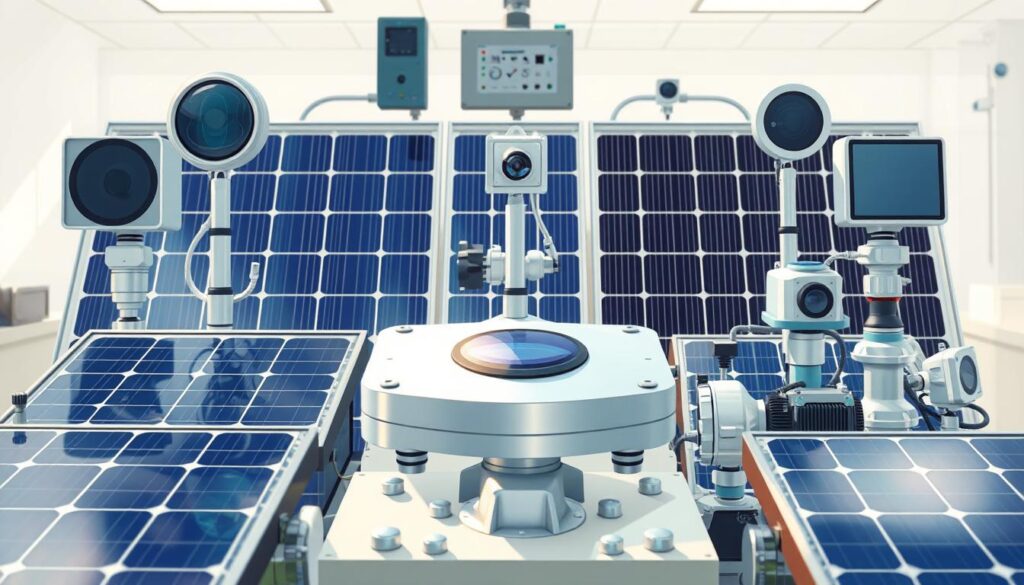
Weather data is key: solar irradiance, temperature, wind speed, and short-term forecasts. High-frequency data helps models catch quick changes.
Electrical data is also important: voltage, current, and power output. Datasets that show normal vs. faulty operation help AI learn.
More data makes forecasts better: thermal images, LiDAR scans, and photos. Cleaning and maintenance records help train models.
Sources of data for solar panels
SCADA systems and IoT sensors give real-time data. Edge platforms like NVIDIA Jetson Nano run local AI and coordinate devices.
Drones with thermal cameras check for issues from above. Ground robots do close checks. Weather services like Meteomatics provide forecasts.
Research groups and partners share extra data. NREL and others help with benchmarking. Market price feeds help with making money.
Building systems needs good data management. Use audits and clear data sources. See how AI helps solar maintenance here.
- Sampling and sync: make sure data is in sync and sampled right.
- Labeling: make sure data is labeled right for AI to learn.
- Edge vs cloud: use edge for quick tasks, cloud for long-term data.
Following these steps makes data reliable for AI models. It helps with forecasting and monitoring solar panels well.
Implementing AI Solutions
Going from a test to a real use needs clear goals and steps. Teams should know what they want to achieve first. This could be making more money, keeping panels working well, or predicting energy needs.
This clear goal helps in collecting data, picking tools, and checking results. It makes sure the AI works well on a big scale in solar energy.
Steps for integration
First, check your data: look at sensors, drone pictures, market info, and SCADA logs. Make sure all data is in sync and labeled well to reduce differences.
Then, pick the right AI models for your needs. For example, using both physics and AI can guess energy production better. AI can also find problems with panels and help manage energy.
Get ready for using AI at remote sites: use special computers for quick responses. Connect forecasts to systems that manage energy and digital models so actions can be taken.
Test in stages: start with small tests, then simulated tests, and lastly, real-world tests. Use dashboards and keep training AI to keep it accurate as you roll it out.
Use a detailed report and resources like this case study and technical note to plan your tests and what to measure.
Practical challenges
Dealing with different types of data and labeling it is hard. Sensors of various kinds make data hard to match and some data is missing. Teams need to work hard on getting data ready for AI.
AI needs to work fast for real-time control. Using special computers at the edge helps but limits how complex the AI can be.
People need to trust and understand AI. They want to know why AI is making decisions when it’s used for solar panel care.
Operational and regulatory limits
There are limits like not having enough water for cleaning in dry places and robots having trouble with uneven ground. AI can help but needs to be tested in real life.
Adding AI to old systems and following rules is hard. It affects when you can start using AI in solar farms.
Mitigation strategies
Use both AI and physics to handle tricky cases and make AI more reliable. Regular checks and tests help when you’re growing AI use.
Start small, then grow: test in a controlled area, then in mixed places, and lastly everywhere. Focus on the most important uses to show AI’s value quickly.
| Phase | Key Actions | Primary Metrics |
|---|---|---|
| Define & Plan | Set objectives, map data sources, assign stakeholders | Time-to-pilot, data coverage (%) |
| Instrument & Collect | Install sensors, drones, edge nodes; synchronize feeds | Sensor uptime, measurements/min |
| Model & Validate | Select architectures, run TRL 4–5 pilots, simulated tests | Prediction error, pilot stability |
| Edge Deployment | Containerize models, deploy on Jetson/RPi, optimize latency | Inference latency, CPU/GPU usage |
| Integrate & Automate | Connect to EMS, digital twins, battery control | Automated actions triggered, energy saved |
| Operate & Improve | Dashboards, automated audits, continuous retrain | Maintenance visits, failure prevention rate |
Fixing problems early makes AI ready for use faster. Clear goals and testing in stages lower risks in solar energy AI.
Teams that explain AI and keep an eye on it get more support. Focusing on important tasks like keeping panels in good shape helps show AI’s worth. It also helps with using AI in solar farms.
Real-World Applications
Real-world AI for solar energy is now used in many places. It helps with forecasting, robotic maintenance, and more. This changes how we use solar energy.
Case Studies of Successful Implementations
PVOP, a Horizon Europe group, made an AI tool for market predictions. It was led by ASIC XXI. The tool is now at TRL 4–5 and works well in tests.
They want to make solar panels work better by 4.7% and cut costs by 32%. This shows how AI can help solar panels work better and save money.
Meteomatics mixed weather models with AI to improve solar and wind forecasts. This saved traders and operators a lot of money each year. It shows how AI can help solar power by making forecasts more accurate.
Teams tested AI and robots for solar panel maintenance. They used drones and special computers. The results were very good, showing how AI can make solar panels work better.
Benefits Realized from AI Implementation
AI has brought financial benefits like better forecasts and stronger market bids. It has also saved money in operations. PVOP and Meteomatics are examples of this.
AI has also made operations better. It finds problems faster and uses less water and energy. This makes solar panels work better and longer.
AI has also helped with strategic planning. It makes battery use better and helps with extra services. This shows why AI is good for solar energy.
- Integrated approach: Forecasting plus maintenance yields bigger returns than separate systems.
- Transparency: Continuous validation and explainability support operator trust and adoption.
- Pilot-first deployment: Small-scale trials reduce risk and speed up scaling.
| Use Case | Outcome | Key Metric |
|---|---|---|
| Market prediction (PVOP) | Improved bidding and reduced O&M | PR +4.7%; O&M -32% |
| Weather+ML forecasting (Meteomatics) | Lowered trading risk and operational costs | Solar forecast +13%; wind +50% |
| AI-robotic cleaning & fault detection | Restored output, cut resource use | Cleaning efficiency 91.3%; output +31.2% |
These examples show how AI helps solar energy. By using AI for forecasting, monitoring, and maintenance, we can make solar energy better and more reliable.
Advantages of AI in Solar-Panel Performance
AI is changing how we manage solar assets. It brings smarter models, faster decisions, and automated operations. These changes add real value for everyone involved.
Enhanced accuracy in predictions
Hybrid models that mix physics and machine learning improve forecasts by about 13 percent. Services like Meteomatics show this. Deep learning pilots from PVOP report 15–20 percent better results than old models.
Probabilistic forecasts help by adding confidence bands. This narrows uncertainty for traders and managers. Models like CNN-LSTM are about 92.3 percent accurate in finding faults. This means they can fix problems early and cut downtime.
Operational efficiency improvements in solar energy
Autonomous cleaning systems with reinforcement learning clean up to 91.3 percent. They can also restore up to 31.2 percent of lost output on dirty modules. Optimized policies also save water and energy by about 34.9 percent.
Edge AI makes decisions faster, in about 47.2 ms on average. This lets drones, ground robots, and control systems work together in real time. It turns forecasts into actions, like dispatching storage, making market bids, and setting maintenance windows.
AI also lowers O&M costs by about 32 percent. It makes plants more available, extends asset life, and cuts carbon intensity per kWh. These benefits mean stronger returns on investment and more reasons to use solar energy.
Future Trends in AI and Solar Energy
Solar power is growing, and smart systems are playing a bigger role. People from utilities to asset managers want better forecasts. They want to know what will really happen.
Emerging Technologies
New models mix weather science with AI to forecast better. Companies like Meteomatics show how this mix gives more accurate forecasts for solar panels.
Edge AI devices, like NVIDIA Jetson modules, work fast at places like inverter racks. This lets them make quick decisions without waiting for the cloud.
Soon, drones and robots will work together to check and clean solar panels. New ways to clean panels, like using vibrations, will also come.
Digital twins will connect forecasts to actions. This lets operators test plans in a virtual world before they try them for real.
Predictions for Market Growth
Better forecasts and maintenance will make solar power more profitable. Big solar farms will save a lot of money by being more accurate and efficient.
People will want AI that they can understand and easy to use. Asset managers want to know how forecasts work and how to use them. Tools that make this easy will become popular fast.
Edge AI and proven models will become common in big solar farms. As they get better and more reliable, teams will choose vendors that offer complete solutions.
| Trend | Technology Example | Operational Impact | Near-Term Outlook (3–5 years) |
|---|---|---|---|
| Hybrid Forecasting | Meteomatics-style physics+ML | Better irradiance forecasts; fewer curtailment events | Wide pilot adoption; growing commercial use |
| Edge AI Deployment | NVIDIA Jetson, Raspberry Pi | Low-latency control; reduced cloud costs | Rising adoption at inverter and plant level |
| Autonomous Maintenance | Drone teams, adaptive cleaning tech | Lower O&M costs; higher uptime | Selective rollouts on large sites |
| Digital Twins | Integrated SIM + EMS platforms | Risk-free strategy testing; faster commissioning | Increasing demand among utilities |
| Explainable AI | Model-agnostic interpretability tools | Faster validation; regulatory compliance | High demand from asset managers |
These paths show where AI and solar energy are headed. Companies and operators who use new technologies will gain an edge as the market grows.
Regulatory and Compliance Considerations
Using AI in solar systems is tricky because of many rules. Companies must follow rules about being on the grid, keeping data safe, and getting local permits. Having clear rules can help teams work better and be ahead of others.
It’s important to know how local rules affect money-making. Making plans for services like aFRR and mFRR needs models that fit market times and are clear. Also, handling data must follow federal and state rules, even with IoT sensors and cloud analytics.
Understanding Government Policies
Groups like the Federal Energy Regulatory Commission and state public utility commissions make rules. Companies should watch for changes in tariffs, how to connect to the grid, and programs that help make money. Rules that help the planet open doors for AI to predict and fix problems.
Teams buying AI need to make contracts with clear rules. These contracts should talk about how well the AI works, when it needs to be updated, and who is responsible for data. Having clear rules and checks helps avoid problems and meets rules.
Aligning with Industry Standards
There are rules for how to measure, report, and keep safe. Following IEEE standards and NREL advice helps make data and results the same everywhere. Knowing what the grid needs helps design systems early.
It’s key to check and show that rules are followed. Clear forecasts and logs help show that everything is done right. Using PVOP-style reports helps keep track of AI’s work and makes sure it’s done right.
| Compliance Area | Key Requirement | Practical Action |
|---|---|---|
| Market Participation | Timescale accuracy for aFRR/mFRR and bidding rules | Align forecasting models to market intervals and keep bid logs |
| Data Privacy & Cybersecurity | Federal/state data protection and secure telemetry | Use encrypted telemetry, role-based access, and privacy impact assessments |
| Standards & Reporting | IEEE guidelines, NREL recommendations, utility interconnection | Adopt standard formats for telemetry and follow NREL reporting templates |
| Procurement & SLAs | Model warranties, retrain schedules, maintenance duties | Specify KPIs, retrain intervals, and incident response in contracts |
| Operational Permits | Drone and water-use permits for cleaning and inspection | Secure local permits and document environmental mitigation plans |
Teams should plan for rules by making sure their work fits. This way, they avoid surprises during checks. Choosing technology that fits with rules makes it easier to grow AI across different places.
When rules encourage being flexible and helping the planet, using AI smartly can make more money. By focusing on both technology and rules, leaders can use AI in a way that’s good for everyone.
Tools and Software for AI in Solar Energy
Choosing the right tools and software for AI in solar energy is key. The market offers forecasting platforms, ML frameworks, edge hardware, and robotics. It’s important to consider accuracy, latency, and cost when making a choice.
Popular AI Tools in the Market
Forecasting vendors like Meteomatics offer forecasts for solar and wind. They use a mix of physics and ML. This helps plant operators quickly see the benefits.
For making models, TensorFlow and PyTorch are top choices. They support complex models and learning agents. Tools for deploying these models to the cloud and edge make things predictable.
Edge hardware includes NVIDIA Jetson Nano for fast inference and Raspberry Pi 4B for basic tasks. MQTT is used for fast messaging. SCADA and smart energy systems connect AI to operations.
Robotics and sensing tools include thermal cameras and drones. They work with navigation and learning agents to automate tasks.
Comparing Performance of Different Tools
When comparing AI tools for solar energy, use the same metrics. Look at forecast accuracy, how fast they work, and their cost over time.
Some tools claim big improvements in forecast accuracy. Meteomatics says they’re 13% better for solar and up to 50% for wind. Research shows 15–20% better PV output in simulations.
Latency is important for quick control. Edge prototypes work fast, beating cloud setups by 63%. But, they can’t handle complex models and need cloud for training.
Looking at how well tools work in real use is key. Some systems clean up to 91.3% of solar panels. Others detect faults with 92.3% accuracy. Learning agents can save a lot of energy and water.
Choose tools that work well on real data, support edge use, and explain their results. Make sure they fit with energy management systems. Also, check if they meet industry standards and save money for operators.
| Category | Representative Tools/Hardware | Performance Highlights | Deployment Notes |
|---|---|---|---|
| Forecasting Platforms | Meteomatics, commercial forecasting vendors | ~13% solar accuracy gain; up to 50% for wind in vendor reports | Delivered models; often API access for integration |
| ML Frameworks | TensorFlow, PyTorch | Support CNN-LSTM, DQN, RL; high model flexibility | Train in cloud; export to edge containers or TensorRT |
| Edge Hardware | NVIDIA Jetson Nano, Raspberry Pi 4B | Edge inference latency ~47.2 ms in prototypes; lower than cloud | Best for low-latency tasks; limited training capacity |
| IoT & Messaging | MQTT, SCADA, Smart EMS | Real-time telemetry and command routing | Essential for operational integration and control loops |
| Robotics & Sensing | Thermal cameras, LiDAR, drones, ground robots | Cleaning efficiency ~91.3%; visual fault detection ~92.3% | Requires robust navigation and safety integration |
| Cost & ROI | Combined solutions | Stronger ROI when forecasting accuracy, explainability, and low-latency edge are present | Evaluate TCO, O&M savings, and vendor case studies |
Conclusion
AI Use Case – Solar-Panel Performance Prediction has grown a lot. It’s now helping solar panels work better and save money. This is thanks to new models that predict and fix problems.
These models have shown great results. They’ve made forecasts more accurate and found faults quickly. They’ve also made cleaning robots work better and increased solar power.
Edge AI and learning help solar systems work faster. They let drones and robots work together in real time. This makes solar power optimization work well on a big scale.
Looking ahead, AI in solar energy is getting even better. New ways to forecast and maintain solar panels are coming. This will help solar energy grow faster.
Investors and operators who know a lot about AI and green energy will do well. They will make solar assets more profitable and reliable. For more on green AI markets, check out this resource: Green AI market insights.
FAQ
What is the central promise of AI for solar-panel performance prediction?
AI uses data to predict how solar panels will work. It helps make better plans for using energy and keeping panels clean. This way, solar panels work better and make more money.
Which AI technologies are most relevant to solar forecasting and operations?
Important AI tools include weather models and machine learning. They help find faults and clean panels. These tools work on devices like NVIDIA Jetson Nano and Raspberry Pi 4B.
Why is performance prediction important for solar asset managers and operators?
Predicting how panels will work helps manage energy better. It makes more money by selling energy when it’s worth more. It also helps keep panels running smoothly.
What key performance indicators (KPIs) should organizations monitor?
Important KPIs are energy output, performance ratio, and how much panels degrade. Also, how much energy is lost to dirt and how often panels stop working. These help make better decisions.
Which environmental and operational factors most influence solar-panel performance?
Things like dust, temperature, and dirt affect panels. So do faults and shading. Market prices and grid needs also play a part.
What supervised learning models work well for power and fault forecasting?
Good models include gradient-boosted trees and deep neural networks. They help predict power and find faults. CNN-LSTM hybrids are also good for finding faults.
How do unsupervised methods contribute to solar operations?
Unsupervised learning finds new fault patterns and extracts features. It helps spot trends without labeled data. This is useful for early warnings and prioritizing checks.
What role does reinforcement learning play in maintenance and cleaning?
Reinforcement learning makes cleaning more efficient. It uses less water and energy. This helps restore energy lost to dirt.
What types of data are required to train these AI systems?
You need weather data, historical energy output, and electrical data from panels. Also, thermal images, LiDAR scans, and market prices.
Where can operators source the necessary data?
Data comes from sensors, drones, and robots. Also, from weather services like Meteomatics and market feeds. And from organizations like NREL.
What are the data quality requirements for reliable models?
Data must be accurate and synchronized. It needs high-frequency sampling and labeled datasets. Regular checks ensure data quality.
How do edge and cloud inference compare for solar applications?
Edge inference is fast, around 47.2 ms. Cloud inference is slower, often 63% slower. The choice depends on speed needs and compute power.
How does hybrid physics + ML forecasting improve outcomes?
Hybrid forecasting combines weather models with machine learning. This improves forecast accuracy by 13%. It saves money and makes better decisions.
What quantified benefits have pilots and studies reported?
Studies show improved forecast accuracy and fault detection. Cleaning efficiency and energy restoration are also better. PVOP aims for a 4.7% PR and 32% O&M cost reduction.
What steps should organizations follow to integrate AI into solar operations?
Define goals, audit data, and deploy sensors. Choose models and deploy on edge hardware. Integrate with energy systems and digital twins. Run pilots and monitor continuously.
What are common implementation challenges and how can they be mitigated?
Challenges include data quality and edge compute limits. Mitigate by using hybrid models, probabilistic outputs, and continuous validation. Clear SLAs and explainability are also important.
How should operators validate and build trust in AI forecasts?
Use probabilistic forecasts and continuous validation. Show drivers and uncertainty. Use automated audits and explainability tools.
What communication and architecture patterns support AI-enabled maintenance?
Use MQTT for IoT messaging and edge devices for low-latency tasks. Cloud services handle training and analytics. Integration with energy systems and digital twins is key.
What environmental constraints affect autonomous cleaning strategies?
Water scarcity, drone permits, and terrain challenges affect cleaning. RL-optimized cleaning reduces water and energy use. Coordinated drone and robot maintenance helps.
Which standards and regulations should be considered?
Consider market rules, data privacy, and utility requirements. PVOP-style audits help meet regulations.
What procurement and risk-management practices are recommended?
Include model guarantees, retraining plans, and data-quality clauses. Address environmental concerns and obtain permits.
Which tools and platforms are commonly used for this use case?
Use forecasting tools like Meteomatics, edge hardware, and ML frameworks. MQTT for IoT messaging and SCADA for integration are also important.
How should teams compare and select AI vendors or tools?
Look for proven accuracy, edge deployment, and explainability. Consider total cost, pilot results, and support for continuous validation.
What commercial timeline and readiness should operators expect?
Early prototypes show promise, but commercial rollouts need validation and regulatory alignment. PVOP’s tool is at TRL 4–5. Plan pilots and scale gradually.
What strategic benefits do integrated AI solutions deliver beyond immediate savings?
AI solutions improve participation in ancillary services and battery use. They extend asset life, reduce carbon intensity, and boost ROI for more solar investment.
How can operators get started to capture early value?
Start with targeted pilots that improve forecasting and maintenance. Validate models, deploy edge inference, and integrate with energy systems. Scale successful pilots.
What emerging trends will shape the next phase of AI in solar energy?
Expect better forecasting, wider Edge AI use, and more efficient maintenance. Digital twins will play a bigger role in managing energy and storage.