At times, one choice can change a career path. This might be learning a new skill, taking a focused course, or working on a project. For many in the U.S., this choice is to join AI training programs.
AI training online opens doors in finance, healthcare, marketing, and IT. Courses and certifications show you’re skilled. They prove your worth to employers.
Miloriano.com offers wise advice. It helps turn learning into a strategic advantage. This article shows the best AI training options. It explains how each path builds skills employers want.
Readers will learn how to pick the right AI training. They’ll know which certifications are important. They’ll also see how to use what they learn in real jobs. Google’s resources are a good start; check them out at Google AI training resources.
Key Takeaways
- AI training programs offer practical paths to career growth with certificates and project portfolios.
- AI training online is available in multiple formats—self-paced courses, bootcamps, and university programs.
- Recognized artificial intelligence certification increases employer recognition and hiring.
- Choosing the best AI training depends on goals, time, and the need for hands-on projects.
- Miloriano.com provides strategic advice to turn technical learning into measurable career impact.
Introduction to AI Training Programs
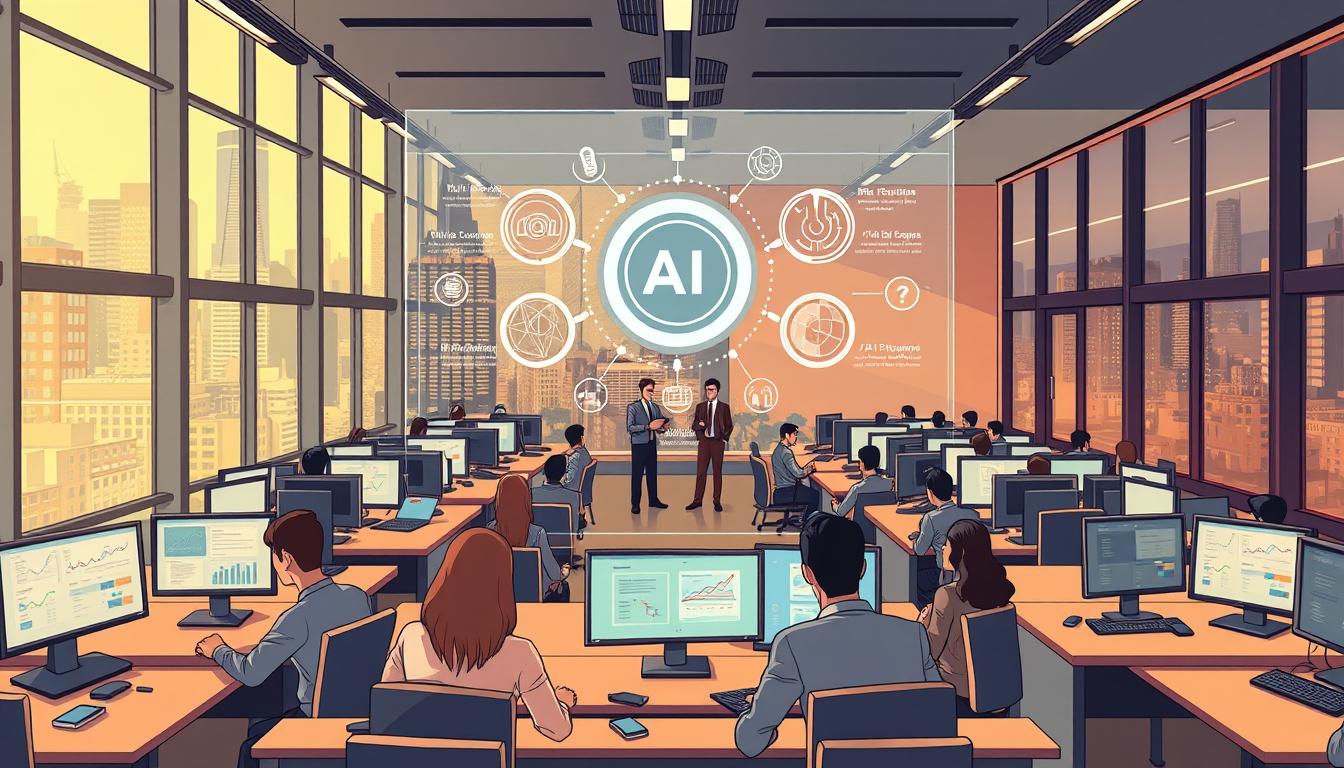
AI training programs offer many paths for learning. You can find short online courses, certification tracks, bootcamps, and even full degrees. Each path includes lectures, hands-on work, and projects to learn by doing.
Many programs have pre-work, help from teachers, and tests. Some even offer meals and lab time. To get a certification, you must attend fully and do all the work.
What Are AI Training Programs?
Courses vary a lot. You can learn a single algorithm in hours or get a degree in AI. Bootcamps focus on doing real projects and helping you find a job.
Learning includes lectures, coding, and projects. Teachers might be experts or professors. Showing you can apply what you learned is important for getting a job.
Importance of AI Skills in Today’s Job Market
AI skills are needed in many jobs. Companies want people who can use AI to improve things and find new ideas. This creates new jobs and changes old ones.
Many people are learning AI. Over seven million have started. Leaders and universities offer free resources to help you grow in your career. The need for AI skills keeps growing.
Good training teaches both technical skills and how to think critically. It’s important to know how to spot problems with AI. Programs should teach coding, thinking, and ethics.
| Program Type | Typical Length | Key Components | Certification Outcome |
|---|---|---|---|
| Short Online Course | Hours to 4 weeks | Video lectures, quizzes, one hands-on lab | Completion badge or certificate |
| Structured Certification Track | 2–6 months | Sequenced courses, capstone project, mentor support | artificial intelligence certification from provider |
| Bootcamp | 8–16 weeks | Immersive projects, career coaching, live instruction | Certificate of completion and portfolio |
| University Degree | 1–4 years | Theory, research, labs, internships | Bachelor’s or Master’s degree with strong cred |
People searching for AI training near them often look for local options. When choosing a program, think about time, money, and your goals. Learning AI can open doors and give you a chance to make a difference.
Types of AI Training Programs
AI learning paths vary by depth, pace, and outcome. You can choose from short online modules, immersive bootcamps, or formal university programs. Each option is for different career stages.
Online Courses and Certifications
Many start with online courses on Coursera, edX, Udacity, DataCamp, and LinkedIn Learning. These include beginner and advanced courses. You get practical projects and industry-backed credentials.
Online learning fits those with busy schedules. It’s flexible and lets you earn a certification without leaving home. Free resources like Andrew Ng’s materials help build foundational skills.
Bootcamps for Intensive Learning
Bootcamps offer intense, hands-on training over weeks to months. You work on real projects, get mentorship, and career services. The goal is to build deployable models.
Bootcamps are great for quick skill updates. They help professionals apply machine learning in their jobs or switch to data science.
University Degree Programs
Universities offer structured learning, research, and projects through various degrees. Classes focus on solid foundations and long-term skills.
University programs might need you to be there in person. They have formal requirements. Executive programs are for managers and leaders to learn AI.
Whether you aim for a certification, deeper skills, or a degree, there’s a path for you. Your choice depends on your goals, time, and career path.
Benefits of AI Training
AI training programs help professionals keep up with fast changes in their fields. Learning a little can lead to big wins: you get certificates, project portfolios, and real-world experience. These are things hiring managers love to see.
Practical courses from places like Harvard Business School Online show how training can make a difference. They turn theory into action. Check out one view here.
Increased Career Opportunities
Learning AI opens doors to new jobs. You could become a machine learning engineer, data scientist, AI product manager, or applied researcher. Companies in finance, healthcare, retail, and logistics need people who know how to use AI.
Those who know their field well and have AI skills are in high demand. They’re sought after for leadership and special roles.
Higher Salary
Having AI skills means you can earn more. Employers are willing to pay more for people who can use AI well. Reports and trends show that AI engineers get paid a lot.
Getting certified from top AI training programs can help you earn more and move up faster.
Skill Diversification
Good programs teach you about machine learning, data analysis, and natural language processing. They also help you learn to make smart choices about AI models. This helps you create better systems and spot problems early.
There are short courses and longer programs. Bootcamps teach you how to do things, while degrees give you more depth. If you’re looking for AI training near you, there are options that fit your schedule and goals.
Keeping learning helps you stay ahead as technology and jobs change. A guide shows what skills employers want and how you can grow your career here.
- Tangible outcomes: certificates and portfolios that prove ability.
- Cross-functional impact: apply models to operations, marketing, and product.
- Future-proofing: neural network training and related skills that scale.
Key Skills Acquired Through AI Training
AI training programs teach learners key skills that employers want. They mix theory with hands-on practice. This way, learners get ready-to-use models and projects that show their skills.
Machine Learning Fundamentals
These courses start with the basics of learning. They cover how to evaluate models and avoid overfitting. Learners practice with real data, getting better at using neural networks.
Applied modules mix machine learning with neural network training. This helps students go from learning to solving real problems.
Data Analysis Techniques
Training focuses on cleaning and preparing data. It also teaches how to analyze and visualize it. Tools like Python and Jupyter notebooks are used to show how to go from raw data to ready code.
Students work on complete projects. Employers like these projects when they look at candidates for data science or ML engineering jobs.
Natural Language Processing
NLP modules teach how to work with text. They cover text prep, embeddings, and models. Learners practice tasks like analyzing feelings in text and extracting information.
Courses also teach how to check AI outputs. They use a framework to spot mistakes in AI content. This helps learners think critically in their jobs.
Short workshops on deep learning give extra practice with advanced models. For those wanting a formal badge, AI certification programs offer tests and badges that show they’re ready for work.
Selecting the Right AI Training Program
Choosing the right path means knowing what you want. You need to think about your goals, schedule, and what you hope to achieve. Look for programs that fit your career goals or help you grow slowly.
Factors to Consider
First, decide if you want to change careers fast or grow slowly. Think about how you learn best. Do you like learning on your own, in a group, or in person?
Look for programs that offer real-world projects. This means you’ll work with actual data and make projects you can show off. Check who teaches the program and if the school is well-known.
See if the program helps with your career. Do they help with your resume, interview skills, and finding a job? Make sure the program is open to people who aren’t tech experts.
Renowned Institutions and Providers
Look for programs from big names like Coursera and edX. They work with schools like Stanford and MIT. Udacity and DataCamp focus on doing real projects. LinkedIn Learning has short lessons for busy people.
Choose programs with great teachers and recognized certificates. Schools that are also research centers offer more learning and chances to meet people in your field.
Program Length and Requirements
Programs last different amounts of time. Some are short and intense, while others take months or even years. Some programs need you to be there in person and do work before you start.
Choose a program that fits your life. If you need to change jobs fast, pick a short program. For more learning, go for a university program. For steady growth, pick online courses that you can do at your own pace.
Think about what you want to achieve. Pick a program that matches your goals. Whether it’s a quick change, deep learning, or steady growth, there’s a program for you.
Popular AI Training Platforms
Choosing where to learn is key for your career. You can mix short, practical modules with deeper, project-driven paths. This helps build skills and get credentials.
Coursera and edX
Coursera and edX offer university-backed specializations and professional certificates. They cover machine learning, deep learning, and AI product management. Many students use these courses to build portfolios and get credibility from places like Stanford and MIT.
Free audit options and career roadmaps help beginners. They guide you toward artificial intelligence certification.
Udacity and DataCamp
Udacity has nanodegree programs that focus on projects and mentor feedback. DataCamp is all about interactive coding exercises for data skills. Both are great for learners who want to build portfolios.
Udacity is good for in-depth, guided projects. DataCamp helps you practice skills quickly with short labs.
LinkedIn Learning
LinkedIn Learning has short modules for quick upskilling. You can learn about neural networks, AI strategy, and more. It’s perfect for professionals who need to fill specific skill gaps.
It’s easy to show off your certificates on LinkedIn. This makes your resume stand out.
Use different resources: coursework for basics, bootcamps for quick skills, and university programs for formal recognition. Subscribe to industry news to stay updated. A mix of approaches boosts your chances of getting certified and finding a good job.
Real-World Applications of AI Skills
AI skills change how we solve problems in many fields. People trained in AI bring big value. They learn by doing in AI training programs and deep learning workshops.
Healthcare Innovations
Doctors and data scientists use AI for imaging and help with diagnosis. They use models to predict patient risks. This helps catch problems early.
AI training near me includes learning about rules for using AI in healthcare. This helps professionals use AI in electronic health records.
AI in Finance
Finance uses AI for finding fraud, scoring credit, and trading. Those trained in AI can make and test these systems. They meet high standards.
Training focuses on testing, managing models, and making them clear. Workshops teach how to spot patterns. This makes systems better and more accurate.
AI in Marketing Strategies
Marketers use AI for personalizing messages and segmenting customers. AI helps create content and test it. This makes marketing better.
Training includes projects that turn data into marketing wins. People learn to measure success and make decisions based on AI.
In all areas, using AI well needs both knowledge and skills. Courses with real projects and feedback help. They prepare people to use AI in real life.
Success Stories from AI Program Graduates
People who finish AI training programs often see big career wins soon after. They get help with portfolios and projects. This helps them move into new roles.
Career Transformations
Good programs and coaching show the way to new careers. Bootcamps and short courses give hands-on experience and interview tips. This helps them get jobs in AI and data science.
Getting a certification in AI makes your resume stand out. Employers like to see real work from machine learning courses.
Businesses Leveraging AI Expertise
Companies hire trained people to make things better. They use AI to automate and make smart products. Leaders learn to plan and grow AI in their teams.
Some companies save money and make decisions faster with AI. Success stories show how AI helps solve real problems. Check out these stories: AI training success cases.
Personal Growth Narratives
Training makes you think better about AI. It teaches you to check models and spot problems. This is useful in many areas.
People feel more confident talking about AI. They learn to make good choices and explain things clearly.
| Impact Area | Example Outcome | Role or Tool |
|---|---|---|
| Operational Efficiency | ~30% reduction in costs via supply chain optimization | Manufacturing engineer using AI models |
| Clinical Accuracy | Faster, more accurate diagnoses and shorter wait times | Healthcare professional with AI diagnostic tool |
| Financial Forecasting | Improved trend prediction and decision support | Analysts applying machine learning algorithms |
| Marketing Performance | Higher engagement and conversion from consumer analysis | Marketing specialist leveraging AI insights |
Conclusion: Investing in Your AI Education
AI skills are now key for ambitious professionals. The right mix of AI training and hands-on projects shapes your career. Practical experience is as important as AI training institute credentials.
Future Trends in AI
Expect more advanced models and systems. They will be better at specific tasks. Synthetic data and hardware advances will open new roles.
Deep learning workshops and special modules will help you stay up-to-date. They are key for keeping your skills sharp.
The Role of Continuous Learning
Lifelong learning is a must. Mix structured study with ongoing learning. Use newsletters, roadmaps, and NLP guides.
Stay active with AI training online and community groups. This keeps your skills sharp and builds a strong portfolio.
Start by setting clear goals. Choose programs that offer both learning and real-world projects. Commit to getting better. This turns education into real results.
FAQ
What are AI training programs and what do they include?
AI training programs offer many options. You can choose from short online courses to full university degree programs. They include lectures, hands-on exercises, and real-world projects.
Some programs offer in-person learning with meal service. To complete, you need to attend all sessions and do pre-work. This earns you a certificate or credential.
Why are AI skills important for my career now?
AI skills are in high demand in many fields. Companies use AI to improve their processes and make better decisions. Trained professionals can work in AI roles like product management and engineering.
They bring benefits like automation and better customer experiences. Learning AI also helps you understand and use AI outputs wisely.
What types of AI training formats should I consider?
There are three main types of AI training. You can choose from online courses and certifications, immersive bootcamps, or university programs. Each type has its own benefits.
Online courses are flexible, bootcamps are for quick learning, and university programs offer deep knowledge and formal credentials.
How do online AI courses and certifications differ?
Online AI courses vary in what they offer. Platforms like Coursera, edX, and Udacity provide different types of training. Some focus on projects, while others offer short, role-specific courses.
Many include practical projects and offer certificates. Some courses are free or help you get started for free.
What makes bootcamps a good option?
Bootcamps are short and hands-on. They are great for those who need to learn AI quickly or change careers. They focus on projects, mentorship, and career help.
Bootcamps are good for those who want to learn fast and work on real projects.
When should I choose a university degree program?
Choose a university program for deep learning and formal recognition. These programs offer lectures, projects, and the chance to work on real projects. They are good for long-term career goals and leadership roles.
What tangible benefits can AI training bring?
AI training can open up new career paths and increase your salary. It also helps you get promoted within your company. You’ll get certificates and project experience that employers value.
Learning AI also helps you stay up-to-date with the latest tools and trends.
Which core technical skills will I learn from AI training?
You’ll learn about machine learning, data analysis, and natural language processing. Programs focus on practical skills like building models and working on end-to-end projects.
This hands-on approach prepares you for real-world applications.
How does training improve my ability to evaluate AI outputs?
Quality programs teach you to spot issues like hallucinations and bias. They use frameworks like Marina Jovic’s VERIFY to help you evaluate AI outputs. This improves your critical thinking and helps you use AI responsibly.
What factors should I weigh when selecting a program?
Consider your career goals, the time you have, and the format of the program. Look at the project focus, instructor credentials, and career services offered. Also, check if the program supports diverse backgrounds.
Choose programs that help you build a portfolio and offer measurable outcomes.
Which institutions and platforms are reputable for AI training?
Reputable providers include Coursera, edX, Udacity, DataCamp, and LinkedIn Learning. They often partner with top universities and industry leaders. Look for programs with good instructor ratings and clear project requirements.
How long do AI programs usually take and what requirements exist?
Program lengths vary from weeks to years. Some require full attendance and completion of pre-work for certification. Choose a program that fits your schedule—short courses for quick learning, bootcamps for immersion, and degree programs for deep study.
Can AI training help me break into specific industries like healthcare or finance?
Yes. Applied training with domain-specific projects can help you transition into industries like healthcare and finance. Combining AI skills with domain knowledge leads to impactful solutions and employer interest.
How do programs help with career transitions and job placement?
Many programs focus on building a portfolio and offer mentor support and career services. This includes resume help, interview prep, and job matching. Strong projects and a good portfolio increase your chances of getting hired.
What evidence shows AI training has scale and market demand?
Industry reports and platform data show millions learning AI. News highlights AI adoption and high demand for skilled professionals. Universities and organizations publish guides and resources, showing strong demand for AI training.
How should I balance technical depth versus practical applicability when choosing a course?
Match your career goals to the program’s focus. Bootcamps are for quick skill-building, university programs for deep knowledge, and online certifications for upskilling. Choose programs that offer hands-on projects and clear outcomes.
What role does continuous learning play after completing a program?
Continuous learning is key as AI evolves fast. Combine structured programs with ongoing resources like newsletters and community groups. Stay updated with new techniques and tools to remain relevant.
How can I demonstrate the value of my AI training to employers?
Build a portfolio of deployable projects and include code and documentation. Get recognized certificates from reputable providers. Highlight measurable outcomes from your projects to show business impact.
Where can I find reputable free resources and roadmaps to start learning?
Start with free materials and curated roadmaps from top educators and platforms. Look for university open resources on Coursera and edX, and introductory tracks on platforms. Combine these with community tutorials, GitHub projects, and industry news.
Are certificates from online platforms valued by employers as much as university credentials?
Employer recognition varies. University-issued certificates are often more credible. But, platform certificates with strong project portfolios and skills are highly valued. Industry partnerships and faculty reputation also boost certificate value.
What ethical and regulatory considerations should training cover?
Responsible AI training should include bias detection, fairness, privacy, and transparency. It should also cover sector-specific regulations. Learning how to validate outputs and document model limitations is important.
How quickly can I expect to apply AI skills in my current role?
Application speed depends on the program and your starting point. Intensive bootcamps and focused online projects can enable immediate application. Deeper roles like machine learning engineering may take longer to prepare for.
What is the VERIFY framework and why is it relevant to professionals?
The VERIFY framework (Marina Jovic) helps evaluate AI-generated content. It checks for validity, evidence, reliability, fairness, and yield. It’s important for professionals to use AI responsibly and maintain integrity.
How can entrepreneurs and leaders use AI training strategically?
Leaders should take executive programs and workshops to learn about AI. This helps them assess use cases, measure ROI, and plan responsible adoption. AI training can help translate technical skills into business success.
What future trends should learners prepare for?
Prepare for more advanced foundation models, agentic systems, and specialized domain LLMs. Also, expect advances in synthetic data and model efficiency. These changes will create new roles and require adaptable skills.
What final advice helps choose and succeed in an AI training program?
Define your career goals and match them to the right program. Prioritize hands-on projects and instructor credibility. Choose programs that offer recognized certificates and help you build a portfolio.
Commit to continuous learning and critical thinking. This will help you grow in both technical skills and judgment.