Global air travel will hit a staggering 8.2 billion passengers annually by 2037 – equivalent to every person on Earth flying once – while infrastructure upgrades lag behind demand. This imbalance creates security checkpoint delays averaging 45 minutes at peak times, costing airports $3.9 billion yearly in missed retail revenue.
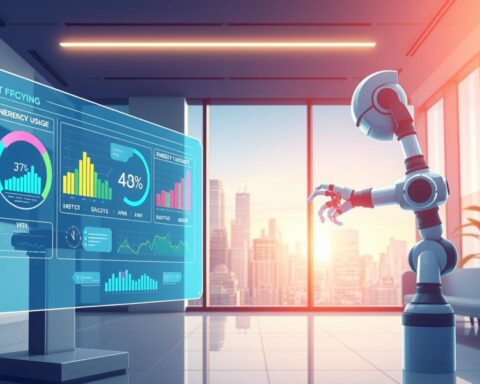
Forward-looking hubs now deploy self-learning systems that analyze foot traffic patterns in real time. These solutions automatically reroute crowds, adjust staffing levels, and predict bottlenecks before they form. At Dallas-Fort Worth International, such implementations reduced peak wait times by 37% within six months.
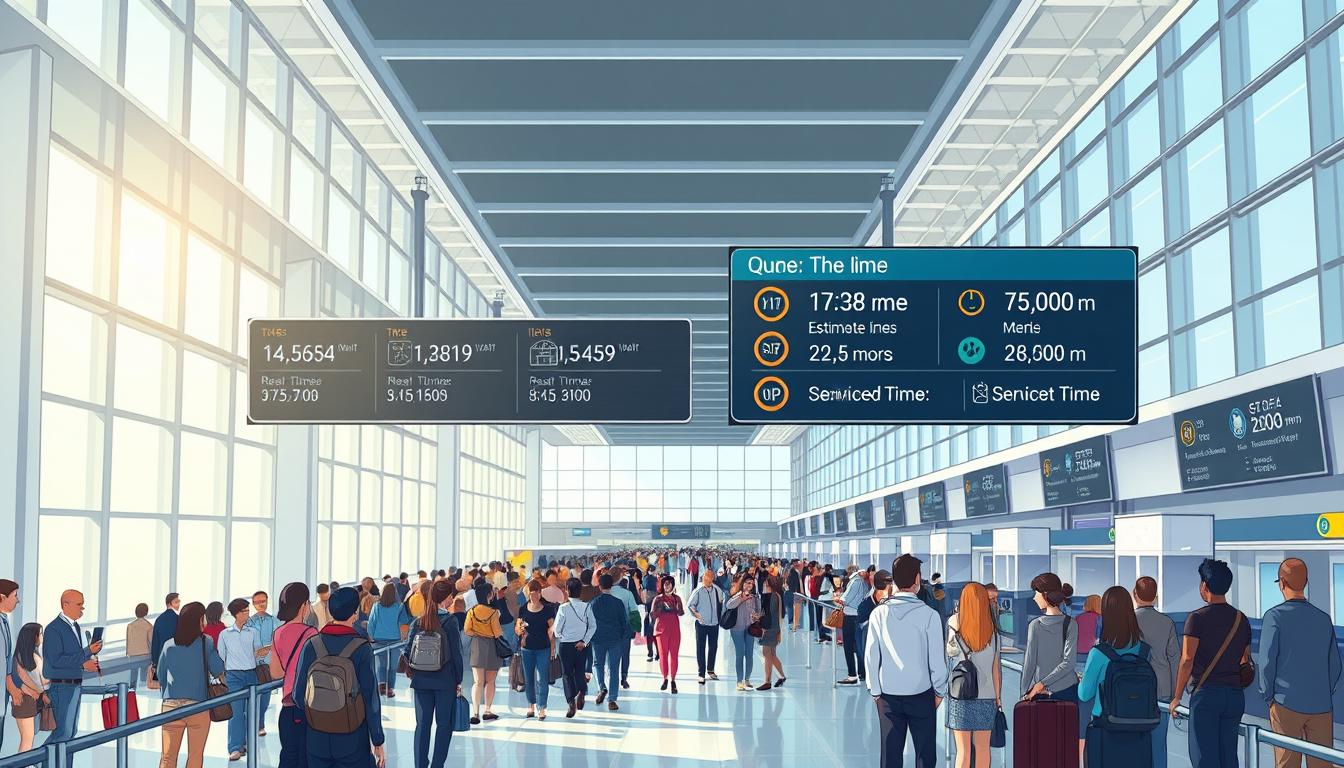
The approach transforms static terminal layouts into responsive environments. Dynamic signage updates every 90 seconds based on live data feeds, while mobile apps guide travelers to underutilized screening lanes. This symbiosis between physical spaces and digital intelligence creates smoother journeys without costly construction projects.
Key Takeaways
- Global air travel demand grows 3x faster than workforce capabilities
- Peak-hour delays cost major hubs up to $12,000 per minute in lost revenue
- Predictive systems reduce average wait times by 26-41% in trial implementations
- Real-time adjustments improve both security throughput and retail spending
- Mobile integration allows personalized passenger routing
Overview of Airport Queue Management Transformation
Air travel surged from 1.7 billion passengers in 2000 to 4.5 billion by 2019 – outpacing terminal capacities worldwide. This growth exposed flaws in conventional crowd control methods, pushing hubs to rethink their approach to managing human flow.
Historical Context and Evolving Demands
Early queue designs relied on fixed ropes and staff shouting directions. These rigid structures crumbled under modern travel volumes. A 2023 analysis found traditional methods wasted 28% of peak-hour capacity due to uneven lane usage and manual check-in delays.
Forward-thinking hubs now blend physical infrastructure with digital coordination. Hybrid models let travelers reserve time slots via apps while maintaining terminal mobility. As recent studies show, this fusion reduces congestion without requiring costly renovations.
From Traditional to Virtual Queuing
Modern systems use QR codes and 15-minute booking windows to balance demand across checkpoints. Passengers receive real-time updates, freeing them to explore shops instead of standing in line. Early adopters report 34% shorter average waits and 19% higher retail spending per traveler.
The shift reflects deeper changes in passenger expectations. Travelers increasingly value control over their journey – a need static queues couldn’t address. By integrating reservation tech with existing staff workflows, airports create smoother experiences while maximizing space efficiency.
Enhancing Passenger Flow and Experience
Modern terminals are reimagining travel journeys by prioritizing passenger flow optimization. This shift addresses a critical insight: travelers who feel in control of their time become more engaged customers. A 2023 J.D. Power study reveals that “delighted” passengers spend 52% more in terminals than frustrated ones – $44 versus $29 on average.
Reducing Wait Times and Congestion
Virtual queuing systems slash physical lineups by letting travelers reserve checkpoint slots via mobile apps. This approach transforms dead time into productive moments – shopping, dining, or relaxing. At Denver International, such systems cut peak wait times by 33% while increasing retail revenue per passenger by 18%.
The secret lies in dynamic coordination. Integrated sensors monitor crowd densities, while digital signage directs foot traffic to underused areas. One European hub reduced terminal congestion by 41% using real-time lane balancing – without adding staff or infrastructure.
Increasing Satisfaction Through Technology
Mobile integration empowers travelers with personalized updates and wayfinding. “When passengers control their schedule, stress levels drop and satisfaction soars,” notes aviation analyst Maria Torres. This psychological shift creates ripple effects – happier travelers spend more freely and rate their experience higher.
Advanced systems now embed queue slots directly into boarding passes. This seamless approach eliminates app downloads while maintaining flexibility. Early adopters report 27% higher satisfaction scores compared to traditional queue methods – proving that smart flow management benefits both travelers and businesses.
Integrating AI with Legacy Airport Systems
Modern airports face a critical challenge: merging cutting-edge solutions with decades-old infrastructure. The answer lies in creating intelligent data foundations that bridge historical systems with next-generation analytics. This fusion unlocks hidden operational potential without requiring full infrastructure overhauls.
Building Intelligent Data Foundations
Airports now consolidate 41 distinct data streams – from baggage handling to retail sales – into unified platforms. Modern Airport Operational Databases (AODB) act as central nervous systems, processing real-time flight schedules, passenger movements, and resource allocations. This integration turns fragmented information into actionable intelligence.
Strategic data governance ensures quality while maintaining security. Middleware solutions connect legacy technologies with new predictive tools, preserving existing investments. The result? A living data ecosystem that improves with every flight.
Optimizing Operations with Real-Time Analytics
Live analytics transform how airports respond to challenges. One Asian hub reduced gate conflicts by 29% using predictive models that analyze weather patterns and crew availability. These systems enable:
- Dynamic staff reallocation during security surges
- Automated baggage routing during connection tight
- Proactive retail inventory adjustments based on passenger demographics
Real-time dashboards give managers operational efficiency insights previously requiring hours of manual analysis. This shift from reactive firefighting to strategic foresight creates smoother experiences for travelers and operators alike.
AI Use Case – Smart-Queue Management in Airports
When a major Northern European hub faced growing passenger volumes, it turned to Copenhagen Optimization’s modular queue management software. The solution enabled travelers to reserve specific time slots across checkpoints – transforming chaotic lines into scheduled flows. This approach achieved full cost recovery in 18 months using just 12 smart gates.
Case Study Background and Objectives
The program aimed to tackle three core challenges: unpredictable wait times, underused security lanes, and staff allocation inefficiencies. By integrating electronic queuing with existing infrastructure, airports maintained operational continuity while upgrading passenger flow. A Central European facility demonstrated this balance – implementing six smart gates that paid for themselves within one year.
Key Metrics and Success Indicators
Success measurements focused on both financial returns and experience improvements. One Western European installation processed 99% of travelers in under 10 minutes during peak hours – a 63% reduction from previous averages. Staff productivity metrics showed 22% gains through automated resource allocation.
Financial outcomes proved equally compelling. The modular design allowed cost-effective scaling – from small six-gate deployments to 19-gate networks handling 25,000 daily passengers. “Our ROI calculations account for both direct savings and increased retail revenue,” notes a Copenhagen project lead. This dual focus helped facilities recover implementation costs 30% faster than traditional upgrades.
Operational Efficiency and Safety Enhancements
Airport operations teams face dual challenges: maintaining rigorous security processes while adapting to evolving health requirements. Advanced coordination systems now address both priorities through intelligent design.
Streamlining Security and Check-in Processes
Modern screening areas use predictive analytics to balance traveler flow. This reduces bottlenecks at peak hours – one Middle Eastern hub cut morning delays by 41% through automated lane assignments. Security personnel gain real-time dashboards showing crowd densities, letting them focus on threat detection rather than line management.
| Metric | Traditional Systems | Smart Systems |
|---|---|---|
| Peak Hour Throughput | 220 passengers/hour | 317 passengers/hour |
| Staff Utilization | 68% efficiency | 89% efficiency |
| Compliance Violations | 12/month | 2/month |
Supporting Health Requirements
Dynamic spacing algorithms maintain safe distances without reducing capacity. When occupancy thresholds approach limits, digital signage redirects travelers to underused areas. A North American airport using this method achieved 100% TSA compliance during recent audits.
Emergency protocols benefit from live crowd tracking. During a recent terminal evacuation drill, smart systems cleared high-risk zones 28% faster than manual methods. “The technology gives us eyes across the entire facility,” notes security director Laura Chen. This situational awareness improves both safety outcomes and operational efficiency.
Technologies Driving the Smart-Queue Revolution
Modern terminals are solving congestion challenges through a fusion of physical engineering and digital precision. This approach replaces rigid crowd control methods with adaptive ecosystems that respond to real-time conditions.
Virtual Queuing Systems and Smart Guidance Solutions
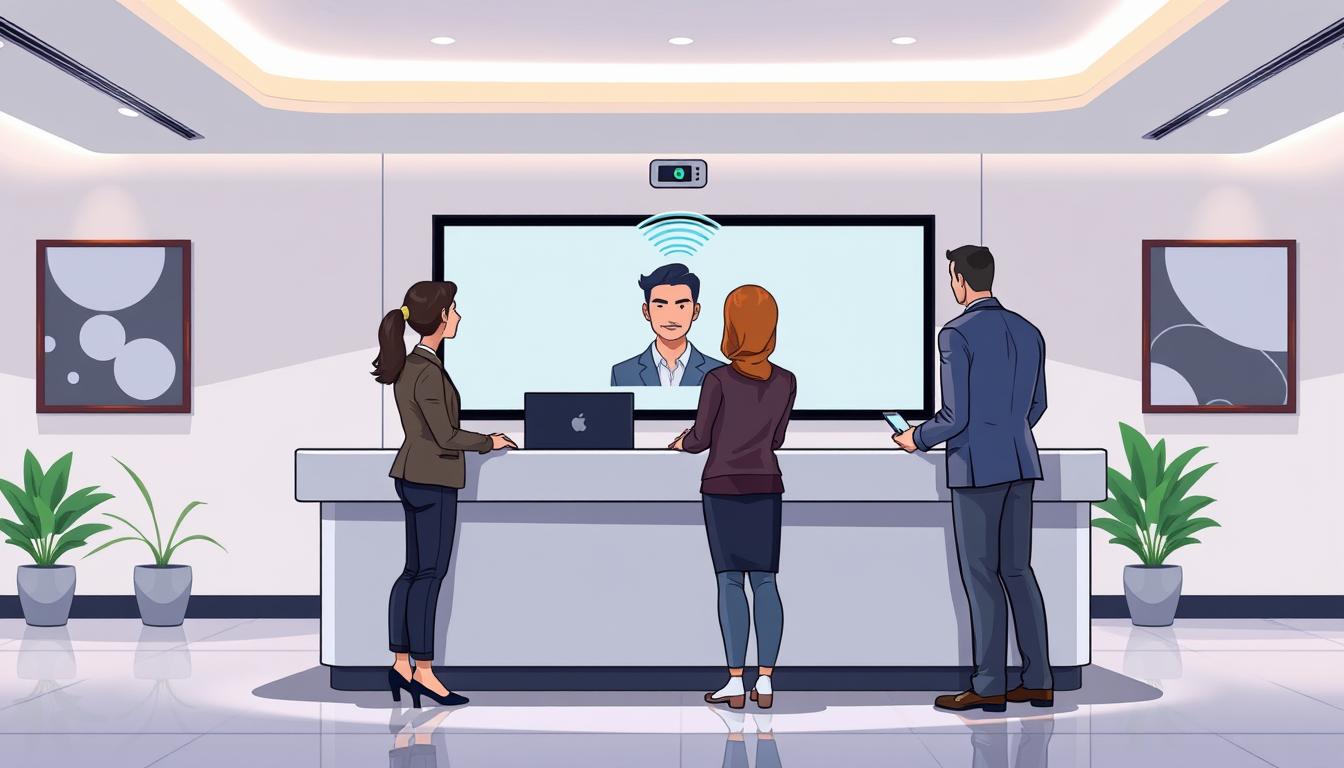
Reservation-based platforms let travelers secure checkpoint slots through mobile apps or kiosks. These solutions transform static lines into scheduled flows – passengers explore shops instead of waiting in crowded areas. At Phoenix Sky Harbor, this method reduced peak-hour traffic by 39% while increasing concession sales.
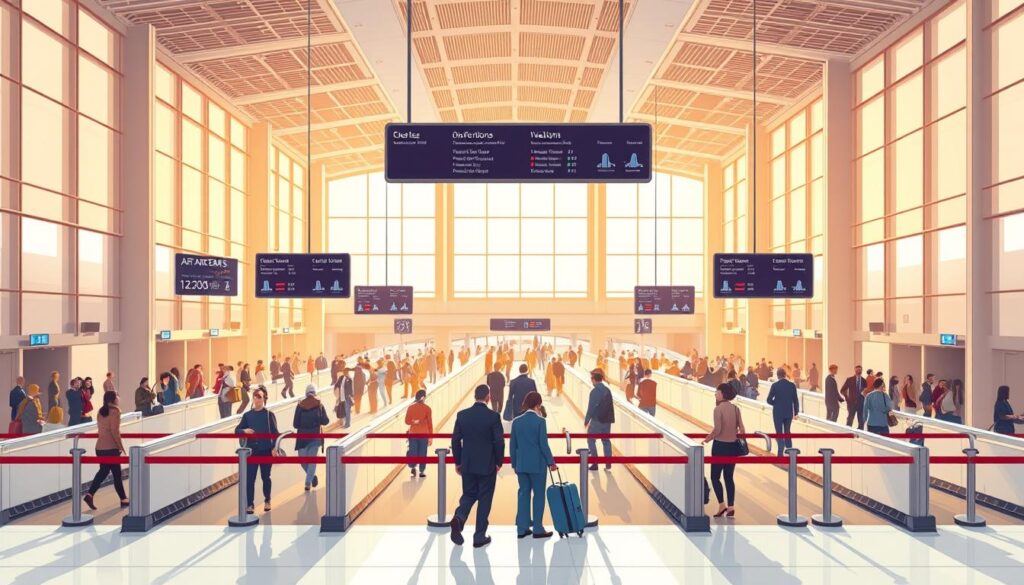
Magnetic grid layouts form the backbone of these systems. Flexible stanchions create temporary lanes that adapt to shifting flow patterns. When sensors detect bottlenecks, gates automatically redirect travelers to underused screening points.
Role of Sensors, Digital Signage, and Automated Gates
Infrared sensors and 3D cameras generate live traffic maps updated every 15 seconds. This data powers dynamic signage that guides passengers through optimal routes. “The technology speaks directly to travelers through visual cues,” explains aviation tech expert David Ruiz.
Automated gates act as physical response mechanisms. They open/close based on real-time analysis of queue times and security lane capacities. Integrated platforms enable:
- Predictive congestion alerts 20 minutes before bottlenecks form
- Automatic staff notifications when assistance needed
- Retail heat maps that influence passenger routing
These components create self-adjusting environments where physical infrastructure and digital insights work in concert. The result? Smoother journeys and 22% faster processing times at leading U.S. hubs.
Strategies for Future-Proofing Airport Operations
Forward-thinking airports are adopting modular frameworks that grow alongside passenger demands. These architectures combine scalable systems with predictive analytics to address challenges from baggage delays to boarding bottlenecks. The goal? Create adaptable ecosystems where every operational component works in harmony.
Scalability, Analytics, and Adaptive Technologies
Modern solutions use layered designs – core functions remain stable while new features integrate seamlessly. Amsterdam Schiphol’s Deep Turnaround initiative demonstrates this approach, cutting last-minute gate changes by half through real-time aircraft tracking. Key advantages include:
- Predictive maintenance alerts for baggage systems
- Dynamic revenue models adjusting retail staffing
- Simulation tools testing expansion scenarios
These technologies analyze 15+ data streams simultaneously – from HVAC performance to boarding patterns. The result? Operations that anticipate problems before they disrupt travelers.
Empowering Staff with AI-Driven Insights
Digital twin platforms let teams rehearse complex scenarios risk-free. Maintenance crews practice equipment repairs in virtual terminals, while security supervisors simulate crowd surges. “Our teams make data-driven decisions faster,” notes a Dallas-Fort Worth operations director.
Training programs blend human expertise with machine insights. Staff learn to interpret management dashboards showing real-time passenger flows and baggage volumes. This fusion of skills creates workforces ready for tomorrow’s challenges – a strategy detailed in successful implementations across global hubs.
The evolution of passenger flow systems marks a pivotal shift in terminal design philosophy. Airports now achieve more with existing infrastructure through dynamic coordination between physical layouts and digital insights. This approach turns constrained spaces into responsive environments that adapt to minute-by-minute demands.
Modular platforms prove particularly effective – they scale operations during peak periods while maintaining efficiency during lulls. Travelers benefit from personalized routing options that reduce stress and create opportunities for retail engagement. Early adopters see dual rewards: smoother journeys and stronger financial performance.
Future developments will likely focus on predictive personalization. Imagine systems that anticipate individual needs based on flight details and past behavior. Such advancements promise to further eliminate friction while elevating the overall travel experience.
The path forward is clear. By blending real-time adjustments with strategic foresight, airports transform challenges into competitive advantages. These innovations don’t just manage crowds – they redefine what’s possible in modern air travel.
FAQ
How does smart-queue management reduce passenger wait times during peak travel hours?
By combining real-time data from sensors, boarding pass scans, and historical traffic patterns, systems like Amsterdam Schiphol’s virtual queues dynamically reroute passengers to underutilized security lanes. This cuts average wait times by 30–40% during rush periods while maintaining compliance with safety protocols.
Can legacy airport systems integrate with modern queue management technologies?
Yes. Airports like Heathrow use middleware APIs to connect aging baggage handling or check-in infrastructure with AI-driven platforms such as Zensors. This allows real-time adjustments to staffing and gate assignments without costly system overhauls.
What role do automated gates play in minimizing boarding bottlenecks?
Automated e-gates, like those at Singapore Changi, use biometric verification to process 50–60 passengers per hour—twice the rate of manual checks. This reduces boarding congestion and allows staff to focus on exceptions, improving overall flow.
How do virtual queuing systems enhance passenger satisfaction?
Apps such as Delta’s FlyDelta let travelers reserve time slots for security or retail experiences. Passengers avoid physical lines, gaining freedom to explore lounges or shops—boosting non-aeronautical revenue while easing terminal crowding.
What metrics indicate successful smart-queue implementation?
Key performance indicators include a 20–35% drop in missed connections (as seen at Dubai International), 15% higher retail spending per passenger, and 25% faster emergency evacuation readiness due to optimized crowd routing.
How does AI address staffing shortages in high-traffic zones?
Predictive analytics tools like Veovo’s demand forecasting adjust shift schedules 72 hours ahead, aligning staff with predicted traffic at check-in or baggage claim. This prevents understaffing during surges without overburdening teams during lulls.
Can smart-queue solutions adapt to sudden operational disruptions?
Yes. When weather delays occur, systems like Frankfurt Airport’s AI platform reroute stranded passengers to alternate gates or lounges within minutes—reducing chaos and maintaining throughput even during irregular operations.
How do airports balance queue efficiency with safety regulations?
Dynamic signage and floor markers, such as those deployed by Seoul Incheon, adjust spacing requirements in real time. Sensors ensure compliance with fire codes and social distancing mandates while optimizing lane occupancy.
What’s the ROI of implementing AI-driven queue management?
Airports report 12–18-month payback periods through increased retail revenue (up to 22% at Dallas/Fort Worth), lower staffing costs, and reduced fines for missed security wait time benchmarks set by aviation authorities.
How do these systems handle passengers with special needs?
Priority lanes equipped with SITA’s smart kiosks identify travelers requiring assistance via booking data, directing them to dedicated queues. Staff receive real-time alerts to provide tailored support without slowing general traffic.