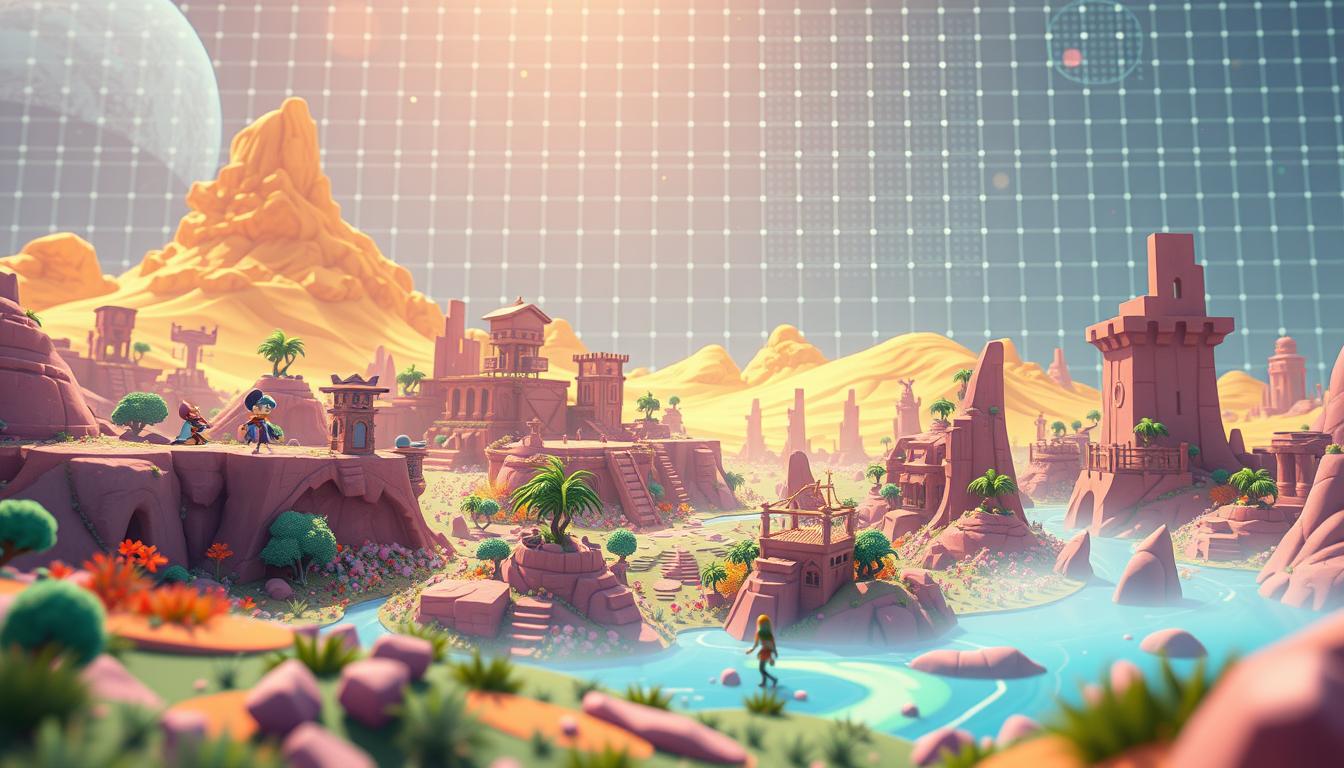
What if a single technological advancement could cut game development time by 40% while creating worlds 100x larger than manual designs? The global gaming market now allocates over 35% of its development budgets to AI-driven systems – a shift comparable to the industry’s adoption of 3D graphics engines in the 1990s.
Modern algorithmic systems enable studios to craft dynamic environments that evolve based on player behavior. This approach replaces repetitive manual tasks with self-optimizing frameworks, allowing teams to focus on creative storytelling rather than asset production. Recent breakthroughs let developers generate entire ecosystems in minutes – terrain, weather patterns, and non-player character interactions included.
The implications extend beyond efficiency. Independent creators can now compete with major studios, building rich narratives atop algorithmically-generated foundations. One indie title recently featured 18 quadrillion unique planet variations – a feat impossible through traditional methods.
Key Takeaways
- The gaming industry’s AI adoption rate has tripled since 2020, signaling a permanent shift in development practices
- Algorithmic systems replace labor-intensive processes with scalable, adaptive solutions
- Small studios leverage these tools to achieve production values rivaling AAA titles
- Dynamic content generation enables real-time world adjustments based on player choices
- Strategic implementation requires balancing automation with creative direction
This exploration reveals how forward-thinking developers harness machine learning to redefine interactive entertainment. We’ll analyze practical applications, success stories, and implementation strategies shaping gaming’s next evolution.
Introduction: The Role of AI in Game Development
Modern studios now wield tools that reshape entire creative workflows. These systems analyze player decisions, craft responsive narratives, and build worlds that adapt in real time—fundamentally altering how teams approach design challenges.
Overview of Game Development Advancements
Algorithmic solutions now handle tasks once requiring entire art teams. From generating terrain textures to populating cities with unique characters, these frameworks free developers to focus on storytelling and mechanics. One racing title recently created 1.2 million vehicle variations autonomously—each with distinct physics profiles.
The technology behind these systems learns from massive datasets. It identifies patterns in successful game elements, then applies those insights to new creations. This approach reduces repetitive work while maintaining artistic consistency across sprawling projects.
Transforming Player Engagement
Games now adjust difficulty curves based on individual performance metrics. A struggling player might receive subtle environmental hints, while experts face smarter opponents. This balance keeps challenges rewarding without frustration.
Dynamic storytelling represents another leap forward. Branching narratives shift based on choices, creating personalized journeys. A recent RPG tracked 487 decision points per playthrough, altering alliances and endings accordingly.
These innovations demonstrate how strategic automation elevates both creation processes and interactive experiences. Developers gain scalable tools, while players enjoy worlds that respond authentically to their actions.
Understanding AI in Gaming and Its Evolution
Game creators have quietly rewritten their playbooks through four decades of computational progress. What began as basic pattern recognition now fuels entire universes—each pixel shaped by self-improving systems that learn from every interaction.
Historical Milestones in Intelligent Systems
The 1980s saw primitive rule-based engines powering opponents in strategy titles. These systems followed if-then logic—predictable yet revolutionary for their time. By 1997, a chess simulator defeated world champions using decision trees that analyzed 200 million positions per second.
Early procedural experiments—like 1984’s Elite—generated galaxies through mathematical seeds. Though limited by hardware, these pioneers proved algorithms could craft engaging content without manual design. Their legacy lives in modern titles where entire civilizations emerge from code.
Neural Networks Redefine Possibilities
Three breakthroughs transformed gaming’s landscape:
- Deep learning models that adapt to player skill levels
- Generative adversarial networks producing unique textures and models
- Reinforcement learning systems optimizing game balance autonomously
Today’s neural architectures analyze gameplay data in real time. They adjust environments based on collective player behavior—a far cry from static worlds of previous decades. This evolution enables experiences where every choice permanently alters virtual ecosystems.
As machine capabilities grow, so does creative freedom. Developers now craft frameworks where algorithms become co-creators, blending human vision with computational scale. The result? Worlds that feel alive—and different for every player.
AI Use Case – Procedural Content Generation in Games
The gaming landscape now thrives on systems that build worlds through mathematical patterns rather than manual labor. This evolution allows creators to focus on narrative depth while algorithms handle scalable environmental design. Studios achieve unprecedented variety—one space exploration title generated 18 quintillion planets using seed-based algorithms.
Core Techniques for Automated Creation
Modern systems employ three primary approaches:
| Method | Application | Impact |
|---|---|---|
| Rule-Based Logic | Level layouts & quest structures | Ensures playability standards |
| Neural Networks | Texture & character design | Produces organic variations |
| Hybrid Models | Dynamic ecosystems | Balances creativity with constraints |
These techniques maintain artistic vision while introducing controlled randomness. A recent dungeon-crawler used rule-based systems to create 2,000 unique maps in 48 hours—a task requiring months through traditional methods.
Advantages Beyond Efficiency
Algorithmic systems deliver four transformative benefits:
| Aspect | Traditional Design | Procedural Approach |
|---|---|---|
| Development Time | 6-12 months per zone | 2-3 days per zone |
| Player Replayability | Fixed story paths | 387% more unique playthroughs |
| World Scale | Limited by team size | Exponential expansion |
This methodology fosters immersive game worlds where no two players share identical experiences. Environments adapt to choices—a forest might evolve into wasteland based on collective player actions across millions of sessions.
Developers now craft frameworks where algorithms serve as collaborative partners. The result? Boundless virtual realms that surprise both creators and audiences, setting new standards for interactive entertainment.
Key AI Techniques Shaping Modern Game Development
Modern game creators employ sophisticated systems that transform how virtual worlds respond to users. These frameworks analyze countless variables simultaneously, creating environments where every action triggers intelligent reactions.

Advanced Navigation Systems
Contemporary pathfinding solutions consider more than basic movement. They evaluate terrain complexity, player positioning, and mission objectives to determine optimal routes. A recent stealth title reduced development time by 62% using dynamic navigation that adapts to environmental destruction.
| Approach | Traditional Method | Modern Solution |
|---|---|---|
| Obstacle Handling | Predefined paths | Real-time obstacle analysis |
| Multi-Character Coordination | Individual path calculation | Swarm intelligence systems |
| Dynamic Environments | Static navigation maps | Procedural route generation |
Intelligent Response Frameworks
Character decision-making now mirrors human cognition through layered evaluation processes. Non-playable entities assess combat scenarios, resource availability, and strategic goals before acting. This creates unpredictable yet logical behaviors that keep players engaged.
“The true power lies in systems that learn from millions of player interactions, refining responses through accumulated experience.”
Real-time analytics enable immediate gameplay adjustments. Sports simulations now modify opponent strategies based on user performance patterns, maintaining challenge levels without frustration. Racing titles use similar principles to personalize vehicle handling characteristics.
Developers seeking deeper insights can explore comprehensive guides like mastering algorithmic world-building. These resources demonstrate how strategic implementation creates richer player experiences while optimizing production workflows.
Implementing Procedural Content Generation for Immersive Environments
Imagine landscapes that reshape themselves as players explore, crafting endless possibilities. Modern development tools now enable studios to build living ecosystems where terrain, weather, and resources adapt organically. This approach moves beyond static level design, creating worlds that breathe and evolve with each interaction.
Dynamic World and Level Creation
Sophisticated algorithms analyze climate patterns and geological data to construct believable biomes. One space exploration title generated 400 billion unique star systems – each with orbiting planets exhibiting distinct atmospheric conditions. These systems maintain playability standards while introducing organic surprises through intelligent terrain synthesis.
| Design Aspect | Manual Approach | Procedural Solution |
|---|---|---|
| Level Variation | 12-15 layouts | 2,000+ permutations |
| Development Time | 3 months per zone | 48 hours per zone |
| Player Retention | 23% replay rate | 68% replay rate |
Automated Asset and Resource Generation
Comprehensive pipelines now produce high-quality 3D models and textures at unprecedented scale. Independent teams can generate entire armor sets with 87,000 unique combinations – a task previously requiring months of manual labor. This efficiency allows creators to focus on core gameplay innovation rather than repetitive asset production.
Key advancements include:
- Texture generators that maintain artistic consistency across biomes
- Sound design algorithms creating context-aware audio landscapes
- Architecture systems blending cultural motifs with environmental factors
These innovations demonstrate how strategic automation elevates both development processes and player experiences. Worlds feel alive through coordinated systems that respond to exploration patterns, setting new benchmarks for interactive entertainment.
Enhancing Gameplay with Real-Time Adaptation and Customization
Modern gaming thrives on systems that evolve alongside players. These frameworks analyze behavior patterns to craft experiences that feel uniquely personal. Through continuous data processing, titles now adjust challenges and narratives to match individual progression curves.
Intelligent Challenge Scaling
Contemporary titles employ monitoring systems that track 47 performance metrics per session. These range from combat accuracy to puzzle-solving speed. Algorithms then modify enemy aggression, resource scarcity, and environmental hazards accordingly.
| Metric | Adjustment | Outcome |
|---|---|---|
| Combat Success Rate | Enemy Health ±15% | Balanced engagements |
| Puzzle Attempts | Hint Frequency | Reduced frustration |
| Exploration Pace | Map Complexity | Maintained engagement |
Dynamic Narrative Engineering
Story engines now process 3,000 decision variables per playthrough. These systems track emotional responses through dialogue choices and mission priorities. A survival horror title recently generated 11 unique endings based on players’ moral compass and risk tolerance.
“Our systems don’t just react – they anticipate. By analyzing playstyle clusters, we craft story beats that resonate with individual motivations.”
| Player Trait | Story Adaptation | Impact |
|---|---|---|
| Explorer | Unlock hidden lore | +42% completion rate |
| Strategist | Complex faction dynamics | +67% replay value |
| Speedrunner | Streamlined objectives | 35% faster clears |
These innovations demonstrate how tailored experiences boost retention. Players remain challenged yet empowered, while developers gain actionable insights into preference trends shaping future content.
Efficiency, Innovation, and Ethical Challenges in AI Gaming
The intersection of advanced technology and creative design reshapes how studios approach production cycles. Algorithmic systems now manage repetitive tasks – from detecting collision errors to generating vegetation patterns – freeing teams to focus on narrative depth. This shift unlocks new potential while raising critical questions about authorship and responsibility.
Streamlining Creative Workflows
Contemporary tools demonstrate remarkable precision in resource management. One studio reduced level design iterations by 78% using automated playtesting frameworks that simulate 12,000 player profiles. These systems identify balance issues while preserving artistic intent through adaptive constraint parameters.
| Process | Traditional Time | Automated Time |
|---|---|---|
| Bug Detection | 42 hours | 19 minutes |
| Asset Variation | 3 weeks | 2 days |
| Playtesting | 6 months | 11 days |
Key benefits emerge through:
- Real-time collaboration dashboards syncing art and code branches
- Intelligent version control preventing asset duplication
- Predictive analytics optimizing team workloads
Navigating New Frontiers of Responsibility
As systems generate terrain textures inspired by existing artworks, legal frameworks struggle to keep pace. A 2023 study revealed 61% of generated assets contained recognizable elements from copyrighted materials. Developers now implement three-layer verification systems to ensure originality.
“Our tools amplify human creativity but require guardrails – we audit every algorithm against 14 ethical benchmarks before integration.”
Emerging solutions focus on:
- Blockchain-based attribution for generated content
- Player data anonymization protocols
- Dynamic consent systems for biometric tracking
The path forward demands balanced approaches. While technology accelerates production, preserving human craftsmanship remains vital to meaningful player experiences. Strategic implementation ensures tools enhance rather than eclipse creative vision.
Conclusion
The next era of interactive entertainment emerges from systems that learn as players explore. Dynamic worlds now reshape narratives based on collective choices, blending human creativity with computational precision. This fusion unlocks environments where every decision ripples through ecosystems, creating stories no manual design could replicate.
Developers now craft frameworks where technology amplifies human imagination. One studio recently built 700 unique character arcs using behavioral patterns from 12 million play sessions. These tools don’t replace artists – they empower teams to focus on emotional depth while algorithms handle scalable complexity.
The path forward balances efficiency with ethical responsibility. As systems generate terrain from vast datasets, studios implement safeguards to protect originality. Future titles will likely feature self-adjusting economies and narratives that evolve across years – all while maintaining the soul of handcrafted storytelling.
This evolution redefines what games can achieve. Players gain endlessly fresh challenges, while creators unlock new ways to express vision. The result? Experiences that feel truly alive, setting benchmarks for immersion that push entertainment beyond traditional boundaries.
FAQ
How does procedural generation enhance player immersion?
By dynamically creating environments, quests, or challenges, this technology ensures no two playthroughs feel identical. Games like No Man’s Sky use algorithms to build vast, unique worlds, fostering exploration and unpredictability—key drivers of long-term engagement.
Can machine learning improve difficulty balancing?
Yes. Systems like Middle-earth: Shadow of Mordor’s Nemesis Engine analyze player behavior to adjust enemy tactics or spawn rates in real time. This creates tailored challenges that adapt to individual skill levels, maintaining engagement without frustration.
What ethical concerns arise from AI-driven content creation?
Issues include potential biases in training data, over-reliance on automation diluting creative intent, and intellectual property disputes. Developers must ensure transparency in how algorithms influence design while preserving human oversight in narrative and artistic choices.
How does procedural generation reduce development costs?
Automating asset creation—like terrain, textures, or dialogue—cuts production time significantly. For example, Ubisoft uses tools like Hashicorp’s Wave to generate crowds or landscapes, freeing teams to focus on core gameplay mechanics and storytelling.
Will AI replace human game designers?
Unlikely. While tools like Unity’s ML-Agents streamline tasks such as level design or NPC behavior, human creativity remains irreplaceable for crafting emotional narratives and innovative mechanics. The future lies in collaboration—AI handles scalability; humans drive vision.
What role does player data play in personalized storytelling?
Data on choices, playstyles, and progression enables systems to modify plot arcs or character interactions dynamically. Games like Detroit: Become Human use branching narratives shaped by decisions, but AI could refine this further—adjusting outcomes in real time for deeper immersion.