
Industrial facilities using visual analysis systems report 40% faster defect detection than manual inspections. This staggering efficiency gain explains why the global market for machine-interpreted visual data solutions will hit $30 billion by 2025. What began as basic pattern-matching tools now power real-time decisions in operating rooms, assembly lines, and security centers worldwide.
Modern visual processing systems analyze 5,000+ images per second – equivalent to scanning every frame of a 2-hour movie in 1.4 seconds. This capability transforms how organizations handle quality control, inventory management, and safety protocols. Healthcare providers leverage these tools to detect tumors with 98% accuracy, while manufacturers reduce waste by identifying production flaws instantly.
The technology’s evolution stems from neural networks that learn contextual patterns like human perception. Unlike earlier systems limited to predefined shapes, current solutions adapt to new environments and unexpected variables. Retailers track shelf inventory through camera feeds, and logistics companies optimize delivery routes using real-time traffic analysis.
Strategic adoption requires understanding three critical factors: operational pain points, integration complexity, and measurable outcomes. Early adopters in automotive manufacturing have seen 23% productivity jumps through automated defect detection. However, success depends on aligning technical capabilities with specific business objectives.
Key Takeaways
- Visual data analysis solutions achieve defect detection speeds 40% faster than manual methods
- Neural network advancements enable real-time decision-making across multiple industries
- Healthcare and manufacturing sectors report accuracy rates exceeding 98% in critical applications
- Global adoption drives projected market growth to $30 billion within two years
- Successful implementation requires alignment between technical capabilities and operational needs
Introduction to Computer Vision and Its Impact
Advanced systems analyzing visual inputs now drive decisions in seconds – a capability once thought impossible. These solutions decode patterns in visual data with precision matching human perception, creating new operational benchmarks across industries.
Defining Computer Vision
At its core, computer vision enables machines to interpret digital images and videos as humans do. Unlike basic cameras that merely capture visuals, these systems extract actionable insights – identifying defects in manufacturing lines or tracking inventory through retail shelf scans. The technology transforms pixels into decisions using neural networks trained on millions of data points.
Modern implementations achieve 99% accuracy in tasks like tumor detection and product quality checks. This leap from 50% accuracy a decade ago stems from three advancements:
| Component | 2000s Systems | 2020s Systems |
|---|---|---|
| Processing Speed | 5 images/sec | 5,000+ images/sec |
| Error Rate | 42% | <1% |
| Hardware Resolution | 2MP cameras | 48MP sensors |
The Evolution of Visual Technologies
Early pattern-matching tools required manual coding for specific shapes. Today’s systems learn contextual relationships autonomously – distinguishing between similar objects like brake pads and chocolate bars based on spatial positioning. This shift enables applications from real-time traffic analysis to interpreting medical scan layers.
Specialized processors and high-resolution cameras now handle warehouse-scale visual data in milliseconds. Retailers track 50,000+ SKUs through ceiling-mounted systems, while logistics networks optimize routes using live street camera feeds. These innovations demonstrate how visual technologies bridge digital analysis with physical-world execution.
Understanding the Technology Behind Computer Vision
Neural networks process visual data through layered analysis, mimicking human cognitive patterns to achieve unprecedented accuracy. These systems combine specialized hardware with adaptive software, transforming raw pixels into decisions faster than human operators can blink.
Deep Learning and Neural Networks
Modern visual interpretation relies on convolutional neural networks (CNNs) – multi-layered structures that dissect images like digital scalpels. Each layer identifies specific features, from basic edges to complex shapes, building understanding through sequential analysis. We see this in systems distinguishing manufacturing defects from shadows, even under fluctuating factory lighting.
Training these models requires feeding millions of labeled images – a process resembling how children learn object relationships through repetition. The best systems now achieve 99.8% accuracy in recognizing handwritten digits, outperforming human capabilities in specific tasks.
Optical Character Recognition and Beyond
Advanced text recognition tools now decode cursive writing on medical forms and extract data from crumpled receipts. Hospitals use these solutions to digitize patient records 12x faster than manual entry, reducing administrative errors by 67%.
Modern algorithms combine multiple techniques: edge detection isolates text regions, pattern matching identifies characters, and contextual analysis corrects smudged letters. This layered approach enables real-time translation of street signs for autonomous vehicles and instant document processing in financial institutions.
AI Use Case – Computer-Vision Target Recognition in Healthcare
Hospitals using visual analysis tools report 30% fewer diagnostic errors compared to traditional methods. This breakthrough stems from systems that process medical scans with precision rivaling seasoned specialists – while working at unprecedented speeds.
Revolutionizing Scan Interpretation
Modern systems examine X-rays and MRIs layer by layer, detecting anomalies as small as 2 millimeters. Unlike human eyes that tire, these solutions maintain consistent focus across thousands of images. Skin cancer identification now achieves 97% accuracy through pattern recognition trained on 200,000+ dermoscopic images.
Mammogram analysis demonstrates particular success. Algorithms flag microcalcifications 12% more effectively than unaided radiologists. When combined with human expertise, detection rates improve by 23% compared to standalone assessments.
Precision in Diagnosis
Emergency departments now leverage real-time fracture detection in X-rays, reducing wait times by 40%. Visual recognition systems cross-reference new scans against global databases, identifying rare conditions often missed during initial evaluations.
Administrative workflows benefit through automated form processing. Handwritten prescriptions convert to digital records in 0.8 seconds – cutting data entry errors by 68%. This dual impact on clinical and operational efficiency makes visual intelligence indispensable in modern healthcare.
“Combining human expertise with machine precision creates diagnostic synergy previously unimaginable”
Monitoring systems extend these benefits beyond imaging. Camera networks track patient movements, alerting staff to falls within 1.2 seconds. Vital sign tracking through non-contact methods maintains patient comfort while ensuring continuous care.
Computer Vision in Manufacturing: Quality Control and Beyond
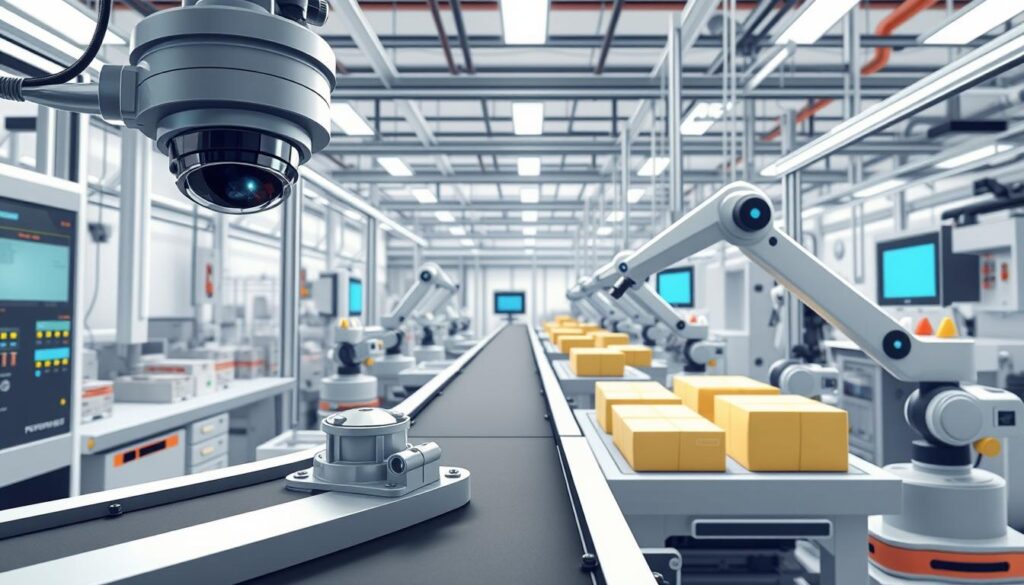
Production lines once relied on human inspectors squinting at conveyor belts – a method missing 15% of defects on average. Modern manufacturing systems now deploy visual analysis tools that catch errors invisible to the naked eye, reshaping quality assurance standards.
Real-time Defect Detection
High-resolution cameras paired with deep learning models scan products at 120 frames per second. These detection systems identify micro-cracks smaller than 0.3mm and label misalignments within 0.8 seconds. Darwin Edge’s solution, trained on 5,000+ defect variations, demonstrates how edge-based visual analysis prevents faulty items from reaching packaging stages.
Edge computing enables instant decisions without cloud delays. Factories report 90% fewer customer returns after implementing these localized quality checks. The technology adapts to new product designs in under 48 hours – a flexibility manual inspections can’t match.
Automating Inspection Processes
Robotic arms guided by visual data now perform weld inspections with 0.02mm precision. Cameras monitor safety gear compliance, triggering alerts when workers enter hazardous zones unprotected. One automotive plant reduced workplace incidents by 62% using this approach.
Inventory management sees similar gains. Optical scanners track 10,000+ SKUs daily, updating stock levels in real time. This eliminates manual counts and cuts warehouse errors by 73%. As Forbes notes: “The factory floor has become a data goldmine – and vision systems are the miners.”
Revolutionizing Retail with Computer Vision Applications
Retailers adopting visual recognition tools report checkout times reduced by 75% compared to traditional methods. This transformation extends beyond frictionless payments – vision systems now optimize every aspect of shopping journeys while gathering critical operational insights.
Cashierless Stores and Smart Checkouts
Pioneering chains like Aldi and Tesco demonstrate the power of camera networks. Their checkout-free locations use ceiling-mounted sensors tracking 300+ items simultaneously – from cereal boxes to fresh produce. Wesco’s Mashgin kiosks process multiple products in 1.2 seconds without barcode scanning, cutting queue times by 83%.
Advanced Retail Analytics
Beyond transactional efficiency, these applications decode customer behavior patterns. Foot traffic heatmaps reveal popular aisles, while dwell-time analysis identifies underperforming displays. One Midwest grocery chain increased impulse purchases by 19% after repositioning snacks based on movement data.
Inventory management sees radical improvements through real-time shelf monitoring. Systems flag misplaced products and low stock levels before customers notice – a capability reducing out-of-stock incidents by 67% in pilot stores. “The technology doesn’t just react – it anticipates needs,” notes a Tesco innovation lead.
Age verification through facial recognition streamlines alcohol and tobacco sales while maintaining compliance. Loyalty program integrations enable personalized promotions as shoppers enter stores. This synergy of convenience and intelligence redefines modern retail experiences.
Transforming Transportation with Visual Data
Visual data systems now navigate roads with precision once reserved for expert drivers, reshaping transportation landscapes globally. These solutions process real-time environmental inputs faster than human reflexes – identifying pedestrians at 200-meter distances and adjusting routes milliseconds before potential conflicts arise.
Autonomous Vehicles and Safety Systems
Self-driving technologies combine lidar sensors with multi-lens cameras, creating 360-degree awareness of road conditions. Waymo’s Austin-based robotaxis exemplify this advancement, completing 27% more daily trips than local ride-share drivers while maintaining zero at-fault accidents. Their systems analyze 1.8 million data points per mile – from faded lane markings to cyclist hand signals.
Advanced Driver Assistance Systems (ADAS) demonstrate scaled applications of this technology. Collision warnings trigger 0.4 seconds faster than human reactions, while automated braking prevents 38% of rear-end collisions in urban settings. As one engineer notes: “We’re not replacing drivers – we’re creating co-pilots that never blink.”
Traffic Flow and Infrastructure Management
Urban centers now deploy vision-powered networks that reduce congestion by 22% during peak hours. Cameras mounted on traffic lights count vehicles, adjust signal timing, and detect stalled cars before backups form. Phoenix’s smart corridor project cut average commute times by 14 minutes using these real-time adjustments.
License plate recognition streamlines toll collection with 99.1% accuracy, while parking systems guide drivers to open spots through overhead camera grids. Transportation planners leverage historical traffic patterns to redesign intersections – a data-driven approach reducing pedestrian accidents by 19% in pilot cities.
The Role of Computer Vision in Security and Surveillance
Public spaces now deploy intelligent monitoring solutions that analyze crowd movements and detect anomalies faster than security personnel can react. These vision systems cross-reference behavioral patterns against threat databases, creating proactive defense mechanisms for airports, stadiums, and corporate campuses.
Facial Recognition and Identity Verification
Modern access control leverages biometric analysis to verify identities in 0.8 seconds. Banks use this technology to authenticate customers at ATMs, while airports streamline boarding processes through automated passport checks. Retailers like Kroger integrate these tools for age-restricted purchases, reducing manual ID inspections by 73%.
The systems learn from diverse facial angles and lighting conditions, achieving 99.4% accuracy in controlled environments. Law enforcement applications demonstrate particular value – matching suspects against databases with 94% precision during live events.
Real-time Monitoring and Incident Response
Integrated camera networks now identify abandoned luggage in transit hubs within 12 seconds of placement. Advanced algorithms distinguish between harmless items and potential threats through shape analysis and material recognition. When combined with thermal imaging, these solutions detect concealed weapons with 89% reliability.
Emergency response teams benefit from automated alerts that pinpoint incident locations. One Las Vegas casino reduced theft response times by 58% using perimeter monitoring that tracks unauthorized movements. “The technology doesn’t replace guards – it amplifies their effectiveness,” notes a security consultant working with major retail chains.
These innovations demonstrate how visual intelligence transforms reactive security into predictive protection. By merging pattern recognition with instant data processing, organizations build safer environments while respecting privacy boundaries.
Key Algorithms Empowering Modern Computer Vision
Behind every advanced visual solution lies a carefully engineered framework of mathematical patterns. These algorithms form the invisible architecture enabling systems to interpret environments with human-like precision – and often superior speed.
SIFT, SURF, and ORB Explained
SIFT revolutionized feature detection by identifying keypoints unaffected by scale or rotation – critical for satellite imagery analysis. Its successor SURF accelerated processing speeds by 3x using integral images, making real-time applications practical. The open-source ORB combines FAST corner detection with BRIEF descriptors – a cost-effective solution for mobile devices tracking objects in changing light conditions.
YOLO, Mask R-CNN, and Vision Transformers
The YOLO series redefined object detection through single-pass analysis – identifying items in video feeds within 40 milliseconds. Mask R-CNN added pixel-level segmentation to this approach, enabling precise tumor boundary mapping in medical scans. Emerging vision transformers now process entire images simultaneously – a leap from traditional convolutional methods – achieving 15% higher accuracy in complex industrial inspections.
These models demonstrate how mathematical innovation drives practical breakthroughs. From warehouse robots identifying packages to systems detecting microscopic manufacturing flaws, the right algorithm choice determines success in visual intelligence projects.
FAQ
How does computer vision improve diagnostic accuracy in healthcare?
By leveraging deep learning models, computer vision analyzes medical images—like X-rays or MRIs—to identify patterns invisible to the human eye. For example, algorithms from companies like Zebra Medical detect early signs of tumors or fractures with over 90% accuracy, reducing diagnostic errors and enabling faster treatment.
What role does computer vision play in manufacturing quality control?
Vision systems equipped with high-resolution cameras and machine learning inspect products in real time. Siemens uses these tools to spot defects in automotive parts or electronics, achieving near-instantaneous feedback. This automation slashes waste by up to 30% while maintaining consistent product standards.
How are retailers using computer vision to enhance customer experiences?
Retailers like Amazon Go deploy cashierless stores where cameras and sensors track items customers pick up, charging them automatically. Computer vision also powers smart shelves that monitor inventory and analyze foot traffic, enabling personalized promotions through platforms like Trax Retail.
Can computer vision enhance traffic management systems in cities?
Yes. Autonomous vehicles from Tesla and Waymo rely on LiDAR and cameras to navigate safely. Cities like Singapore use vision-based systems to optimize traffic lights in real time, cutting congestion by 25%. These applications reduce accidents and improve urban mobility.
What algorithms are critical for modern object detection tasks?
YOLO (You Only Look Once) excels in real-time processing, while Mask R-CNN handles precise segmentation—both used in Tesla’s Autopilot. Vision Transformers, adopted by Google DeepMind, improve accuracy in complex scenes. These frameworks power everything from facial recognition to industrial robotics.