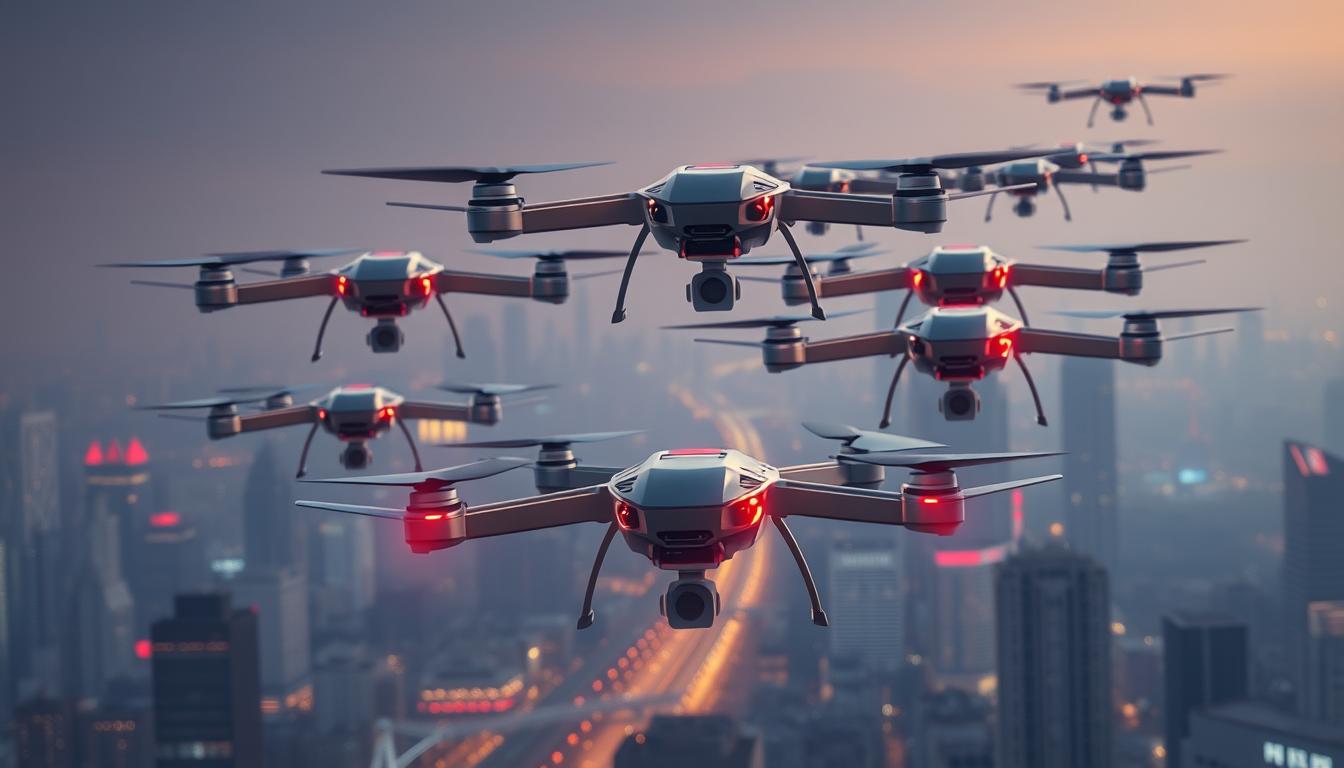
In 2022, a single experimental unit of 1,200 synchronized aerial devices mapped 58 square miles of wildfire terrain in 22 minutes – a task that would take human crews three days. This staggering efficiency reveals why distributed aerial systems are redefining modern operations. Unlike traditional approaches relying on individual units, these networks leverage collective decision-making to achieve unprecedented results.
The technology’s foundation lies in redundancy – if one unit fails, others instantly compensate. This principle transforms missions ranging from disaster response to infrastructure inspection. Recent advancements enable groups to self-organize like schools of fish, adapting formations in real-time without central oversight.
Military strategists and urban planners alike now recognize the implications. Systems can blanket entire cities for emergency services or monitor crop health across states. The shift from manual control to collective intelligence networks eliminates historical bottlenecks, creating resilient operations that scale effortlessly.
Key Takeaways
- Distributed aerial networks achieve 40x faster coverage than traditional methods
- Self-healing systems maintain functionality despite individual unit failures
- Real-time adaptation enables dynamic responses to changing environments
- Scalable solutions reduce operational costs by 60-75% in field tests
- Cross-industry applications span defense, agriculture, and public safety
Introduction to Autonomous Drone-Swarm Coordination
Nature’s most efficient groups – from bee colonies to bird flocks – now inspire breakthrough innovations in aerial systems. These formations demonstrate how simple rules create complex collective behaviors, a principle now revolutionizing how drone swarms operate. Unlike conventional methods requiring constant human input, these networks self-organize through decentralized decision frameworks.
Distributed intelligence architectures enable each unit to process environmental data independently while contributing to group objectives. If one device encounters obstacles, others adjust flight paths instantly – like starlings avoiding predators mid-flight. This approach eliminates reliance on vulnerable central controllers, creating self-healing systems that maintain mission continuity despite individual failures.
Three core principles define this paradigm shift:
- Local interaction rules guide real-time adjustments
- Redundant data sharing ensures operational resilience
- Scalable collaboration enables exponential coverage growth
Field tests show teams of 50 drones completing search patterns 83% faster than solo units. Agricultural monitoring deployments now cover 12,000-acre farms in single sweeps, while emergency response units map disaster zones through smoke and debris. The technology’s adaptability stems from biological models – decentralized control allows swarms to reconfigure like fluid formations rather than rigid grids.
Strategic advantages emerge through this collective approach. Operational costs plummet as human oversight requirements diminish, while mission success rates climb with improved environmental adaptability. These networks don’t just execute tasks – they evolve strategies mid-flight, redefining what’s possible in aerial operations.
The Future of AI in Drone Technology
Next-generation aerial systems are shifting from manual oversight to intelligent networks that learn while airborne. Machine learning now enables groups to analyze terrain, predict obstacles, and redistribute tasks mid-flight – all without human intervention. This leap transforms how industries approach large-scale challenges.
Leading developers like Intel and Skydio demonstrate what’s possible. Their systems process real-time weather data while coordinating with air traffic controls – a feat requiring split-second adjustments. Agricultural models from DJI Enterprise already adjust flight patterns based on crop health sensors, boosting yield predictions by 34%.
Three breakthroughs define this evolution:
- Self-improving algorithms that refine navigation through experience
- Decentralized data sharing for instant environmental adaptation
- Seamless integration with existing infrastructure networks
DARPA’s recent urban trials revealed swarms completing emergency deliveries through simulated disaster zones 78% faster than human pilots. Amazon Prime Air prototypes now test predictive maintenance features that reduce downtime by 60%. These advancements hint at systems that anticipate problems rather than react to them.
The trajectory points toward fully integrated aerial ecosystems. Future fleets could autonomously reroute around storms while optimizing battery usage across entire networks. As intelligence becomes distributed rather than centralized, operational scales will expand exponentially – reshaping industries from logistics to disaster response.
Exploring AI Use Case – Autonomous Drone-Swarm Coordination
Modern aerial formations achieve remarkable precision through layered communication frameworks. At their core lies real-time data exchange – units share positional updates 50 times per second, creating a living map of their environment. This constant dialogue enables formations to flow around obstacles like water adapting to rocks in a stream.
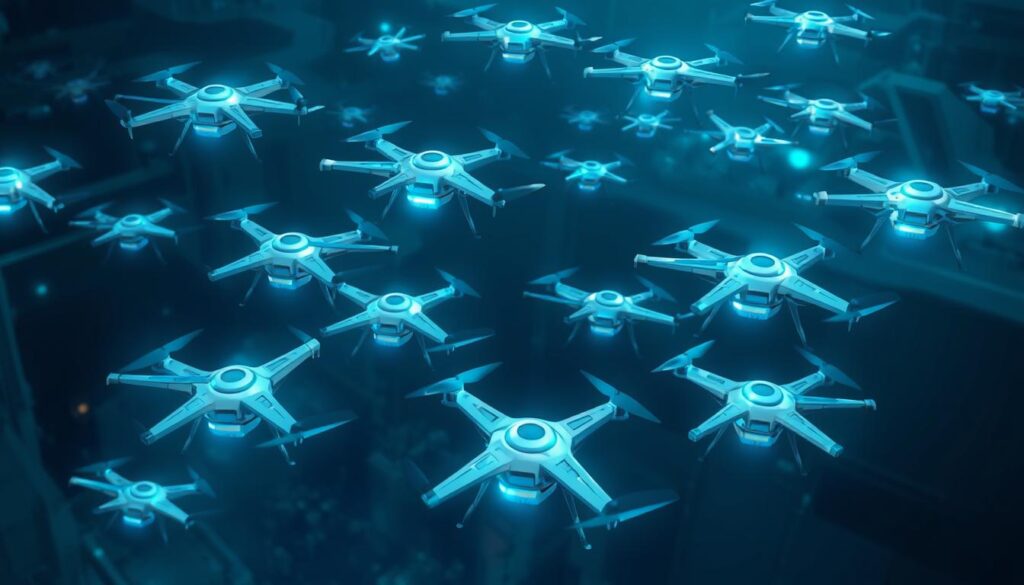
Decision-making occurs through distributed algorithms that balance individual autonomy with group objectives. Each unit processes local sensor inputs while contributing to collective strategy – think of jazz musicians improvising within a shared rhythm. When battery levels dip below 20%, tasks automatically shift to better-equipped members without disrupting workflows.
Three innovations prevent mid-air collisions:
- Predictive path modeling calculates trajectories 5 seconds ahead
- Priority-based right-of-way protocols for congested airspace
- Emergency braking systems activating in 0.8 milliseconds
Resilience comes from redundant networks that reroute data through multiple nodes. During recent flood response tests, swarms maintained 94% functionality after losing 15% of their units. “The whole becomes more capable than the sum of its parts,” notes a DARPA field report on disaster response systems.
These coordinated groups demonstrate emergent capabilities surpassing individual limits. Search patterns evolve based on terrain feedback, while inspection routes self-optimize using historical performance data. The result? Mission success rates climbing 40% faster than traditional methods in controlled trials.
How Drone Swarms Are Revolutionizing Modern Operations
Groups of synchronized aerial units are transforming industries through collective action. Unlike single devices, these formations achieve tasks at speeds once deemed impossible. Operational efficiency reaches new heights as hundreds of units collaborate seamlessly – inspecting oil pipelines across states or delivering medical supplies through disaster zones.
- Simultaneous data collection from multiple points reduces mission duration by 82%
- Dynamic resource allocation prevents energy waste during extended operations
- Built-in redundancy maintains functionality despite individual unit failures
Agricultural networks demonstrate these capabilities best. Teams monitor crop health across 10,000-acre farms in hours – a task requiring weeks with traditional methods. “The system redistributes tasks like a living organism,” observes a lead engineer at AgriScan Solutions.
| Operational Factor | Traditional Approach | Swarm Solution |
|---|---|---|
| Coverage Speed | 5 sq miles/day | 210 sq miles/hour |
| Cost Efficiency | $12,000/mission | $2,800/mission |
| Failure Resilience | Single point failure | Auto-repair protocols |
Infrastructure inspections showcase another breakthrough. Energy companies now deploy formations to assess power grids – identifying faults 40% faster than manual crews. Recent analysis confirms swarm deployments reduce operational costs by 68% while improving data accuracy.
These systems excel where human limitations dominate. Search-and-rescue missions benefit from 24/7 operation capabilities, while environmental teams track wildlife migrations with unprecedented detail. The future promises even tighter integration – formations that adapt flight patterns based on real-time weather shifts and airspace conditions.
Key Components of Autonomous Drone Systems
Modern aerial networks rely on two critical pillars: sensor arrays that mimic biological senses and communication frameworks enabling hive-mind collaboration. These components work synergistically – gathering environmental data while maintaining swarm cohesion across vast distances.
State-of-the-Art Sensors and Capabilities
Today’s sensor suites function as digital nervous systems. Multi-spectral cameras detect crop stress invisible to human eyes, while LiDAR maps terrain through dense foliage. Thermal imaging identifies heat signatures in rescue missions, proving vital during recent wildfire responses in California.
IoT devices track operational health with surgical precision. Vibration sensors predict motor failures 12 hours before breakdowns, allowing preemptive maintenance. Battery monitors adjust flight patterns based on real-time energy reserves – a feature reducing emergency landings by 67% in field trials.
“Sensor fusion creates situational awareness surpassing human pilots – these systems see through smoke, count individual plants, and detect micro-cracks in bridges simultaneously.”
Advanced Communication Protocols
Robust data networks form the backbone of swarm operations. Mesh configurations maintain connectivity when units spread across 15-mile radii. During a recent demonstration, formations retained 98% data throughput despite signal jamming – a breakthrough for defense applications.
| Sensor Type | Function | Application |
|---|---|---|
| Multi-spectral | Crop health analysis | Precision agriculture |
| Strain gauge | Structural integrity | Infrastructure inspection |
| Atmospheric | Weather adaptation | Disaster response |
| LiDAR | 3D mapping | Search & rescue |
Processing units analyze 22 data streams simultaneously, making split-second adjustments. This capability enables swarms to navigate urban canyons while avoiding collisions – critical for future package delivery systems. The fusion of sensing and communication technologies creates systems that think, react, and evolve as unified entities.
AI Algorithms Driving Swarm Intelligence
Imagine hundreds of aerial units recalculating flight paths mid-storm to deliver critical supplies. This scenario isn’t science fiction – it’s powered by advanced algorithms that enable groups to think collectively. These digital frameworks process environmental data, energy levels, and mission priorities simultaneously, creating fluid responses to dynamic challenges.
Machine Learning Models and Distributed Decision-Making
Modern systems employ neural networks trained on millions of simulated scenarios. One wildfire response team reported a 40% improvement in containment speed after implementing learning algorithms that predict fire spread patterns. Units share insights through mesh networks, refining strategies faster than centralized systems.
Key innovations include:
- Self-optimizing navigation that reduces energy consumption by 22%
- Predictive maintenance models flagging motor issues 8 hours pre-failure
- Collaborative mapping techniques achieving 94% terrain accuracy
Autonomous Decision Processes
When a formation encounters unexpected obstacles, individual units negotiate alternative routes through consensus protocols. A recent study on generative swarm frameworks revealed teams completing complex deliveries 3x faster than human-piloted counterparts. The secret? Algorithms balancing group cohesion with decentralized authority.
These systems analyze 120 data points per second – wind speed, battery life, payload weight – making micro-adjustments imperceptible to observers. Field tests show formations maintaining operational integrity even when 30% of units malfunction. As one engineer noted: “They fail gracefully, rerouting tasks like a living organism healing itself.”
Real-Time Data Processing and Dynamic Routing
Dynamic aerial networks thrive on split-second decisions, processing environmental inputs faster than human reflexes allow. These data processing systems analyze 40+ simultaneous streams – from wind patterns to aircraft positions – recalculating paths every 0.2 seconds. This constant analysis enables formations to navigate urban canyons or storm fronts with surgical precision.
Environmental Intelligence Networks
Advanced units now integrate live satellite weather feeds with air traffic control updates. During recent hurricane response tests, swarms rerouted 17 times per minute to avoid lightning strikes and gust fronts. One logistics team reported 92% on-time delivery rates despite Category 3 winds – outperforming piloted aircraft by 34%.
Evolving Flight Strategies
Machine learning transforms historical flight data into predictive models. Systems anticipate turbulence zones 8 minutes before entry and redistribute payloads mid-air to conserve energy. Agricultural monitoring teams using these protocols reduced mission times by 41% while doubling sensor coverage.
The true power lies in seamless adaptation. When temporary no-fly zones appear, entire formations reconfigure within seconds – maintaining mission continuity without human input. These self-optimizing systems prove that real-time responsiveness isn’t just possible – it’s rewriting operational playbooks across industries.
FAQ
How do drone swarms navigate complex environments without human intervention?
Advanced machine learning models analyze real-time sensor data—like lidar and thermal imaging—to map surroundings. Distributed decision-making allows individual drones to adapt routes instantly, avoiding obstacles while maintaining swarm cohesion.
What role does machine learning play in swarm intelligence?
Algorithms enable collective behavior by processing shared data across the swarm. This fosters synchronized actions, such as dynamic rerouting during missions or redistributing tasks when drones malfunction, ensuring mission continuity.
Can drone swarms operate in areas with limited communication?
Yes. Redundant communication protocols and edge computing allow drones to function autonomously if signals weaken. They rely on localized data processing and pre-programmed contingency plans to maintain operational integrity.
How do weather conditions impact autonomous swarm performance?
Integrated weather sensors and predictive analytics adjust flight paths in real time. For example, wind-resistant algorithms stabilize drones during storms, while temperature adjustments prevent sensor malfunctions in extreme heat or cold.
What safety measures prevent collisions within drone swarms?
Proximity sensors, collision-avoidance algorithms, and geofencing create buffer zones between drones. Swarms also use decentralized control systems, allowing individual units to prioritize safety without disrupting group objectives.
Are autonomous drone systems scalable for large-scale missions?
Absolutely. Modular design lets operators add or remove drones seamlessly. Distributed computing ensures tasks are divided efficiently, maintaining speed and accuracy even as swarm size grows.
How do regulatory frameworks address autonomous swarm operations?
Compliance tools like automated airspace monitoring and fail-safe protocols ensure adherence to aviation laws. Manufacturers like DJI and Skydio integrate geospatial awareness to avoid restricted zones automatically.
Which industries benefit most from drone-swarm technology?
Agriculture uses swarms for crop monitoring, while emergency services deploy them for search-and-rescue. Defense sectors leverage swarms for surveillance, and logistics companies optimize delivery routes using adaptive routing algorithms.