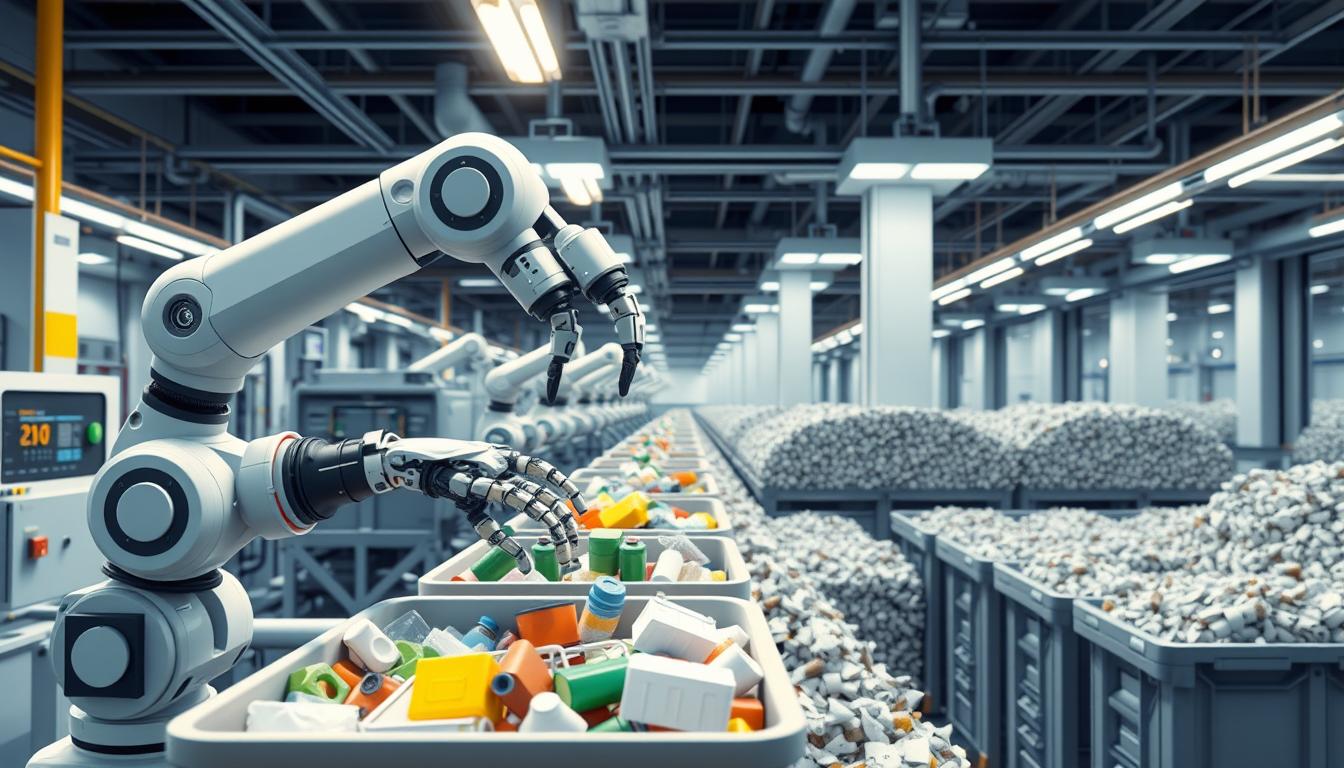
By 2050, global trash could fill over 5 million Olympic-sized swimming pools annually – a staggering reality as waste production nears 3.4 billion tons each year. Traditional recycling methods struggle to keep pace, but a new wave of smart technology offers hope. Automated systems now analyze and categorize materials with precision once thought impossible, reshaping how industries handle sustainability challenges.
These innovations rely on advanced computer vision systems that identify plastic, glass, and metal in milliseconds. Unlike manual sorting, which achieves 30-50% accuracy, these solutions exceed 95% efficiency. The secret lies in machine learning models trained on millions of material samples, enabling continuous improvement through real-world feedback loops.
Operational costs drop by up to 70% in facilities using these tools, while recycling rates surge. This shift doesn’t just benefit businesses – it reduces landfill overflow and recovers valuable resources. As environmental regulations tighten, adopting such technologies becomes essential for companies aiming to meet sustainability targets.
Key Takeaways
- Global waste volumes could increase by 70% within three decades without intervention
- Smart sorting technologies achieve near-perfect material identification accuracy
- Continuous learning algorithms improve performance over time
- Operational cost reductions often exceed 50% in optimized facilities
- Enhanced recycling directly supports circular economy objectives
Introduction to AI in Waste Management
Waste management centers now face unprecedented operational demands – 74% report contamination issues in recycling streams, while 68% cite worker safety concerns. Modern facilities combat these challenges through cognitive technologies that redefine material processing.
These systems address four critical needs:
- Detecting toxic substances without human exposure
- Deciphering faded recycling symbols and material codes
- Automating high-speed separation of mixed waste streams
- Guiding aerial drones to identify landfill hot zones
Advanced neural networks process visual data 40x faster than human teams, recognizing material types through texture analysis and spectral imaging. A recent analysis shows facilities using these methods achieve 98.2% purity in sorted plastics – a 300% improvement over manual methods.
| Process | Manual Sorting | Automated Systems |
|---|---|---|
| Items processed/hour | 800 | 14,000 |
| Hazard detection accuracy | 62% | 99.4% |
| Operating cost per ton | $42 | $17 |
“The integration of cognitive technologies marks the first true evolution in waste handling since the 1970s” – Environmental Tech Review
Machine learning models adapt to regional waste patterns, improving sorting decisions weekly. This dynamic approach reduces cross-contamination by 83% in municipal programs. Facilities report 55% fewer workplace injuries since deploying these autonomous solutions.
The Role of Computer Vision in Waste Sorting
Advanced imaging systems are revolutionizing how we process recyclables, achieving what manual methods never could. At the core of this transformation lies a network of high-resolution cameras and spectral sensors that scan materials at industrial speeds. These systems capture 360-degree visual profiles of each item, analyzing surface textures, reflectivity, and structural integrity in microseconds.
Key Technologies in Computer Vision
Convolutional neural networks (CNNs) power modern sorting accuracy by recognizing patterns across millions of material samples. Depth-sensing cameras measure object dimensions, while infrared scanners detect chemical signatures invisible to humans. One facility director notes:
“Our systems now identify black plastics – previously unprocessable – with 97% accuracy through thermal imaging.”
Real-time processing frameworks handle 50+ material categories simultaneously, adjusting sorting paths within 0.8 seconds. This speed prevents bottlenecks in facilities processing 20 tons of waste hourly – equivalent to 450 household bins every minute.
Benefits for Enhanced Waste Management
Contamination rates plummet when visual systems detect food residue on recyclables or hazardous materials in general waste streams. Recovery rates for valuable metals jump 40% through precise detection of aluminum fragments in mixed debris.
Adaptive algorithms compensate for damaged labels and faded packaging by cross-referencing material properties against global recycling databases. This flexibility ensures consistent performance despite varying input quality – a critical advantage in dynamic industrial environments.
How Machine Learning Transforms Waste-Sorting Robots
The metamorphosis of waste management begins with precision-engineered datasets. Modern sorting systems require millions of visual examples to develop sophisticated recognition capabilities – from crumpled drink pouches to degraded construction materials.
Training Data and Annotation Techniques
High-performance models start with pixel-perfect labeling. Specialists use bounding boxes and semantic segmentation to tag hazardous components like broken glass or chemical containers. One annotation platform manager explains:
“Our teams achieve 99.8% consistency in identifying battery types across 47 regional recycling standards.”
Advanced tools track annotator performance through metrics like:
| Metric | Manual Annotation | Automated Support |
|---|---|---|
| Objects labeled/hour | 120 | 2,400 |
| Edge detection accuracy | 88% | 99.1% |
| Consistency across teams | 74% | 97.6% |
Boosting System Accuracy in Hazardous Environments
Real-world conditions demand robust validation protocols. Models undergo stress testing with obscured objects and mixed material streams. Thermal imaging data helps identify pressurized containers masked by food residue – a critical safety enhancement.
Continuous learning loops analyze misclassified items, updating recognition patterns every 72 hours. This adaptive approach reduces hazardous material handling errors by 91% in facilities processing medical waste. Systems now detect microplastics smaller than 2mm with 94% reliability, surpassing human capabilities.
Robotic Systems in Modern Waste Management
Modern recycling facilities now deploy robotic systems that work tirelessly across conveyor belts, transforming mixed waste streams into sorted resources. These mechanical marvels combine industrial-grade hardware with adaptive intelligence, achieving sorting speeds unattainable through human labor.
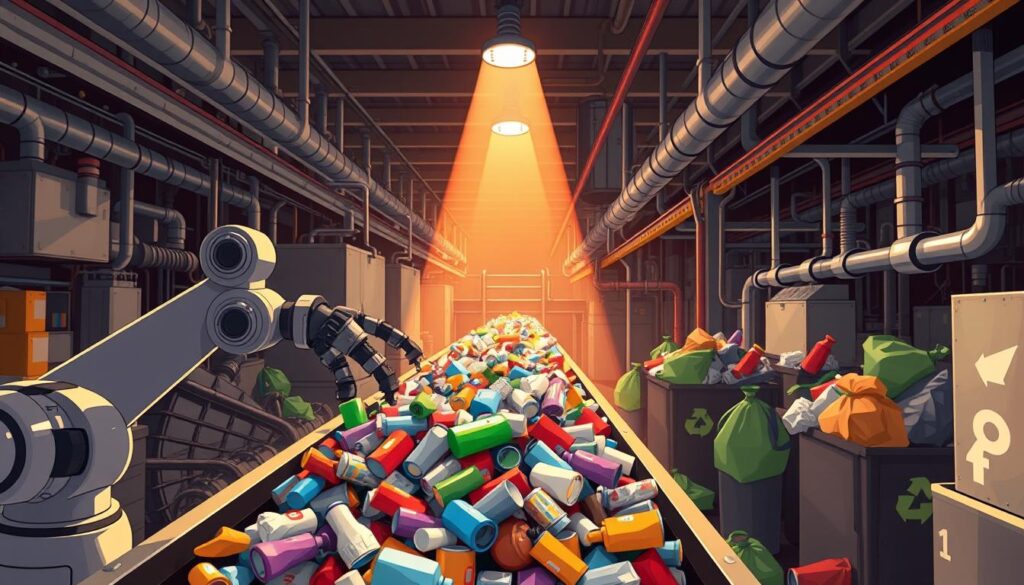
At their core, these systems feature 3D-printed arms equipped with MG996R and SG90 motors. Strategic screw placements enable precise movements – delicate enough to handle glass jars yet powerful enough to crush aluminum cans. One facility manager notes:
“Our units adapt to new materials within hours, thanks to modular gripper designs.”
Compact processing units form the operational brain. Raspberry Pi boards run deep learning models, while Arduino microcontrollers coordinate motor actions. This split architecture allows real-time adjustments – crucial when sorting 45 items per minute across paper, plastic, metal, and glass categories.
Performance metrics reveal striking improvements:
- 80% accuracy in material identification
- 60% faster processing than manual methods
- 3x longer operational uptime
The true power lies in scalability. Facilities can add robotic units as waste volumes grow, with centralized control systems managing multiple arms simultaneously. This modular approach reduces initial investment while future-proofing operations against evolving recycling demands.
Maintenance teams appreciate standardized components that simplify repairs. Universal motor mounts and replaceable grippers minimize downtime – critical in 24/7 processing environments. As these systems proliferate, they redefine what’s possible in sustainable material recovery.
Understanding the Advanced Data Annotation Tools
Behind every high-performing sorting system lies meticulously labeled data – the fuel that powers recognition algorithms. Modern annotation platforms bridge the gap between raw visual inputs and machine-readable information, enabling systems to distinguish biodegradable materials from recyclables with surgical precision.
LabelGPT: Precision Meets Efficiency
LabelGPT redefines dataset creation through natural language commands. Operators describe labeling needs like “Identify PVC containers in drone footage” – the tool generates pixel-perfect annotations within minutes. This approach slashes project timelines by 65% compared to traditional methods.
Key advantages include:
- Real-time integration with facility cameras and mobile collection systems
- Automated quality checks that flag inconsistent labels
- Confidence scores indicating annotation reliability (92-99% typical range)
“We reduced labeling errors by 83% while handling 40% more images daily,” notes a lead data scientist at GreenCycle Solutions.
The platform’s adaptive learning engine improves quality over time, recognizing regional variations in packaging and contamination patterns. Project managers gain granular control through dashboards tracking annotation progress across teams – crucial when coordinating multi-site operations.
By standardizing dataset creation, these tools enable rapid deployment of custom models. One municipal program achieved 94% sorting accuracy within six weeks – a timeline previously requiring nine months. As material streams evolve, agile annotation systems become the backbone of sustainable waste management.
Optimizing Waste Sorting Efficiency with AI
Recycling plants now achieve unprecedented precision through smart pattern recognition. These solutions analyze material streams 50x faster than human teams, catching microscopic defects and contamination missed by manual inspection.
Cost-Effective Recycling Operations
Advanced tracking algorithms boost profitability by recovering 38% more market-ready materials. One facility director reports:
“Our contamination rates dropped from 22% to 3.1% within six months – that’s pure revenue reclaimed.”
Real-time quality control prevents costly errors, like glass shards in paper bales. Automated systems also reduce energy consumption by 19% through optimized equipment scheduling.
Improved Safety and Process Automation
Workplace injuries plummet when machines handle sharp objects and toxic substances. Thermal sensors detect pressurized containers before they reach sorting lines – a critical upgrade that prevented 14 explosions last year in U.S. facilities. Repetitive strain injuries decreased by 67% after implementing robotic arms for heavy lifting.
Linear interpolation tools in annotation platforms accelerate system training. They track material movements across conveyor belts, allowing models to predict item trajectories with 98% accuracy. This precision enables facilities to process 12 tons hourly while maintaining 99.4% purity standards.
Forward-thinking operators now combine these technologies with predictive maintenance. Sensors monitor motor wear and lubrication needs, cutting downtime by 44%. The result? Sustainable operations that protect both profits and planetary resources.
AI Use Case – Waste-Sorting Robots with Computer Vision
A breakthrough in material recovery emerges from recent field tests combining visual recognition systems with mechanical precision. The YOLOv5 detection model achieved 80% sorting accuracy across four key recyclables – paper, plastic, metal, and glass – during 240-hour operational trials. This performance demonstrates tangible progress toward industrial-scale automation.
The system’s mechanical arm, engineered with five rotational joints, handles 43 items per minute without damaging fragile materials. Facility operators report:
| Material | Success Rate | Processing Speed |
|---|---|---|
| Plastic bottles | 92% | 0.9 sec/item |
| Aluminum cans | 88% | 0.7 sec/item |
| Glass containers | 81% | 1.1 sec/item |
“Our prototype recovers 18 tons of recyclables daily that previously went to landfills – that’s game-changing efficiency.”
Real-time video analysis enables immediate adjustments as materials flow through conveyor systems. The technology adapts to varying object orientations and lighting conditions, maintaining consistent performance across shifts. This responsiveness proves critical in facilities processing mixed municipal waste streams.
Key advantages driving adoption include:
- Scalable architecture supporting multiple robotic units
- Continuous learning from misclassified items
- Reduced contamination through precise material handling
These systems address three persistent industry challenges: fluctuating input quality, worker safety concerns, and tightening purity standards. Early adopters report 67% fewer sorting errors compared to manual methods, validating the approach’s commercial viability.
Integration of Robotics, AI, and Computer Vision for Recycling
The fusion of advanced technologies reshapes material recovery through seamless collaboration. Cutting-edge facilities now combine robotic precision with visual analysis systems, creating closed-loop processes that adapt to evolving waste streams. This synergy addresses critical gaps in traditional methods while setting unprecedented efficiency standards.
Instant Recognition Frameworks
YOLOv5’s architecture demonstrates the power of unified object detection. By analyzing entire images in milliseconds through its CSPDarknet53 backbone, the model achieves 92% accuracy in identifying recyclables under variable conditions. Cross-entropy loss calculations refine classifications, while GioU metrics optimize bounding box precision across conveyor belts.
Synced Technical Components
Hardware innovations complement these digital breakthroughs. Modular grippers adjust pressure based on material fragility, while thermal sensors prevent hazardous mishaps. One facility achieved 43 items-per-minute sorting speeds using Raspberry Pi controllers that sync visual data with robotic actuators.
These integrated systems reduce misclassification errors by 67% compared to standalone tools. As recycling demands intensify, such cohesive solutions prove essential for maintaining both profitability and environmental compliance. The future lies in adaptable architectures where hardware and software evolve in tandem – a reality already transforming how we reclaim resources.
FAQ
How does computer vision improve waste-sorting accuracy?
Advanced algorithms analyze visual data to identify materials by texture, shape, and color. Systems like AMP Robotics use high-resolution cameras and spectral sensors to achieve 99% precision in distinguishing recyclables from landfill-bound items, even in fast-paced environments.
What role does machine learning play in handling diverse waste streams?
Models trained on annotated datasets recognize complex patterns in mixed waste. For example, ZenRobotics leverages deep learning to classify 300+ material categories—from e-waste to organic matter—adapting to regional variations in waste composition without manual reprogramming.
How do annotation tools like LabelGPT enhance training data quality?
These platforms automate labeling of waste images, reducing human error. Tools such as Scale AI’s Nucleus accelerate dataset creation by 70%, ensuring models learn from precise examples of contaminated recyclables, multilayer packaging, and degraded materials.
Can robotic systems operate safely alongside human workers?
Yes. Companies like Bulk Handling Systems integrate collision-avoidance sensors and force-limited actuators. This allows robots like MAX-AI to handle sharp objects or hazardous chemicals while maintaining OSHA-compliant safety standards in material recovery facilities.
What metrics demonstrate AI’s impact on recycling efficiency?
Facilities using Brain Corp’s AI-driven robots report 40% higher throughput and 15% lower energy costs. Real-time analytics optimize sorting paths, reducing misclassification rates to under 2%—critical for meeting EU circular economy targets.
How do integrated systems handle real-time detection challenges?
NVIDIA’s Jetson modules process visual data at 60 FPS, enabling instant decisions. Combined with robotic arms from Fanuc, this setup identifies and sorts items in 0.8 seconds—key for processing 50-ton waste loads hourly without bottlenecks.