Crafting compelling advertising content has long been a pain point for businesses. Traditional methods required weeks of brainstorming, costly focus groups, and endless revisions. Today, a strategic shift is reshaping how teams approach this critical marketing task.
Modern solutions analyze consumer behavior patterns across platforms, producing multiple polished variations of headlines and calls-to-action simultaneously. These systems don’t just save time—they identify language patterns that drive 3x higher click-through rates compared to human-written drafts, according to recent industry reports.
The real breakthrough lies in adaptive learning. Sophisticated algorithms test different messaging approaches against live audiences, refining content based on real-time engagement data. This approach helps brands maintain creative freshness while scaling campaigns across digital channels effortlessly.
Key Takeaways
- Traditional ad creation timelines shrink from weeks to minutes with automated solutions
- Data-driven tools outperform manual methods in audience targeting precision
- Multi-format adaptation ensures consistent messaging across platforms
- Continuous optimization cycles improve campaign performance incrementally
- Scalable systems handle large-volume content needs without quality loss
The Role of AI in Revolutionizing Ad Copy Testing
Traditional ad development was plagued by inefficiencies and inconsistent results. Teams spent weeks crafting single campaign concepts, often struggling to balance creativity with data-driven precision. Manual processes created bottlenecks, leaving little room for iterative improvements or cross-platform consistency.
Historical Challenges in Crafting Effective Ads
Before advanced tools emerged, marketers faced three core hurdles. First, personalization limitations made ads feel generic. Second, slow production cycles delayed campaign launches. Third, maintaining brand voice across channels required constant oversight.
Streamlining Copy Creation and Optimization
Modern systems now analyze consumer behavior to generate tailored variations in minutes. These tools assess competitor strategies and audience preferences, producing high-converting content at scale. For example, platforms like those discussed in modern ad development strategies reduce brainstorming sessions from days to hours.
The impact is measurable. Brands report 73% faster campaign deployment and 40% higher engagement rates when using data-optimized copy. This shift allows teams to focus on strategic refinement rather than repetitive tasks, creating a sustainable advantage in crowded markets.
Establishing Your AI-Powered Ad-Copy Testing Strategy
Marketing teams face a critical challenge: balancing speed with precision in today’s fast-paced digital landscape. A structured approach to tool implementation ensures brands maximize technological advantages while maintaining creative control.
Step-by-Step Guide to Integrating Modern Tools
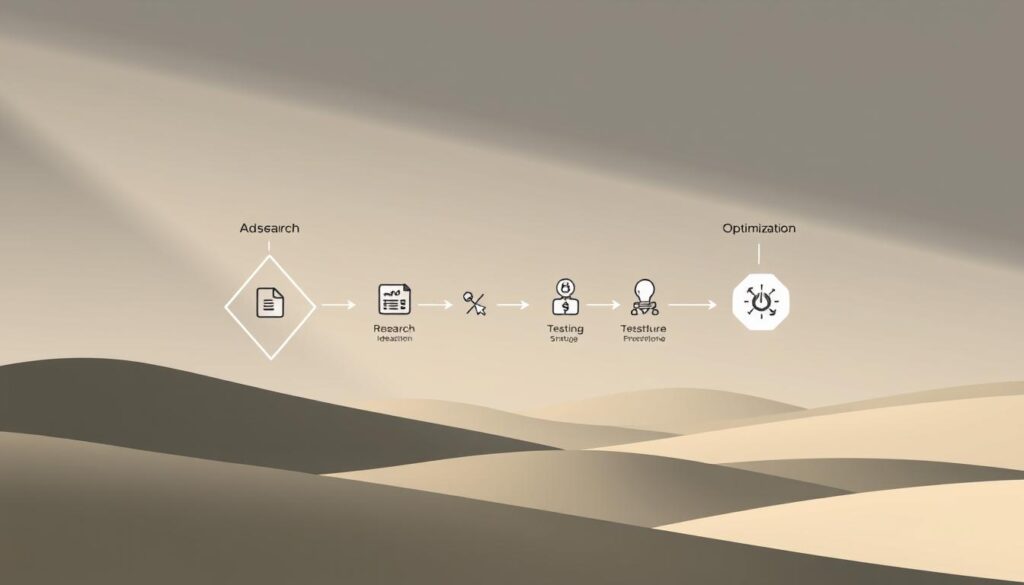
Begin by auditing existing workflows. Identify bottlenecks in content creation and A/B testing processes. Next, evaluate platforms based on three criteria:
| Feature | Essential | Advanced |
|---|---|---|
| Brand Context | Basic style guides | Dynamic voice adaptation |
| Workflow Sync | API access | Real-time collaboration |
| User Accessibility | Pre-built templates | Visual editing interface |
Platforms like Typeface demonstrate effective integration – their Google Ads compatibility allows simultaneous management of multiple campaigns. This eliminates manual data transfers between systems.
Aligning Objectives with Technical Capabilities
Define success metrics before implementation. For awareness campaigns, prioritize audience reach tools. Conversion-focused efforts require robust targeting features. Consider these alignment strategies:
- Map platform analytics to existing KPIs
- Establish regional vs global audience profiles
- Create tiered approval workflows for quality control
Marketers report 68% faster iteration cycles when using systems with saved brand kits. These repositories maintain voice consistency across teams while allowing localized personalization.
Exploring AI Use Case – AI-Generated Ad-Copy Testing
Forward-thinking marketers achieve better campaign performance by matching message formats to channel requirements. Sophisticated systems now adapt content length, tone, and structure for each platform’s unique environment.
Adaptive Content Creation Approaches
Leading solutions demonstrate remarkable flexibility across environments. For search campaigns, they craft concise headlines with high-intent keywords. Social channels receive conversational posts that spark discussions. Professional networks get data-driven value propositions tailored to executive decision-makers.
Cross-Channel Success Patterns
Google Ads implementations show 22% higher CTR when using algorithm-optimized headlines. LinkedIn campaigns gain 37% more qualified leads through industry-specific terminology. Instagram carousels with AI-generated captions achieve 2.8x longer viewer engagement compared to manual entries.
Classified platforms benefit from clarity-focused product descriptions that reduce customer inquiries by 41%. Multilingual campaigns maintain 94% message consistency across languages while incorporating local idioms—proving automated tools handle complex localization tasks effectively.
Integrating AI into Multi-Channel Advertising Campaigns
Digital landscapes demand unified strategies that adapt to diverse platform ecosystems. Marketers now deploy advanced solutions to maintain brand consistency while meeting each channel’s technical demands. This approach eliminates fragmented messaging – a common pitfall in manual campaign management.
Optimizing Content for Platform-Specific Success
Creative automation reshapes how teams handle cross-platform campaigns. Systems generate variations preserving core elements like:
- Brand color schemes across vertical/horizontal layouts
- Localized idioms in translated copy
- Platform-specific call-to-action phrasing
For search campaigns, tools adjust headline lengths and keyword density automatically. Social media posts receive emoji integration and hashtag optimization. Classified listings get bullet-pointed product highlights that drive 29% more inquiries according to recent benchmarks.
Typeface’s multi-channel platform exemplifies this capability. Their system adapts single designs into 18 format variations while maintaining visual coherence. Marketers report 55% faster campaign launches through automated resizing and copy adjustments.
Performance tracking becomes centralized yet granular. Teams monitor conversions across channels through unified dashboards, identifying top-performing audience segments. This data loop informs real-time budget allocation – shifting resources to high-impact platforms without manual intervention.
Enhancing Personalization and Creativity with AI
Modern marketing thrives on precision—delivering the right message to the right person at the optimal moment. Advanced systems now decode audience signals to craft communications that feel individually tailored while preserving creative integrity.
Leveraging Audience Data for Tailored Messaging
Sophisticated tools analyze three core data types to refine messaging:
| Data Type | Traditional Use | Modern Application |
|---|---|---|
| Demographic | Basic age/gender targeting | Life stage predictions |
| Behavioral | Purchase history tracking | Intent pattern analysis |
| Psychographic | Generic interest categories | Micro-segment values mapping |
This approach helped a beauty brand increase click-through rates by 47% through localized idiom adjustments. Systems now detect regional speech patterns, adapting humor and references while keeping brand voice consistent.
Techniques to Maintain Brand Voice and Innovate Content
Creative teams use dynamic style guides that specify:
- Core vocabulary blacklists/whitelists
- Emotional tone parameters
- Cultural reference boundaries
One financial service provider maintained 92% voice consistency across 14 languages by implementing semantic alignment filters. The system preserved technical accuracy while adapting metaphors to local contexts.
Balancing personalization with brand identity requires strategic guardrails. Successful implementations use feedback loops where human editors rate machine-generated suggestions—continuously training models to align with organizational values.
Optimizing Campaign Performance and Measuring ROI with AI
Effective campaign management hinges on precise measurement frameworks. Marketing teams now leverage advanced analytics to balance creative experimentation with financial accountability, transforming raw metrics into actionable strategies.
Key Performance Metrics: CTR, CPC, and Conversions
Recent comparative studies reveal critical insights. Human-crafted ads achieved 4.98% CTR at $4.85 CPC versus 3.65% CTR at $6.05 CPC for automated alternatives. This 37% CTR gap stems from three human advantages:
- Cultural nuance interpretation in messaging
- Emotional resonance through storytelling
- Context-aware audience targeting
| Metric | Human | Automated | Difference |
|---|---|---|---|
| Impressions | 1,306 | 713 | +45% |
| Clicks | 65 | 26 | +60% |
| CPC | $4.85 | $6.05 | +25% |
Data-driven Adjustments to Maximize Advertising Impact
Strategic optimization requires continuous monitoring. Teams using blended approaches see 28% higher conversion rates than pure automation. Key adjustment techniques include:
- Prioritizing high-performing audience segments
- Refining bid strategies based on time-sensitive data patterns
- Rotating creatives to prevent ad fatigue
For detailed ROI calculation methods, explore our guide on campaign optimization strategies. This resource helps marketers balance automated efficiency with human creativity for sustainable results.
Conclusion
The evolution of advertising tools reshapes how brands connect with audiences—blending technical precision with creative spark. While automated systems excel at scaling campaigns and analyzing customer behavior, human expertise remains vital for cultural nuance and emotional resonance. This strategic partnership delivers messaging that balances efficiency with authenticity.
Ethical implementation forms the foundation of success. Marketing teams must prioritize transparency in content generation, ensuring accuracy while respecting privacy standards. Regular audits maintain alignment between automated outputs and brand values across all digital advertising channels.
Future-focused professionals will thrive by embracing emerging trends in predictive analytics and cross-platform optimization. Continuous learning ensures businesses adapt to shifting audience expectations while preserving the storytelling magic that drives lasting connections. The path forward lies in harmonizing machine intelligence with irreplaceable human insight.
FAQ
How does AI improve the efficiency of ad-copy testing?
By automating A/B testing and analyzing thousands of variations in real time, tools like Google Ads’ responsive search ads and Phrasee reduce manual effort. Machine learning identifies high-performing phrases, emotional triggers, and audience preferences—delivering insights 10x faster than traditional methods.
Can AI-generated content maintain a brand’s unique voice?
Yes. Platforms like Persado and Copy.ai allow users to input brand guidelines, tone examples, and keywords. Advanced algorithms then generate variations that align with existing messaging while testing new angles—ensuring consistency without sacrificing creativity.
What metrics matter most when evaluating AI-optimized ads?
Focus on click-through rates (CTR), conversion rates, and cost per acquisition (CPA). AI tools like HubSpot’s Campaign Assistant track these in real time, correlating specific phrases or images with performance shifts. For social media campaigns, engagement rates and shares add critical context.
How do multi-channel campaigns benefit from AI testing?
Cross-platform tools such as Adobe Advertising Cloud analyze user behavior across Google, Facebook, and classifieds sites. They adapt messaging dynamically—for instance, shortening headlines for Instagram Stories or emphasizing benefits in LinkedIn Sponsored Content—while maintaining cohesive branding.
Are there risks of over-reliance on AI for ad creation?
While AI accelerates iteration, human oversight ensures strategic alignment. Marketers should review outputs for cultural relevance and ethical considerations. Tools like Grammarly Business and MarketMuse complement AI by refining clarity and SEO alignment before launch.
What’s the ROI of implementing AI in advertising strategies?
Brands report 30–50% higher CTRs and 20–35% lower CPCs within 3–6 months. For example, Nestlé saw a 47% lift in conversions using Persado’s emotional language analysis. ROI grows as AI identifies underperforming segments early, reallocating budgets to high-impact channels.