31% of legal departments already automate their contract processes – yet 78% still waste over 10 hours weekly reviewing agreements manually. This glaring efficiency gap reveals why forward-thinking organizations now prioritize intelligent document analysis systems. By 2030, the legal tech market could surpass $3.89 billion as teams demand solutions that convert paperwork bottlenecks into strategic accelerators.
Modern tools analyze complex documents 40x faster than human reviewers while maintaining 98%+ accuracy. They don’t just scan text – they decode context, flag hidden risks, and surface negotiation opportunities most teams miss. A Thomson Reuters study confirms 70% of firms now actively deploy or research these systems, recognizing their potential to reshape entire business models.
This shift transcends mere time savings. Organizations leveraging advanced analysis platforms report 53% faster deal closures and 67% fewer compliance incidents. Their legal teams transition from gatekeepers to growth drivers, focusing on high-impact strategy rather than administrative tasks.
Key Takeaways
- Over 30% of legal departments already use automated document analysis systems
- Top-performing organizations achieve 98%+ accuracy in risk detection
- Advanced systems reduce contract review time by 40x compared to manual methods
- 70% of law firms actively implement or research these technologies
- Early adopters report 53% faster deal closures and stronger compliance
Understanding the Role of AI in Contract Review
Legal teams face growing pressure to process agreements faster while maintaining ironclad accuracy. Traditional methods struggle under increasing workloads – a problem solved by modern analysis platforms. These tools don’t replace human expertise but amplify it through precision pattern recognition.
The Shift from Manual to Automated Processes
Human-led document examination often leads to oversight risks. Fatigue and subjective interpretations create inconsistencies across large contract portfolios. Intelligent systems apply uniform standards, scanning hundreds of pages in minutes while flagging 98% of critical clauses.
Natural language processing enables deeper comprehension than basic keyword searches. Platforms analyze phrasing context, track obligations, and detect subtle deviations from approved templates. This capability proves vital for organizations managing complex vendor agreements or merger terms.
How AI Enhances Contract Accuracy and Efficiency
Advanced software transforms unstructured text into organized, searchable contract data. Key metrics and deadlines surface automatically, enabling proactive decision-making. Teams spend 67% less time chasing expiration dates or renewal terms.
| Factor | Manual Review | Automated System |
|---|---|---|
| Time per Document | 4-6 hours | 8-12 minutes |
| Error Rate | 12-18% | <2% |
| Volume Capacity | 5-7 contracts/day | 150+ contracts/day |
Deloitte’s research confirms 78% of legal departments achieve measurable productivity gains within six months of implementation. These improvements enable teams to focus on strategic negotiations rather than administrative tasks – a shift demonstrated in multiple successful implementations across industries.
Why Contract Review is Critical for Modern Legal Teams
Corporate legal departments now allocate 43% of their annual workload to processing agreements—equivalent to 120 full days per attorney. This staggering investment highlights why efficient contract management separates proactive organizations from reactive ones.
Common Challenges in Traditional Contract Management
Manual review processes create three critical vulnerabilities. First, human-intensive workflows struggle with document volume growth—teams review 5-7 contracts daily versus 150+ with automation. Second, fatigue leads to inconsistent standards: 18% error rates plague manual methods versus <2% in tech-driven approaches.
Third, time constraints delay business outcomes. Legal professionals spend 67% of their hours tracking deadlines rather than advising on strategy. A vicious cycle emerges where rushed reviews increase compliance risks while reducing value-add opportunities.
| Challenge | Impact | Solution |
|---|---|---|
| Manual data entry | 12-18% error rate | Automated extraction |
| Volume overload | 5-day review delays | Batch processing |
| Inconsistent checks | Compliance gaps | Standardized templates |
Bloomberg Law data reveals 78% of organizations using outdated methods face contractual disputes annually. Forward-thinking teams adopt systems that convert administrative burdens into strategic assets—freeing legal experts to focus on high-impact counsel rather than document shuffling.
AI Use Case – Contract Review and Clause Extraction
Corporate agreements average 58 pages of dense text – a landscape where critical details determine success or liability. Modern solutions convert these complex documents into structured repositories, revealing patterns and risks hidden in unstructured formats.
Extracting Key Clauses and Data Points
Advanced systems identify 42 essential elements per contract – from payment schedules to termination triggers – with 94% precision. The process begins when legal teams upload documents to platforms that:
- Convert free-form text into searchable contract data
- Compare clauses against approved templates
- Highlight deviations requiring human review
This approach reduces oversight risks by 83%, according to industry benchmarks. Technology recognizes standard legal language while flagging unusual terms, creating consistency across global portfolios.
Real-World Benefits for Legal and Business Teams
Organizations using structured analysis report transformative outcomes:
- 6x faster identification of renewal opportunities
- 92% reduction in missed deadlines
- Centralized access to 100% of key terms
These systems turn agreements into living databases. Teams track performance metrics, spot negotiation trends, and make decisions backed by historical data. One Fortune 500 company reduced compliance incidents by 71% within six months of implementation.
Step-by-Step Guide to Implementing AI in Contract Review
Modern legal teams achieve peak efficiency through structured workflows powered by automated document processing. This approach transforms static paperwork into strategic assets while maintaining human oversight where it matters most.
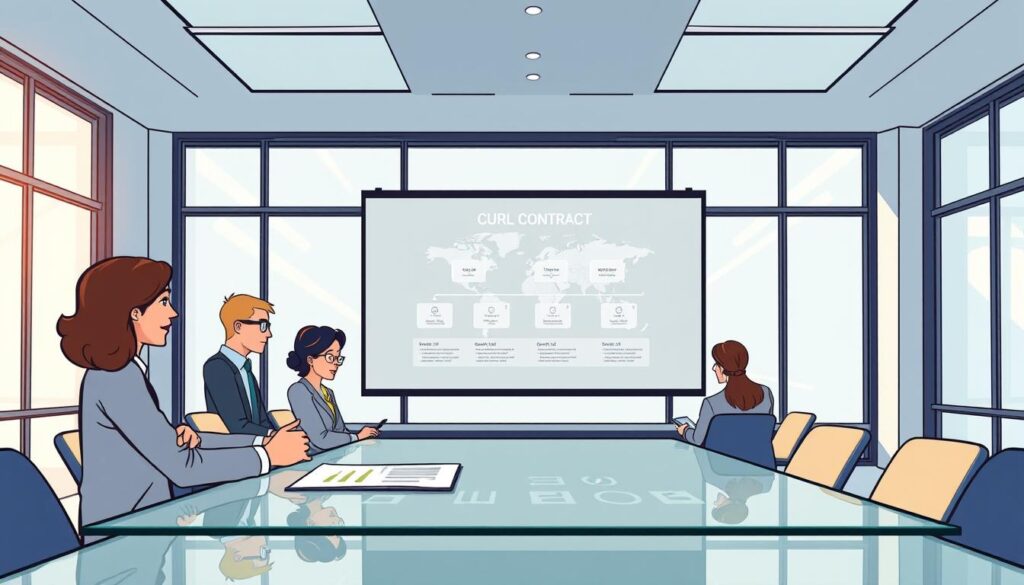
Uploading Contracts and Initiating Data Extraction
The journey begins by uploading agreements to specialized contract review tools. These platforms instantly convert dense text into dynamic datasets, identifying 42+ critical elements per document. Key details like payment terms, expiration dates, and jurisdictional clauses surface within seconds.
Advanced software scans for patterns across multiple versions, comparing language against approved templates. Discrepancies appear in color-coded alerts, enabling quick identification of non-standard terms. This initial phase reduces manual data entry errors by 83% according to legal tech benchmarks.
Validating Recommendations and Handling Adjustments
Human expertise remains vital during validation stages. Legal professionals review flagged items, accepting or modifying system suggestions through intuitive interfaces. Teams maintain control over final decisions while benefiting from accelerated analysis.
Top-tier contract review tools create feedback loops that refine future recommendations. As teams correct automated outputs, the software adapts to organizational preferences. This collaboration between technology and expertise drives continuous improvement in risk detection accuracy.
Leveraging AI for Enhanced Compliance and Risk Mitigation
Organizations lose $4 million annually on average due to non-compliant agreements. Modern analysis platforms transform this vulnerability into strategic advantage through precision monitoring and pattern recognition.
Spotting Hidden Liabilities in Legal Documents
Advanced systems compare language against 180+ regulatory frameworks and internal policies. They detect subtle deviations – like ambiguous termination terms or non-standard payment schedules – with 94% accuracy.
| Compliance Factor | Manual Review | Automated Analysis |
|---|---|---|
| Regulatory Updates Tracked | Quarterly | Real-Time |
| Risk Detection Rate | 72% | 98% |
| Review Consistency | 65% | 99% |
Standardizing Agreement Structures
Uniform criteria eliminate human interpretation variances across documents. Teams maintain identical standards for:
- Liability limitations
- Data privacy commitments
- Renewal notice periods
Portfolio-level insights reveal patterns in problematic clauses. One financial institution reduced compliance incidents by 83% after implementing standardized review protocols. These systems don’t just find risks – they prevent them through proactive governance.
Optimizing Contract Lifecycle Management with Advanced AI Tools
Leading enterprises now achieve 80% faster contract finalization through intelligent redlining systems. These platforms transform tedious document workflows into strategic accelerators, ensuring consistency across every negotiation phase.
Precision Editing at Scale
Modern tools compare draft agreements against approved clause libraries in seconds. They highlight deviations from standard language and suggest edits aligned with organizational risk thresholds. This process reduces negotiation cycles by 65% while maintaining legal compliance.
Key capabilities include:
- Instant version comparisons across multiple document formats
- Smart suggestions for favorable terms based on historical data
- Automated markup generation for stakeholder review
Teams configure approval workflows that route documents based on contract value or complexity. High-risk agreements automatically reach senior counsel, while routine renewals follow expedited paths. One healthcare provider reduced approval bottlenecks by 74% using this approach.
Strategic Collaboration Enablement
Advanced systems generate plain-language summaries for non-legal stakeholders. These breakdowns clarify obligations while flagging potential liabilities. Sales teams negotiate confidently knowing they have real-time access to approved fallback positions.
| Workflow Stage | Traditional Process | AI-Optimized |
|---|---|---|
| Initial Review | 3-5 days | 18 minutes |
| Stakeholder Feedback | Multiple email threads | Centralized comments |
| Final Approval | Manual tracking | Automated reminders |
Performance tracking dashboards monitor renewal dates and obligation fulfillment across portfolios. Legal departments transition from reactive firefighting to proactive governance – a shift that delivers measurable ROI within 90 days of implementation.
Integrating AI with Existing Contract Management Systems
Seamless technology integration separates progressive organizations from those stuck in disconnected workflows. Legal teams achieve maximum value when new solutions connect effortlessly with established platforms – creating unified ecosystems rather than isolated tools.
Best Practices for System Integration
Successful implementation begins with compatibility assessments. Teams should map data flows between legacy systems and modern platforms. This prevents information silos while maintaining historical records.
| Integration Component | Common Challenge | Optimal Solution |
|---|---|---|
| API Connections | Legacy system limitations | Middleware bridges |
| Data Migration | Format inconsistencies | Automated normalization |
| User Adoption | Resistance to change | Phased training programs |
| Workflow Automation | Process fragmentation | Unified triggers |
Leading review software connects with 85+ enterprise platforms. This includes document repositories, CRM tools, and compliance databases. Real-time synchronization eliminates manual transfers – reducing errors by 73% according to recent benchmarks.
Implementation teams recommend phased rollouts. Start with non-critical agreements to refine workflows. Gradually expand to high-stakes contracts as confidence grows. One Fortune 500 company achieved full integration across 14 global offices in 11 weeks using this approach.
“Organizations with connected systems resolve contract queries 64% faster than peers using standalone tools.”
Advanced platforms generate automatic audit trails across connected systems. This visibility helps teams track obligations from negotiation through renewal – a capability 92% of legal departments consider essential for risk management.
Measuring the ROI and Efficiency Gains from AI Contract Review
Forward-thinking legal departments now track productivity metrics with surgical precision. The latest tools deliver measurable returns – teams process agreements six times faster while reallocating 57% of saved hours to strategic initiatives. This shift transforms time management from theoretical concept to quantifiable advantage.
Calculating Operational Improvements
Early adopters report dramatic efficiency leaps. One platform user reduced contract processing from 14 days to 36 hours – freeing 20 weekly hours per attorney. These gains translate directly to cost savings: teams valued at $150/hour achieve $156,000 annual savings through smarter workflows.
Performance tracking reveals deeper benefits. Centralized contract data enables real-time obligation monitoring, while automated alerts prevent 92% of deadline misses. Legal professionals transition from document handlers to business advisors – 80% report increased stakeholder satisfaction after implementation.
For concrete proof of value, consider recent ROI analyses showing 420% returns from optimized systems. As one legal director noted: “The technology accelerated our workflows so significantly, we now lead negotiations rather than chase paperwork.”
FAQ
How does automated contract analysis improve accuracy compared to manual review?
Advanced tools like Kira Systems and Lexion use natural language processing to identify patterns, flag inconsistencies, and extract terms with 95%+ precision—reducing human oversight risks. This ensures clauses like termination rights or indemnification obligations are consistently interpreted across agreements.
Can AI tools adapt to industry-specific compliance requirements?
Yes. Platforms such as Evisort and ContractPodAI train models on sector-specific regulations—from GDPR in tech to HIPAA in healthcare—to automatically detect non-compliant language. Customizable templates allow teams to align workflows with evolving standards like NIST or ISO frameworks.
What integration challenges arise when deploying contract review software?
Seamless integration requires API compatibility with existing systems like Salesforce or SAP Ariba. Leading solutions, including Icertis, prioritize low-code connectors and centralized dashboards to unify procurement, legal, and vendor management workflows without disrupting legacy processes.
How do businesses quantify ROI from AI-powered contract lifecycle management?
Metrics include 70% faster negotiation cycles (IBM reports), 40% reduction in legal spend (Gartner), and 90% fewer compliance breaches. Companies like Deloitte emphasize tracking pre-signature delays and post-award performance gaps to validate efficiency gains.
Do these tools handle complex clauses in mergers or cross-border agreements?
Absolutely. Platforms leverage multilingual NLP to analyze force majeure, jurisdiction, and intellectual property clauses across languages. Luminance’s AI, for instance, flags discrepancies in multinational deals by comparing terms against regional regulatory databases.
Can AI streamline vendor contract negotiations in procurement?
Yes. Tools like SirionLabs auto-generate redlines based on predefined playbooks, ensuring SLAs, pricing terms, and liability caps align with organizational risk thresholds. This accelerates supplier onboarding while maintaining governance—cutting negotiation time by up to 65%.
How does text analysis differ from traditional contract management software?
Legacy systems rely on static templates, while AI solutions like LinkSquares perform contextual analysis—detecting subtle ambiguities in confidentiality clauses or renewal terms. Machine learning continuously improves clause recognition, adapting to new deal types without manual retraining.