A recent industry study revealed that synthetic media tools now reduce editing timelines by up to 83% compared to traditional methods. This seismic shift stems from advancements in realistic facial mapping and voice replication – core components of modern visual storytelling techniques.
Pioneering studios have adopted these tools to solve previously insurmountable challenges. When Martin Scorsese needed to de-age Robert De Niro in The Irishman, his team used a cost-effective alternative to traditional CGI that preserved the actor’s nuanced performance. Similar breakthroughs now enable directors to modify performances during editing while maintaining emotional authenticity.
The economic implications extend far beyond efficiency gains. Licensing digital likenesses has created new revenue streams for actors, with some A-list stars earning residual income from projects they never physically attended. Meanwhile, indie filmmakers access Hollywood-grade effects through subscription-based platforms.
Key Takeaways
- Advanced media synthesis reduces post-production timelines by over 80%
- Digital de-aging techniques preserve acting nuances better than traditional methods
- Licensing agreements create ongoing revenue from digital likenesses
- Democratized tools enable small studios to compete visually with majors
- Ethical frameworks lag behind technical capabilities in critical areas
Understanding Deepfake Technology in the Film Industry
Hollywood’s visual effects revolution began when a CGI team transformed Dwayne Johnson’s face onto another actor’s body for Central Intelligence – a process that took months. Today, that same feat requires days, thanks to neural networks that generate realistic facial mappings through machine learning.
Definition and Core Components
At its core, this technology uses generative adversarial networks (GANs) – twin neural networks that compete to refine outputs. One network creates synthetic faces while the other detects flaws, iterating until the result mirrors human features. Key elements include:
- 3D facial landmark tracking for precise muscle movement replication
- Voice cloning algorithms that analyze speech patterns
- Texture synthesis engines that simulate skin pores and lighting effects
Transition from Traditional CGI to AI-Driven Visual Effects
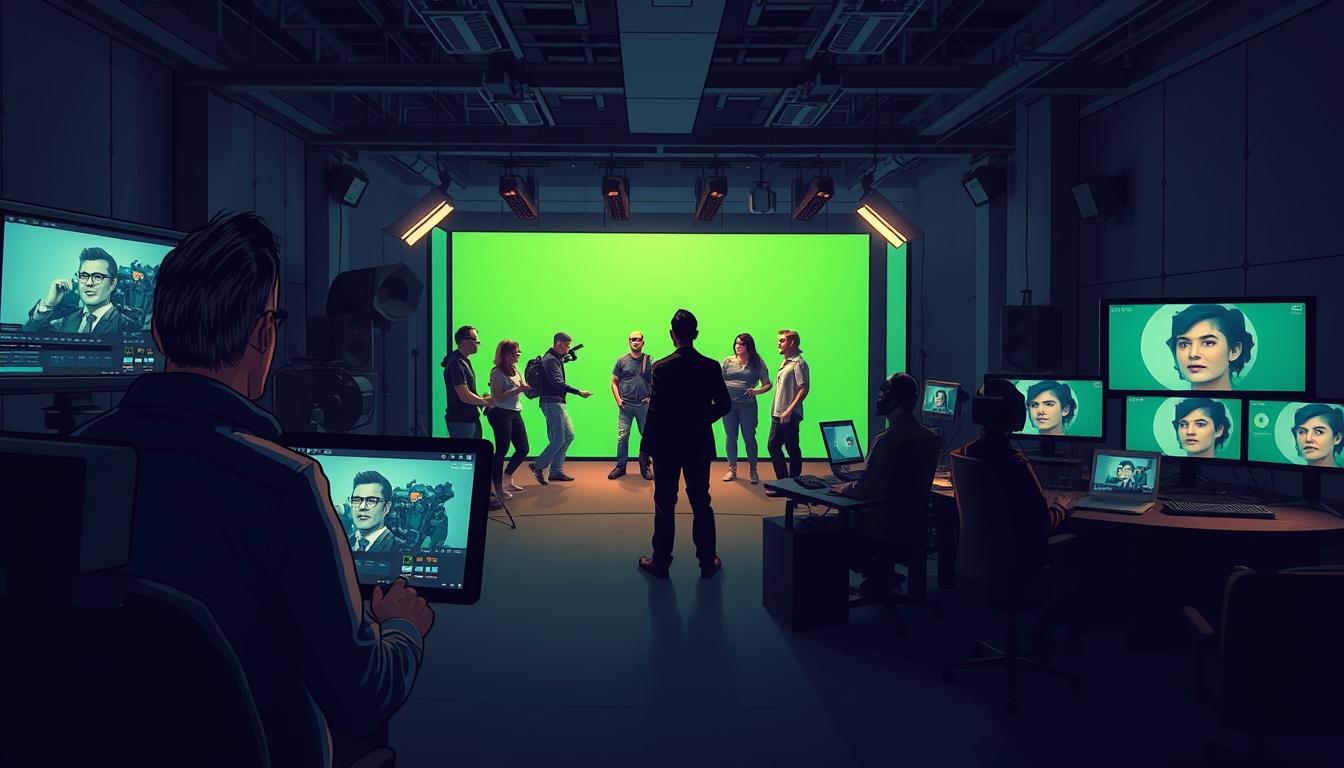
Where manual animators once sculpted digital faces polygon by polygon, modern systems used create photorealistic results through automated pattern recognition. The shift became evident when Martin Scorsese’s team employed infrared camera arrays on The Irishman set, capturing micro-expressions for later age manipulation.
This evolution enables directors to adjust performances during editing – altering a smirk’s timing or widening eyes for dramatic effect. As explored in recent analyses, such capabilities are redefining creative workflows while sparking debates about digital authenticity.
Historical Perspectives and Milestones in Deepfake Filmmaking
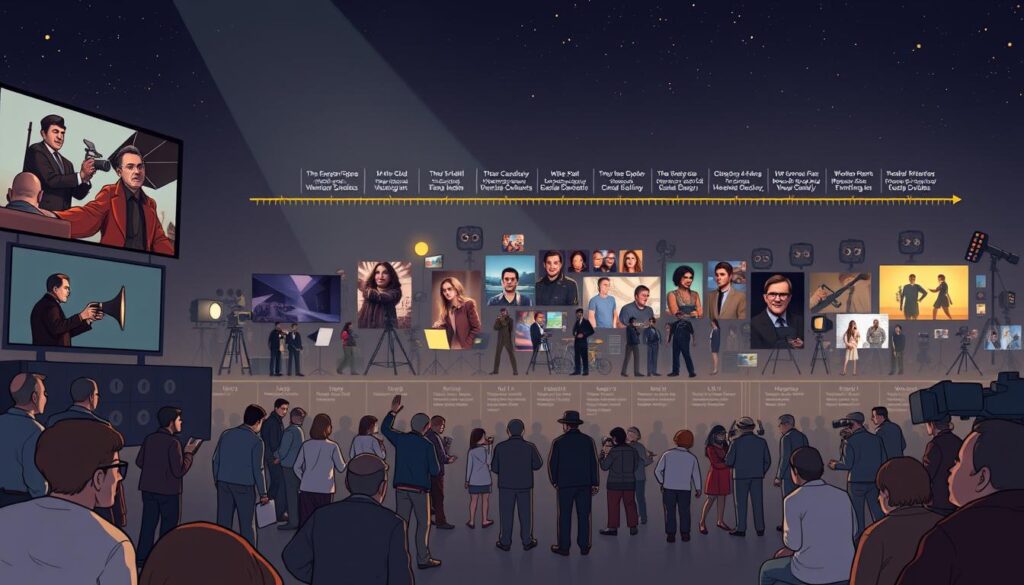
From face-swapping experiments to digital resurrections, cinematic storytelling has undergone a silent revolution. Early adopters faced skepticism but proved synthetic media’s value through groundbreaking applications that solved real production challenges.
Pioneering Films and Breakthrough Moments
The 2016 comedy Central Intelligence marked a turning point. Directors used CGI to create a younger version of Dwayne Johnson by overlaying his face on another actor’s body – a process requiring three months of manual work. This technique evolved dramatically when Paul Walker’s untimely death during Fast and Furious 7 filming forced creators to blend his brothers’ facial features with archival footage.
Martin Scorsese’s The Irishman (2019) raised the bar. Infrared cameras captured Robert De Niro’s expressions from multiple angles, enabling seamless age manipulation across decades. “We weren’t just de-aging faces,” noted VFX supervisor Pablo Helman. “We preserved the soul behind the wrinkles.”
Evolution of Deep Learning and Machine Learning in Media
Recent advancements demonstrate machine learning’s growing sophistication. The latest Indiana Jones installment analyzed 40 years of Harrison Ford’s performances to generate a convincing young version. Key developments include:
- Neural networks that map facial movements across different lighting conditions
- Voice synthesis algorithms trained on historical recordings
- Texture generators that replicate aging skin with microscopic accuracy
These tools now enable directors to reshape performances during editing while maintaining emotional truth – a capability that’s transforming entertainment from nostalgic revivals to original narratives.
AI Use Case – Deepfake-Enhanced Film Production Strategies and Trends
Modern filmmakers are rewriting visual effects playbooks through adaptive synthetic media systems. The emergence of tools like FSGAN (Face Swapping GAN) now resolves occlusion challenges – when actors’ faces get partially hidden by props or lighting – with pixel-perfect accuracy. This advancement eliminates weeks of manual frame-by-frame corrections.
Revolutionizing Creative Workflows
Production teams achieve unprecedented flexibility through three key innovations:
- Real-time effect previews during filming sessions
- Automated facial mapping across diverse lighting setups
- Voice modulation synchronized with facial movements
A recent Marvel Studios project demonstrated this shift. Directors adjusted a lead actor’s performance across 14 scenes post-filming while preserving emotional authenticity – a task requiring just 48 hours instead of six weeks.
| Aspect | Traditional VFX | Deepfake Approach | Time Saved |
|---|---|---|---|
| Occlusion Handling | Manual frame editing | AI-driven texture synthesis | 92% |
| Training Time | 300+ hours | Pre-trained models | 98% |
| Multi-Actor Scenes | Individual tracking | Batch processing | 85% |
| Localization | Reshoots | Digital likeness swaps | 100% |
These advancements empower smaller studios. A Texas-based team recently created crowd scenes using deepfake actors that mirrored lead performers’ mannerisms – slashing casting costs by 60%. The technology’s scalability extends to marketing, where personalized trailers generate 34% higher engagement according to Warner Bros. analytics.
As synthetic media matures, ethical frameworks must evolve alongside technical capabilities. The industry now faces crucial questions about digital consent while celebrating liberated creative potential.
Practical Applications and Impact on Talent in Entertainment
When Val Kilmer’s son heard his father’s recreated voice through synthetic technology, it revealed synthetic media’s emotional power. This innovation now reshapes how performers engage with audiences – and their own limitations.
Case Studies: From Celebrity Resurrections to Actor Substitutions
Three landmark examples demonstrate synthetic media’s range:
- Sonantic restored Val Kilmer’s voice using archival recordings after throat cancer – preserving his artistic identity
- David Beckham delivered malaria prevention messages in nine languages through real-time facial animation
- Snoop Dogg’s commercial required zero reshoots when deepfakes altered his mouth movements for brand updates
Influence on Talent Rights, Likeness, and Performance Capabilities
The technology creates paradoxical opportunities. Established celebrities gain global reach through multilingual content, while unknown performers face new competition from digital counterparts. Key considerations include:
“My father’s voice hadn’t sounded like that in years. It was like getting part of him back.”
Rights management grows complex when individuals can appear in projects without physical participation. Emerging solutions include:
- Blockchain-based likeness tracking systems
- Residual payment models for digital appearances
- Multi-language performance clauses in contracts
As synthetic performers gain sophistication, the industry must balance creative potential with protections for human artists. The next frontier lies in legal frameworks that address these dual realities.
Navigating Legal, Ethical, and Security Considerations
The rapid adoption of synthetic tools has outpaced regulatory frameworks, creating a legal labyrinth for creators. States like New York now protect deceased performers’ digital likenesses for 40 years, while Texas and California restrict political deepfake videos near elections. These laws highlight growing concerns about authenticity in digital media.
Legal Frameworks in Flux
New York’s 2020 law sets strict limits on posthumous character revivals, forcing studios to rethink legacy projects. As explored in recent analyses, such regulations could lead to creative constraints but protect public trust. Texas and California’s election rules reveal how political risks shape entertainment policies.
Consent in the Age of Replication
The Anthony Bourdain documentary controversy exposed gaps in permission protocols. When creators generated lines without his widow’s consent, it underscored the need for clear contractual terms. Current solutions include blockchain-based ownership tracking and residual payment models for digital replicas.
Balancing innovation with ethics remains critical. As detection tools improve, users gain protection – but the way forward requires collaboration between lawmakers and creators. The industry must address these challenges to harness synthetic media’s full potential responsibly.
FAQ
How does deepfake technology differ from traditional CGI in film production?
Unlike traditional CGI, which relies on manual animation and 3D modeling, deepfake technology uses machine learning algorithms to analyze and replicate facial movements, expressions, and voices. This AI-driven approach automates the process—generating realistic results faster while requiring less human intervention. For example, Disney leveraged similar techniques in The Mandalorian to de-age actors seamlessly.
What were some early films that pioneered deepfake techniques?
Films like Rogue One: A Star Wars Story (2016) used digital resurrection to recreate actor Peter Cushing’s likeness, while The Irishman (2019) employed AI-driven de-aging. These projects marked milestones in integrating machine learning with visual effects, demonstrating how generative adversarial networks (GANs) could redefine character portrayal.
How do filmmakers ensure ethical use of deepfakes for actor substitutions?
Studios increasingly adopt strict consent agreements and likeness rights clauses. For instance, James Dean’s estate licensed his image for an upcoming AI-generated role in Back to Eden, highlighting the need for legal frameworks. Transparency with audiences and collaboration with talent unions also help mitigate ethical risks.
What legal challenges arise from using deepfakes in movies?
U.S. laws, such as California’s AB-602 and New York’s anti-deepfake legislation, require explicit consent for digital replicas. However, gaps remain—particularly for deceased actors. The SAG-AFTRA union has negotiated terms to protect performers’ digital rights, emphasizing the urgency for federal regulations as technology evolves.
Can deepfake technology replicate voices as effectively as faces?
Yes. Tools like Respeecher and Voicemod use AI to clone vocal patterns, enabling actors to “speak” in different languages or replicate iconic voices. For example, documentary filmmakers recreated Anthony Bourdain’s voice in Roadrunner using archived recordings, sparking debates about posthumous consent.
What security risks do deepfakes pose to the entertainment industry?
Unauthorized deepfakes could enable piracy, fraudulent content, or reputational harm. Studios combat this with blockchain-based watermarking and detection tools like Truepic. Training crews to identify manipulated media and partnering with cybersecurity firms further strengthens defenses against malicious use.
How might deepfake-enhanced production reshape storytelling?
By enabling hyper-realistic historical recreations, multilingual dubbing, or collaborative cross-border projects, deepfakes expand creative possibilities. However, overreliance on AI may homogenize performances. Balancing innovation with artistic integrity remains critical—a lesson learned from Marvel’s mixed reception of fully digital characters.