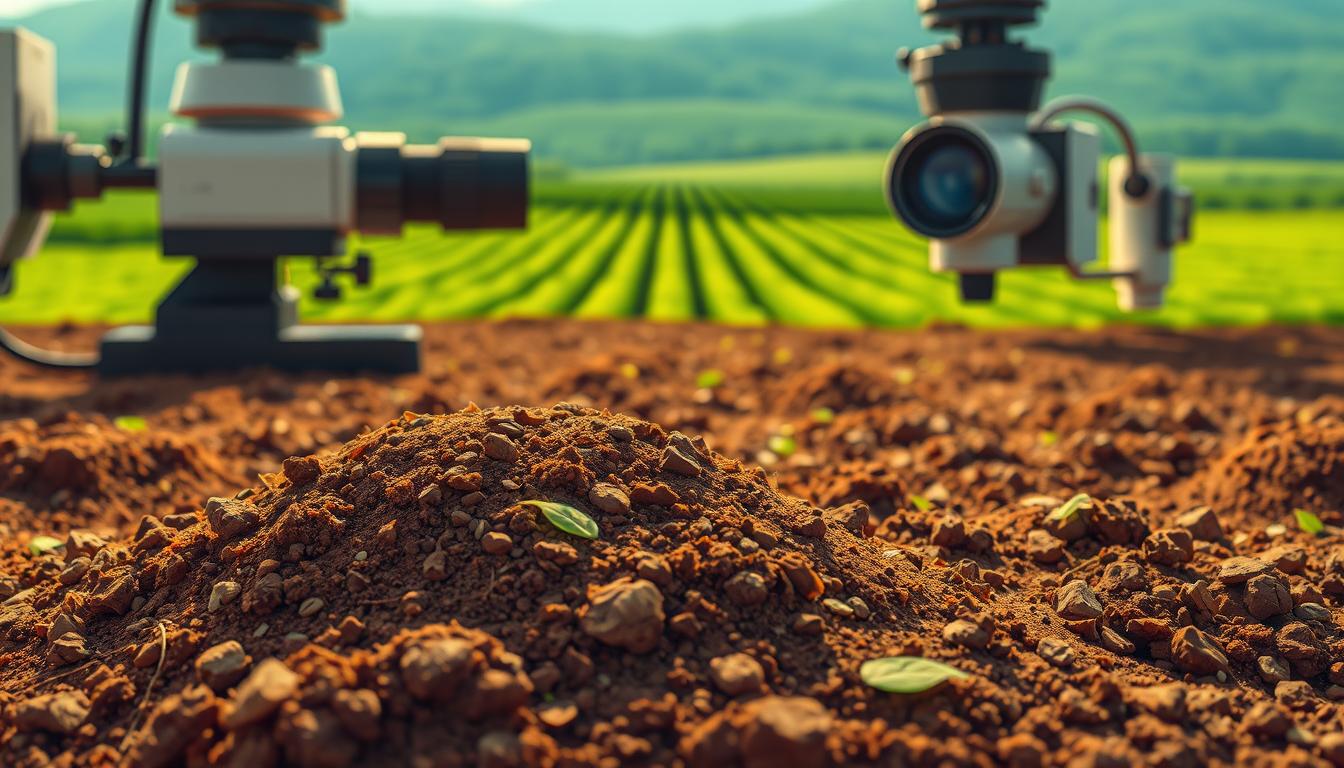
Farmers today face a silent crisis: nearly one-third of the world’s fertile land can no longer support healthy crops. Traditional testing methods, which often take weeks to deliver results, leave growers guessing about soil-water content and nutrient levels. But new tools are turning this challenge into an opportunity for innovation.
Advanced algorithms now process complex environmental data in minutes, uncovering patterns invisible to conventional approaches. These systems combine spectral imaging with machine learning techniques like neural networks, creating predictive models that adapt to regional climate conditions and crop types. The result? Farmers gain precise recommendations for fertilizer use, irrigation, and crop rotation – all while reducing waste.
This shift matters beyond individual fields. When agricultural professionals implement these data-driven strategies, they contribute to larger sustainability goals. Efficient resource management preserves ecosystems while maintaining food production for growing populations. The technology’s ability to provide real-time insights helps prevent over-tilling and chemical runoff, protecting soil health for future harvests.
Key Takeaways
- Advanced spectral technology detects soil nutrients faster than traditional lab tests
- Machine learning models analyze multiple environmental factors simultaneously
- Real-time data helps farmers make immediate adjustments to crop management
- Precision agriculture techniques reduce fertilizer waste by up to 40%
- Sustainable soil practices support global food security initiatives
Overview of Precision Agriculture and Advances in AI
Soil complexity demands smarter solutions. Traditional farming struggles with unpredictable variations in texture, moisture, and nutrient distribution. Modern agricultural management systems now combine ground sensors, satellite feeds, and weather trackers into unified platforms. This integration allows instant responses to shifting field conditions.
Advanced algorithms process multiple variables simultaneously – from soil-water content patterns to microclimate fluctuations. A recent agricultural study highlights how these systems reduce analysis time from weeks to hours. Farmers gain actionable insights about fertilizer ratios and irrigation schedules during critical growth phases.
| Factor | Traditional Methods | Modern Techniques |
|---|---|---|
| Data Sources | Manual sampling | Multi-sensor networks |
| Decision Speed | 2-4 weeks | Real-time |
| Environmental Impact | Higher runoff risk | Targeted resource use |
These innovations address two pressing challenges: feeding 10 billion people by 2050 and reversing soil degradation. By analyzing historical trends and current conditions, predictive models suggest optimal crop rotations. This prevents nutrient depletion while maintaining yields.
The shift toward data-driven agriculture creates resilient farming ecosystems. It transforms raw numbers into preservation strategies – protecting topsoil integrity while maximizing harvest potential. As technology evolves, so does our capacity to nurture both crops and landscapes.
Role of Spectral AI in Soil-Nutrient Analysis
Modern agriculture requires tools that match the complexity of Earth’s ecosystems. Emerging solutions harness light wavelengths to decode hidden patterns in soil composition, offering insights that lab tests can’t replicate. This approach transforms raw environmental data into actionable strategies for sustainable farming.
Spectral Imaging Techniques
Hyperspectral sensors capture hundreds of light bands across electromagnetic spectra. These devices identify unique signatures for nitrogen, phosphorus, and organic matter. Combined with geostatistical techniques like kriging, they map nutrient distribution at unprecedented resolutions.
Farmers no longer rely on random sampling. Instead, multispectral drones scan entire fields, detecting subtle variations in soil-water content and mineral levels. Machine learning models process this information, predicting fertilizer needs based on crop type and growth stage.
Advantages in Nutrient Detection
Traditional methods struggle with time delays and incomplete data. Light-based systems deliver results within hours – not weeks. This speed enables immediate adjustments to irrigation schedules or micronutrient applications.
Key benefits include:
- Identification of potassium deficiencies before visible symptoms appear
- Real-time tracking of pH balance changes across different soil layers
- Reduced chemical runoff through precise fertilizer targeting
These innovations support decision-making that balances productivity with ecological preservation. As detection capabilities improve, so does our ability to nurture both crops and the land they grow in.
Exploring Soil Organic Carbon and Organic Matter Dynamics
Healthy soil thrives on invisible partnerships. Beneath every thriving crop lies a delicate balance of organic matter and minerals working in harmony. Rainfall patterns and landscape contours shape how carbon accumulates, with valley soils often storing three times more organic carbon than sloping terrain.
Advanced sensing tools now map these variations down to square-meter precision. They reveal how tillage practices alter bulk density – compacted earth holds 15% less water and nutrients. Strategic crop rotations prove vital, with legume cover crops boosting nitrogen levels while stabilizing soil organic carbon.
Farmers using these insights adjust practices in real time. Reducing plowing frequency preserves carbon-rich layers near the surface. Introducing diverse root systems enhances microbial activity, creating natural pathways for nutrient cycling. These changes improve C/N ratios – a critical measure of decomposition rates and fertility.
The implications stretch beyond individual fields. Detailed carbon mapping supports verification programs for environmental credits, rewarding sustainable land management. By understanding organic matter dynamics, agricultural professionals balance immediate yields with long-term soil vitality – ensuring productive harvests while safeguarding Earth’s living skin.
Machine Learning and Deep Learning Innovations in Soil Analysis
Agricultural decision-making enters a new era through computational power. Modern soil assessment now leverages machine learning architectures that detect nutrient patterns faster than traditional methods. These systems process spectral data through layered neural networks, revealing hidden relationships between soil properties and crop performance.
Algorithm Insights
Different computational approaches excel in specific scenarios. Random forests handle complex variable interactions, while support vector machines excel with limited training data. Deep learning models – particularly trilayered neural networks – achieve 99.2% accuracy in classification tasks by analyzing thousands of spectral bands simultaneously.
Recent breakthroughs show Bayesian networks reaching 99.83% precision in nutrient prediction. Subspace discriminant methods follow closely at 99.8%, outperforming conventional statistical models. These techniques adapt to regional soil variations, learning from each new dataset to refine their predictions.
Performance Metrics
Comparative studies demonstrate transformative results. Neural networks reduce error rates by 62% compared to manual analysis, while processing speeds enable real-time field adjustments. The table below highlights key performance differences:
| Method | Accuracy | Processing Speed |
|---|---|---|
| Bayesian Network | 99.83% | 18 sec/acre |
| Subspace Discriminant | 99.80% | 22 sec/acre |
| Trilayered Neural Net | 99.20% | 9 sec/acre |
Continuous learning mechanisms allow models to improve with each growing season. Farmers receive dynamic recommendations for fertilizer application and irrigation – adjustments that previously required weeks of lab analysis. This evolution in soil analysis empowers growers to address deficiencies before crops show visible stress.
Remote Sensing Applications for Soil Quality Assessment
Soil assessment enters a new dimension through eyes in the sky. Modern remote sensing tools map nutrient distribution across thousands of acres with pixel-level precision. Satellite constellations and drone fleets capture data from multiple spectra, revealing hidden patterns in soil composition.
These systems outperform traditional sampling methods. Where manual collection might miss critical variations, multispectral imaging detects pH imbalances and organic matter concentrations. A recent agricultural survey found fields using sensing technologies reduced fertilizer costs by 28% while maintaining yields.
“Geostatistical methods like kriging transform sparse data points into actionable field maps – a game-changer for precision agriculture.”
| Approach | Coverage Area | Resolution | Update Frequency |
|---|---|---|---|
| Satellite Imaging | Continental | 10-30 meters | Weekly |
| Drone Sensors | 500-1000 acres | 2-5 cm | Daily |
| Ground Sampling | 1 acre | Point data | Seasonal |
Three innovations drive this revolution:
- Hyperspectral cameras identifying 16+ nutrient types simultaneously
- Cloud platforms merging weather data with soil moisture readings
- Automated alerts for compaction risks or salinity spikes
Farmers now access layered maps showing soil quality gradients across topography. These visuals guide variable-rate applications – delivering 40% more precision in lime spreading than blanket treatments. As sensing networks expand, they create living databases that track seasonal changes and long-term trends.
The fusion of aerial data with ground truth measurements builds resilient farming systems. It empowers growers to make decisions preserving both current harvests and future soil vitality – balancing productivity with stewardship.
Integration of IoT Sensors and Artificial Intelligence

Agricultural innovation now thrives through interconnected systems. IoT devices paired with artificial intelligence form intelligent networks that monitor fields with surgical precision. These sensors measure electrical conductivity and water content without disturbing the earth – a breakthrough scientists pursued for decades.
Dense sensor grids collect 15+ metrics simultaneously. Temperature fluctuations, pH shifts, and nitrogen levels stream to cloud platforms. Machine learning models analyze these inputs, detecting patterns human experts might miss. One Midwest farm reduced fertilizer waste by 34% using this approach.
Three critical advantages emerge:
- Instant alerts for compaction risks or salinity spikes
- Predictive irrigation schedules based on root-zone moisture
- Custom nutrient maps that adjust for crop growth stages
These systems adapt to diverse operations. A 50-acre organic vineyard and 5,000-acre cornfield both receive tailored insights. Real-time data enables corrections during crucial growth windows – not after damage occurs.
“Sensor networks create living soil maps that evolve with each rainfall and harvest.”
Scalability remains key. Modular sensor arrays expand as farms grow. Combined with weather satellites and equipment telemetry, they form decision-support ecosystems. This fusion of ground truth and computational intelligence redefines sustainable land stewardship.
Comparative Analysis: AI vs Conventional Statistical Tools
Agricultural decisions now hinge on split-second insights that traditional approaches struggle to deliver. Conventional statistical tools often require weeks to interpret basic metrics like electrical conductivity or moisture levels. Modern computational systems process spectral images and sensor feeds in minutes – a critical advantage during planting windows.
Speed isn’t the only differentiator. Legacy methods falter with multi-layered data from drones and ground sensors. Advanced algorithms excel at filtering interference in water content readings while maintaining 99%+ accuracy. This precision prevents costly over-application of amendments across varied terrain.
| Criteria | Conventional Tools | Modern Systems |
|---|---|---|
| Processing Time | 14-21 days | Under 2 hours |
| Data Types Handled | Numerical only | Multispectral + 3D mapping |
| Noise Reduction | Manual adjustments | Automated filtering |
Field trials demonstrate measurable impacts. Farms using predictive analysis techniques report 27% fewer crop losses from unexpected nutrient deficiencies. Real-time adjustments based on soil health monitoring systems help preserve topsoil integrity during extreme weather patterns.
The gap widens with scale. While spreadsheets struggle with 500+ data points, neural networks process millions of variables across entire watersheds. This capacity transforms regional planning – enabling coordinated responses to salinity threats or erosion risks before they escalate.
Challenges in Real-Time Soil-Nutrient Monitoring
Accurate soil insights remain elusive for many agricultural operations. Diverse landscapes and shifting climate patterns create measurement hurdles that demand innovative solutions. Two primary obstacles hinder progress: technological constraints and unpredictable environmental interactions.
Technical Limitations
Current sensor networks face precision gaps in extreme conditions. Heavy rainfall can distort soil-water content readings by 12-18%, while clay-rich earth interferes with electrical conductivity measurements. Data transmission bottlenecks compound these issues – wireless systems lose 22% of readings in hilly terrain.
| Challenge | Impact | Solution Trend |
|---|---|---|
| Sensor Calibration | ±15% accuracy variance | Self-adjusting probes |
| Power Demands | 4-hour battery life | Solar hybrid systems |
| Data Processing | 38-second latency | Edge computing |
Environmental Variability
Seasonal shifts dramatically alter measurement conditions. Frozen ground renders 60% of surface sensors ineffective, while summer heatwaves accelerate data drift in subsurface units. Three critical factors complicate analysis:
- Diurnal temperature swings altering microbial activity
- Unexpected rainfall patterns washing out key nutrients
- Wind erosion redistributing topsoil composition
These variables require adaptive monitoring techniques that compensate for transient conditions. Recent field trials show promise with multi-spectral calibration – systems that cross-reference ground sensors with aerial imagery achieve 89% consistency across weather extremes.
Impact of Soil Texture and Composition on Nutrient Detection
The foundation of fertile land lies beneath our feet—in the intricate dance between soil texture and composition. These physical properties determine how well earth retains life-sustaining elements, shaping agricultural outcomes across diverse landscapes.
Finer-textured soils with higher clay content (10.71–13.94%) demonstrate superior nutrient retention. Their increased surface area boosts cation exchange capacity – nature’s method of storing essential minerals. Sandy soils (59.60–67.91% sand) face different challenges, with nutrients leaching rapidly through their porous structure.
Detection methods must adapt to these variations. Dense clay layers obscure spectral signals, while coarse textures require adjusted moisture calibration. Modern analysis techniques cross-reference texture data with organic matter levels, creating dynamic models that account for regional differences.
Three critical insights emerge:
- Silt-dominated soils (18.18–28.28%) balance drainage and retention
- Water-holding capacity drops 40% in sandy versus loamy compositions
- Nutrient availability fluctuates with seasonal texture shifts
Understanding these relationships transforms detection accuracy. Farmers gain precise fertilizer maps that respect each field’s unique physical makeup – turning soil diversity from obstacle into advantage.
FAQ
How does spectral imaging enhance soil-nutrient detection compared to traditional methods?
A: Spectral imaging—like hyperspectral and multispectral techniques—captures detailed light reflectance data from soil surfaces. This allows non-invasive identification of nutrients like nitrogen and phosphorus by analyzing unique spectral signatures. Unlike lab-based chemical tests, it delivers faster, scalable insights while preserving soil integrity.
What role does machine learning play in predicting soil organic carbon levels?
A: Algorithms such as convolutional neural networks (CNNs) process spectral and remote sensing data to model carbon dynamics. These systems learn patterns from historical datasets, enabling accurate predictions of organic matter content. Tools like Google’s TensorFlow have been used in studies published by Springer Nature to optimize these models for regional variability.
Can IoT sensors improve real-time nutrient monitoring in agriculture?
A: Yes. Integrated IoT devices—like wireless electrochemical sensors—stream pH, moisture, and nutrient data to cloud platforms. When paired with deep learning frameworks, they enable dynamic adjustments to fertilization plans. Companies like Bosch and Siemens are advancing such solutions to reduce waste and boost crop productivity.
Why is environmental variability a challenge for AI-driven soil analysis?
A: Factors like seasonal rainfall, temperature shifts, and microbial activity alter nutrient availability and sensor accuracy. Machine learning models trained on limited datasets may struggle with unseen conditions. Ongoing research focuses on adaptive algorithms that account for these variables through continuous data assimilation.
How do soil texture and composition affect spectral analysis accuracy?
A: Clay-rich soils, for instance, retain moisture differently than sandy soils, altering spectral reflectance patterns. Compositional elements like iron oxides or organic residues can also obscure nutrient-specific signals. Advanced classification techniques in platforms like ENVI or ArcGIS Pro help isolate these interferences for clearer insights.
What sustainable practices benefit from AI-powered nutrient management?
A: Precision agriculture techniques—such as variable-rate fertilization and cover crop optimization—leverage AI to minimize chemical runoff. Startups like Indigo Ag use predictive analytics to balance soil health with yield targets, aligning with global initiatives like the UN’s Sustainable Development Goals (SDGs).