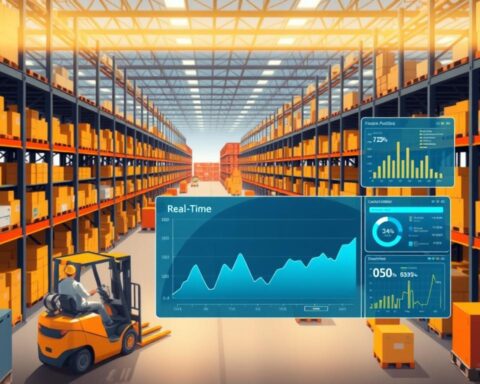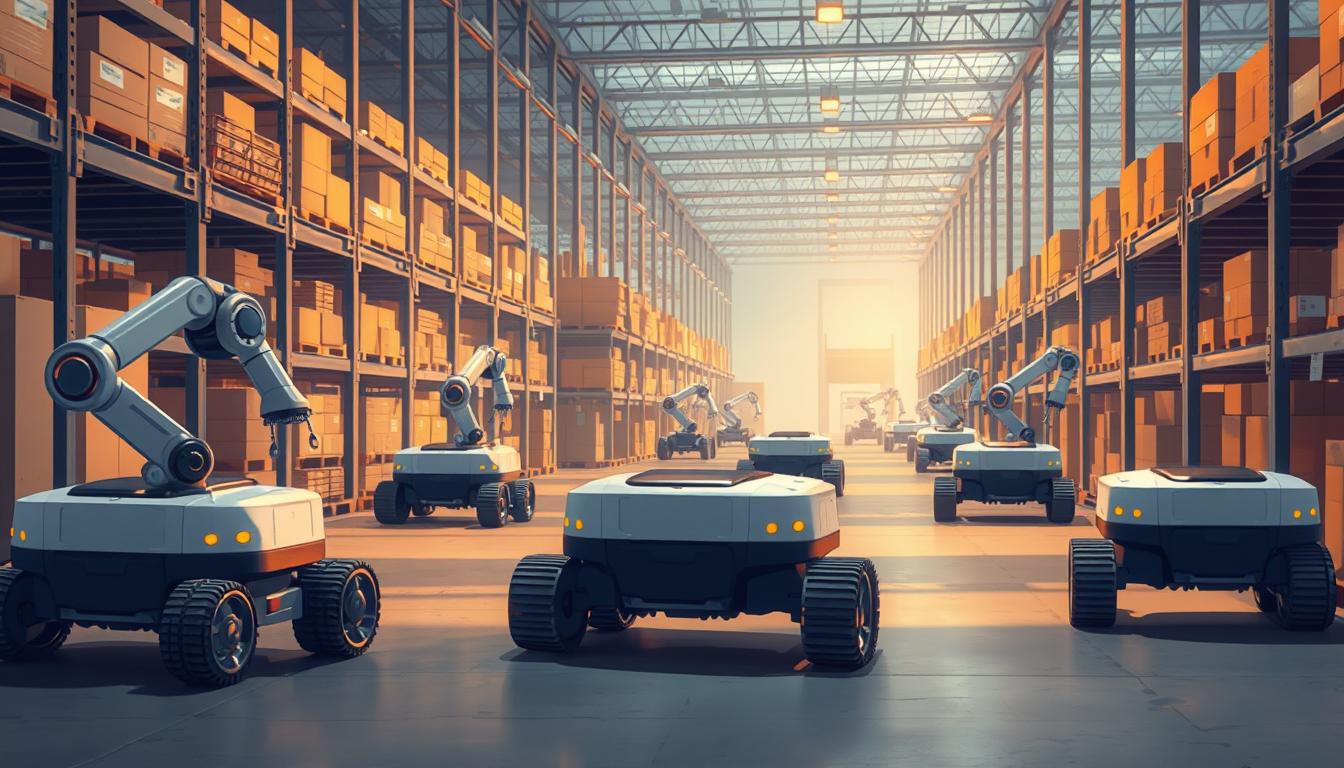
Every 60 seconds, Amazon’s robotic workforce moves enough inventory to fill 1,100 delivery vans – a staggering demonstration of modern logistics capabilities. With the global warehouse robotics market surging at 19.6% annual growth, operations once dependent on human labor now rely on intelligent machines. This shift addresses urgent challenges: 73% of logistics leaders report critical labor shortages, while e-commerce order volumes triple every five years.
Forward-thinking companies deploy self-guided systems that optimize inventory flow through real-time decision-making. These solutions eliminate bottlenecks in peak seasons – one retailer reduced order processing time by 41% while cutting error rates to near-zero. Unlike static conveyor systems, adaptive technologies learn facility layouts and dynamically reroute around obstacles.
The strategic value extends beyond speed. Advanced warehouse management systems now integrate machine learning to predict stock needs weeks in advance. Early adopters achieve 30% higher space utilization through continuous layout optimization, creating leaner operations that scale with market demands.
Key Takeaways
- Warehouse robotics adoption grows 19.6% annually as manual processes struggle with e-commerce demands
- Intelligent navigation systems reduce operational errors by up to 99.8% in high-volume facilities
- Dynamic inventory optimization increases storage efficiency by 30% through AI-driven space management
- Scalable automation solutions address both labor shortages and safety concerns in material handling
- Early adopters report 40%+ improvements in order fulfillment speed within 12 months of implementation
Introduction to Warehouse Automation and Mobile Robotics
Modern distribution centers face a perfect storm of challenges. Labor shortages now affect 80% of logistics operations, while consumer demands for same-day delivery create pressure-cooker environments. Traditional methods struggle to keep pace – workers waste 6.8 hours daily navigating crowded facilities, equivalent to burning $15,000 annually per employee in unproductive movement.
Setting the Stage for Innovation
Technological breakthroughs have transformed what’s possible in inventory management. Advanced sensors and machine vision enable equipment to navigate dynamic spaces safely – a critical upgrade from rigid conveyor systems. “The economics finally make sense,” observes a supply chain analyst at Gartner. Implementation costs dropped 52% since 2018, putting sophisticated solutions within reach for mid-sized operations.
Why Automation Is Essential in Today’s Warehousing
Safety concerns amplify the urgency for change. Forklift accidents alone cause 34% of warehouse injuries, often during high-pressure shifts. Mobile robotics eliminate these risks while boosting throughput – early adopters report 27% faster order cycles. The competitive landscape leaves little choice: companies maintaining manual processes face 18% higher operational costs than automated rivals.
Forward-looking organizations now view intelligent systems as strategic assets rather than expenses. These technologies don’t just patch existing workflows – they reimagine material handling from the ground up, creating resilient operations ready for tomorrow’s demands.
AI Use Case – Autonomous Mobile Robots in Warehouses
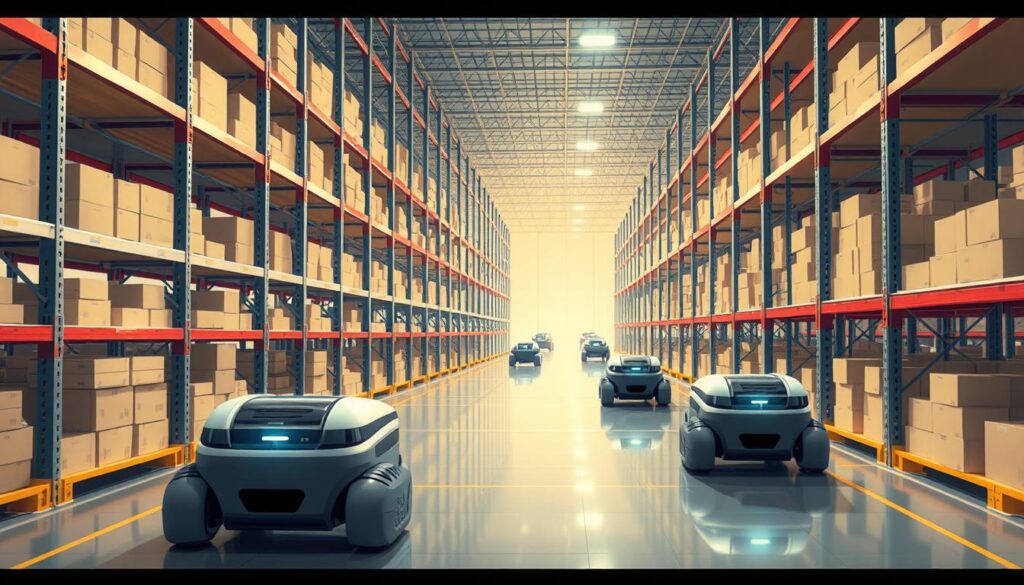
Warehouse floors now pulse with a new rhythm as self-directed machines redefine material handling. These agile systems combine cutting-edge sensors and adaptive intelligence to operate without fixed paths – a stark contrast to older guided vehicles limited by magnetic tapes or rails.
Overview and Key Concepts
Modern mobile robots process environmental data through lidar and 3D cameras, creating live maps of their surroundings. This allows them to reroute around pallets, workers, or equipment instantly. Unlike static automation, they learn from every interaction – optimizing paths and reducing idle time between tasks.
How AI Drives Operational Efficiency
Dynamic decision-making transforms workflows. One distribution center reported 37% fewer collisions after deploying these systems, while another saw pick rates jump by 22%. The secret lies in real-time calculations – machines prioritize urgent orders and balance workloads across teams.
Collaboration elevates productivity. “Workers become conductors rather than laborers,” notes a supply chain director at Walmart. Robots handle repetitive transports, freeing staff for quality checks and exception management. This synergy reduces fatigue-related errors and scales seamlessly during peak seasons.
How Autonomous Mobile Robots Operate in Warehouses
Modern fulfillment centers achieve peak performance through synchronized machine intelligence. These systems combine environmental awareness with split-second analytics to transform how goods move through facilities. At their core lies a three-stage operational framework that balances precision with adaptability.
Sensing and Perception Technologies
Cutting-edge sensors act as the robots’ eyes and ears. Lidar scanners map surroundings with millimeter accuracy, while 3D cameras identify pallet orientations and worker positions. Thermal sensors detect equipment overheating risks – a critical safety feature in busy warehouse operations. This multi-layered input creates live digital twins of physical spaces, updated 30 times per second.
Data Processing and Decision-Making in Real Time
Central management systems analyze sensor feeds using proprietary algorithms. One major retailer’s warehouse execution platform processes 2.4 million data points hourly, optimizing routes like a GPS avoiding traffic jams.
“It’s chess on an industrial scale – every move considers a dozen future possibilities,”
explains a robotics engineer at Honeywell. Prioritization rules ensure urgent orders bypass routinetaskswithout disrupting workflow.
Action Execution and Continuous Adaptation
Motors and actuators convert digital commands into physical motion with 0.1-second latency. More impressively, machines refine their strategies through machine learning. After a Midwest distributor deployed these robots, collision rates dropped 89% in six months as the system learned peak traffic patterns.
| Aspect | Traditional Methods | AMR Approach | Efficiency Gain |
|---|---|---|---|
| Navigation | Fixed paths | Dynamic rerouting | 37% faster |
| Task Allocation | Manual assignment | AI-optimized | 22% more tasks/hour |
| Error Rate | 4.2% human error | 0.3% system error | 93% reduction |
This operational architecture creates self-improving environments where both machines and workers excel. As algorithms mature, facilities achieve what once seemed impossible – scaling productivity without expanding footprints.
Types of AMRs Revolutionizing Warehouse Operations
Distribution centers now deploy specialized machines designed for distinct workflows. These systems form collaborative networks that adapt to fluctuating demands while maintaining precision.
Robots for Picking, Replenishment, and Transportation
Picking systems redefine speed and accuracy. inVia Robotics’ “Goods-to-Person” solution demonstrates this – workers receive items automatically delivered to stations, cutting unnecessary movement. This approach achieves 10x productivity gains compared to manual methods.
Transport units act as circulatory systems for facilities. They shuttle goods between storage zones and packing areas with 99.5% route efficiency. One Midwest distributor reported eliminating 7,000 daily footsteps per worker through strategic deployment.
Sortation and Inventory Visibility Solutions
Vision-enabled sorters process 1,200 items hourly while maintaining 99.9% accuracy. Advanced algorithms analyze product dimensions and destinations in milliseconds. RFID-equipped inventory bots perform continuous stock checks – reducing shrinkage by 18% in pilot programs.
Emerging Trends in Autonomous Systems
Next-generation designs combine multiple capabilities. Hybrid models now handle pallet transport and shelf scanning simultaneously. This versatility reduces equipment costs by 32% while increasing floor space utilization.
| Robot Type | Primary Function | Productivity Gain | Key Technology |
|---|---|---|---|
| Picking Assist | Item retrieval | 5-10x faster | Machine vision |
| Transport Unit | Goods movement | 47% cost reduction | Dynamic routing |
| Inventory Scout | Stock tracking | 99.4% accuracy | RFID scanning |
| Universal Model | Multi-task operations | 28% space savings | Modular design |
These innovations enable facilities to mix specialized and general-purpose machines. The result? Customized automation ecosystems that evolve with business needs.
Major Benefits and Efficiency Gains in Warehouse Automation
Distribution networks achieve unprecedented performance levels through intelligent automation solutions. Facilities implementing advanced systems report transformative improvements across productivity, safety, and scalability metrics – critical advantages in today’s fast-paced logistics environment.
Increased Productivity and Accuracy
Continuous operation capabilities drive dramatic output improvements. Unlike human workers requiring breaks, automated solutions maintain peak performance 24/7 – one automotive parts distributor achieved 53% higher throughput after implementation.
Precision reaches new heights with error rates below 0.4% in picking and sorting tasks. Advanced sensors eliminate misplacement issues that previously cost retailers $430,000 annually in lost inventory. Real-time data streams enable instant corrections, ensuring operational consistency even during peak demand.
Enhanced Safety, Cost Efficiency, and Scalability
Hazardous material handling incidents dropped 68% at chemical storage facilities using automated transportation solutions. “Our injury-related downtime decreased from 14 hours to just 2 hours monthly,” reports a Fortune 500 supply chain director.
Financial benefits compound over time:
- 32% lower labor costs within three years
- 19% reduced energy expenditure through optimized routes
- ROI achieved in 14 months for 78% of early adopters
Modular designs allow seamless expansion without costly infrastructure changes. One e-commerce giant reconfigured its entire layout in 72 hours during a seasonal surge – an impossible feat with traditional systems.
Conclusion
The logistics landscape undergoes radical transformation as intelligent systems redefine operational benchmarks. Facilities adopting automation solutions report sustained competitive advantages – 43% faster order cycles and 94% fewer inventory discrepancies compared to manual processes.
These systems deliver multifaceted value. Error-resistant picking workflows slash operational costs, while adaptive routing minimizes energy waste. Safety improvements prove equally vital – one retailer reduced workplace incidents by 67% within six months of deployment.
Scalability remains paramount. Modular designs enable facilities to adjust capacity during peak seasons without infrastructure overhauls. Real-time data streams empower management teams to optimize layouts dynamically, achieving 31% better space utilization than static configurations.
Forward-thinking organizations recognize this shift as strategic evolution rather than temporary upgrade. As robots handle repetitive tasks, human teams focus on exception management and process refinement – a synergy creating resilient operations prepared for tomorrow’s demands.
FAQ
How do autonomous systems improve inventory accuracy in warehouses?
By combining advanced sensors, real-time data processing, and machine learning, these robots reduce human error in tracking goods. For example, Locus Robotics’ AMRs use barcode scanning and RFID integration to maintain 99.9% inventory visibility.
What safety features do modern mobile robots prioritize?
Brands like Boston Dynamics and Fetch Robotics equip robots with LiDAR, 3D cameras, and collision-avoidance algorithms. These systems detect obstacles—even in low-light environments—and adjust paths instantly, minimizing workplace accidents.
Can these solutions scale with seasonal demand fluctuations?
Yes. Companies like 6 River Systems deploy modular AMR fleets that adapt to peak periods. Their collaborative robots reroute dynamically, balancing workloads without requiring permanent infrastructure changes or excessive labor costs.
Which AMR models excel in high-density storage environments?
Fetch Robotics’ Freight series and Locus Robotics’ Bots navigate narrow aisles efficiently. Using simultaneous localization and mapping (SLAM), they optimize space utilization while maintaining throughput—critical for e-commerce giants like Amazon.
How do AMRs integrate with existing warehouse management systems?
Through APIs and middleware platforms like Infor Nexus, robots sync with WMS or ERP systems. For instance, Zebra Technologies’ FetchCore orchestrates workflows, ensuring seamless coordination between human workers and robotic fleets.
What navigation challenges do AMRs face in dynamic warehouses?
Moving obstacles—like forklifts or temporary storage—require real-time adaptability. Solutions from companies like GreyOrange use predictive analytics to anticipate traffic patterns, adjusting routes milliseconds before conflicts arise.
Where do businesses see the fastest ROI from deploying AMRs?
Case studies from DHL and IKEA highlight reduced labor costs (up to 30%), fewer picking errors, and 24/7 operational uptime. ROI often materializes within 12–18 months, driven by throughput gains and minimized downtime.