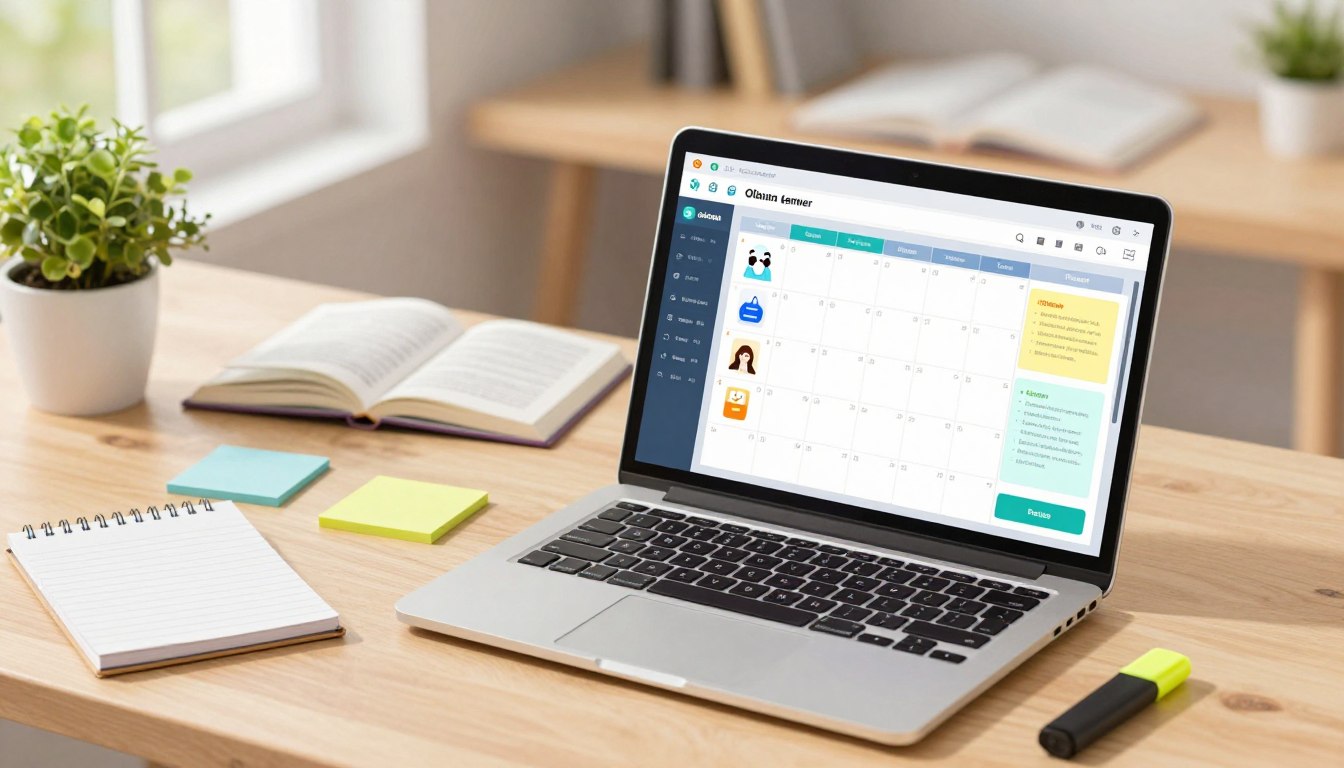
“The secret of getting ahead is getting started.” — Mark Twain. This idea frames the promise of FlowScholar.com: start faster, teach better, and reclaim time.
FlowScholar.com serves as an essential teacher lesson prep tool that streamlines online lesson planning and organizes content in minutes. Educators can build a clear plan, align with standards, and reduce the administrative work that pulls them from the classroom.
We recognize that teachers wrestle with data collection and the need to track student progress during a busy school day. FlowScholar.com helps manage plans and student learning so the focus returns to teaching and classroom experience.
Key Takeaways
- FlowScholar.com speeds up weekly lesson planning and saves valuable time.
- It acts as an online lesson planner that organizes standards, content, and plans.
- Teachers can track student learning and simplify data collection.
- The platform reduces stress tied to daily plans and complex standards.
- Both veteran educators and new staff gain structure and consistency.
- Using a dedicated lesson planner may also improve focus on student outcomes.
The Modern Challenge of Lesson Planning
“Good planning saves hours later.” Crafting a single quality lesson often takes longer than anticipated, turning planning into an unofficial second job.
The Time-Consuming Reality
Many teachers spend hours each week moving content between Planboard, Google Docs, Notion, and OneNote. That repetitive work steals time that could be spent with students.
Lesson planning now requires managing standards, schedules, and student data—often in separate places. Without a reliable online lesson planner, plans stay fragmented and fragile.
Impact on Educator Burnout
When educators must perfect every plan daily, their well-being suffers. The pressure to produce flawless lessons can reduce creativity and harm learning outcomes.
“Too much administrative load turns teaching from craft into clerical work.”
Streamlining planning frees up time to focus on teaching and meaningful student interactions. A focused plan reduces stress and restores the classroom to its central purpose.
Why You Need a Dedicated Teacher Lesson Prep Tool
When content, schedules, and student data live in one place, daily workflow improves.
A dedicated system acts as a central hub for lesson plans and related content. This reduces the time spent hunting through drives, emails, and school platforms.
Centralization helps educators keep standards, assessments, and student notes connected to each plan. That makes adjustments faster and more accurate during the day.
- Accessible data: all student progress and materials are available when needed.
- Real-time updates: modify lessons and track learning instantly.
- Professional growth: consistent plans support reflection and improvement.
Investing in an online lesson planner or lesson planning tool reduces repetitive work and helps teachers focus on students. The right system adapts to individual needs and improves outcomes across the school.
Essential Features for Efficient Curriculum Management
Efficient curriculum management begins with clear standards alignment and reliable student data at hand.
Standards Alignment Capabilities
Mapping standards to every plan ensures each lesson aligns with the district framework. A platform that links standards directly to activities and assessments saves time and supports consistent instruction.
Look for systems with search, tagging, and bulk-apply functions. These features let educators assign standards to multiple plans in seconds.
Data Collection and Tracking
Robust data collection lets teachers track student mastery without extra paperwork. Built-in assessments, quick entry forms, and visual reports make it simple to monitor growth.
When data and content share the same platform, adapting plans mid-day becomes practical and fast.
“When standards and assessments live together, instructional decisions become evidence-driven.”
| Feature | Benefit | Classroom Impact |
|---|---|---|
| Standards tagging | Fast alignment across units | Consistency in grading and objectives |
| Built-in assessments | Immediate performance snapshots | Timely interventions for students |
| Template library | Reusable plans and materials | Saves planning time each day |
| Graphics via Canva Education | Professional visuals without leaving browser | Engaging materials for learners |
Evaluating Your Personal Teaching Workflow
Start by mapping a typical school day to see which tasks slow planning and which run smoothly.
Reflection is the first step toward a leaner routine. A short audit reveals where content moves twice, where data entry repeats, and where time leaks occur.
Identifying Your Tech Comfort Level
Not all educators need the same system. Some prefer simple, reliable apps. Others want deep customization and full data integration.
- Comfortable with tech: choose an online lesson system that supports detailed reports and API connections.
- Moderate comfort: look for platforms with clear templates and one-click exports.
- Low comfort: prioritize ease of use and fast onboarding to avoid wasted time.
Understanding habits helps craft a plan that saves time and reduces stress. When workflow and platform align, students benefit from clearer pacing and more focused learning.
| Comfort Level | Best Fit | Primary Benefit |
|---|---|---|
| High | Customizable online lesson systems | Deep data ties and automation |
| Medium | Template-driven platforms | Balance of features and simplicity |
| Low | Minimalist planners | Fast setup and less daily friction |
Explore resources like AI teaching updates or guides on building smarter systems such as GPT-powered educational tools to match capability with need.
The Role of Automation in Reducing Administrative Burden
Automated processes turn scattered daily chores into a single, reliable routine that runs in the background. This reduces repetitive clerical work and frees up meaningful time for classroom priorities.
Automation simplifies data collection so educators can track student progress without manual entry. Built-in forms and synced reports cut time spent on spreadsheets and make data actionable.
When standards alignment is automated, plans stay compliant and current. That removes a common bottleneck and keeps content focused on learning goals.
“Automation lets educators spend more energy on instruction and less on administration.”
- Reduce repetitive work across the school day.
- Automate assessments to quickly track student growth.
- Streamline plans so updates happen in minutes, not hours.
FlowScholar recommends tools that integrate with existing systems; teachers may also take advantage of a 50% discount on Jotform for streamlined data collection. Ultimately, automation creates a sustainable workflow that supports both professional balance and stronger student outcomes.
Balancing Digital Tools with Hands-on Learning
An effective weekly workflow pairs online organization with tactile, inquiry-driven classroom moments.
Use digital systems for planning and data review during prep time, then reserve the school day for active materials and face-to-face activities. This keeps students engaged and preserves the human side of learning.

Integrating hands-on activities into each lesson often increases engagement and retention. Simple experiments, group projects, and physical manipulatives translate plans into memorable experiences.
A well-organized online lesson planner helps track these diverse experiences so content stays aligned with goals. It stores resources, records quick data notes, and links materials to your weekly plans.
We encourage educators to treat digital solutions as partners—not replacements—for in-person instruction. When tech supports rather than substitutes, students benefit from richer learning and stronger relationships.
- Use digital time for preparation and assessment entry.
- Reserve class time for tactile activities and student collaboration.
- Keep records in one place so adjustments are fast and evidence-based.
For practical integration strategies and school-level guidance, explore this curated set of resources on tech integration: school tech integration tips.
How FlowScholar.com Transforms Your Weekly Preparation
FlowScholar.com reshapes weekly workflow so planning takes minutes, not hours. The platform centralizes content, standards, and student data so educators spend less time switching apps and more time designing meaningful activities.
Streamlining Weekly Lesson Flows
Build a complete lesson plan in minutes. Integrated templates and a library of materials cut repetitive work. Reusable templates and Canva Education graphics speed creation and polish.
Accessing Resources Anywhere
Access plans and files from any device so you are ready for the next day at school. The app supports sharing across grade teams, making collaboration simple and fast.
Enhancing Student Learning Outcomes
Align plans with standards and track student learning over time. Quick data entry and visual reports let educators adapt activities and interventions within minutes.
| Feature | Benefit | Impact |
|---|---|---|
| Centralized platform | One place for plans, content, and standards | Less time on admin; more focus on students |
| Templates + Canva Education graphics | Fast, engaging materials | Improved classroom experience |
| Sharing & app access | Easy collaboration across staff | Consistent instruction school-wide |
TSHA (The School House Anywhere) pairs well with FlowScholar for curriculum depth. Visit FlowScholar.com to try the platform and see how streamlined lesson planning saves valuable time.
Integrating Standards and Assessments Seamlessly
Aligning curriculum standards with everyday activities turns scattered plans into reliable pathways for student growth.
Embedding standards into each lesson plan ensures instruction meets the broader framework used by the district. This alignment clarifies goals and reduces guesswork during class.
Attach assessments directly to a lesson so evaluation becomes part of instruction. When assessments live with content, entering and reviewing data takes less time.
Organized data helps teachers spot which students need extra support and which are ready for extension. Clear records also make it easier to show how plans improve learning over the year.
- Attach assessments: tie checks for understanding to specific activities.
- Keep data central: identify gaps quickly and act on them.
- Use a framework: let plans map to standards for consistent instruction.
Educators who prioritize this integration report greater confidence and faster adaptation in the classroom. Every lesson becomes purposeful, standards-aligned, and focused on measurable student outcomes.
Customizing Templates to Fit Your Classroom Needs
Flexible templates turn a generic plan into targeted, usable materials. Custom templates let educators shape each lesson plan to match student profiles and classroom pace.
Adapting to Diverse Learning Styles
Start with a simple template and build variations that address visual, auditory, and kinesthetic learners. An app that supports flexible template design speeds this work.
Incorporate graphics from Canva Education to make content clearer and more engaging. Keep a library of templates so plans can be reused and modified quickly.
- Tailor a lesson plan for small-group work or whole-class instruction.
- Save versions that emphasize assessment data or hands-on activities.
- Use templates to maintain consistent, professional materials across the school.
When teachers invest a few minutes customizing a template, student access improves and daily work gets easier. For more on adaptive approaches, explore adaptive learning platforms via this adaptive learning platforms.
Strategies for Collaborative Planning and Resource Sharing
Structured collaboration converts individual expertise into reusable content that benefits every classroom.

Over 600,000 educators use Lesson Planner to streamline collaborative work and make sharing more efficient. Teams who share materials and standards-aligned plans save time and improve consistency across grades.
Start by creating a shared library of proven lesson plans and activities. Keep each entry short, tagged by standards, and linked to quick formative checks. This keeps content searchable and actionable.
- Use digital platforms for resource sharing to cut redundant work.
- Align strategies with peers to build coherent school-wide instruction.
- Leverage collective reviews so materials improve over time.
“Collaboration scales great ideas into everyday practice.”
For a practical rubric to guide team conversations, consult the collaborative planning rubric. Small, regular exchanges of plans and data shift the burden from individuals to the whole staff—freeing time for stronger teaching.
Overcoming the Learning Curve of New Educational Software
A short, deliberate approach makes mastering new educational software achievable for any busy educator.
Start simple in your browser and explore core features first. Open a basic lesson plan and add one activity. This reduces friction and builds confidence without wasting time.
Focus on what your class needs now: core content, quick formative checks, and simple data entry. Ignore advanced options until the basics feel natural.
Every educator learns at a different pace. Practice for short blocks and ask for help when a task stalls. Our support resources and community guides are there to speed adoption.
“Small, consistent steps turn unfamiliar software into a dependable part of weekly work.”
- Begin with one reusable lesson plan template.
- Add assessments later, once data entry is routine.
- Use the app in short sessions to build habit and skill.
| Stage | Action | Benefit |
|---|---|---|
| First week | Open in browser; create one plan | Low effort, quick wins |
| Second week | Add content and a short formative check | Meaningful data in minutes |
| Ongoing | Gradually use advanced features | Save long-term time and reduce work |
Conclusion
Small changes in tools and routine often deliver the biggest gains in time and consistency. ,
Finding the right online lesson planner is a critical step toward improving daily experience. A clear plan that fits your workflow saves hours and keeps content and data connected.
We hope this guide helped teachers choose systems that support student learning and better use of time. Revisit your workflow periodically; one quick audit may also reveal simple wins.
By staying organized and focused, educators create a more sustainable career and stronger classroom outcomes. Visit https://www.flowscholar.com to begin a more efficient approach to lesson planning today.
FAQ
How does FlowScholar.com save time on weekly lesson preparation?
FlowScholar.com centralizes planning workflows, standards alignment, and materials in one accessible platform. Educators can reuse templates, import resources from Canva Education, and sync assessments—reducing duplicate work and cutting planning hours each week.
What makes modern lesson planning so time-consuming?
Planning demands mapping standards, differentiating activities, creating assessments, and collecting student data. Without streamlined systems, teachers juggle multiple apps, file formats, and templates—adding administrative overhead that detracts from instruction.
How does planning overload contribute to educator burnout?
Repetitive admin work and after-hours planning limit recovery time and reduce job satisfaction. When planning systems lack automation or collaboration, the emotional load rises—lowering retention and impacting classroom effectiveness.
Why choose a dedicated online lesson planning platform?
A focused platform offers structured templates, standards mapping, integrated assessments, and data tracking. This improves consistency across classes, supports differentiated instruction, and enables faster iteration based on student outcomes.
What essential features support efficient curriculum management?
Look for standards alignment capabilities, assessment integration, curriculum mapping, version control, and straightforward sharing options. These features turn scattered resources into a coherent program that’s easy to monitor and update.
How does FlowScholar handle standards alignment and tracking?
The platform links activities and assessments directly to standards, allowing educators to tag lessons and generate reports on mastery. This simplifies progress monitoring and ensures instruction meets state or district requirements.
Can the system collect and track student data effectively?
Yes. FlowScholar enables formative and summative data capture, customizable rubrics, and performance dashboards. Teachers can spot trends, group students for interventions, and export data for gradebooks or assessment platforms.
How should educators evaluate their personal workflow before adopting new software?
Start by mapping current steps: resource sourcing, planning, assessment, and data entry. Identify bottlenecks and note tech comfort levels. That insight guides customization and training choices for a smoother rollout.
How does the platform accommodate different technology comfort levels?
FlowScholar offers tiered interfaces, templates, and guided onboarding. Novice users can rely on presets, while power users access advanced customization—so teams with mixed skills can collaborate efficiently.
What role does automation play in reducing administrative burden?
Automation handles routine tasks—like populating weekly plans, aligning standards, and scheduling assessments—freeing time for instruction and analysis. It also reduces human error in grading and record-keeping.
How can digital planning coexist with hands-on learning?
Digital plans should document hands-on activities, materials, and assessment criteria. FlowScholar supports multimedia lesson components and printable templates so teachers can blend screen-based planning with tactile classroom experiences.
How does FlowScholar streamline weekly instructional flows?
Weekly flows are assembled from reusable modules—objectives, activities, checks for understanding, and assessments. Teachers drag-and-drop components, adjust pacing, and publish plans to students or substitutes in minutes.
Can educators access resources from anywhere?
Yes. Cloud-based access ensures plans, student data, and shared libraries are available on desktop and mobile browsers. This flexibility supports in-school, remote, and hybrid teaching models.
Does using FlowScholar improve student learning outcomes?
By aligning instruction to standards, enabling targeted interventions, and providing clear formative feedback, the platform helps teachers make data-driven decisions that support measurable improvements in learning.
How are standards and assessments integrated?
Assessments can be tagged to standards and linked to lesson activities. The platform aggregates results into standards-aligned reports, so educators track mastery and adjust instruction based on evidence.
Can templates be customized for diverse classroom needs?
Templates are fully editable: adjust objectives, scaffolds, materials, and assessment rubrics to match grade levels, content areas, and diverse learning styles. Templates can also be shared across teams to ensure consistency.
How does FlowScholar support collaborative planning and resource sharing?
The platform enables shared libraries, version control, and real-time collaboration. Teams can co-create units, comment on drafts, and export resources—fostering efficient cross-grade and cross-discipline planning.
What training helps overcome the learning curve for new educational software?
Effective onboarding includes guided walkthroughs, role-based tutorials, and short video lessons. Ongoing support—help center articles, community forums, and responsive customer service—speeds adoption and builds confidence.