“Anyone who has never made a mistake has never tried anything new.” — Albert Einstein
Practice becomes learning when misses turn into clear, repeatable fixes. Most students feel frustration after a missed question; that feeling is useful data, not a verdict on ability.
Wrong answers reveal questions just beyond current skill. A shallow look at solutions wastes valuable repetition-based tests. Instead, use a simple promise: focused analysis raises score steadily over weeks.
We will start with mindset, then a post-test workflow, confidence sorting, root-cause diagnosis, and a journal system that makes progress measurable. This approach fits timed, high-stakes exams such as LSAT, SAT, ACT, and professional boards because patterns repeat.
For related strategies on learning from misses, see stop wasting practice questions and a perspective about growth from career pacing. Learn how FlowScholar can streamline your system at FlowScholar.
Key Takeaways
- Misses are signals: analyze them, don’t avoid them.
- Deep post-test work outperforms passive answer scanning.
- Track recurring patterns in a simple journal.
- Prove correct choices; eliminate flawed options decisively.
- Small, consistent changes compound into higher scores.
Why wrong answers are the fastest path to a higher score
Every miss is a compass showing which skill to train next. Missed questions mark the boundary where current prep meets stretch work. Those boundaries focus effort efficiently: spend less time on easy items and more where growth happens.
Productive challenge beats comfort. Speed through easy items builds confidence but rarely raises the actual score. Targeted practice at these skill edges yields measurable improvement, especially in LSAT prep where question patterns repeat.
Why errors map your next skill
Missing a question usually means practice sat at or just above current skill. That gap is the best use of study time: convert one mistake into a repeatable method and you gain leverage across many similar items.
Flag and reset: a practical performance approach
Use a short routine on test day: choose an answer, mark it, and move on. This preserves time and prevents one hard item from derailing subsequent questions.
- Commit to the best available choice at a preset checkpoint.
- Flag the question for later review only if time remains.
- Take three deep breaths and re-center attention for the next block.
| Situation | Comfort Strategy | Growth Strategy |
|---|---|---|
| Easy, repetitive questions | Speed through for confidence | Quick checks; avoid over-practice |
| Borderline, tricky items | Ruminate and lose time | Flag, commit, reset |
| Recurring mistakes | Ignore pattern | Turn miss into rule and drill |
Implementation cue: If uncertainty lasts past your checkpoint, pick the best answer, mark it, and return only if time permits. Practice tests are the ideal place to rehearse calm decision-making and build test-day resilience.
For practical prep strategies that emphasize learning from misses, see this focused guide. Once timed work is complete, disciplined review converts misses into rules you can apply across sessions and organize with FlowScholar.
How to Review Wrong Answers the Right Way after any practice test or timed section
A disciplined post-test routine turns each miss into a repeatable gain.
Pause before the key: close the packet and restate the question in plain language. Write one clear sentence that captures what the question actually asks. This step prevents hindsight bias and checks comprehension rather than memory.
Predict first: make a best-possible predicted answer or feature before reading choices. A short prediction trains active reasoning and reduces traps. Record one phrase that your final answer must satisfy.
Prove the correct answer: once the key is visible, explain precisely why the correct answer meets the prompt and every constraint. Avoid calling it merely a better fit — the correct answer is fully supported.
Eliminate your picked wrong answer: say why your answer wrong: unsupported claim, wrong variable, excessive scope, or misread wording. Name the lure that pulled you in — a familiar pattern, a tempting phrase, or a timing shortcut.
- Restate question in one sentence.
- Predict the right answer feature before choices.
- Write a two-line proof of the correct answer.
- Label why your chosen answer failed and what misled you.
- Turn insight into a short process rule for next time.
Time note: apply this sequence quickly for low-value misses and deeply for high-value ones. Capture the rule in your journal so future practice targets the real, recurring flaw — that saves time and raises score.
Sort missed questions by confidence to find patterns in your approach
A quick confidence sort turns scattered errors into a clear map for targeted practice.
Start small: after a test section, mark each missed question with one of three simple tags. Keep this list short so it can be logged manually or in a tool later.

Separate skipped, guessed, and thought-you-knew items
Skipped: no workable path; a random pick or time-driven triage. This usually signals pacing or missing fundamentals.
Guessed: partial elimination led to a choice. The student had some basis, but reasoning was unstable.
Thought-you-knew: high confidence that proved incorrect. This often points at misread wording or a misconception.
Review guessed questions you got right to reduce “lucky” answers
Flag guessed-but-correct items. Those are hidden issues waiting to flip into future misses. Write one sentence explaining the elimination steps you used and whether they rest on a rule or on chance.
Use confidence trends to choose what practice next
If most misses are “thought-you-knew,” prioritize reading precision and trap drills. If skips dominate, build pacing rules and decision thresholds.
- Update counts after each section.
- Pick the largest, most fixable category for your next practice block.
- Track progress weekly and adjust your approach based on trends.
Performance analytics for ambitious professionals: treat confidence patterns as data — then let practice match the issue, not habit. For a practical primer on turning misses into study rules, see stop wasting practice questions.
Diagnose the real reason you missed the question
Not every miss is a content gap—many stem from process or timing failures.
Use a simple diagnostic framework: assign one primary cause for each mistake so fixes are specific and repeatable.
Time issue
When time breaks a solid method, the problem is pacing, not knowledge. Compare scores under strict timing and with extra time. A meaningful gap points at a fluency problem.
Fix: set per-question checkpoints, flag slow items, and practice with paced blocks. Log a rule: “Checkpoint at X seconds; flag if over.” Then drill timed sections that match your weak question type.
Question comprehension
Wording can trick a first read. Missing qualifiers like except or scope words creates wrong answers even when the method is known.
Fix: restate the ask in one sentence and circle qualifiers. Rule: “Restate, then scan choices.” Drill brief passages that emphasize prompt language.
Procedural or content
Distinguish not knowing the method from lacking material. If extra time helps little, the root is content or procedure.
Fix: find one clear lesson, practice that exact method, then repeat targeted questions until fluent. Record the lesson source and drill set.
Careless error
Careless errors are process gaps—solving the wrong variable or skipping a constraint. They are not character flaws.
Fix: add micro-checks: verify target variable, re-read last line, and confirm units. Rule: “Two-second final check.” Turn each careless mistake into a checklist item and a short drill.
- Assign one cause per miss: time, comprehension, procedural, or careless.
- Write one rule and one drill for that cause.
- Log results so the next practice session targets the real problem, not a vague reason.
Build a wrong answer journal that makes review repeatable
Logging each mistake creates a searchable record that guides efficient practice.
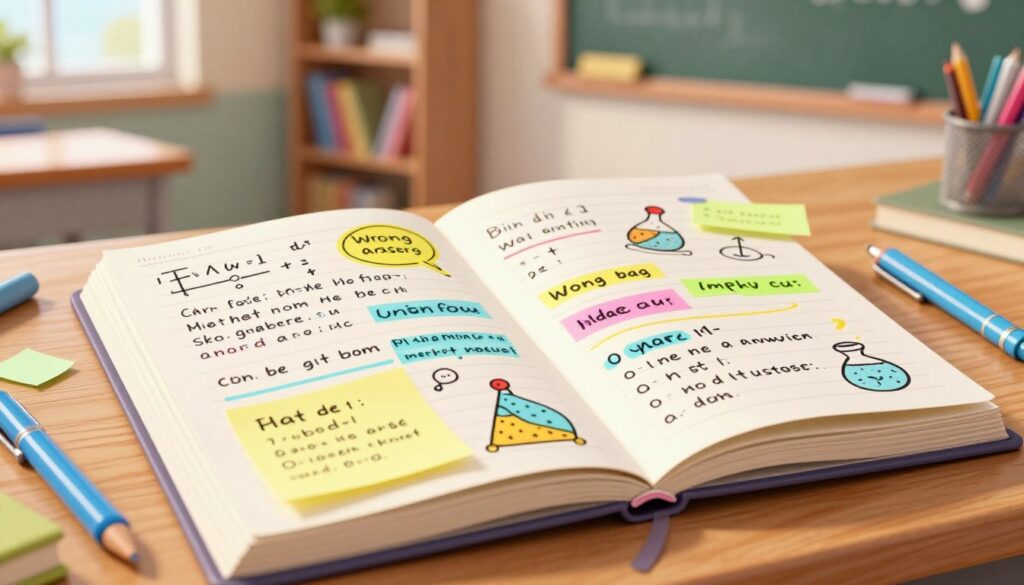
Purpose: make review repeatable, searchable, and trend-driven so improvement is measured in eliminated mistake patterns, not motivation.
What to log every time
- Test identifier, section, and question number.
- Selected answer choice and the correct answer.
- One-sentence summary of what the question demanded.
Add tags that matter
- Question type and perceived difficulty.
- Confidence bucket: skipped / guessed / knew.
- Timing notes: behind pace / on pace / extra hours needed.
Write an actionable “next time” rule
Rules must be behavioral and testable (example: predict before choices, underline the target variable, or skip after checkpoint and flag).
Set a practice plan from your journal
Pick the top two recurring tags, then drill those question types with the specific fix—timing drills for pacing, trap drills for comprehension, procedure drills for method gaps.
| Field | Why | Example Entry | Action |
|---|---|---|---|
| Test / Section / Q# | Locates the miss | SAT Practice 6 / Sec 2 / Q14 | Retake that passage set |
| Tag: question type | Groups similar items | Conditional logic | Drill 20 conditional questions |
| Timing note | Shows pacing issues | Behind pace by 25s | Paced blocks, reduce hours wasted |
| Next time rule | Creates a testable habit | “Predict then read options” | Practice until rule is automatic |
Make it scalable: spreadsheets work early on; when entries grow, use an Education AI tool like FlowScholar to surface patterns and save hours. Try FlowScholar for faster mistake analysis and cleaner review workflows at https://www.flowscholar.com
Conclusion
, Treat each missed question as a precise signal about what to practice next. This system is simple: mindset, one clear step-by-step check, confidence sorting, root-cause diagnosis, a compact journal, then focused drills.
Prove the right answer and explain why your chosen answer failed. That rule stops vague fixes and turns a single mistake into a repeatable lesson that raises score over time.
Protect time: flag, reset, and return only when it helps. Keep a light, steady cadence — review every section and fix one pattern before the next test. For organizing work and scaling insights, use FlowScholar: https://www.flowscholar.com. Depth beats volume; steady method builds lasting gains and future confidence.
FAQ
Why do incorrect choices accelerate score improvement?
Wrong selections reveal specific skills that need development; they expose gaps faster than correct answers do, so focusing on them shortens the learning loop and guides targeted practice.
How do wrong items show which skill to build next?
Missed items cluster by type—logic, timing, or content. Sorting those clusters highlights the highest-impact weakness, letting students prioritize drills and methods that yield the largest score gains.
What is the “flag and reset” approach for test-day resilience?
Flag hard items, move on, and reset focus for the next question. This prevents one problem from derailing timing and preserves mental energy for the entire section.
What should students do before consulting the answer key?
Pause and restate the prompt in your own words. That forces clarity about what the question asks and prevents chalking mistakes up to ambiguous wording.
Why predict the correct choice before rereading options?
Predicting creates an independent standard to compare answer choices against; it reduces attraction to plausible distractors and strengthens analytical discipline.
How do you prove the correct answer is truly correct?
Show why the right choice follows from premises or passage facts; cite specific lines or logic steps rather than claiming one option “feels” better.
What’s the best way to handle a chosen wrong answer?
Eliminate it decisively: name the exact misread, assumption, or trap that led there. Turning that failure into a labeled error prevents repetition.
How do you turn takeaways into reusable process rules?
Convert insights into short action steps—e.g., “If stimulus contains comparative language, create a mini-table.” These rules are checklist items for future questions.
How should missed items be sorted by confidence?
Use three buckets: skipped, guessed, and believed-correct. This reveals whether errors came from time pressure, luck, or mistaken certainty.
Why review guessed-but-correct questions?
Identifying why a guess succeeded helps reduce reliance on luck. If a pattern emerges, turn it into a reproducible method rather than a fluke.
How can confidence trends guide practice choices?
Low-confidence clusters point to topics or timing issues that need drills; high-confidence misses suggest procedural blind spots to simulate under pressure.
How do you diagnose a timing problem?
Note when work stalls or methods break under a clock. If timing causes shortcuts that produce errors, build timed drills that preserve the full method.
What indicates a question comprehension issue?
Repeated misreads or falling for similar wording traps show comprehension gaps. Practice careful parsing and paraphrase strategies to fix this.
How do you tell if the miss was procedural or content-based?
If the method is unclear or you can’t recall a rule, it’s procedural; if you lack underlying facts or formulas, it’s content. Each requires distinct practice: method drills versus review.
What counts as a careless error and how is it fixed?
Careless mistakes stem from overlooking a qualifier or math sign. Reduce them with routine checks—answer sanity checks, re-reading key lines, and a final glance for traps.
How should fixes be matched to mistake types?
Map each error type to a specific remedy: timing drills for time issues, paraphrasing for comprehension, targeted lessons for content gaps, and checklists for careless slips.
What belongs in a wrong answer journal?
Log test, section, question, chosen answer, correct answer, and a brief error tag. Capture the why and one prescriptive “next time” rule that’s actionable.
Which tags matter most in a review log?
Tag by question type, difficulty, timing notes, and error category. Those tags make pattern-finding efficient and practice selection smarter.
What should an actionable “next time” rule look like?
It must be specific and executable—e.g., “When stimulus has two competing premises, write a quick 2‑line comparison before evaluating choices.”
How do you turn a journal into a practice plan?
Extract the most frequent tags and schedule focused drills by type and issue. Prioritize high-frequency, high-impact errors for weekly practice blocks.
How can an Education AI tool improve review workflows?
Tools like FlowScholar automate logging, tag aggregation, and drill recommendations, making mistake analysis faster and more consistent across sessions.
Where can students try FlowScholar for organized review?
Visit https://www.flowscholar.com to explore features that streamline mistake analysis and create cleaner study workflows.