“Education is not the filling of a pail, but the lighting of a fire.” – William Butler Yeats. This timeless insight captures the essence of what it means to truly inspire learners. For years, many educators operated with a limited view of motivation, seeing it as a simple choice between external rewards and internal drive.
Modern research, like Deci and Ryan’s self-determination theory, has revolutionized this understanding. It reveals a critical distinction between autonomous motivation, where individuals feel a sense of volition, and controlled motivation, which relies on pressure. This guide moves beyond the outdated binary of rewards and punishments.
It offers a nuanced, sustainable framework for inspiring young minds. We synthesize years of educational research with practical classroom application. The goal is to provide actionable strategies that foster genuine engagement and academic success, respecting both student autonomy and academic rigor.
Key Takeaways
- Modern motivation science has moved beyond simple rewards and punishments.
- Self-determination theory highlights the power of autonomous motivation.
- Effective strategies foster internal drive rather than external pressure.
- This guide blends research with real-world classroom application.
- Educators can create environments where a genuine love of learning thrives.
- The focus is on sustainable engagement that respects student autonomy.
Overview of Student Motivation Without Pressure
A significant evolution in educational philosophy centers on cultivating genuine interest rather than demanding obedience. This approach represents a fundamental shift from compliance-driven models toward methods that honor natural curiosity.
Research consistently demonstrates that pressure-based systems yield short-term compliance but undermine long-term engagement. They often sacrifice creativity and authentic learning experiences for immediate results.
| Pressure-Based Approach | Pressure-Free Approach | Long-Term Impact |
|---|---|---|
| External rewards and punishments | Internal drive and curiosity | Sustainable engagement |
| Compliance-focused | Autonomy-supportive | Lifelong learning mindset |
| Short-term performance | Deep understanding | Adaptive problem-solving |
“When learners experience genuine volition and alignment with their values, they achieve superior academic performance and greater persistence.”
This method directly influences academic performance and emotional well-being. Motivated individuals tend to achieve higher grades while developing more effective study habits.
The connection between motivation strategies and mental health is profound. When young people feel respected and competent, they experience reduced anxiety and increased resilience.
Effective motivation prepares learners for complex real-world demands. It supports their ability to adapt and contribute meaningfully in a rapidly changing environment.
We will explore evidence-based frameworks that transform classroom practices. These approaches create environments where authentic engagement thrives naturally.
Foundations of Student Motivation
Effective educational practices are built upon a clear understanding of what drives learners. This foundation distinguishes between two primary sources of drive.
Intrinsic vs. Extrinsic Motivation
Intrinsic motivation springs from within. It is powered by personal interest, curiosity, or the simple joy of mastering a new skill. A learner exploring history for the sheer fascination of past events is intrinsically motivated.
Conversely, extrinsic motivation depends on external factors. This includes grades, rewards, or the desire to avoid negative consequences. While both types influence behavior, intrinsic motivation typically leads to more profound and lasting engagement.
It is a common oversimplification to label one as “good” and the other as “bad.” The reality is far more nuanced. Extrinsic factors exist on a continuum, with some feeling more controlling and others more personally chosen.
Self-Determination Theory Essentials
The work of Deci and Ryan revolutionized this understanding. Their self-determination theory frames motivation on a spectrum from controlled to autonomous.
This framework identifies four types of extrinsic regulation:
- External: Actions are driven solely by rewards or punishments.
- Introjected: Motivation is partially internalized, often fueled by guilt or ego.
- Identified: The person sees personal value in the activity.
- Integrated: The activity fully aligns with one’s values and identity.
The practical goal for educators is not to eliminate external motivators. Instead, the aim is to help students internalize the value of learning. This shifts their motivation toward the autonomous end of the spectrum.
Grasping these concepts empowers educators to design experiences that honor psychological needs while upholding academic rigor.
Understanding Autonomous and Controlled Motivation
The psychology of learning reveals a critical distinction between two fundamentally different types of drive. Autonomous motivation emerges when individuals feel genuine volition and self-direction. Controlled motivation, conversely, stems from external pressures or internalized guilt.
This distinction profoundly shapes learning outcomes. Autonomous engagement leads to deeper understanding and lasting retention. Controlled approaches often yield temporary compliance without genuine internalization.
Effective educational environments nurture the conditions for autonomous motivation to flourish. They recognize that true engagement cannot be forced but must be cultivated.
Key Components: Autonomy, Competence, and Relatedness
Self-determination theory identifies three essential psychological needs that support autonomous motivation. When these needs are met, learners naturally engage more deeply with academic material.
Autonomy involves feeling that learning behaviors align with personal values rather than external imposition. A compelling study demonstrated this principle powerfully. Researchers gave some high school students choice between homework tasks while others received no options.
The results were striking. Students with choice showed significantly higher intrinsic motivation and test performance. This simple intervention enhanced their sense of competence and engagement.
Competence means feeling capable of achieving desired outcomes. “Desirably difficult” tasks—challenging yet achievable—help learners experience accomplishment without frustration. These calibrated challenges promote growth while maintaining confidence.
Relatedness involves feeling connected, valued, and respected within the learning community. When educators genuinely know and care about their students as individuals, they create foundations for sustained motivation.
These three components work synergistically to create robust, self-sustaining motivation. Together, they foster environments where genuine love of learning can thrive naturally.
Incorporating Research-Based Strategies in Teaching
Translating educational research into daily classroom instruction requires a deliberate and informed approach. Effective teaching moves beyond tradition or intuition, grounding practices in a robust body of evidence.
Multiple theoretical frameworks converge to offer a comprehensive toolkit. Self-determination theory emphasizes autonomy, competence, and relatedness. Expectancy-value theory highlights the need for learners to believe in their success and find value in tasks.
Carol Dweck’s growth mindset research adds a critical dimension. It shows that viewing intelligence as malleable fuels persistence. These theories are not competing but complementary.
They provide a unified foundation for designing powerful strategic practices. The challenge for teachers lies in adapting abstract findings to diverse learners.
A practical framework helps. Educators can evaluate any method by asking key questions. Does it support student autonomy? Does it build a sense of competence?
Does it foster relatedness and align with values? Crucially, does it promote a growth-oriented mindset? This critical lens empowers teachers to make informed choices.
Research-based teaching is not about rigid scripts. It is about understanding core principles. These principles can be flexibly adapted to unique classroom contexts and subject areas.
This empowers educators to create environments where all students can thrive. The goal is sustainable engagement built on a solid scientific foundation.
A Teacher’s Guide to Student Motivation Without Pressure
The journey toward autonomous learning environments begins with recognizing extrinsic motivators as potential stepping stones. This transition represents a sophisticated pedagogical shift—not the elimination of structure, but its thoughtful redesign.
Educators can strategically navigate the four types of extrinsic regulation identified by self-determination theory. External regulation serves as an entry point, while integrated regulation represents near-autonomous engagement. Each stage offers unique opportunities for growth.
The Shift from Extrinsic to Autonomous Motivation
This progression mirrors how learners internalize educational value. Initial compliance with external requirements can evolve into genuine personal investment. The process requires patience and intentional scaffolding.
Effective practices meet individuals where they are motivationally. They provide appropriate challenges while supporting movement toward self-direction. This approach honors diverse starting points and learning trajectories.
| Motivation Stage | Teacher Role | Student Experience |
|---|---|---|
| External Regulation | Clear expectation setter | Compliance with external rules |
| Introjected Regulation | Values connector | Internal pressure to perform |
| Identified Regulation | Meaning maker | Personal value recognition |
| Integrated Regulation | Autonomy supporter | Alignment with self-identity |
Evidence-Backed Approaches in Classroom Settings
Research demonstrates that autonomy-supportive teaching enhances rather than compromises academic rigor. A comprehensive analysis of motivation research confirms this relationship.
Practical strategies include offering meaningful choices within structured frameworks. This balances freedom with necessary academic standards. The result is increased engagement without sacrificing learning outcomes.
This professional growth requires reflection on educational philosophy. It challenges educators to reconsider traditional authority dynamics. The reward is classrooms where authentic curiosity drives achievement.
Leveraging Technology and AI Tools in the Classroom
In today’s classrooms, thoughtfully implemented digital tools can amplify educators’ capacity to foster genuine engagement. These resources offer new pathways to support the psychological needs essential for autonomous motivation.

Introduction to FlowScholar Education AI Tool
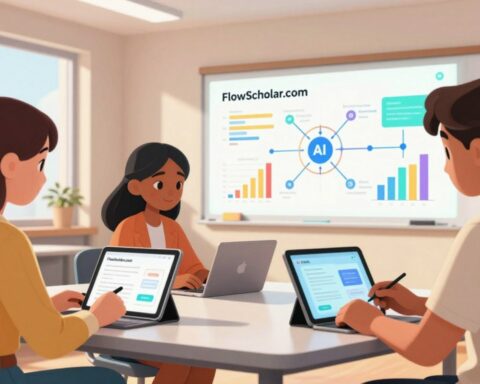
FlowScholar represents a significant advancement in educational technology. This AI platform helps teachers implement motivation strategies more effectively. It provides personalized learning experiences that would be challenging through traditional methods alone.
The tool offers immediate, tailored feedback addressing the competence need from self-determination theory. Students receive timely insights about their progress and growth areas. This supports their development without unnecessary delays.
Technology platforms like FlowScholar expand student choice through differentiated learning pathways. Learners can select topics and challenge levels matching their interests. This autonomy enhancement builds intrinsic motivation naturally.
| Traditional Approach | Technology-Enhanced Approach | Impact on Motivation Needs |
|---|---|---|
| Standardized assignments | Personalized learning paths | Enhanced autonomy and competence |
| Delayed feedback | Immediate progress insights | Strengthened competence development |
| Limited choice options | Multiple engagement formats | Increased volition and interest |
Educators should evaluate technology through the lens of motivation research. Tools must genuinely support autonomy rather than create surveillance environments. FlowScholar positions itself as a partner that handles routine tasks.
This frees teachers to focus on relational aspects of their work. They can dedicate more time to mentoring and creative instruction. The result is a balanced approach where technology enhances human connection.
Classroom Techniques for Promoting Autonomy
Practical autonomy-building strategies bridge the gap between theoretical motivation research and daily classroom reality. These approaches transform passive learning into active engagement.
Structured choice represents a powerful starting point. Educators can design assignments with multiple pathways that all meet learning objectives. This avoids overwhelming learners while providing meaningful options.
Student-led discussions and peer teaching fundamentally shift classroom dynamics. When learners become knowledge creators, they develop deeper ownership of their educational journey. This approach positions teachers as facilitators rather than sole authorities.
Collaborative goal-setting balances curriculum requirements with individual interests. Working together, educators and students establish personalized targets that honor both academic standards and personal aspirations.
The “choice paradox” requires careful navigation. Too many options can paralyze, while too few feel restrictive. Effective teachers calibrate choice based on developmental levels and prior autonomy experiences.
Elementary learners might choose between project formats, while high school students could select research topics. This scaffolding builds autonomy skills progressively across grade levels.
Addressing classroom management concerns is essential. Clear frameworks maintain productivity while honoring agency. When implemented thoughtfully, autonomy-supportive techniques enhance rather than compromise learning environments.
Effective Practices for Building Student Competence
The concept of “desirable difficulty” offers a powerful framework for designing effective learning experiences. Cognitive psychologists Robert and Elizabeth Bjork demonstrated that optimal challenge creates conditions for both competence development and motivational engagement.
Educators must distinguish between tasks that are appropriately challenging versus those that create boredom or anxiety. The sweet spot lies in activities that stretch capabilities without causing frustration.
Designing Desirably Difficult Tasks
What constitutes a desirable challenge varies significantly among individuals. For one learner, organizing materials might represent substantial growth, while another needs complex problem-solving.
This individualization requires knowing each student’s current capabilities. Pre-assessment strategies help educators pitch tasks at the appropriate challenge point.
Flexible grouping and scaffolded support allow for differentiation. Assignment options at varying complexity levels ensure all learners experience productive struggle.
Low-stakes assessments build competence without high-pressure consequences. Practice opportunities where mistakes are valued create supportive learning environments.
Teaching metacognitive strategies empowers learners to approach challenges strategically. We help them develop self-awareness and problem-solving skills for independent growth.
Building genuine competence isn’t about avoiding difficulty but ensuring challenges are reachable. With proper tools and mindset, students can persist through productive struggles toward meaningful accomplishment.
Cultivating Relatedness and Community in Classrooms
Building genuine connections among learners represents a cornerstone of effective educational practice. This relational foundation—often called relatedness—fuels engagement by making individuals feel valued and supported.
Educators can foster this essential connection through intentional strategies. Simple gestures like learning names and personal interests demonstrate authentic care. These actions create psychological safety where students feel comfortable taking intellectual risks.
| Traditional Approach | Community-Focused Approach | Impact on Engagement |
|---|---|---|
| Teacher-centered instruction | Collaborative learning structures | Increased peer support |
| Individual performance focus | Shared identity activities | Enhanced mutual respect |
| Error avoidance culture | Normalized struggle process | Greater risk-taking |
Peer relationships matter significantly. Structured collaboration helps people connect meaningfully. Classroom rituals that celebrate collective achievements strengthen bonds.
Effective teachers balance professional boundaries with authentic relationship-building. They create environments where every voice contributes to the learning community’s success.
Integrating Genius Hour for Enhanced Engagement
Genius Hour transforms traditional classroom dynamics by giving learners ownership of their educational journey. This approach, inspired by Google’s innovative 20% Time policy, dedicates structured periods for self-directed exploration.
Young people pursue projects aligned with their personal curiosity and passions. The framework simultaneously addresses autonomy, competence, and relatedness—the core psychological needs for sustained motivation.
Implementing Genius Hour Projects
This is not unstructured free time but a carefully designed process. Educators provide clear parameters while offering meaningful choice in content and methodology.
Implementation varies by grade level. Elementary classes often dedicate one hour weekly, while secondary programs might allocate 20% of instructional time.
Flexibility is key—educators can implement focused 6-10 week cycles rather than year-long commitments. This allows for deep engagement without overwhelming curriculum demands.
Research confirms the power of such approaches. A study on student-directed learning shows significant gains in engagement and skill development.
Participants develop research abilities, project management skills, and creative problem-solving competencies. They experience the joy of learning driven by genuine interest rather than external requirements.
Fostering Student Creativity and Problem Solving
Passion-driven work represents a paradigm shift from standardized assignments to personally meaningful investigations. This approach unleashes creative potential by connecting academic work to real-world challenges that matter to young people.
Supporting Passion Projects and Innovation
When learners identify problems they genuinely care about, their engagement transforms fundamentally. A third-grader created an anti-bullying campaign using positive sticky notes throughout their school. A fourth-grader developed their own video game using Scratch software.
These projects demonstrate how authentic problem-solving integrates multiple competencies. Young people research solutions, manage resources, and communicate findings. They develop resilience by navigating obstacles independently.
The educator’s role evolves from content expert to facilitator and resource connector. Teachers support diverse interests even when unfamiliar with specific topics. This requires embracing uncertainty while maintaining academic rigor.
| Traditional Approach | Passion Project Approach | Impact on Skills |
|---|---|---|
| Predetermined outcomes | Student-directed solutions | Enhanced creativity |
| Standardized assessment | Authentic demonstration | Real-world application |
| Teacher as expert | Teacher as facilitator | Independent learning |
High school students have pursued projects ranging from plant cloning to learning sign language for family members. One learner performed “I Hope You Dance” in sign language for her deaf cousin. Such work builds intrinsic motivation through personal relevance.
Fostering innovation prepares students for complex future challenges. It channels natural curiosity toward meaningful problems that develop both skills and lasting engagement.
Strategies for Setting Clear and Achievable Goals
Establishing clear targets transforms abstract ambition into tangible progress. Effective strategies help learners move from vague hopes to concrete action plans.
Research confirms the powerful benefits of goal-setting for academic engagement. When young people define their objectives, they gain direction and purpose.
The SMART framework provides a practical structure. Goals should be Specific, Measurable, Achievable, Relevant, and Time-bound. This approach creates accountability while maintaining flexibility.
Collaborative development distinguishes effective goal-setting. When educators and learners work together, commitment deepens significantly. Co-created targets feel personally meaningful rather than externally imposed.
| Teacher-Imposed Goals | Collaborative Goals | Impact on Motivation |
|---|---|---|
| External compliance focus | Internal commitment focus | Enhanced ownership |
| Standardized targets | Personalized objectives | Increased relevance |
| Fixed timeline | Negotiated milestones | Adaptive pacing |
Breaking larger objectives into incremental steps is crucial. Regular milestones provide frequent success experiences. This sustains momentum through challenging learning journeys.
Educators scaffold the process for inexperienced learners. They gradually release responsibility as competence grows. This supportive approach builds confidence alongside skills.
Celebrating progress reinforces growth mindset. Acknowledging effort and strategy makes achievement feel replicable. These practices create sustainable pathways to academic success.
Providing Constructive Feedback to Boost Motivation
Strategic feedback practices can transform classroom dynamics by positioning learners as active participants in their own development. When implemented effectively, this approach becomes one of the most powerful instructional tools available to educators.
Research consistently demonstrates that high-quality feedback dramatically accelerates learning and strengthens engagement. The key lies in distinguishing between feedback that enhances autonomous motivation and feedback that undermines it.
Timely and Meaningful Feedback Mechanisms
Effective feedback balances affirmation of strengths with specific, actionable guidance for improvement. It avoids both empty praise that provides no useful information and purely critical comments that damage confidence.
The timing of feedback delivery is critically important. Delayed feedback loses instructional value as young people move on mentally from the work being evaluated. Immediate, focused input has greater impact.
During Genius Hour implementations, educators conduct brief two- to three-minute conferences with each learner. They ask probing questions about progress and challenges. This approach encourages reflection on both successes and learning opportunities.
Effective mechanisms position students as active participants rather than passive recipients. Self-assessment, peer feedback, and revision opportunities build capacity for independent evaluation. The ultimate goal is developing each person’s ability to identify productive next steps.
Addressing scalability challenges requires strategic approaches like focused feedback on specific criteria. Technology tools and peer systems help educators provide meaningful guidance at scale while maintaining quality.
Emphasizing the Importance of a Growth Mindset
Carol Dweck’s pioneering research fundamentally reshaped our understanding of learning potential. Her work distinguishes between fixed mindset beliefs, where ability is seen as static, and growth mindset perspectives, where capabilities develop through dedicated effort.
This distinction carries profound implications for how students approach challenge. Those with growth orientations demonstrate greater persistence and view setbacks as opportunities rather than failures. They engage more deeply with difficult material because they believe in their capacity to improve.
Practical implementation begins with teaching about brain plasticity. When young people understand that learning literally strengthens neural connections, they embrace the struggle inherent to mastery. Language plays a crucial role—praising strategy and progress rather than innate talent reinforces malleable intelligence.
Classrooms can normalize struggle through practices like “epic failure boards” where educators and students share mistakes. This reduces perfectionism while building resilience. Sharing stories of individuals who succeeded through persistence despite obstacles further solidifies these beliefs.
Developing genuine growth mindset requires more than posters or isolated lessons. It demands consistent alignment between classroom structures, feedback practices, and educator behaviors. When integrated throughout the academic year, these approaches create powerful foundations for growth mindset in education that benefit all learners.
Overcoming Challenges in Student Motivation
The path to fostering intrinsic motivation inevitably includes addressing persistent challenges that can undermine progress. Even research-based approaches encounter real-world obstacles requiring adaptive problem-solving.
Educators should anticipate these hurdles as natural parts of the implementation process. Each challenge presents opportunities for refinement and growth.
Addressing Low Engagement and Fixed Mindset
Low engagement often stems from multiple factors working together. Lack of perceived relevance, inappropriate task difficulty, and unclear expectations can all contribute.
Diagnostic surveys help identify specific barriers. Educators can then adjust instruction accordingly. Relationship-building initiatives create psychological safety for participation.
Fixed mindset beliefs require consistent intervention throughout the academic year. Lessons on brain plasticity and effort’s value help reshape thinking patterns.
| Common Challenge | Root Cause | Practical Solution |
|---|---|---|
| Low Participation | Fear of peer judgment | Low-stakes practice opportunities |
| Task Avoidance | Lack of confidence | Scaffolded success experiences |
| Resistance to Challenge | Fixed mindset beliefs | Growth-oriented feedback language |
| Implementation Fatigue | Slow visible results | Celebrating incremental progress |
Secondary learners particularly benefit from peer mentoring programs. These provide support in comfortable environments. Normalizing struggle reduces fear of documented failure.
Viewing challenges as valuable feedback informs responsive approaches. This mindset sustains educator persistence during cultural transformation.
Conclusion
The true measure of educational success extends far beyond test scores and academic achievements. This guide has demonstrated how fostering genuine engagement creates lasting impact across all learning domains.
Autonomy, competence, and relatedness remain the essential pillars supporting effective motivation strategies. When educators honor these psychological needs, they unlock students’ natural drive to learn and contribute meaningfully.
Implementing these approaches requires professional courage within systems often focused on control. Begin with small, manageable changes that build momentum. Tools like FlowScholar provide valuable support for this transformative work.
Ultimately, classrooms become spaces where students develop resilience and a lifelong love of learning. This aligns with research showing how passion and focus create powerful foundations for success throughout their lives.
FAQ
What is the main difference between intrinsic and extrinsic motivation in a learning environment?
Intrinsic motivation comes from within the student—they engage in learning because they find the subject or task inherently interesting and satisfying. Extrinsic motivation, on the other hand, relies on external pressures or rewards, like grades or praise. While both can drive performance, fostering intrinsic motivation leads to deeper, more sustainable engagement and a genuine love for learning.
How can teachers effectively build student competence without creating excessive pressure?
Building competence involves creating a classroom where students feel challenged but supported. Teachers can design “desirably difficult” tasks that are achievable with effort. Providing timely, meaningful feedback that focuses on the learning process rather than just the final performance is crucial. This approach helps students see their own growth, boosting their confidence and sense of mastery over time.
What role does student choice play in fostering motivation in high school classrooms?
Student choice is a powerful driver of autonomy, a core psychological need. When learners have a say in their work—whether it’s selecting a research topic, choosing how to present their findings, or having input on classroom practices—they feel a greater sense of ownership. This autonomy directly fuels their intrinsic motivation, making them more invested in the learning process and the outcome.
Can technology tools like FlowScholar genuinely support student motivation?
Absolutely. When used strategically, educational technology can be a powerful ally. Tools like FlowScholar Education AI can help teachers personalize learning paths, provide instant support, and free up time for more one-on-one interactions. The key is to use technology to enhance, not replace, the human elements of teaching that build relatedness and support student interests.
How does fostering a growth mindset contribute to a pressure-free learning environment?
A growth mindset—the belief that abilities can be developed through dedication and hard work—shifts the focus from fixed performance to continuous improvement. When students understand that challenges are opportunities to grow, not tests of innate talent, they become more resilient. This reduces the fear of failure and the pressure to perform perfectly, creating a safer space for exploration and learning.
What are some practical first steps a teacher can take to shift from controlled to more autonomous motivation strategies?
A great starting point is to introduce simple choices. Instead of assigning one topic, offer a short list for students to pick from. Implement practices like Genius Hour, where learners dedicate time to a passion project of their choice. Begin by explaining the “why” behind a task, connecting it to students’ lives and interests. These small steps gradually build a classroom culture centered on autonomy and understanding.