
“If you cannot explain it simply, you do not understand it well enough.” This insight from Albert Einstein cuts to the heart of a fundamental challenge in education. It highlights the critical need for clarity—especially when defining success for learners.
The concept of a rubric has deep roots, originating from the Latin ‘rubrica,’ meaning red earth used to mark important text. This historical purpose remains relevant today. A modern rubric is a structured assessment tool that signals to students exactly what matters most in their work.
At its core, a well-designed rubric contains three essential parts: a set of criteria, a performance scale, and clear descriptors for each level. This framework serves a dual purpose. For instructors, it ensures fair and consistent grading. For students, it acts as a roadmap, clarifying expectations before they begin an assignment.
When rubrics are unclear, frustration mounts on both sides. Students may submit work without a true understanding of what excellence entails. This guide provides a strategic approach to crafting rubrics that foster learning and streamline evaluation.
Key Takeaways
- Rubrics are powerful tools that communicate expectations and ensure consistent assessment.
- Their historical purpose of highlighting important information remains central to their modern use.
- Effective rubrics combine specific criteria, a performance scale, and clear level descriptors.
- They serve a dual role as a grading instrument for instructors and a learning guide for students.
- Clarity in rubric design is directly linked to improved student outcomes and reduced grading time.
- A well-crafted rubric creates a shared language for discussing quality work.
Why Rubrics Matter in Education
Educational assessment reaches its full potential when expectations are transparent and measurable. Well-designed evaluation frameworks create pathways for meaningful growth and achievement.
Benefits for Students and Instructors
For learners, these tools eliminate grading uncertainty. They can direct efforts strategically rather than guessing what educators value most.
Educators experience significant time savings with predetermined criteria. Consistency improves across multiple sections or when different instructors evaluate the same assignment.
Enhancing Learning Outcomes with Effective Assessments
These frameworks serve as continuous learning targets. Learners reference them throughout their work process, fostering metacognitive skills and self-assessment.
The feedback loop benefits both parties. Specific, actionable input highlights strengths and areas needing improvement. Simultaneously, educators gain valuable data about instructional effectiveness.
| Stakeholder | Primary Benefit | Key Outcome |
|---|---|---|
| Students | Clear expectations | Strategic effort direction |
| Instructors | Grading efficiency | Consistent evaluation |
| Institution | Alignment with standards | Improved learning quality |
These assessment tools promote fairness and support diverse learners. Explicit expectations help everyone understand requirements regardless of background or learning style. For comprehensive guidance on developing effective evaluation frameworks, explore these instructional resources.
Elements of Effective Rubrics
The architecture of an effective evaluation tool rests on two foundational pillars. These components transform a simple checklist into a strategic blueprint for learning and assessment.
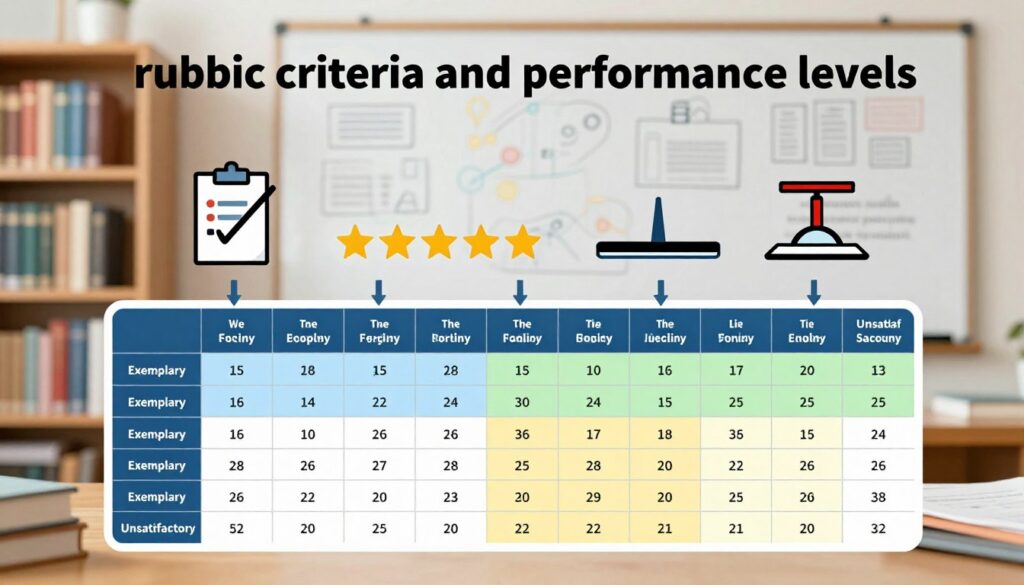
- Criteria: The specific qualities or traits being assessed.
- Performance Levels: The scale defining different degrees of quality for each criterion.
Defining Clear Criteria and Performance Levels
Appropriate criteria are born directly from learning objectives. They should reflect the essential skills or knowledge the task aims to measure. It’s crucial to distinguish between work criteria—like content accuracy and organization—and skills criteria, such as collaboration.
The performance levels create a meaningful continuum, typically with three to five distinct tiers. This range effectively captures the journey from novice to expert without becoming overly complex. Descriptors for each level must use concrete, observable language.
Instead of vague terms like “good,” effective descriptors state what “good” looks like in practice. Parallel structure across levels ensures clarity, allowing for easy comparison. For a deeper exploration of this foundational structure, consider the principles of designing clear rubrics.
Limiting the number of criteria to the most vital elements maintains focus. This approach prevents overwhelm and ensures the tool measures what truly matters for learning and evaluation.
How to Write Clear Rubrics Students Understand
Educators can navigate the creation of a high-quality assessment guide by following a proven six-step framework. This systematic process ensures the final product is clear, fair, and instructionally sound.
Step-by-Step Guide to Rubric Creation
The first step involves a deep analysis of the assignment and its purpose. Instructors should identify key learning outcomes and define what excellence looks like.
Next, selecting the appropriate rubric type is critical. The choice depends on the assessment’s goals.
Step three focuses on selecting a starting point. This can involve adapting existing examples and templates, using AI tools like FlowScholar to generate a draft, or building from scratch.
Subsequent steps involve defining precise criteria, describing performance levels, and piloting the tool for feedback.
Choosing the Right Rubric Type
Each rubric type serves a distinct purpose. The table below outlines the primary options to help instructors match the tool to the task.
| Type | Best For | Key Advantage |
|---|---|---|
| Holistic | Quick assessments, creative work | Provides an overall impression quickly |
| Analytic | Essays, research projects | Offers detailed feedback on specific criteria |
| Single-Point | Formative assessments, drafts | Encourages personalized, growth-oriented comments |
This strategic selection directly impacts the quality of feedback and the efficiency of the grading process.
Incorporating Modern Drafting Tools
Platforms like FlowScholar represent a modern approach to this work. They can quickly generate a structured framework based on assignment details.
This allows educators to focus their time on refining and personalizing the content rather than starting from a blank page. The initial draft serves as a powerful springboard.
Utilizing Rubrics for Consistent Assessment and Feedback
The utility of a rubric is fully unlocked by how it is integrated into the learning and feedback cycle. A brilliantly designed framework achieves little if its application is inconsistent or unclear. Strategic implementation ensures these tools drive meaningful improvement.
Sharing the evaluation guide at the start of an assignment is crucial. This allows learners to internalize expectations and use the criteria to guide their efforts. It transforms the document from a mere grading sheet into a roadmap for success.
Best Practices in Rubric Design
Conciseness is paramount. A one-page limit forces a focus on the most critical skills and prevents cognitive overload. Using parallel language across performance levels enhances clarity and ease of use.
Effective implementation involves discussing the framework with the class. Walking through each criterion with concrete examples makes abstract quality standards tangible. This practice builds a shared understanding of what excellence entails.

Creating adaptable templates saves valuable time across multiple assignments. A well-structured analytic rubric for research papers, for instance, can be slightly modified for different topics throughout a course.
Leveraging Rubrics to Provide Specific, Actionable Feedback
Analytic rubrics excel as feedback instruments. They break down performance into distinct traits, providing targeted information on strengths and areas for growth. This specificity is the cornerstone of effective feedback.
High-quality feedback through these tools must meet key criteria. It should be understandable, timely, and, most importantly, actionable—giving clear direction for improvement.
| Feedback Characteristic | Definition | Impact on Learning |
|---|---|---|
| Specific | Clearly identifies what was done well and what needs work. | Provides a precise target for improvement. |
| Actionable | Offers a clear path or strategy for enhancement. | Empowers the learner to take concrete next steps. |
| Timely | Provided while the learning experience is still fresh. | Maximizes the opportunity to apply the feedback. |
This process creates a dual feedback loop. Educators gain insights into instructional effectiveness, identifying patterns that may signal a need to reteach certain concepts.
Conclusion
Mastering rubric design transforms evaluation from a mystery into a clear, shared roadmap. The ultimate goal is a tool that students genuinely comprehend, enabling strategic effort and ownership of their learning.
This clarity pays dividends through consistent grading, improved performance, and meaningful feedback. Effective frameworks create a common language for discussing work quality.
Educators can begin with one assignment, refining their approach based on real student use. Modern tools like FlowScholar accelerate this process, generating drafts that save valuable time.
Explore how AI can help you build powerful, transparent assessments that drive growth.
FAQ
What is the primary purpose of a rubric in education?
A rubric’s primary purpose is to clearly communicate assignment expectations and performance standards to students. It serves as a transparent assessment tool that outlines the criteria for evaluation and describes different levels of quality for student work. This clarity helps learners understand what constitutes excellent performance and guides their efforts effectively.
How can a well-designed rubric improve student learning outcomes?
A well-designed rubric improves learning outcomes by providing a clear roadmap for success. It breaks down complex tasks into manageable skills and criteria, allowing students to focus their efforts strategically. This tool encourages self-assessment and metacognitive thinking, as learners can evaluate their own work against established standards before submission, leading to higher quality assignments and deeper understanding.
What are the key differences between holistic, analytic, and single-point rubrics?
Holistic rubrics provide a single, overall score based on a general impression of the work. Analytic rubrics break down performance into separate criteria, each with its own scoring levels, offering detailed feedback. Single-point rubrics focus solely on describing proficient performance for each criterion, with space for instructors to note how a student’s work exceeds or falls short of expectations, offering maximum flexibility.
How can instructors ensure their rubric criteria are clear and understandable to students?
Instructors can ensure clarity by using specific, observable language and avoiding educational jargon. Each performance level description should distinctly differentiate between quality tiers. Providing concrete examples of work that meets each criterion helps solidify understanding. Piloting the rubric with a sample assignment and gathering student feedback on its clarity is also a highly effective strategy for improvement.
Can digital tools like FlowScholar assist in the rubric creation process?
Yes, AI-powered tools like FlowScholar can significantly streamline rubric creation. These platforms can generate draft rubrics based on assignment descriptions, suggest relevant criteria, and help structure performance level descriptions. They serve as powerful assistants for instructors, saving time while ensuring a comprehensive and well-organized assessment tool that aligns with learning goals.
What is the best way to introduce a new rubric to a class?
The most effective introduction involves actively engaging students with the rubric before they begin the assignment. This can include reviewing the criteria together, analyzing exemplar work using the rubric, or having students practice scoring sample submissions. This process transforms the rubric from a simple grading sheet into a practical guide for learning, ensuring students fully understand how to use it to improve their work.