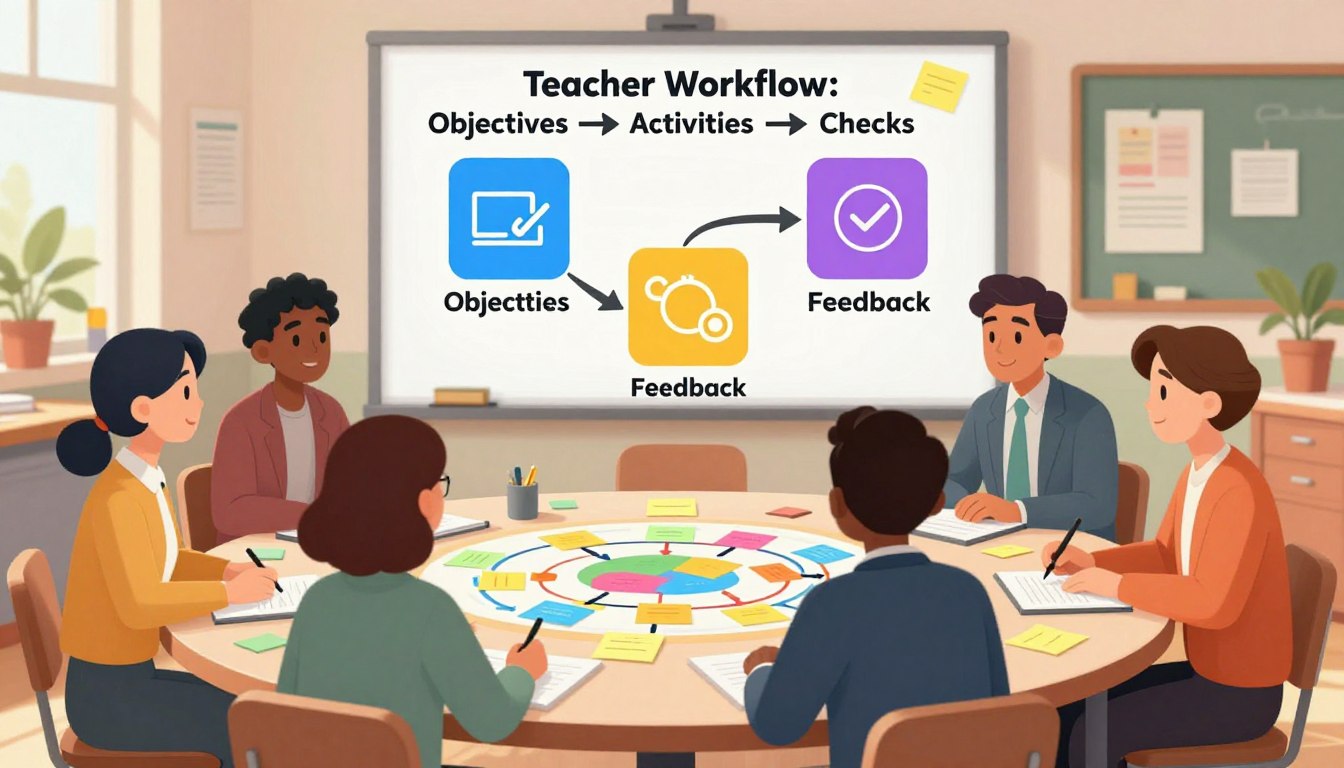
“Education is not preparation for life; education is life itself.” – John Dewey’s timeless insight captures the essence of what happens in classrooms every day. Great instruction involves countless subtle decisions that shape student outcomes.
Educators navigate a continuous cycle of planning, execution, and refinement. This framework transforms isolated lessons into strategic, cohesive learning experiences. Each stage builds upon the previous one, creating momentum that benefits all learners.
The process begins with clear goals that define student success. Engaging experiences then facilitate meaningful learning. Robust assessments measure understanding, while constructive guidance informs future instruction.
Modern tools like Flowscholar amplify this framework without replacing human expertise. These AI-powered educational tools handle routine tasks, freeing educators to focus on relationship-driven aspects of instruction.
Mastering this approach empowers intentional decision-making and effective time allocation. It creates environments where young people thrive academically and developmentally.
Key Takeaways
- The instructional framework represents a continuous improvement cycle
- Clear learning goals establish the foundation for student success
- Engaging experiences facilitate meaningful educational moments
- Assessment methods provide crucial understanding checks
- Constructive guidance informs future teaching decisions
- Technology enhances rather than replaces educator expertise
- This approach benefits learners at all starting points
Introduction to the Teacher Workflow
At the heart of every successful classroom lies a dynamic, interconnected process that guides student growth. This methodology represents a significant shift from periodic reviews to an ongoing cycle of refinement.
Educators navigate a framework built on four core pillars. Clear goals establish the destination for learning. Engaging experiences allow pupils to practice and build skills.
Formative checks provide real-time snapshots of understanding. Actionable insights then close the loop, informing the next instructional steps.
Overview of a Cohesive Instructional Process
This cohesive process functions as an engine for improvement. Each phase directly informs the next, creating momentum.
It transforms static lesson delivery into a responsive practice. Educators can adapt based on evidence from their specific classroom.
| Aspect | Traditional Teaching Evaluation | Continuous Improvement Workflow |
|---|---|---|
| Focus | Annual summative judgment | Ongoing, supportive conversation |
| Data Use | Limited, often delayed | Immediate, data-driven insights |
| Impact on Practice | Infrequent major adjustments | Constant, incremental refinements |
| Outcome for Students | Variable, less responsive | Sustained growth and adaptation |
Importance of Continuous Improvement in Teaching
Embracing this cycle is crucial for professional development. It moves beyond a once-a-year event to become part of daily practice.
Small, consistent adjustments compound over time. They produce significant gains in pupil outcomes. This approach empowers educators to reflect deeply on their craft.
Technology integration, such as strategies for modern lesson planning, amplifies this capacity. It helps gather meaningful data without overwhelming workloads.
Defining the Core Components of Effective Teaching
Purposeful instruction hinges on two foundational pillars: well-defined targets and the experiences crafted to reach them. These elements work in concert to create meaningful educational moments.
Setting Clear Objectives
Strong lesson planning starts with precise goals. These targets answer critical questions for young learners: What will I learn today? Why does it matter? How will I know I’ve succeeded?
Effective objectives are measurable and aligned with standards. They provide a north star for the entire learning process. This clarity builds student agency and motivation.
Strategic planning considers grade level, subject standards, and time constraints. It also accounts for diverse learner needs including ELL support and IEP accommodations.
Designing Engaging Activities
Well-crafted activities transform abstract goals into concrete experiences. They provide opportunities for pupils to apply skills in authentic contexts.
Successful design incorporates multiple entry points for different learning styles. It balances challenge with support to maintain productive engagement. Every task should clearly connect to one or more learning objectives.
Educators must think strategically about the learning process. What prior knowledge needs activation? What scaffolds will support struggling learners? What extensions will challenge advanced students?
This intentional alignment between objectives and activities creates coherent understanding over time. It moves beyond isolated facts toward genuine mastery.
Leveraging an Education AI Tool for Modern Classrooms
Today’s classrooms operate under unprecedented pressures, making smart technological integration essential for sustainable teaching. Platforms like Flowscholar represent the next generation of educational support systems.
Introduction to Flowscholar
Flowscholar stands as a comprehensive AI-powered platform designed specifically for educational environments. This sophisticated tool assists educators across the entire instructional cycle without disrupting established workflows.
The platform seamlessly integrates with existing Learning Management Systems. It respects educators’ valuable planning time while providing meaningful insights.
Integrating AI for Real-Time Feedback
Traditional observation cycles often delay feedback for weeks. Flowscholar transforms this process through immediate, data-driven insights.
The technology analyzes classroom interactions and assessment data in real-time. It identifies patterns that might otherwise remain invisible to educators.
| Feature | Traditional Approach | AI-Enhanced System |
|---|---|---|
| Response Time | Weeks or months | Immediate analysis |
| Data Sources | Limited observations | Comprehensive classroom data |
| Personalization | Generic recommendations | Framework-specific insights |
| Impact on Students | Delayed improvements | Continuous adaptation |
This approach augments human expertise rather than replacing it. Educators gain objective metrics to inform their instructional decisions.
Streamlining Objectives Setting for Learning Success
Clear learning targets transform classroom experiences from random activities to purposeful growth. This precision saves valuable instructional time while ensuring every moment contributes to student progress.
Aligning Objectives with Educational Standards
Modern AI platforms revolutionize how educators approach goal-setting. These tools analyze grade-level standards and suggest measurable targets aligned with curriculum requirements.
Effective planning now incorporates specific parameters. Educators input grade level, standard codes, time constraints, and learner characteristics. Constrained prompts yield pedagogically relevant outputs that maintain academic rigor.
| Feature | Traditional Method | AI-Enhanced Approach |
|---|---|---|
| Time Investment | Manual research and writing | Automated suggestions and alignment |
| Standards Alignment | Individual verification required | Automatic database integration |
| Differentiation Support | Limited phrasing options | Multiple readability levels |
| Cognitive Balance | Manual Bloom’s taxonomy application | Built-in rigor and accessibility checks |
| Progress Monitoring | Separate documentation | Continuous alignment reporting |
This streamlined process doesn’t dilute expectations. Instead, it ensures all pupils understand what success looks like. Educators reclaim time for sophisticated instructional decisions that drive meaningful learning outcomes.
Technology handles administrative burdens while human expertise focuses on anticipating misconceptions and designing authentic assessments. This partnership elevates educational performance across diverse classroom environments.
Crafting Engaging Classroom Activities
Dynamic learning environments thrive when instructional design prioritizes student engagement through thoughtfully crafted experiences. These moments transform passive reception into active knowledge construction.
Well-designed activities provide opportunities for skill application and concept exploration. They honor diverse learning preferences through varied modalities and collaborative formats.
Incorporating Differentiated Tasks
Effective differentiation acknowledges that students enter learning with different readiness levels and interests. It creates multiple pathways to the same rigorous destination.
Differentiated tasks maintain consistent expectations while varying access points and support levels. This approach ensures equity without limiting opportunities for any learner.
Utilizing AI to Enhance Lesson Plans
Modern platforms like Flowscholar serve as creative partners in lesson design. They help educators rapidly generate activity variations tailored to specific learner needs.
AI tools can produce foundation, core, and challenge level versions of the same content. Each targets identical learning objectives while providing appropriate scaffolding.
| Design Element | Traditional Method | AI-Enhanced Approach |
|---|---|---|
| Differentiation | Manual creation of variations | Automated level adjustments |
| Time Investment | Hours per activity | Minutes for multiple versions |
| Scaffolding | Generic support strategies | Specific learner accommodations |
| Engagement | Limited choice options | Multiple modality suggestions |
This technology handles administrative burdens while educators focus on anticipating student responses. The partnership elevates classroom experiences for all participants.
Implementing Robust Checks and Data-Driven Assessments
Formative assessment represents the diagnostic pulse of modern instruction, offering immediate insights into student comprehension. Unlike traditional testing that occurs after learning concludes, these continuous checks provide real-time evidence of understanding.

Automated systems dramatically increase assessment frequency without overwhelming educators. They handle routine evaluation tasks while preserving human judgment for complex analysis.
Automated Feedback Systems for Accuracy
These technologies analyze student work with remarkable precision. Research from Stanford demonstrates their positive impact on engagement and satisfaction.
Systems track instructional patterns like question types and response timing. This objective data helps educators identify areas for improvement.
| Feature | Traditional Assessment | Automated System |
|---|---|---|
| Timing | End-of-unit evaluation | Continuous monitoring |
| Bias Potential | Human judgment influenced | Objective criteria applied |
| Data Richness | Limited snapshots | Comprehensive patterns |
| Implementation | Manual grading burden | Streamlined processes |
Effective implementation requires clear success criteria. The strategic question involves balancing automated and human evaluation for optimal results.
This approach transforms assessment from a grading exercise into a growth catalyst. It empowers educators to make evidence-based instructional decisions.
Integrating Effective Feedback Mechanisms
Constructive comments represent the final, crucial link in the learning chain. This guidance serves dual purposes: helping learners improve their current work while informing instructional decisions for future lessons.
Timing dramatically influences impact. Immediate insights during drafting allow for real-time adjustments. Summative evaluation after completion primarily assesses final quality.
Immediate vs. Summative Feedback
Research consistently shows that prompt, specific guidance yields better results than delayed comments. Effective feedback focuses on the task rather than the person and includes revision opportunities.
Classroom reality often makes this ideal challenging. Educators facing numerous assignments struggle to provide detailed comments quickly. This is where technology creates meaningful change.
| Characteristic | Immediate Feedback | Summative Feedback |
|---|---|---|
| Primary Purpose | Improvement during process | Evaluation of final product |
| Student Impact | Corrects misconceptions | Documents achievement |
| Implementation | Continuous during work | After task completion |
| Teacher Role | Coach and guide | Evaluator and recorder |
Automated systems now handle initial analysis of writing assignments. Tools integrated with platforms like Google Docs generate draft comments for educator review. This approach maintains quality while saving valuable hours.
Feedback is most effective when students can use it to improve their work while still engaged in the learning process.
Strategic implementation involves transparency. Educators explain that technology provides initial analysis while they add context and motivation. This partnership ensures every learner receives timely, personalized guidance.
Saved time can be reinvested in higher-impact activities. These include one-on-one conferences and creative assessment design. Platforms like BookWidgets demonstrate how technology enhances without replacing human connection.
Reflecting on Instructional Practices with Technology
Professional growth in education increasingly relies on technology-enhanced reflection that provides objective insights into classroom dynamics. This approach transforms routine lesson execution into deliberate, evidence-informed refinement.
Traditional reflection often suffers from selective memory bias. Educators naturally remember successful moments while overlooking instances where explanations confused rather than clarified. Technology offers unbiased mirrors through classroom transcripts and engagement metrics.
Research demonstrates significant improvements when teachers receive specific, data-driven feedback. A Stanford study found educators using AI tools improved markedly in acknowledging student ideas and asking higher-quality questions.
Effective reflection requires psychological safety and collaborative structures. Educators need trust that data serves growth rather than evaluation. Professional learning communities and peer coaching enhance this process.
The systematic approach follows a consistent cycle: identify focus areas, gather baseline data, implement changes, and reflect on results. This elevates teaching from isolated practice to shared professional endeavor.
Technology-supported reflection empowers educators to build collective expertise tailored to their student populations. It represents a powerful evolution in instructional improvement.
The Teacher Workflow: Objectives → Activities → Checks → Feedback
When educational components function as a unified system rather than isolated steps, they create powerful momentum for student growth. This integrated approach transforms individual lessons into cohesive learning experiences.
Each element amplifies the others in this continuous cycle. Clear targets guide activity design, which generates meaningful assessment data. That information then informs targeted guidance.
| Element | Isolated Implementation | Integrated System |
|---|---|---|
| Planning Focus | Individual lesson components | Cohesive learning progression |
| Student Experience | Disconnected activities | Purposeful skill building |
| Data Utilization | Limited to grading | Drives next instructional steps |
| Educator Impact | Reactive adjustments | Proactive refinement |
Great education systems don’t just sequence lessons—they create learning pathways where each step naturally leads to the next.
Platforms like Flowscholar support this entire process within one ecosystem. They maintain alignment between standards, experiences, and assessment methods. This creates coherent journeys for young learners.
The approach benefits pupils through consistent progress monitoring. Educators gain structure while preserving professional creativity. Technology handles routine tasks, freeing instructors for high-impact interactions.
Strategies for Time-Saving and Classroom Efficiency
Educational professionals constantly seek methods to maximize their limited resources while maintaining instructional excellence. Smart automation represents a powerful approach to this challenge.

Platforms like Flowscharter handle routine cognitive work efficiently. They generate differentiated materials and provide initial writing feedback.
Automating Repetitive Tasks
This approach doesn’t depersonalize education. Instead, it delegates mechanical tasks to technology. Educators preserve their energy for relational aspects.
Consider essay grading: marking 150 papers takes approximately 12.5 hours. Automated systems handle grammar and structure checks quickly. This frees teachers to focus on content quality.
The key question becomes: “Does this task require my unique expertise?” Routine activities become automation candidates. This strategic thinking transforms daily work.
Effective implementation requires initial investment. Learning to craft precise prompts and establish workflows pays dividends. The process eventually saves significant time.
Saved hours compound throughout the school year. Thirty minutes weekly recovery equals 18 hours annually. This represents valuable time for higher-impact activities.
Educators can explore comprehensive productivity strategies to maximize these gains. The right tool creates consistency while improving equity.
Ultimately, these strategies enable smarter work—not just less work. They protect space for the deeply human aspects of education that transform young learners.
Planning for Strategic AI Implementation in Schools
Strategic implementation of educational technology requires more than purchasing licenses—it demands cultural transformation. District leaders must approach AI tools as systemic changes affecting pedagogy, policy, and professional practice.
Successful adoption begins with clarity about institutional needs. Are schools seeking workload reduction, differentiation improvement, or assessment enhancement? Clear goals guide vendor selection and success metrics.
Educator buy-in proves non-negotiable. Teachers must see how technology supports rather than evaluates their work. Including educator voices in selection processes ensures tools serve actual classroom needs.
Data privacy considerations remain paramount. District policies must address FERPA compliance and vendor data agreements. A thorough risk assessment protects student information.
Professional development should focus on pedagogical integration, not just technical skills. Teachers need support in prompt engineering and workflow adaptation.
Pilot programs allow manageable testing before full rollout. A six-to-eight-week study with diverse participants surfaces practical challenges. This approach helps refine implementation strategies.
Metrics should balance efficiency gains with quality indicators. Track time savings alongside educator satisfaction and student engagement. Equity measures ensure all learner groups benefit equally.
Long-term success requires ongoing support structures. Communities of practice and regular feedback loops help schools continuously improve their AI integration. This strategic planning transforms technology from disruption to enhancement.
Conclusion
In an era of educational transformation, the most effective classrooms blend human expertise with artificial intelligence. This powerful combination elevates teaching from isolated tasks to a continuous improvement cycle.
Educators who embrace tools like Flowscholar report significant benefits. They gain time for creative lesson design and meaningful student relationships. Better data informs instructional decisions, while consistent feedback supports learner growth.
Successful implementation requires strategic planning around pedagogy and professional development. Schools must prioritize features that solve core challenges. This ensures technology becomes an essential part of school culture.
The future of education isn’t about choosing between human judgment and artificial intelligence. It’s about leveraging both strategically. Technology handles routine tasks, freeing educators to focus on high-value work that transforms young lives.
Explore how Flowscholar can enhance your teaching practice. Consider complementing this with professional development through AI skills workshops to maximize your impact on student learning.
FAQ
What is the core purpose of the teacher workflow model?
The workflow’s primary purpose is to create a structured, repeatable process for planning and delivering instruction. It ensures that learning goals, student tasks, and performance checks are tightly aligned. This model helps educators maximize student engagement and achievement by focusing on a clear sequence: defining objectives, designing activities, implementing checks, and providing feedback.
How can technology like Flowschary support this workflow?
Tools like Flowschary integrate artificial intelligence to assist educators at every stage. They can help teachers formulate clear objectives aligned with standards, suggest differentiated activities for various learning levels, and automate the collection of assessment data. This technology provides real-time insights, saving valuable planning hours and enabling more personalized support for each student.
Why is immediate feedback so critical in the learning process?
Immediate feedback allows students to correct misunderstandings and refine their skills while the lesson content is still fresh. This timely intervention is far more effective than summative feedback delivered days or weeks later. It turns assessments into active learning moments, helping students grasp concepts more deeply and improve their performance on subsequent tasks.
What are some strategies for creating engaging classroom activities?
Effective strategies include incorporating differentiated tasks that cater to diverse student needs and interests. Utilizing project-based learning, collaborative group work, and interactive technology can boost engagement. Educators can also use AI tools to analyze student data and generate personalized activity ideas that align with the lesson’s core objectives.
How does this workflow help with time management for educators?
By providing a clear framework, the workflow reduces time spent on lesson planning and grading. Automating repetitive tasks like data collection and initial feedback frees up educators to focus on high-impact teaching strategies, such as one-on-one student support and refining instructional content. This leads to greater classroom efficiency and less teacher burnout.
What should a school district consider before implementing a new teaching tool?
Districts should evaluate the tool’s alignment with existing curriculum goals and its ease of integration into daily practice. Professional development for staff is essential to ensure confident adoption. It’s also crucial to assess the tool’s data security measures and its ability to provide actionable insights that genuinely support student learning and growth.