“If you want to go quickly, go alone. If you want to go far, go together.” This African proverb perfectly captures education’s collaborative spirit. Modern institutions build these connections through strategic communication.
Email remains the cornerstone of educational outreach. It maintains consistent contact with prospective learners throughout their enrollment journey. A 2025 survey reveals open rates around 45% for institutions—significantly outperforming many industries.
This channel creates meaningful connections between communities and organizations. Learning experiences often engage entire families more effectively than other marketing avenues.
Crafting personalized messages for every interaction strains resources. Pre-designed templates offer a strategic solution. They enable schools to maintain timely communication at scale.
This guide bridges traditional wisdom with modern automation. Tools like Flowscholar.com empower marketers to implement sophisticated sequences efficiently. We explore templates that build relationships and drive enrollment actions.
Key Takeaways
- Email is the most powerful tool for maintaining contact throughout the enrollment process.
- Educational institutions achieve high open rates, around 45%, making email a top-performing channel.
- Strategic templates allow for personalized communication without draining staff resources.
- Effective email sequences build relationships and guide prospects toward enrollment.
- Modern AI tools can enhance template efficiency and personalization capabilities.
- Communication should engage not just prospective students but often their entire families.
- A well-planned email strategy keeps institutions front-of-mind during decision-making.
Importance of Email Templates in Educational Marketing
In the competitive landscape of academic recruitment, standardized communication is no longer a luxury but a strategic necessity. Pre-designed frameworks provide a powerful foundation for outreach efforts. They transform sporadic contact into a cohesive journey for each individual.
This approach ensures marketing teams can operate efficiently. It allows them to focus on strategy rather than repetitive drafting.
Boosting Engagement with Consistent Messaging
A primary advantage lies in delivering a uniform experience. Every inquiry receives the same high-quality response, regardless of staff workload or time of day. This consistency builds institutional credibility.
Families begin to recognize the organization’s voice and values. Repeated, professional touchpoints foster trust and reinforce the brand. This reliability is crucial during the decision-making process.
Streamlining Communication with Automation
Automation elevates templates from static documents to dynamic tools. Systems can trigger specific messages based on actions, like a submitted inquiry form. This creates an immediate, personalized welcome.
Such timely responses keep the institution front-of-mind. They guide prospects through enrollment steps without manual effort. Staff gain valuable time to address complex, individual needs.
This synergy between prepared content and smart delivery is transformative. It enables personalization at a scale that would otherwise be impossible. The result is a more efficient and effective pathway to enrollment.
Key Elements of an Effective School Email Template
Several foundational pillars separate mediocre templates from those that consistently capture attention. These components work together to create messages that resonate with recipients.
Crafting Compelling Subject Lines
Research reveals the extraordinary power of subject lines. An OptinMonster survey found 47% of recipients decide whether to open an email based solely on this element.
Remarkably, 69% use subject lines to determine spam classification. This underscores their critical role in communication success.
Effective subject lines follow proven formulas. They remain under 50 characters with clear sender identification. A friendly tone and action-oriented language drive engagement.
Personalization and Visual Appeal
Merge fields transform generic bulk emails into individually crafted messages. Systems automatically populate tokens with recipient names and program interests.
This approach maintains relevance without manual effort. Visual elements serve strategic purposes beyond decoration.
Campus photos and program-specific imagery reinforce messaging. They sustain engagement throughout longer communications. Proper balance ensures essential information communicates effectively even when images don’t load.
Each template element functions as part of an integrated system. Subject lines capture attention while personalization maintains relevance. Visual appeal then carries engagement through to the final call-to-action.
Designing Mobile-Friendly and Responsive Templates
With mobile devices dominating email consumption, responsive design has become non-negotiable for educational outreach. HubSpot research reveals 41% of communication opens occur on smartphones, with tablets adding another 19%. This 60% mobile majority fundamentally shapes template architecture.
Optimizing Layout and Imagery
Single-column layouts provide the most reliable mobile experience. Multiple columns that appear elegant on desktop can create confusion on narrower screens. Larger font sizes ensure readability without zooming.
Button-based calls-to-action outperform text links for touch navigation. Images should complement rather than carry essential messaging. Many mobile clients disable automatic image loading by default.
Strategic image sizing balances visual impact with loading speed. Pictures under 200 pixels in height and 600 pixels in width prevent abandonment from slow rendering. This technical detail makes sure messages load quickly across all connection types.
Ensuring Dark Mode and Cross-Device Compatibility
Dark mode compatibility addresses growing user preference for reduced eye strain and battery conservation. Templates must remain visually appealing against both light and dark backgrounds. Testing across multiple platforms ensures consistent presentation.
| Device Type | Design Consideration | Optimal Specification |
|---|---|---|
| Mobile | Single-column layout | Font size 16px+ |
| Tablet | Touch-friendly buttons | Minimum 44px touch targets |
| Dark Mode | Contrast ratios | 4.5:1 minimum |
Responsive design creates flexible templates that automatically adapt to each recipient’s screen size and display preferences. This approach eliminates the need for separate versions while maximizing engagement across all viewing environments today.
The Student Email Templates You’ll Use All Year
Educational institutions manage complex communication cycles that evolve with prospective learners’ readiness. Different enrollment stages demand specialized approaches to maintain engagement.
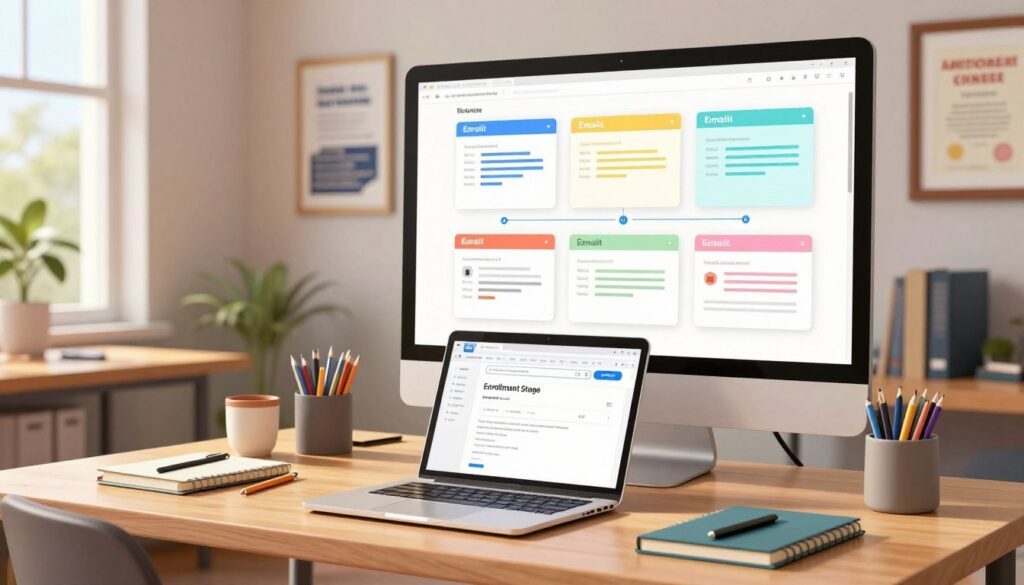
Template Variations for Each Enrollment Stage
The enrollment journey unfolds through distinct phases. Discovery messages introduce program offerings to curious prospects. Consideration content addresses specific questions about curriculum and outcomes.
Application-stage communications guide candidates through submission requirements. Decision-focused emails provide deadline reminders and financial aid information. Final enrollment messages confirm registration details and orientation schedules.
Each template variation serves a specific purpose in the recruitment timeline. They prevent communication fatigue by matching message intensity to prospect readiness.
How Automation Enhances Template Efficiency
Modern platforms transform static documents into dynamic communication systems. Trigger-based automation sends responses immediately after prospect actions.
Form submissions generate welcome sequences automatically. Incomplete applications trigger reminder messages as deadlines approach. Registration milestones initiate congratulatory notes with next-step guidance.
Merge fields like {First Name} and {Program Interest} personalize content at scale. This creates individually crafted messages without manual effort. Automation ensures timely follow-up while freeing staff for complex inquiries.
Strategic template orchestration guides candidates through their entire enrollment journey with precision timing.
Platforms like Flowscholar.com optimize this process. They coordinate message sequences that deliver appropriate information at the right moments.
Email Templates Tailored for Different Enrollment Phases
Summer months offer a unique opportunity to engage future scholars when they have mental space to consider their academic futures. Communication during this period should balance excitement with practical guidance.
Reaching Out to High School Seniors
Arizona State University demonstrates effective summer outreach with cheerful templates that acknowledge seasonal enthusiasm while framing future planning. Their approach includes subject lines like “Summer’s officially here!” that create positive associations.
These messages provide multiple engagement pathways. They invite participation in summer camps, campus visits, and early application preparation. This multi-option strategy accommodates varying readiness levels while maintaining forward momentum.
Engaging Prospective Applicants with Custom Messages
As candidates progress deeper into consideration, communication shifts toward specific support. The University of San Diego Kroc School models this with templates offering Office Hours registration and application assistance.
Course exploration messages respond directly to expressed interests. They deliver detailed program , career pathways, and growth projections. Clear calls-to-action prospects to comprehensive resources.
This supportive approach reduces application friction. It positions the institution as a helpful partner rather than another pressure source. Educational marketers can find additional strategic templates for student engagement that build trust during critical decision-making phases.
Incorporating Education AI Tools for Email Optimization
Artificial intelligence is reshaping how educational institutions approach communication strategies. These intelligent platforms transform standard templates into adaptive systems that respond to individual recipient behaviors and preferences.
Leveraging Flowscholar.com to Automate Campaigns
Specialized education platforms like Flowscholar.com understand unique academic workflows. They analyze student data—demographics, engagement patterns, application status—to customize content automatically.
This approach delivers significant benefits. AI serves as a drafting partner that generates personalized variations incorporating program interests and previous interactions. Platforms can make email communication more effective through predictive send-time optimization and continuous subject line testing.
Effective implementation requires clear strategic direction. Marketers define goals and brand voice parameters while AI handles execution. This partnership allows institutions to scale personalization without increasing workload.
For those exploring AI capabilities, resources like AI-powered course creation provide valuable foundational knowledge. The right platform transforms static templates into dynamic conversation tools that build stronger relationships throughout the enrollment journey.
Best Practices for Email Marketing and Template Customization
Optimizing communication channels involves adopting frameworks that have demonstrated measurable success. These established methodologies form the backbone of effective outreach campaigns.
Campaign performance improves significantly when institutions implement systematic approaches. Data reveals personalized messages achieve open rate improvements exceeding 300%.
Personalizing Content and Subject Lines
Sophisticated customization extends beyond basic name insertion. Effective strategies incorporate program-specific content and acknowledgment of previous interactions.
Segmentation forms the foundation for meaningful personalization. Dividing audiences by program interest and engagement level enables appropriately tailored messaging.
Single-CTA focus proves essential for driving measurable completion rates. Messages attempting multiple actions typically achieve none effectively.
Clear contact information builds trust and demonstrates institutional accessibility. This practice differentiates supportive organizations from impersonal bureaucracies.
Continuous improvement through performance tracking establishes optimization cycles. Metrics for open rates and conversions refine timing and messaging approaches. Educational instructors can leverage these frameworks to enhance communication effectiveness.
Integrating Multimedia and Social Media Elements
Strategic multimedia integration elevates standard email templates into immersive communication experiences. These elements capture attention and convey institutional spirit in a way text alone cannot achieve.

Visual content transforms messages from informational documents into engaging journeys. This approach strengthens brand connection and emotional resonance.
Utilizing Relevant Images and Videos
A clear hierarchy exists for visual content effectiveness. Authentic in-house photography of campus life builds the most genuine connection and trust.
User-generated content serves as powerful social proof. Encouraging shares with branded hashtags creates a library of authentic material.
- In-house visuals: Photos of facilities, events, and actual students.
- User-generated content: Shared experiences from the community.
- Stock imagery: Used sparingly for specific thematic support.
Each image should add context and value beyond the accompanying text. Selecting relevant visuals turns them into strategic communication tools. Resources like online yearbooks demonstrate effective visual storytelling.
Linking to Social Media for Extended Engagement
Email messages can serve as bridges to extended engagement on social platforms. Incorporating follow buttons and share prompts expands reach beyond the original recipient list.
This creates an audience expansion strategy. Interested individuals become potential amplifiers who share content within their networks.
The approach balances email self-sufficiency with social extension. Templates deliver complete messages while offering pathways for deeper exploration. This builds community-driven enrollment momentum across multiple channels.
Call-to-Action Strategies to Drive Student Interaction
Effective communication campaigns culminate in decisive moments where recipients must take measurable steps forward. Strategic call-to-action design transforms passive readers into active participants who complete enrollment actions.
Creating Prominent CTA Buttons
Visual prominence determines conversion success. Bold contrasting colors draw immediate attention to desired actions. Generous white space eliminates visual competition around each button.
Mobile optimization requires adequate sizing for easy tapping. Buttons outperform text links on smaller screens. Proper placement ensures visibility without scrolling.
Encouraging Immediate Action with Clear Messaging
Action-oriented language creates compelling invitations. Phrases like “Schedule Your Visit” outperform generic “Learn More” options. Specificity builds confidence in next steps.
Single-focus approach prevents decision paralysis. Each message should guide toward one primary action. Multiple placements accommodate different reading patterns.
Strategic alignment between content and destination eliminates friction. Buttons must deliver exactly what messaging promises. This consistency builds trust throughout the enrollment journey.
Conclusion
The transformation of sporadic outreach into a cohesive enrollment pathway represents a fundamental shift in educational marketing. Today’s prospective learners face overwhelming options, making consistent communication essential for standing out.
Well-designed frameworks address diverse audience needs throughout the entire journey. From initial inquiry to final registration, these systems deliver timely reminders and relevant information. They ensure every interaction builds toward enrollment success.
Combining strategic content with automation creates responsive communication ecosystems. This approach maximizes efficiency while maintaining personal touchpoints. Institutions can explore comprehensive email templates that span various educational scenarios.
Educational marketers should view this as an ongoing optimization process. Continuous refinement of subject lines, content personalization, and call-to-action testing drives measurable improvements. The right platform transforms static documents into dynamic engagement tools.
Flowscholar.com provides the comprehensive solution discussed throughout this guide. It combines strategic frameworks with intelligent automation capabilities. This empowers institutions to implement these insights and achieve significant enrollment growth.
FAQ
Why are email templates important for educational institutions?
Email templates provide a consistent and professional framework for communication. They streamline outreach, saving valuable time for staff while ensuring every message to students and prospects maintains brand voice and clarity. This consistency boosts engagement and builds trust throughout the enrollment journey.
What are the essential components of a high-performing student email?
A compelling subject line is critical to capture attention. The email body should feature personalized content, a clear visual hierarchy, and a prominent call-to-action button. Ensuring the design is mobile-friendly and loads quickly across all devices is also fundamental for modern audiences.
How can personalization improve email campaign results?
Personalization goes beyond using a student’s first name. It involves tailoring content based on their interests, application stage, or past interactions. This relevance significantly increases open rates and click-throughs, making the recipient feel valued and understood, which drives higher conversion rates.
What role does automation play in managing student communication?
Automation platforms, like Flowscholar.com, allow institutions to set up triggered email sequences based on specific actions or dates. This ensures timely follow-ups, such as application reminders or course registration deadlines, without manual effort, leading to a more efficient and scalable communication strategy.
How should calls-to-action be designed to encourage interaction?
Calls-to-action should be visually distinct, using a contrasting button color. The messaging must be action-oriented and specific, such as “Schedule Your Campus Tour Today” or “Complete Your Application.” Placing the CTA button strategically within the email copy prompts immediate and clear next steps for the student.
Why is mobile optimization non-negotiable for educational emails?
A significant portion of students access emails primarily on smartphones. A mobile-optimized template with a responsive layout, legible fonts, and appropriately sized images and buttons guarantees a positive user experience. Neglecting this can lead to frustration and missed engagement opportunities.
Can integrating social media enhance an email campaign’s impact?
Absolutely. Including links to social media platforms extends the conversation beyond the inbox. Students can connect with the community, see campus life, and engage with user-generated content. This multi-channel approach builds a stronger, more relatable brand presence.