As Benjamin Franklin once said, “An investment in knowledge pays the best interest.” For students, this investment is crucial, especially when faced with a vast amount of material to learn. The challenge lies not just in understanding the content, but in retaining it over time.
Rereading notes and textbooks is a common study habit, but research shows that this passive approach is not the most effective way to retain information. Instead, active recall has emerged as a superior learning technique, strengthening memory by actively engaging students with the material.
By adopting active recall, students can significantly improve their learning outcomes. Tools like FlowScholar can further enhance this approach, providing a structured way to implement active recall and maximize retention.
Key Takeaways
- Active recall is a more effective learning technique than passive rereading.
- Strengthening memory through active recall leads to better retention.
- Tools like FlowScholar can enhance the active recall process.
- Adopting active recall can improve learning outcomes for students.
- Active recall involves actively engaging with study material.
Understanding the Science of Learning
The human brain’s ability to learn and remember is rooted in its intricate neural connections. When we learn new information, our brain creates new pathways between neurons, strengthening the connections each time we recall the information.
How Your Brain Forms Memories
The process of forming memories involves encoding, consolidating, and retrieving information. Research shows that the effort of retrieval strengthens the memory trace, making it more durable. This process creates multiple pathways to the same information, ensuring that if one pathway weakens, others remain available.
Why Most Students Study Ineffectively
Many students rely on ineffective study methods because they misunderstand how learning actually works. They often focus on recognition rather than active recall, which doesn’t translate to actual retrieval ability during exams. By understanding these fundamental brain processes, we can adopt more effective study strategies that enhance our ability to recall information.
For more information on learning strategies, you can visit https://www.5staressays.com/blog/active-recall-vs-passive-reading to explore the benefits of active recall versus passive reading.
What Is Active Recall?
Active recall is a powerful study technique that involves actively recalling information from memory without relying on notes or textbooks. This method is centered around the concept of retrieval practice, where the act of recalling information strengthens the neural pathways associated with that knowledge, making it easier to remember in the future.

The Retrieval Practice Mechanism
The retrieval practice mechanism is fundamental to how active recall works. Each time you successfully retrieve information from memory, you strengthen the neural connections related to that information. This process can be likened to creating a well-worn path through a forest; the more you walk it, the clearer and easier it becomes to navigate. By leveraging this mechanism, active recall enhances your ability to retain and recall information.
Why Struggle Strengthens
The struggle experienced during active recall is not only beneficial but necessary for effective learning. This productive difficulty forces the brain to work harder, thereby strengthening memory pathways and making future retrieval more reliable. Research has shown that even unsuccessful retrieval attempts can be beneficial when followed by correct feedback, underscoring the effectiveness of active recall as a learning method. For more information on active recall, visit this resource.
| Study Technique | Description | Effectiveness |
|---|---|---|
| Active Recall | Involves actively recalling information from memory | High |
| Passive Rereading | Involves rereading material without active engagement | Low |
The Problem with Passive Rereading
Passive rereading is a common study technique where students read through their notes or textbooks multiple times, hoping to absorb the information. However, this method creates a dangerous illusion of competence without building actual retrieval strength.
The Illusion of Competence
When students reread their study materials, their brain recognizes the information, signaling “I know this.” This recognition is often mistaken for true understanding or mastery. Research shows that students who rely on passive rereading overestimate their knowledge by 30-50%, leading to false confidence before exams and subsequent disappointment.
Recognition vs. True Recall
The human brain has two distinct memory systems: recognition and recall. Recognition is the ability to identify information as familiar, whereas recall is the ability to retrieve information from memory without prompts. Exams test recall, but passive reading only builds recognition. To perform well on exams, students need to practice recall through active methods.
| Study Method | Effectiveness |
|---|---|
| Passive Rereading | Limited – Strengthens recognition, not recall |
| Active Recall | High – Improves ability to retrieve information independently |
Active recall is a more effective study technique that involves actively recalling information from memory rather than simply re-reading it. By practicing active recall, students can significantly improve their exam performance.
The Best Way to Review: Active Recall vs Rereading (Student Version)
The debate between active recall and rereading has been settled by research, showing a clear winner in terms of retention and efficiency. Studies have consistently demonstrated that active recall dramatically outperforms passive rereading in retention rates.
Retention Rates Compared
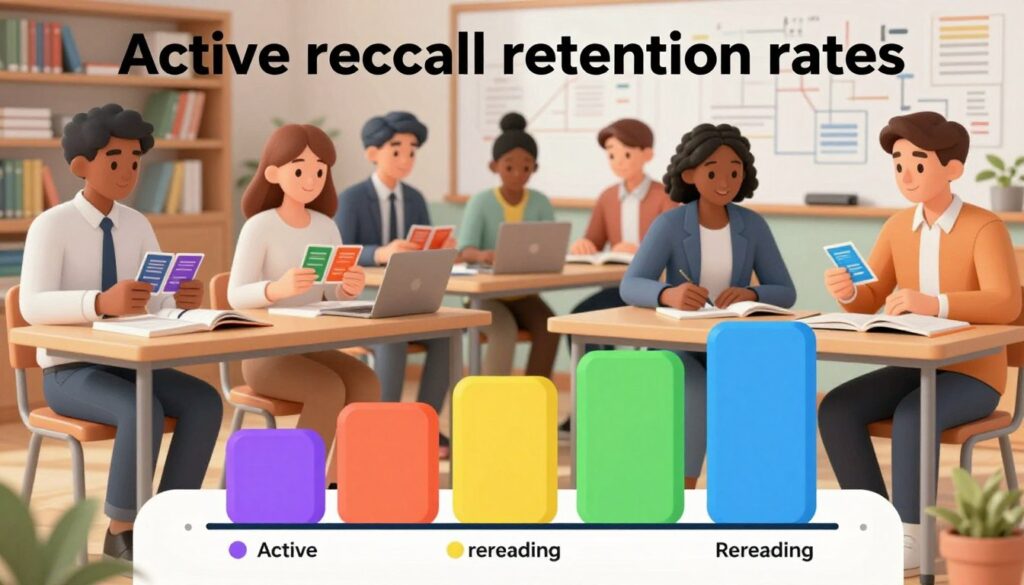
Research comparing active recall vs passive reading shows that while both methods have similar retention rates immediately after studying (85-90% for active recall vs. 80-85% for passive rereading), the gap widens significantly within 24 hours. By 1 week, active recall retains 60-70% of the material, whereas passive rereading retains only 10-15%, a difference of 50-55%. For more detailed information on the research, visit NeuroLearnLab.
Time Efficiency Benefits
The time efficiency benefit of active recall is substantial. Students using active recall techniques typically spend 40% less total study time while achieving better results than those using passive methods. By leveraging active recall, students can optimize their study routine and improve retention.
- Active recall produces medium to large improvements across all subjects and age groups.
- Combining active recall with spaced repetition maintains retention rates above 80% even months after initial learning.
Practical Active Recall Techniques for Students
Active recall is a powerful learning technique that involves actively recalling information from memory rather than simply re-reading it. This method has been shown to improve retention and understanding of material.
The Blank Page Method
The Blank Page Method is a simple yet effective technique for active recall. After studying a topic, close your notes and write down everything you can remember. This helps to identify what you’ve retained and what you need to review further.
Effective Flashcard Strategies
Flashcards are a popular tool for active recall. To use them effectively, create cards with meaningful questions on one side and the answers on the other. Review them regularly, using spaced repetition to help solidify the information in your long-term memory.
How FlowScholar Enhances Active Recall
FlowScholar is an AI-powered learning tool that can enhance active recall by providing personalized question generation and adaptive difficulty adjustment. It helps to identify knowledge gaps and optimize the learning process.
Conclusion
The scientific consensus is clear: active recall is the key to unlocking superior learning outcomes, including higher exam scores and improved retention. By implementing active recall techniques, such as the blank page method and strategic flashcards, students can significantly enhance their learning process. This approach not only strengthens memory but also offers time efficiency benefits. To experience the benefits of optimized active recall learning, visit FlowScholar.com today.
FAQ
What is active recall, and how does it differ from passive rereading?
Active recall is a learning technique that involves actively recalling information from memory, whereas passive rereading involves simply re-reading material without engaging with it. Active recall strengthens memory pathways and promotes retention.
How does active recall improve retention rates?
Active recall improves retention rates by reinforcing the connection between neurons in the brain, making it easier to recall information over time. This process strengthens memory and promotes long-term retention.
What are some effective active recall techniques for students?
Effective active recall techniques include the blank page method, where students recall information from memory without looking at notes or other resources, and flashcard strategies, which involve actively recalling information from cards.
How can I implement active recall into my study routine?
To implement active recall, start by identifying key concepts and information you want to retain. Then, use techniques like summarizing notes in your own words, creating concept maps, or making flashcards to actively recall the information.
Is active recall more time-efficient than rereading?
Yes, active recall can be more time-efficient than rereading, as it helps to identify knowledge gaps and focus study efforts on areas that need improvement, reducing overall study time.
Can active recall be used for complex or difficult topics?
Yes, active recall can be particularly effective for complex or difficult topics, as it helps to break down information into manageable chunks and reinforce understanding through repetition and practice.
How does active recall impact understanding and comprehension?
Active recall promotes deeper understanding and comprehension by requiring students to engage actively with the material, making connections between different pieces of information, and identifying areas where they need more practice or review.