There are moments when a simple, sharp idea can change a team’s rhythm. Many professionals feel that pressure: tight timelines, high expectations, and a pile of unanswered questions. This guide meets that feeling with clear methods and calm reasoning.
Demand is rising fast. Forbes projects the AI market will hit $1,339 billion by 2030, and marketers already use tools like SurferSEO, Clearscope, Jasper, and ChatGPT. Practical prompts—40–60 words using Act-Task-About-Output—deliver better responses and save time.
This guide explains how to package a repeatable product that fits business goals and buyer needs. It shows why tailored workflows beat generic lists and gives examples that map to roles, datasets, and constraints.
Readers will get a clear path: market context, product definition, client personas, design steps, engineering standards, and delivery. The aim is simple—help teams turn knowledge into measurable results with fewer questions and less friction.
Key Takeaways
- Market momentum creates real opportunity for productized content and services.
- Concise, context-rich prompts yield higher-quality responses and faster results.
- Tailored workflows outperform generic lists for teams and companies.
- A defined tool stack reduces friction across creation, distribution, and support.
- Standardized templates save time while preserving brand language and voice.
Why industry-specific GPT cheat sheets are a timely opportunity
As AI tools mature, the real demand is for compact playbooks that turn raw models into predictable business results. U.S. marketing stacks already embed machine learning across ad delivery, content analysis, and prediction engines. The AI market is projected to reach $1,339 billion by 2030, and that scale changes buyer expectations.
AI market momentum and marketing adoption in the United States
Google and Meta use ML for targeting and bidding. NLP powers chatbots and review responses. Predictive analytics in GA4 and Adobe forecast conversions and churn.
From trend to necessity: where businesses gain efficiency, personalization, and ROI
Cheat sheets bridge research and real work. They package proven patterns so teams can apply analysis and data quickly.
- Faster results: Automate routine tasks and reduce time spent on experiments.
- Better customer personalization across social media, email, and blog channels.
- Repeatable strategies that improve campaign performance and project outcomes.
- Low-friction assets that plug into existing tools and software landscapes.
“Teams buy clarity: examples and steps that cut learning time and raise confidence.”
What industry-specific GPT cheat sheets are and why they sell
Teams buy ready-made workflows that map prompts to real job responsibilities and outcomes.
Definition: These products are role-based prompt systems that bundle concise prompts, workflows, and example responses for a defined niche. Each sheet includes a role tag (for example, “Act as a B2B SaaS lifecycle marketer”), a 40–60 word Act‑Task‑About‑Output prompt, and sample outputs for content, email, and social media campaigns.
The difference from generic prompt lists is clear: context and constraints drive results. Sheets encode ICP details, compliance notes, channel limits, tone standards, and data sources so outputs align with client goals.
- Ready-to-run prompts that shorten setup and reduce rework.
- Role anchors that match how teams already think and work.
- Tool references—ChatGPT, Jasper, SurferSEO—so adoption is frictionless.
“Example inputs and outputs prove adaptability across offers and seasonal shifts.”
| Feature | Generic Lists | Role-Based Sheets |
|---|---|---|
| Context | Minimal | ICP, compliance, channel rules |
| Ready Use | Requires tailoring | Day-one deployment |
| Examples | Often missing | Inputs + outputs for email and social media |
sell, access, to, industry-specific, gpt, cheat, sheets
A clear commercial offer turns prompt collections into repeatable revenue engines for teams that need predictable results.
What buyers get: evergreen and versioned content, concise prompts built on the Act‑Task‑About‑Output formula, and formatted outputs that match channel limits and brand voice.
Specifying language, tone, audience, and formatting greatly improves responses from ChatGPT and similar tools. A single 40–60 word prompt with those constraints yields more accurate outputs and cuts revision cycles.
Why it matters: clear messaging helps prospects see the practical value. Example use cases—email sequences and short-form content for social media—demonstrate time saved and uplift in quality.
“Concise prompts with tone and format rules produce predictable outcomes for teams under deadline.”
- Versioned examples and sample outputs reduce onboarding friction.
- Mapping assets to media planning and content calendars shows ROI.
- Outcome-led positioning makes purchasing decisions straightforward.
| Offering Element | What it Includes | Buyer Benefit |
|---|---|---|
| Prompts | 40–60 word Act‑Task‑About‑Output templates | Faster, predictable copy for email and content |
| Examples | Channel-specific outputs and tone guides | Easier adoption and consistent brand language |
| Versioning | Changelogs and updates | Ongoing relevance and reduced maintenance work |
Pinpoint your ideal buyers and highest-value industries
Pinpointing high-value buyers clarifies where prompts and templates produce measurable lift.
Primary buyers are agencies that run multiple accounts, SMEs with lean teams, and cross-functional groups in marketing, sales, CX, and operations.
Agencies, SMEs, and internal teams
Why they fit: Agencies and brands in digital marketing already deploy AI for ads, SEO, content, and analytics. That makes them ready buyers for role-based prompt systems.
Within a company, champions are leaders who own outcomes and budgets—marketing directors, growth managers, and operations leads. They drive pilots and expand successful projects.
High-fit verticals
Target digital marketing, eCommerce, SaaS, and professional services. These industries run recurring campaigns and hold rich data, so standard templates pay off fast.
- Teams plug sheets into planning cadences and media calendars.
- Buyer research must capture client pain points and channel priorities—improved email performance, tighter media targeting, faster content throughput.
- Scope pilots around one team, one channel, and one KPI for quick wins.
| Buyer Type | Typical Need | Quick Win |
|---|---|---|
| Agency | Repeatable outputs across clients | Cross-industry bundles |
| SME | Limited staff, fast delivery | Single-industry pack |
| Internal Team | Consistent customer messaging | Email and social media templates |
Message focus: connect offerings to measurable outcomes customers care about: higher response rates, shorter production cycles, and consistent outputs across roles.
Design the product: structure, scope, and deliverables
A compact, modular product structure helps teams move from one-off experiments to predictable content outputs.
Core elements: role, task, about, and output standards
Define each artifact around four fields: a precise role, the tasks it performs, an about/context block with critical data, and clear output and tone standards.
Embed the Act‑Task‑About‑Output formula into every prompt. Keep prompts in the 40–60 word range; add audience, tone, and format constraints. That combo raises the quality of responses from chatgpt and similar models.
Deliverable formats: sheets, templates, mini-guides, and SOPs
Package a master sheet, channel templates for social media and email, mini-guides for common scenarios, and SOPs that codify reviews and approvals.
- Structured content with field annotations and examples so every response is fit for purpose.
- A standard response rubric—format, length, and acceptance criteria—so teams know when output is publish-ready.
- Editable files that work across common software and tools for easy integration into existing workstreams.
- Modular design: add roles, prompts, and outputs as the business grows without breaking consistency.
“Define when to iterate prompts and when to change inputs—separate prompt craft from content strategy.”
| Deliverable | Contents | Benefit |
|---|---|---|
| Master sheet | Role, tasks, examples, rubric | Single source of truth for content production |
| Channel pack | Social media + email prompt variants | Fast campaign rollout and seasonal tweaks |
| Mini-guide & SOP | Decision paths, approvals, QA checklist | Fewer revisions, smoother handoffs |
Create the cheat sheets: a repeatable content workflow
Start by turning real customer problems into narrow research fields that guide every prompt and example.
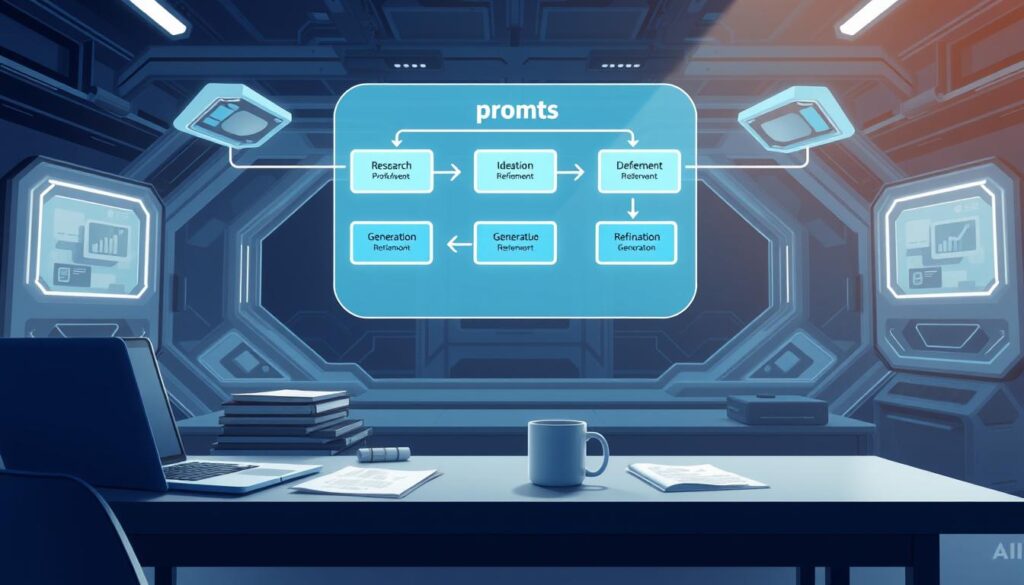
Research first. Gather industry data, audience insight, and competitive examples. Convert findings into fielded inputs that anchor each prompt and provide useful context for the team.
Research and data
Define tasks and acceptance criteria. Capture samples from social media and campaign archives. Use those samples as example inputs for quick testing.
Drafting prompts
Write Act-Task-About-Output prompts in 40-60 words. Include tone, format, and any hard constraints so model responses match the target channel and length.
Few-shot and chain-of-thought
Provide two to three example inputs and outputs. For complex analysis, ask for step-by-step reasoning so outputs show clear logic and fewer hidden errors.
Testing and review
- Run prompt trials and measure clarity, completeness, and relevance.
- Have subject experts validate edge cases and add exception rules.
- Document findings, track time saved, and roll successful examples into final content.
“Fielded research and repeatable steps cut ramp time and raise confidence across teams.”
Prompt engineering standards for consistent results
Standard rules produce consistent outputs and cut iteration time. Teams gain speed when every request defines role, scope, and output criteria up front.
Role-playing personas for specialized outputs
Standardize a clear role so the model acts as an expert. Example: “Act as a B2B SaaS lifecycle marketing manager focused on expansion and retention.” This anchors expectations and improves relevance for real work.
Constraints: length, tone, audience, and formatting
Specify length limits, channel tone, and audience. Scope what is in and out of context. These constraints raise the quality of model responses and reduce rework.
- Length: words or bullets
- Tone: brand voice tag
- Format: headings, tables, or short posts
Follow-ups: expansion, revision, and format conversion
Provide a simple taxonomy for follow-ups: expand, simplify, make conversational, or convert formats. Use targeted prompts such as “expand on point 3” or “convert to a table” when refining outputs.
“Set clear acceptance criteria—accuracy, clarity, completeness, and fit for channel.”
| Action | Result | When |
|---|---|---|
| Expand | More detail | Draft → Review |
| Revise | Tone/length | QA |
| Convert | Different format | Delivery |
Formatting and UX: making cheat sheets effortless to use
A clear visual hierarchy helps people find the right example and get started fast. Design for fast scanning: use categories, tags, and a short step flow so users reach a working prompt in minutes.
Modular content blocks reveal critical information at a glance. Each sheet should show role, one-line task, and an example output. Deeper guidance and annotated examples sit behind a link or tooltip for teams that need more context.
Fast-scanning layouts: categories, tags, and step-by-step flows
Place example prompts and outputs adjacent to input fields so readers can copy and adapt patterns without hunting across the media catalog. Add a “best ten prompts” quick-start list for common use cases to cut time to first success.
Versioning, changelogs, and examples to guide usage
Build versioning and changelogs into each sheet. Note what changed in prompts, data fields, and accepted outputs so teams can trust updates and preserve historical behavior.
- Annotated screenshots and inline tooltips shorten onboarding and reduce errors.
- Standardized spacing, icons, and headings lower cognitive load and improve content comprehension.
- Offer printable PDFs and responsive web layouts to keep the sheet useful across devices and workflows.
“UX clarity increases adoption; example prompts and outputs help users understand expected structure.”
For an example quick-start and sample prompts, see this quick-start guide that demonstrates layout and use patterns.
The tool stack: research, writing, automation, and hosting
A pragmatic tool mix helps teams move from raw data to published work with minimal friction.
Start with a clear core: AI assistants and SEO software that turn research into actionable briefs. Use ChatGPT and Jasper for drafting, then run outputs through SurferSEO or Clearscope for on‑page optimization. This pairing speeds content creation and raises quality.
Social scheduling and automation amplify reach. NotionNinja offers a free Notion-based scheduler with no post limit and no ads, making it ideal for automating social media publishing and testing engagement. Combine scheduling with email forms via ActiveCampaign and protect signups using Google reCAPTCHA.
Delivery channels should match customer workflows: collaborative Notion workspaces, exportable PDFs, searchable web portals, and gated member areas for paid distribution. Embed a lightweight chatbot in portals to suggest relevant sheets and answer common questions.
- Core creation stack: AI assistants + SEO software for research and briefs.
- Automation add-ons: scheduling, forms, security, and lightweight web frameworks.
- Data feedback loop: GA4 and native analytics drive iterative prompt and content improvements.
“Keep the stack modular—teams should swap components without losing historical data or breaking workflows.”
| Function | Recommended tool | Benefit |
|---|---|---|
| Research & writing | ChatGPT, Jasper | Faster drafts, consistent voice |
| SEO validation | SurferSEO, Clearscope | Higher organic performance |
| Scheduling & hosting | NotionNinja, Notion, web portal | Automated publishing and collaborative delivery |
Pricing, packaging, and licensing models
A pragmatic pricing framework ties updates and support to tangible business outcomes.
One-time vs subscription: Offer a perpetual purchase for stable templates and a subscription for recurring updates. Subscriptions justify ongoing updates as models and marketing best practices evolve.
Team seats and client licenses: Sell seat bundles for internal teams and separate client licenses for agencies that manage external accounts. Include migration credits for company-wide rollouts.
White-label and tiering: Provide editable packs and rebranding rights for agencies; create tiered bundles by industry, role depth, and task complexity so buyers match spend with need.
“Anchor pricing to outcomes—time saved, fewer revisions, and clearer handoffs—so procurement evaluates impact, not just features.”
- Clear licensing: personal, team, agency, and client distribution limits.
- Premium tiers: support, office hours, and implementation reviews.
- Refunds and SLAs: simple terms and transparent renewal notices.
| Model | Includes | Best for |
|---|---|---|
| One-time | Master pack, static updates | Small teams needing immediate content |
| Subscription | Regular updates, support, changelogs | Agencies and companies requiring ongoing alignment |
| White-label Tier | Editable files, rebranding rights, client licenses | Agencies packaging offerings for clients |
Set up sales, delivery, and customer support
A streamlined delivery path moves buyers from checkout to productive use in minutes. Build a checkout that grants gated portal entry and instant file delivery so clients can begin work immediately. Use marketing automation like ActiveCampaign for form handling and reCAPTCHA for security.
Checkout flows, gated access, and instant delivery
Fast fulfillment: immediate downloads, member portal links, and webhook triggers for license activation. This reduces friction and cuts time-to-value.
Onboarding emails, walkthroughs, and sample prompts
Send an onboarding email sequence that highlights sample prompts and setup steps. Short walkthroughs and annotated examples accelerate adoption and reduce support requests.
Ongoing support and update notifications
Provide a searchable help center with FAQs, short guides, and example responses. Embed a lightweight chatbot in the portal to answer common questions and suggest relevant sheets based on user intent.
“Automate updates via email and track support patterns; use that data to improve docs, prompts, and example sets.”
- Offer office hours and asynchronous channels for client feedback.
- Automate update notices so people know when new prompts arrive.
- Maintain SLAs and escalation paths for standard and premium tiers.
| Element | Setup | Benefit |
|---|---|---|
| Checkout | Member portal + instant delivery | Begin work immediately |
| Onboarding | Email sequence + sample prompts | Faster adoption, fewer tickets |
| Support | Help center + chatbot + office hours | Faster responses and better retention |
Marketing and distribution channels that convert
Marketing that pairs strategic content with precise channel choices converts prospects faster. The plan below focuses on repeatable formats and measurable channels. It favors early demos and proven examples that help a client see value quickly.
Content and SEO: blog posts, demos, and comparison pages
Build a content engine with long-form blog posts, product demos, and comparison pages. Use Jasper and ChatGPT to draft outlines and demo scripts, then refine for search intent and on-page keywords.
Publish comparison pages that show before/after examples and performance gains. These pages drive organic discovery and support paid campaigns.
Social media campaigns and creator partnerships
Use targeted social media campaigns and creator partnerships to amplify reach. Provide partners with ready example prompts and short post drafts so they can produce content quickly.
Share weekly ideas and short walkthroughs that highlight how prompts become publish-ready assets across media formats.
Email sequences and value-led lead magnets
Design an email sequence that delivers mini guides, checklists, and short demos. Give prospects a hands-on preview so they can trial the approach before they commit.
Turn blog and email assets into downloadable lead magnets and nurture flows to build a steady funnel.
Use cases and case studies to drive proof
Publish case studies grounded in GA4 and channel metrics. Include clear before/after examples that quantify speed gains and quality improvements.
Equip sales with one-pagers and a short table that summarizes which channel converts best for each client segment.
| Channel | Best Use | Key Metric |
|---|---|---|
| Blog | Long-form demos & comparison pages | Organic sessions & leads |
| Social media | Creator content & weekly ideas | Engagement & demo signups |
| Lead magnets & nurture sequences | Open rate & demo-to-purchase |
“Measure which channels attract the most qualified client segments and double down on those with strong demo-to-purchase conversion.”
Compliance, ethics, and data considerations
Clear guardrails for data and prompts turn promising workflows into safe, repeatable practices. Compliance is practical: set rules, train teams, and document choices so products remain useful and trustworthy.
Attribution, originality, and policy alignment
Document expected attribution—when external research or media sources inform outputs, cite them. Define originality standards and note when human review is required.
Privacy and sensitive information in prompts and outputs
Prohibit sensitive PII in prompts. Run a quick analysis of workflows to find where customer records might surface and remove or anonymize them before use.
- Establish what information can appear in prompts and what must be redacted.
- Provide a compliance checklist per product pack: permissions, retention, and channel rules.
- Clarify customer responsibilities for legal disclaimers and public-facing review steps.
| Element | Rule | Benefit |
|---|---|---|
| Research sources | Always cite public or proprietary origins | Provenance & trust |
| Prompt content | No raw customer PII | Reduces legal risk |
| Version notes | Log policy changes in updates | Maintains audit trail |
“Make compliance visible: users should know what data was used, how it was transformed, and how to raise questions.”
Measure, improve, and scale
Activation metrics turn usage into a clear signal for product decisions. Define simple indicators—first use, time to first output, and template adoption rate—and tie them to campaign performance and client retention.
Instrument data collection: use GA4 and platform analytics to track engagement, conversion, and downstream performance. Capture how many prompts feed live campaigns and whether content throughput rises.
Run A/B tests on prompt variants, tone, and formatting. Use rigorous analysis to identify winning patterns and retire underperformers.
Activation metrics: usage, results, and retention
Track first use, time-to-first-output, and adoption rate. Link these metrics with campaign performance and client retention so results are measurable and actionable.
A/B testing prompts and continuous optimization
Test small changes: wording, constraints, and output format. Measure open rates, engagement, and conversion lifts; document the best-performing variants for standardization.
Expanding to new industries and building a partner ecosystem
Sequence expansion like a project portfolio: prioritize moves that unlock high performance with low effort.
- Review findings with client stakeholders and the internal team; convert insights into prioritized steps for the next release cycle.
- Share concrete examples—before/after outputs and performance snapshots—so progress is tangible.
- Publish a quarterly blog recap summarizing wins, learnings, and roadmap updates.
- Build partners—agencies, educators, and tool vendors—to co-market, co-create templates, and scale distribution.
“Documented results and steady feedback loops turn experimentation into repeatable strategies.”
Conclusion
This guide distills a clear path: capture expert judgment, package it as a repeatable product, and iterate until performance stabilizes.
Start with one sheet, then test. Keep prompts in the 40–60 words range and use the Act‑Task‑About‑Output formula. Define roles, set constraints, and run small experiments so each step proves value quickly.
Teams and people across functions can contribute: experts encode rules, newcomers follow examples, and clients see faster results. Begin with a single channel—email or social media—measure impact, update often, and scale the media mix when outcomes justify it.
Next step: pick a niche, build one sheet, ship it, and let momentum follow disciplined iteration and data-led decisions.
FAQ
What exactly is "Make Money with AI #125 – Sell access to industry-specific GPT cheat sheets"?
It is a practical guide and product concept that teaches professionals how to package role-based prompts, workflows, and response templates for niche industries. The focus is on creating repeatable deliverables—templates, SOPs, mini-guides, and prompt bundles—that save clients time, improve outcomes, and create a recurring revenue stream.
Why are industry-focused prompt bundles a timely opportunity?
AI adoption in the United States has reached a tipping point: businesses now seek efficiency, personalization, and measurable ROI. Verticalized prompt sets convert faster because they reduce friction—users get context-aware outputs that match real tasks, tone, and constraints used by marketing, sales, CX, and operations teams.
How do these niche prompt packages differ from generic prompt lists?
Differentiators include contextual data, role constraints, and outcome-driven formats. Instead of one-off prompts, the best packages use the Act-Task-About-Output formula, few-shot examples, and chain-of-thought patterns to produce predictable, high-quality responses aligned with specific business workflows.
Which buyers and industries are highest value for these products?
High-fit customers include agencies, small and medium-sized enterprises, and internal teams in marketing, sales, customer experience, and operations. Top verticals are digital marketing, eCommerce, SaaS, and professional services—areas where repeatable language, templates, and SOPs directly impact revenue and efficiency.
What should be included in the product design and deliverables?
Core elements are clearly defined roles, task descriptions, context, and output/tone standards. Deliverables should come in multiple formats—structured sheets, editable templates, mini-guides, SOPs, and examples—so teams can plug them into workflows, chatbots, or content tools like ChatGPT and Jasper.
How do you create reliable, repeatable cheat sheets?
Start with research: map tasks, collect real examples, and interview users. Draft prompts using Act-Task-About-Output. Add few-shot demonstrations and chain-of-thought cues. Test for relevance, tone, and performance, then iterate based on A/B testing and user feedback to ensure consistent results.
What prompt engineering standards ensure consistency?
Standards include role-playing personas (e.g., B2B SaaS marketing manager), explicit constraints (length, format, audience), and follow-up patterns for expansion or revision. Document versioning and changelogs so teams understand updates and maintain predictable outputs across use cases.
How should cheat sheets be formatted for easy use?
Use fast-scanning layouts with categories, tags, and step-by-step flows. Provide example inputs and outputs, conversion tips for different formats, and a changelog. Clear UX—searchable tables, copy-ready prompts, and annotated examples—reduces onboarding friction and raises activation.
What tool stack supports research, writing, automation, and hosting?
Combine AI assistants (ChatGPT, Jasper) with SEO and content tools (Surfer, Clearscope), plus automation and scheduling platforms for distribution. Host deliverables on Notion, gated web portals, or PDF downloads; integrate with email and social scheduling for onboarding and promotion.
What pricing, packaging, and licensing models work best?
Offer one-time purchases and subscription plans with a clear update cadence. Include team seats, client licenses, and white-label agency options. Tier bundles by industry, role, or task complexity, and include explicit legal language about usage rights, redistribution, and support levels.
How do you handle sales, delivery, and customer support?
Implement smooth checkout flows, gated access, and instant delivery. Provide onboarding emails, walkthroughs, and sample prompts. Maintain ongoing support via update notifications, customer success touchpoints, and dedicated help resources to maximize retention.
Which marketing channels convert for these products?
Content and SEO (blogs, demos, comparison pages), social campaigns, and creator partnerships perform well. Use email sequences and value-led lead magnets, plus case studies and use cases that demonstrate measurable client results to build trust and drive purchases.
What compliance and ethical concerns should creators address?
Ensure attribution and originality, align with platform policies, and avoid prompting for sensitive data. Include privacy guidance in prompt instructions and red-team outputs for risky use cases. Clear terms and disclaimers help mitigate legal and ethical exposure.
How should success be measured and scaled?
Track activation metrics—usage frequency, outcomes, and retention. Run A/B tests on prompts and iterate continuously. Scale by expanding into adjacent industries, building partner ecosystems, and offering higher-touch services like custom prompt authoring and agency integrations.
Can agencies white-label or customize these prompt collections for clients?
Yes. Many vendors offer white-label licensing, client-seat models, and custom bundles tailored to agency workflows. These options include implementation guides, onboarding templates, and support to ensure consistent client delivery and measurable performance.
What examples of deliverables increase customer adoption?
High-adoption items include plug-and-play templates for emails and ads, SOPs for campaign setup, sample chat flows for CX, and conversion-focused copy prompts. Real-world examples and before/after outputs make the value tangible and speed up internal buy-in.
How frequently should prompt packages be updated?
Maintain a regular update cadence—monthly or quarterly depending on the niche. Use changelogs and versioning to communicate improvements. Prioritize updates based on user feedback, performance metrics, and shifts in platform features or industry practices.