There are moments when a simple change in tools flips a career. A freelancer who once handled a few local clients can now reach global markets from a laptop. The content explosion and rising demand mean that language work is no longer niche.
AI-powered workflows lower the start-up bar. Analysts report the language industry topped $52B in 2022 and could near $65.5B by 2026. Data shows localized content can lift conversions by up to 47%, and 72.4% of shoppers prefer buying in their native tongue.
For ambitious professionals, that translates into fast wins: lean operations, targeted offerings, and tools that scale quality. Blend automated drafts with human review to protect tone and brand voice, then focus on content types that drive ROI—product pages, support, and video captions.
Key Takeaways
- AI lowers barriers—solo operators can serve US businesses quickly.
- Combine automated output and human review to preserve brand tone.
- Target high-ROI content: web pages, listings, support docs, and videos.
- Market demand and industry growth create timely income paths.
- Use clear workflows and glossaries to stand out and build trust.
Why now: demand, opportunity, and search intent for AI translation in the United States
U.S. firms now compete on a global stage where language choice shapes buyer behavior. Data shows 72.4% of consumers prefer buying in their native language, and localized content can lift conversions by up to 47%.
That drives urgent demand: search intent around “AI translation” and localization reflects businesses seeking faster, scalable solutions for multiple languages. Global content volume—hundreds of hours uploaded to video platforms every minute—outpaces human-only workflows.
Prospects want outcomes: better SEO, less support friction, and measurable revenue gains. Decision criteria are simple: accuracy, speed, cost, and tone consistency.
“Localized product pages and support materials convert better and reduce churn.”
Opportunity areas include e-commerce catalogs, SaaS onboarding, help centers, and marketing campaigns—high-volume targets where improved language communication yields rapid ROI.
- Offer free audits and prioritized roadmaps tied to business metrics.
- Publish sample projects and SLA-backed turnaround times to build credibility.
- Use recognizable tools and transparent workflows to meet buyer expectations.
| Area | Main Benefit | Typical KPI |
|---|---|---|
| E-commerce catalogs | Higher discovery and conversions | Conversion rate, AOV |
| SaaS onboarding | Lower churn and faster adoption | Activation rate, time-to-first-success |
| Support & help centers | Reduced tickets and better satisfaction | CSAT, ticket volume |
Market outlook and revenue potential in 2025 and beyond
The language market is expanding into clear, repeatable revenue streams for specialists. The global industry exceeded $52B by 2022 and is forecast to reach roughly $65.5B by 2026. That growth creates room for new offers and higher margins.
What drives this expansion? Three forces: globalization, a digital content boom, and the SEO advantage of localized pages. Companies that localize product pages can see conversion lifts up to 47%—real money tied to language work.
Translate market size into revenue paths. A bigger industry pie means niche specialization—legal, medical, and technical verticals pay premiums. Repeatable work appears in catalog updates, release notes, and help articles.
- SEO to revenue: multiple languages capture long-tail search and non-English demand, compounding traffic and sales.
- Pricing growth: build case studies, then raise rates while guaranteeing KPIs.
- Resilience: translation spend ties to expansion—durable even during budget shifts.
How GPT multilingual models power modern translation workflows
Quality language outcomes now depend on how well a system grasps intent, tone, and cultural cues. Context matters: marketing copy and support text must preserve intent, not just swap words.
Context over word swaps: tone, culture, and domain nuances
Effective outputs keep meaning and brand voice intact. That reduces back-and-forth and avoids costly rewrites.
Practical steps include feeding system prompts, a style guide, and a term glossary before generating drafts. These steer the system toward the right audience and tone.
Custom GPT and multilingual coverage: strengths and limits in practice
Strengths: fast, fluent drafts across many language pairs; great for conversational copy and iterative edits. Systems speed up workflows and improve reviewer productivity.
Limits: accuracy drops with slang, typos, low-resource language pairs, and domain-specific jargon. Brands must guard against incorrect product names or taboo phrasing.
- Mitigate risk: enforce glossaries, declare locale and tone, and add human review for regulated or high-stakes text.
- Build custom instructions and memory for product names, prohibited words, and sample translations.
- Ask the system to flag ambiguous segments and explain translation choices—this speeds reviewer decisions and improves final accuracy.
monetize, translation, services, with, gpt, multilingual, models
Turn core language capabilities into clear product offers that buyers can understand fast. Define a package: source review, glossary setup, an AI draft pass, human edit, and QA sign-off. That sequence sells clarity and reduces scope creep.
Pick channels early to validate demand: use platforms like Upwork, Fiverr, and ProZ.com to win pilot projects and collect testimonials. Use tools like DeepL and Google Translate for initial drafts, then refine to brand standards.
- Productize outcomes—sell bundles for multiple languages to lift average order value.
- Add value ladders: audits, keyword localization, and style guides to become a business partner.
- Prove ROI: track organic traffic in new markets, conversion uplift, and time-to-publish.
| Offer | Deliverables | Early KPI |
|---|---|---|
| 5-language website | Glossary, AI draft, human edit, QA | Traffic, AOV |
| Help-center bundle | Source review, SEO keywords, rollout plan | Ticket volume, CSAT |
| Video captions | Subtitles, timed QA, voice-over notes | Watch time, reach |
High-ROI monetization playbooks you can start today
Practical, revenue-focused playbooks turn language skills into steady monthly income. Each path below maps clear steps, tools, and early KPIs so teams and freelancers can win repeatable work fast.
Freelance and agency partnerships
Begin on platforms like Fiverr and Upwork to build pipeline and social proof. Offer a concise package: glossary, AI draft, human edit, QA.
Why it works: agencies subcontract steady volume while freelancers refine a niche.
Website and SEO localization
Localize navigation, metadata, and keywords using tools like Weglot. Target specific regions to improve discoverability for businesses expanding abroad.
Subtitles, captions, and voice-over
Offer end-to-end media: captions, timed QA, and AI-assisted voice-over via Descript or Sonix.ai. Repurpose content into different languages to boost reach.
Software and app localization
Localize UI strings and help docs using Lokalise. Integrate continuous localization into release cycles for faster market entry.
Specialized industries and digital products
For legal or medical texts, pair AI drafts with domain experts to safeguard key words and compliance. Translate and resell eBooks or courses on Amazon KDP, Udemy, or Gumroad when rights allow.
| Playbook | Entry platforms | Early KPI |
|---|---|---|
| Freelance & agency | Upwork, Fiverr | Booked gigs, repeat clients |
| Website SEO | Weglot, site CMS | Organic traffic, conversions |
| Media & captions | Descript, Sonix.ai | Watch time, reach |
| App localization | Lokalise, Git | Time-to-release, bugs |
Pricing tip: bundle offers with SLAs and charge premiums for rush or domain-specific documents. Share short case studies that prove faster time-to-launch and measurable market traction.
Tool stack: AI translation, QA, localization, and client acquisition
A compact, reliable tool stack is the difference between slow pilots and scalable contracts. Pick proven tools to speed drafts, standardize quality, and present clear ROI to clients.
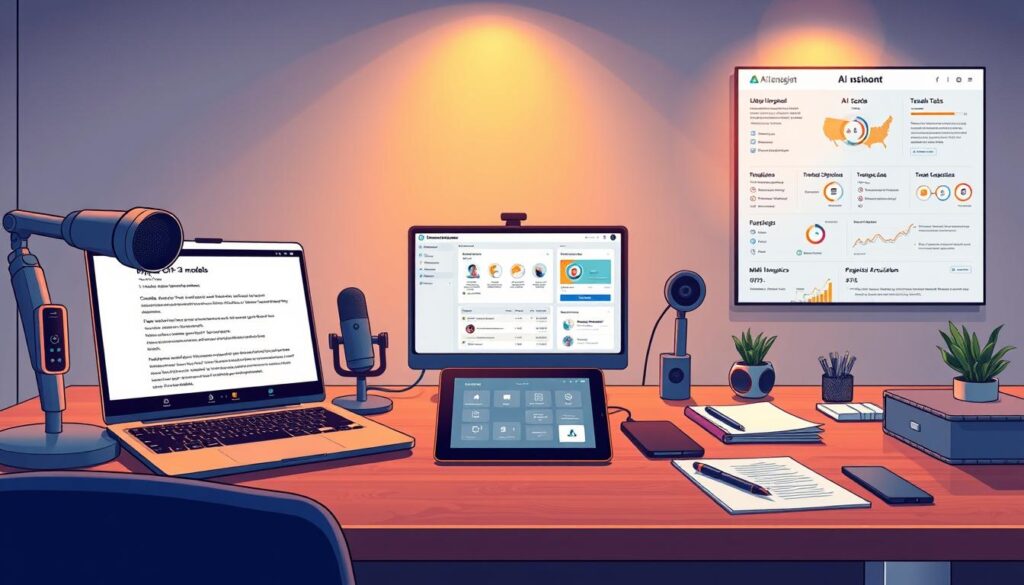
Core MT + LLM: use DeepL and Google Translate for quick baselines, then apply ChatGPT prompts to inject brand tone, locale, and glossary rules.
Editing and QA: run Grammarly and QuillBot for clarity and consistency. Maintain a living glossary per client and a short checklist for terminology, numbers, units, and legal notices.
Web and software: Weglot offers rapid site rollout; Lokalise handles developer workflows and string management across releases.
Media workflows: use Descript for edits and dubs, Subtitle Edit for precise timing, and Sonix.ai for fast transcription—deliver accessible documents and videos in multiple languages.
Ops and client acquisition: win pilots on Upwork and Fiverr, track briefs, approvals, and SLAs in Notion or Trello, and capture data on throughput and quality to show benefits.
Security note: prefer paid tiers and privacy settings for sensitive documents; template recurring packages so setup time falls as volume grows.
Step-by-step: launch a profitable GPT-assisted translation service
Start small: pick one market, build clear samples, and prove the approach before scaling. A focused start reduces friction and demonstrates value fast.
Pick a niche and languages, build samples, and set your stack
Niche focus: choose an industry or format—SaaS onboarding, e-commerce catalogs, or video captions—to sharpen accuracy and speed.
Language coverage: begin with language pairs you support well; expand as glossaries and QA mature.
Tool stack: use DeepL and Google Translate for baselines, refine tone via ChatGPT prompts, and run Grammarly for clarity and accuracy.
Publish offers, gather testimonials, and iterate pricing
List clear tiers, turnaround times, and deliverables on platforms and the company site. Promote via LinkedIn, SEO content, and freelance platforms to attract pilots.
“Start competitively, raise rates as you show measurable results in target markets.”
- Build before/after samples for landing pages and videos to show impact.
- Standardize prompts, QA checklists, and handoff steps to cut time per deliverable.
- Measure time, error rates, and client satisfaction; iterate pricing based on proof.
Tip: link a case study or method page such as this guide to show process maturity and win trust.
Packaging and pricing strategies that sell
Packages that spell outcomes sell faster than hourly quotes. Buyers prioritize predictable results: localized SEO lift, quicker publishing, and a coherent brand tone.
Productize offerings into clear bundles so businesses can buy confidently. Examples: web localization kits, document packs with certified review, and media bundles (ten videos + captions and AI voiceover).
- Tiered pricing: Basic — AI draft and light edit; Pro — AI plus human editor; Premium — senior reviewer and compliance check.
- Value metrics: anchor fees to outcomes: faster launches, lift in conversions, and consistent brand tone rather than per-word rates.
- Add-ons & retainers: rush fees, glossary development, stakeholder training, and monthly retainers for steady updates—these drive recurring money and improve results.
Social proof matters: present short case metrics and client quotes to reduce buyer risk and justify premium pricing.
| Offer | Deliverables | Primary benefit |
|---|---|---|
| Web kit | Glossary, AI draft, human QA | Faster go-live, SEO lift |
| Media pack | 10 captions, timed QA, voice notes | Larger reach, repurposed content |
| Compliance bundle | Senior review, certified sign-off | Risk mitigation, brand safety |
Quality, accuracy, and human-in-the-loop guardrails
Reliable results come from systems that combine clear context, strict glossaries, and human review. Set rules early to stop errors before they propagate into live content.
Context injection and glossary enforcement for brand and industry terms
Preload prompts with brand terms, disallowed translations, and locale rules. Enforce glossaries so product names and key words never flip meaning—remember the “Ganafor” example that became “winery.”
Handling slang, idioms, typos, and mixed-language input
Normalize messy text: correct typos, flag mixed-language segments, and ask the system to explain ambiguous choices. This reduces rework and speeds reviewer decisions.
When to bring in human translators for sensitive or regulated content
Apply thresholds: require human translators for legal agreements, medical documents, and compliance-heavy material. Use a QA checklist for names, numbers, units, links, and dates.
- Guardrails: style guides and preloaded context protect tone and reduce risk.
- Cultural fit: validate idioms and cultures with native reviewers.
- Risk policy: document escalation and dispute handling to protect clients and teams.
For legal workflows, link process notes to a case study like legal AI transformation. For method primers, reference this NLP primer.
Enterprise readiness: security, data, and brand voice at scale
Enterprise buyers demand predictable quality, data controls, and clear governance before scaling language work.
Public systems can mishandle slang, brand names, and messy user input. That risks inconsistent tone and leaked data.
Limitations of generic tools and how to layer context
Mitigate risk by layering glossaries, style rules, and reviewer checkpoints. Enforce brand terms before any automated pass.
- Security posture: prefer enterprise tiers or private deployments to protect client data and meet compliance.
- Context layering: combine glossaries, tone rules, and reviewer workflows so outputs match brand standards across platforms.
- People and process: assign lead translators and editors per account to keep institutional knowledge intact.
Cultural and dialect adaptation for different markets
Specify locales—Mexican Spanish vs. Castilian—and adapt tone and terminology for each market. Small changes in phrasing affect conversion.
“Standardized context and secure workflows turn pilots into repeatable programs.”
| Focus | Action | Metric |
|---|---|---|
| Security | Private deployment, NDAs, encryption | Compliance audit pass rate |
| Quality | Glossary enforcement, editor roster | Accuracy score, errata rate |
| Scale | SLAs, reviewer SLAs, reporting | Cycle time, coverage per month |
Executive reporting should show quality, cycle time, and cost savings to sustain investment across industries and businesses.
Comparing GPT workflows to Google Translate and traditional MT
Practical comparisons focus on three axes: speed, fluency, and domain control. Studies show ChatGPT-quality outputs match Google Translate and DeepL for many European language pairs, but performance falls on low-resource languages and user-generated slang.
Speed and fluency vs reliability and domain control
Google Translate excels at raw speed and simple, low-context text. It returns usable drafts fast and is reliable for basic machine translation tasks.
Conversational LLMs add natural fluency and tone. They handle colloquial phrasing and can render copy into different languages conversationally. Yet they need guardrails for consistent product names and legal wording.
Where hybrid approaches win for business outcomes
Hybrid workflows deliver the best ROI: use a machine pass for volume, an LLM for refinement, and human QA on high-risk content. This stack balances throughput and accuracy.
- Use MT for first pass and speed.
- Refine tone and context in an LLM pass.
- Apply human review for product pages, legal text, and marketing copy.
“Combine tools, log prompts, and enforce glossaries so improvements persist across platforms.”
Governance matters: track prompts, record errors, and lock model settings. That protects data and raises accuracy over time—especially for enterprise clients who need strong domain controls.
Go-to-market: winning clients and entering new target markets
Clients choose partners who show concrete results for target markets, not theory. Clear proof—faster cycles and better conversions—speaks to decision makers in busy businesses.
ICP focus: define industries, company size, and key languages. Tailor messages to expansion plans and pain points. Prioritize markets where SEO gains and reduced support tickets matter most.
Channel mix: maintain profiles on platforms like Upwork and Fiverr while running targeted outreach on LinkedIn. Combine platform leads and direct sales for steady pipeline growth.
Offer-led sales: lead with audits and pilot projects that prove speed, quality, and SEO lift. Use before/after samples to make value tangible.
- Proof engine: publish case studies and sample pages to lower buyer risk.
- Expansion: package multi-locale rollouts—coordinate copy, design, and dev for efficient launches across multiple languages.
- Retention: offer ongoing updates and seasonal campaigns; keep communication regular and proactive.
“A short pilot that shows measurable gains converts faster than a long proposal.”
Conclusion
Practical success depends on pairing automation speed with clear, repeatable human checks. Combine AI efficiency and hands-on QA to produce translations that respect brand tone and cultural nuance.
The benefits are tangible: faster cycles, better discoverability, and clearer customer communication that drives measurable outcomes. Teams that enforce context and glossaries reduce risk and save time.
Be pragmatic: draft with high-speed tools, refine with a quality pass, and require human review where stakes are high. Start in a focused niche, use a compact stack, and iterate based on client feedback.
Close the loop—share wins in a blog to attract inbound leads and show expertise to people who shop the global market.
FAQ
What is the core opportunity in offering AI-assisted language solutions today?
The core opportunity is helping businesses and creators reach new audiences fast and affordably. Demand is rising because companies need content localized for SEO, apps, marketing, and compliance. By combining machine output with human review and industry glossaries, providers can deliver scalable, high-margin offerings that improve conversion and brand trust in new markets.
Why is the United States a strong market for these offerings now?
The U.S. market shows high search intent and budget for language solutions due to diverse populations, global trade, and digital content growth. Firms prioritize multilingual SEO, customer support, and localized product experiences. This creates steady demand for fast, accurate workflows that balance cost and quality.
What revenue potential should companies expect in 2025 and beyond?
Industry forecasts point to continued expansion—driven by globalization and content volume—creating sizable revenue pools across niches like SaaS localization, legal and medical translation, and multimedia captions. Providers who specialize and package offerings for specific verticals can capture higher rates and recurring contracts.
How do modern large language systems improve on traditional word-for-word machine translation?
Large language systems prioritize context: tone, cultural nuance, and domain-specific phrasing. They reduce literal errors and produce more natural copy for websites, marketing, and product interfaces. Still, they perform best when guided by glossaries and human editors to protect brand voice and accuracy.
Which tasks are ideal for automation, and where is human oversight essential?
Automate bulk drafts, subtitle generation, and first-pass localization to save time. Use human reviewers for legal, medical, regulated content, marketing copy, and anything needing strict brand alignment. A hybrid model balances speed and liability control.
What niche monetization playbooks work fastest for freelancers and small agencies?
Start with high-demand micro-offers: website localization packages, captioning and AI voice-over for creators, app localization for indie developers, and reselling translated digital products. Pair clear deliverables with fixed pricing and optional retainer support for steady cash flow.
Which tools should a small operation include in its stack?
Combine a core machine translator for throughput, a large language interface for context refinement, and QA tools for grammar and style. Add localization platforms for site and app deployment, media tools for subtitles, and project platforms for client onboarding and billing.
How should providers price packages to win and scale?
Use tiered packages: basic automated draft, reviewed localization, and premium brand-voice guarantee with glossary enforcement. Price per word for large volumes and per project for creative work; offer retainers for ongoing content flows to stabilize revenue.
What guardrails ensure consistent quality and brand safety?
Implement context injection, enforce glossaries and style guides, and require human-in-the-loop checks for key assets. Use version control and tested QA checklists to catch idioms, typos, and mixed-language input before delivery.
When should a vendor escalate to specialized human translators?
Escalate for legal, clinical, certified, or security-sensitive texts, and when cultural nuance could affect outcomes. Also use specialists for dialect adaptation and lengthy marketing campaigns that demand perfect tone and regulatory compliance.
How do GPT-style workflows compare to Google Translate and other machine translation platforms?
GPT-style workflows excel at tone, rewrite quality, and contextual coherence; traditional platforms offer consistent baseline translations and fast batch processing. Hybrid approaches—using both types plus human review—often deliver the best balance of speed, cost, and reliability.
What are practical steps to launch a profitable AI-assisted language offering?
Pick a profitable niche and language pair, build portfolio samples, set up a reliable toolchain, publish clear offers, and gather testimonials. Start with small, repeatable packages and iterate pricing as you secure client feedback and case studies.
How can providers enter new target markets effectively?
Use localized landing pages optimized for multilingual SEO, offer market-specific samples, partner with local agencies, and demonstrate case studies showing measurable results. Cultural adaptation—beyond literal translation—will win client trust.
What security and data practices should enterprise clients demand?
Enterprises should require data handling policies that include encryption, non-retention guarantees, on-prem or private-cloud options when needed, and clear SLAs for confidentiality. Vendors must document controls and compliance measures for peace of mind.
Which industries offer the highest margins for language providers?
Specialized sectors—legal, medical, technical, and academic publishing—tend to pay premium rates because accuracy and domain knowledge are critical. SaaS localization and enterprise documentation also yield recurring contracts and higher lifetime value.
How can a small team handle multimedia localization like subtitles and voice-over?
Use automated transcription and captioning tools for the first pass, refine with language models for timing and tone, and finalize with human review. For voice-over, combine AI voice solutions with human direction to match brand personality and ensure natural delivery.
What metrics should businesses track to measure success?
Track revenue per client, retention rate, turnaround time, revision frequency, and net promoter score. For marketing outcomes, monitor multilingual organic traffic, conversion lift, and user engagement in localized markets.