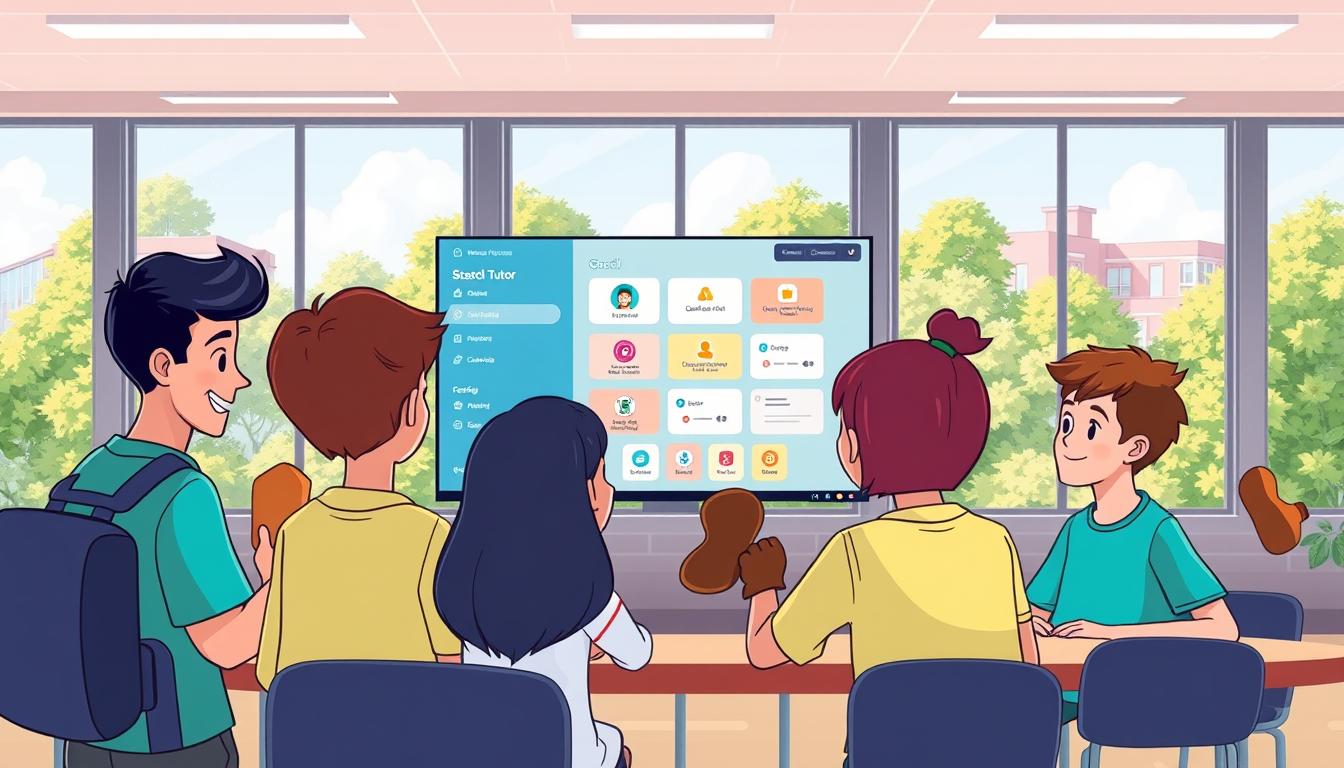
Someone who watched a classroom gain quiet confidence remembers the moment forever. This piece opens there: in real rooms where teachers seek tools that respect routines and lift student voice.
The proposal is clear and practical. It presents one trusted platform modeled on Khanmigo and praised tools like SchoolAI and Synthesis Tutor. That mix prioritizes safety, guided thinking, and measurable gains.
Educators report better grammar, timely help, and reclaimed planning time. Students get patient, step-by-step feedback that builds true understanding, not quick fixes. Districts see scalable pilots turn into broad adoption with visible outcomes.
This page frames the product as responsible innovation: on-topic coaching inside the classroom, clear data practices, age-appropriate controls, and teacher-aligned workflows. It maps a pathway from idea to implementation with minimal friction and measurable impact.
Key Takeaways
- Position the platform as credible and classroom-ready.
- Deliver timely feedback that fosters deep learning.
- Align safeguards to academic standards and routines.
- Show educator testimonials and trusted benchmarks.
- Highlight measurable gains for administrators, teachers, and students.
Launch a school-friendly AI tutor app that empowers student learning today
Schools need tools that respect classroom rhythms while lifting student outcomes. This platform is purpose-built for classrooms, students, teachers, and parents—designed to deliver on-topic guidance and clear progress signals.
Commercial-grade, school-ready from day one: single sign-on, rostering, safe defaults, and audit trails make rollouts predictable and fast. Those features mirror proven solutions that earned educator trust and simplify district approvals.
Speed-to-value matters: setup is streamlined so teachers get help and feedback into daily routines in less time than planning a traditional lesson. The instructional intent is explicit—the tutor coaches thinking, models steps, and preserves academic integrity and classroom norms.
- Students receive patient, stepwise support that builds confidence.
- Teachers gain actionable insights and reclaimed planning time.
- Parents see transparent progress cues and next steps.
Pilot to scale: begin with a class or department, measure early wins, and expand once outcomes stabilize. Commercial functionality—permissions, auditability, and support—reduces risk and accelerates district adoption.
Why schools and districts trust AI tutoring in the classroom
District leaders point to clear classroom evidence when they explain why guided tutoring earns trust. Superintendents and principals value consistent on-topic behavior and measurable gains over novelty.
Teachers reclaim planning time because tools like SchoolAI and Khanmigo generate differentiation, lesson plans, question sets, and exit tickets in minutes. That frees teachers to lead targeted mini-lessons and high-impact interventions.
Districts gain actionable data. Leaders see class-level and student-level progress at a glance, which makes directing action easier and faster.
From busy work to personalized instruction: teacher outcomes
Educators report small-group work becomes personalized, not busy work. Ready-to-use materials and dynamic groupings speed up teaching and improve learning.
District-level insights that guide action
Transparent analytics support accountability without adding teacher burden. The superintendent perspective shows how district-wide views accelerate coaching cycles and program improvement.
- Translate insights into decisions: adjust instruction and target standards gaps.
- Reinforce teacher agency: teachers choose when and how to use system outputs.
- Build trust: predictable behavior and clear outcomes increase administrator confidence.
Core benefits for students: adaptive learning and real-time feedback
Learners get targeted support that nudges thinking instead of handing over answers. The system prompts the student to reason, reflect, and iterate—building durable skills rather than offering shortcuts.
Just-in-time help meets students at the point of confusion. Quick, on-demand guidance keeps momentum and reduces frustration so learning continues without long resets.
Feedback is granular and immediate: clarifying misconceptions, modeling strategies, and pacing support to match current needs. Scaffolds fade as competence rises and progress is tracked for teacher follow-up.
- Adaptive prompts that match each student’s skill level.
- Real-time feedback that mirrors one-on-one tutoring.
- Visible progress indicators to build confidence and guide instruction.
| Feature | What it does | Classroom impact |
|---|---|---|
| Guided problem-solving | Prompts reasoning steps | Stronger skills, reduced guessing |
| On-demand help | Immediate hints and examples | Less frustration, sustained engagement |
| Progress tracking | Mastery indicators over time | Actionable teacher insights |
Outcome: Students gain confidence through small wins; teachers receive concise summaries that inform instruction without extra reporting. The system preserves academic integrity by resisting answer-giving and keeping learners productively engaged.
Teacher time-savers that turn hours into minutes
Teachers gain back hours each week by shifting routine prep into guided templates that produce high-quality materials fast.
Lesson planning, differentiation, and student groupings
Generate lesson outlines and differentiation pathways in minutes. Systems like Khanmigo and SchoolAI produce student groupings from performance signals so small groups target real needs.
Teachers can refine outputs to match pacing calendars and district standards. This reduces prep work and lowers cognitive load with templates and exemplars.
Exit tickets, rubrics, quizzes, and hooks—ready fast
Create assessment assets—exit tickets, rubrics, quizzes, and engagement hooks—aligned to learning targets with consistent quality.
- Cut prep hours: ready items free time for interventions and coaching.
- Iterative planning: use yesterday’s exit tickets to inform today’s mini-lessons.
- Flexible tools let the teacher adjust tone, rigor, and pacing quickly.
The tool acts as a companion: it amplifies teacher expertise, reduces grading overhead, and returns time for high-value teaching.
Designed for neurodiverse learners and math anxiety relief
Warm, multisensory routines help students move from worry to curiosity in math. The platform emphasizes inclusion and calm, predictable interactions that reduce cognitive load. Small supports make big differences for learners with dyslexia, dyscalculia, ASD, ADHD, and 2E.
- Warm, multi-sensory flows that translate abstract math into visual steps and real-world contexts.
- Flexible supports—text-to-speech, step highlighting, and paced hints—tailored to student needs and attention patterns.
- Gentle feedback that normalizes mistakes and guides the next move, lowering anxiety and building resilience.
Teachers keep control: adjust difficulty, change representations, and set scaffolds to match individual needs. The system logs small wins and progress markers so educators can follow up with targeted help.
For additional resources on tools that support attention differences, see this guide for ADHD-friendly tools.
Trusted nonprofit DNA and independent ratings that matter
Nonprofit roots shape design choices that favor learning and student safety over hype.
Khanmigo comes from Khan Academy, and that heritage anchors the product in clear educational priorities. That influence shows up in guardrails, vetted content, and an emphasis on measurable learning gains.
Built with safety and learning as top priorities
Design choices limit off-topic behavior and keep interactions age-appropriate. Those constraints protect students and support teachers in real classrooms.
Rated 4 stars by Common Sense Media
The four-star review is a public benchmark: it signals responsible design and trustworthy content to administrators who evaluate district purchases.
Recognized as an assistant teachers will actually use
Fast Company named it an assistant teachers choose because it fits classroom workflows and reduces friction. That real-world adoption matters more than theoretical promise.
| Credibility | What it signals | Classroom effect |
|---|---|---|
| Nonprofit heritage | Learning-first mission | Standards-aligned materials |
| Independent rating | Common Sense Media, 4 stars | Administrator confidence |
| Press recognition | Fast Company endorsement | Higher teacher adoption |
Bottom line: Integrations with trusted libraries and clear security and policy postures give schools the confidence to adopt the tutor as a dependable teaching partner.
Curriculum coverage: math, humanities, coding, social studies, and more
A unified curriculum library ensures teachers and students find the right pathway fast.
Comprehensive content across subjects brings math problem-solving, humanities writing support, coding practice, and social studies inquiry into one experience. Teachers can pull lesson sequences that match district standards and student needs.
Standards-aligned by level means each module maps to grade expectations so students access appropriate materials and teachers plan coherent units. Level filters let teams sequence lessons and monitor vertical alignment.
- Quality content from trusted libraries ensures depth and academic relevance.
- Coding pathways offer scaffolded challenges and immediate feedback to boost applied learning.
- Math modules guide step-by-step reasoning, connecting procedures to concepts.
- Support for languages and multilingual exposure aids academic language development.
- Teachers curate units that mix direct instruction, guided practice, and formative checks.
Student choice fits inside teacher-defined pathways to increase ownership while keeping outcomes aligned. The result: consistent quality across grade bands and clear, measurable learning progress.
Small-group instruction reimagined
Small-group stations become a strategic engine for progress when instruction aligns to each group’s current gaps. Teachers shift from managing busy work to delivering focused lessons that respond to real-time evidence.

Personalized lessons for each group’s needs
Dynamic grouping lets students rotate through short, personalized lessons while the educator confers with the highest-need group. The system adapts prompts, examples, and pace to match each group’s needs.
Teacher focuses on targeted interventions
While one station engages with guided practice, teachers give high-impact feedback to another group. Concise snapshots show which misconceptions surfaced and what to address next.
- Immediate help sustains momentum and reduces off-task behavior.
- Group lessons stay aligned to whole-class objectives for coherence across the unit.
- Templates and auto-generated practice cut prep time for teachers.
- Quick regrouping is evidence-driven—students move when ready or revisit skills as needed.
- The tutor acts as a station partner, keeping rigor without constant oversight.
Student progress, data, and actionable feedback
District dashboards turn raw classroom activity into clear, teachable signals. Real-time views let leaders and teachers see who is making steady gains and who needs quick intervention.
Real-time analytics that inform instruction
Live dashboards surface student data on mastery, error patterns, and pacing so instruction can shift that day. Teachers get concise class snapshots and individual traces that reveal where students stall.
Clear next steps for teachers, students, and parents
Metrics translate into recommended actions: targeted mini-lessons for teachers, individualized practice for the student, and plain-language guidance parents can follow. Detailed feedback transcripts show how a learner reasoned and where to intervene next.
- Progress visibility: standards-linked indicators track growth over time and enable class comparisons for planning.
- Math-specific views: highlight conceptual gaps, procedural slips, and fluency needs.
- Consolidated insights: one tool reduces time spent hunting across systems and promotes equitable check-ins for quietly struggling students.
Close the loop: align suggested next steps to upcoming lessons so progress becomes a coherent path and learning stays forward-moving.
Safety-first: school-friendly guardrails and responsible AI
When systems follow classroom norms, teachers and students engage with confidence.
Safety is built into the product architecture, not bolted on later. That means on-topic prompts, age-appropriate language, and predictable behavior that fits teaching routines.
On-topic guidance with limitless patience
Patient coaching nudges reasoning and resists answer-giving. Students receive stepwise help that encourages thinking, preserves academic integrity, and supports lasting understanding.
Ethical design to support safe classroom use
- Guardrails keep interactions aligned to lesson goals and approved resources set by teachers.
- Moderation layers filter unsafe content and escalate issues to school staff when needed.
- Consistent behavior across sessions helps students know what to expect and how to engage.
- Transparent summaries let teachers review transcripts and reflect on learning pathways.
- Quick policy controls let administrators align the system with local security and community standards without disrupting instruction.
| Capability | How it protects students | Benefit for teaching |
|---|---|---|
| On-topic filters | Blocks off-track responses | Keeps lessons focused |
| Tiered moderation | Detects risks, escalates appropriately | Reduces staff exposure to unsafe content |
| Teacher controls | Set goals, approved sources, and constraints | Aligns system with classroom plans |
Result: a secure, transparent environment that supports teachers and protects students while enabling meaningful learning.
Data privacy and security for schools in the United States
District leaders expect clear, enforceable privacy practices before approving any classroom technology. That expectation shapes procurement: clarity about what data is collected, how long it is kept, and who can access it speeds approvals and protects communities.
Secure handling of student data and compliance alignment
Minimize collection—only keep fields required for instruction and reporting. The platform aligns with FERPA, COPPA where applicable, and common state frameworks so districts can map requirements to policy quickly.
Encryption in transit and at rest, least-privilege access, and continuous monitoring make the architecture resilient. Clear retention and deletion rules let districts and parents set expectations for how long student data lives on the system.
Admin controls, permissions, and auditability
Role-based permissions, class-level scoping, and detailed audit logs create oversight without slowing teachers. Educator-friendly roster tools let teachers manage classes and languages while IT retains centralized controls.
- Administrative clarity: role definitions and vendor/district responsibilities are documented for procurement and compliance.
- Auditability: exportable logs and change histories support reviews and investigations.
- Multilingual support: consent materials and communications are available in key community languages.
| Control | What it does | Benefit |
|---|---|---|
| Role-based access | Limits data to job needs | Reduces exposure |
| Retention policy | Defines storage lifecycle | Meets district and parent expectations |
| Audit logs | Records access and changes | Supports accountability |
Result: districts gain actionable insights into student progress while keeping data protected and operational work light for IT and educators. We recommend documenting vendor and district responsibilities up front to streamline due diligence and deployment.
Fast implementation: from signup to your first class
A concise rollout turns configuration into classroom practice within hours.
Rapid setup checklist: enable SSO, import rosters, create classes, and apply templates. These initial steps cut manual work and save time for planning.
Design delivers classroom-ready templates for lessons, practice, and exit tickets. Teachers can pick a template and run a first lesson within hours, not days.
Setup, rostering, and classroom-ready templates
- SSO and roster sync—IT handles connections; teachers control classes.
- Quick-start templates align to common units and assessments.
- Auto-generated practice and exit tickets make the first week productive.
Teacher onboarding with zero steep learning curve
Multiple ways to learn: self-serve tutorials, PLC demos, and short webinars fit school schedules. Support channels and office hours aid fast troubleshooting.
“Educators report time reclaimed from routine work and reallocated to interventions and data analysis.”
| Step | Who | Benefit |
|---|---|---|
| SSO & roster sync | IT | Fewer login issues; quick access |
| Template selection | Teacher | Saves planning time; lesson ready fast |
| Pilot plan | Leaders & teachers | Demonstrates value; informs scale |
Integrations and ways to work with your existing tools
Integrations remove friction and make the platform feel like part of daily classroom routines. Schools gain immediate utility when systems log in once, share rosters, and pass scores to the LMS.
LMS connections and single sign-on
Supported LMS: Canvas, Google Classroom, Schoology, and Blackboard. Single sign-on works with SAML and OAuth so teachers and students access resources without extra credentials.
Seamless workflows for teachers and educators
The tool hands off grades, syncs rosters, and embeds lesson materials so educators plan, assign, monitor, and follow up without switching systems constantly.
- Keep data flows minimal and transparent—only the fields needed for instruction and progress tracking.
- Support for multiple languages and accessibility ensures equitable use in every school setting.
- Extensible APIs and secure connectors let districts scale integrations over time.
IT-ready documentation covers deployment, backups, and change management so rollout is predictable and supportable. The result: fewer clicks, less tech work, and more time for students and teachers.
Social proof: results educators are seeing now
Classroom leaders are now sharing measurable wins that change how schools judge instructional tools.
Improved grammar scores and soaring confidence
Teachers report clear gains when guided practice becomes routine. Priscila Prestes of Oak Canyon Junior High credits improved grammar scores and a rise in student confidence after regular targeted sessions.
Teachers reclaim time to analyze data and adjust instruction
Sara Elder at Hidden Valley Middle School notes that saved prep minutes let the teacher focus on intervention and on-the-spot adjustments. That freed time turns into faster cycles of progress and more useful feedback for learners.
From burnout to renewed engagement in teaching
Principals describe human changes: Leroy Dixon from White Plains Middle School saw a colleague move from exhaustion back to energized teaching. When routine work lightens, teachers report better experiences and deeper engagement with students.
Classroom impact at-a-glance:
- Small-group sessions become personalized, not busy work.
- Timely help converts corrections into genuine understanding.
- Positive experiences compound: more participation, better questions, steady progress.
| Outcome | Reported by | Classroom effect |
|---|---|---|
| Higher grammar scores | Priscila Prestes (Oak Canyon Junior High) | Rising confidence in writing |
| Time reclaimed for analysis | Sara Elder (Hidden Valley Middle School) | Faster instructional adjustments; clear progress |
| Teacher renewal | Leroy Dixon (White Plains Middle School, NY) | Reduced burnout; deeper student engagement |
“Tools that reduce busywork let teachers do what matters most—teach and guide.”
start, a, school-friendly, ai, tutor, app: pricing, licenses, and how to get started
Licensing tiers are simple and tied to headcount and service level. Offerings include classroom pilots, school subscriptions, and district plans priced per student with seat bands. Each tier lists included hours, support SLA, and training credits.
School, district, and classroom options
Quick-start pilots suit single teachers proving value. School subscriptions unlock grade-level rollout and shared reporting. District plans add rostering, SSO, and managed implementation.
- Onboarding by level: quick-start, coordinated rollout, or managed deployment.
- Timelines: pilots (2–6 weeks), school rollouts (4–8 weeks), district deployments (8–16 weeks).
- Time commitments are explicit so leaders can align testing windows and reporting cycles.
Support for parents and families
Provide family guides that explain how the tutor supports learning at home without giving answers. These materials show next steps teachers recommend and simple ways parents can reinforce skills.
| Package | What’s included | Typical timeline |
|---|---|---|
| Classroom Pilot | 10–30 students, quick-start onboarding, 4 office hours | 2–6 weeks |
| School Subscription | Grade-level seats, teacher training cohort, parent guides | 4–8 weeks |
| District Plan | All features, managed rollout, priority SLA, custom reporting | 8–16 weeks |
Purchase options: self-serve checkout for small teams or assisted procurement for districts needing vendor onboarding. Training scales from on-demand modules to live cohorts and office hours. SLAs and renewal terms match school budgeting cycles.
“Start small, measure impact, and expand with confidence.”
Conclusion
Educators find the system strengthens instruction without replacing teacher judgment. It advances learning by guiding thinking rather than handing out answers. This approach supports students with steady, stepwise help and builds lasting skill.
Trust signals matter: independent ratings, classroom outcomes from SchoolAI and Synthesis Tutor, and Khanmigo’s safety-first design back measurable gains. Leaders see clear reports that make procurement decisions simple.
Teachers remain central: the platform augments instruction and gives teachers time for high-impact work. Privacy, guardrails, and on-topic behavior are built in so safety is part of everyday practice.
Impact shows up in math and across subjects: timely feedback turns confusion into clarity and momentum. Choose the way that fits your context—pilot a class, roll out school-wide, or scale district-wide—and align stakeholders to launch with purpose.
FAQ
What is the goal of "Make Money with AI #85 – Start a school-friendly AI tutor app"?
The goal is to guide educators, entrepreneurs, and district leaders through launching a commercial-grade, classroom-ready tutoring platform. It explains how to deliver adaptive instruction, protect student data, integrate with school systems, and create sustainable revenue while improving learning outcomes.
How does this platform support teachers and lesson planning?
The platform saves teacher time by automating lesson planning, differentiation, and student groupings. It generates exit tickets, rubrics, quizzes, and instructional hooks quickly, enabling teachers to focus on targeted interventions and instructional decisions based on real-time analytics.
Can the tutoring system be used for small-group instruction?
Yes. Personalized lessons can be created for each group’s needs while the teacher concentrates on high-impact activities. The system supports guided problem-solving, formative checks, and differentiated content to maximize small-group effectiveness.
Which subjects and grade levels does the product cover?
Curriculum coverage spans math, humanities, coding, social studies, and more. Content is standards-aligned across grade levels and integrates with world-class content libraries to match various learning objectives and educator needs.
How does the platform help neurodiverse learners and students with math anxiety?
It offers warm, gentle, multi-sensory tutoring tailored for ASD, ADHD, dyslexia, dyscalculia, and twice-exceptional learners. By breaking problems into manageable steps and providing scaffolded supports, it builds confidence and reduces anxiety while promoting measurable progress.
What real-time data and feedback are available to teachers and parents?
Teachers and parents receive actionable data dashboards with real-time analytics, progress indicators, and clear next steps. Reports inform instruction, show skill mastery, and provide timely feedback to guide student growth and parental support.
How does the system ensure student safety and responsible use?
The product is designed with safety-first guardrails, ethical AI guidelines, and on-topic guidance. Controls limit off-topic content, ensure respectful interactions, and prioritize learning outcomes to make it safe for classroom use.
What data privacy and security measures are in place for U.S. schools?
The platform uses secure handling of student data, adheres to FERPA and COPPA where applicable, and supports district compliance needs. Admin controls, permissions, and audit logs provide transparency and governance for IT leaders.
How fast is implementation from signup to classroom use?
Implementation is designed to be fast: rostering, single sign-on, LMS connections, and classroom-ready templates accelerate setup. Teacher onboarding focuses on minimal learning curve so educators can start using the tool with their first class quickly.
Which integrations and workflows are supported?
The platform supports LMS integrations, single sign-on, rostering, and data export. Seamless workflows allow teachers to use existing tools while centralizing student progress, lesson assets, and assessment data for efficient instruction.
What evidence exists that educators see results?
Early adopters report improved grammar and math scores, increased student confidence, and reclaimed teacher time for data analysis and intervention. Independent ratings and nonprofit partnerships bolster credibility and practical classroom impact.
How are pricing and licensing structured for schools and districts?
Pricing includes flexible school, district, and classroom options with volume licensing, professional development, and support tiers. Transparent plans help districts budget for long-term adoption and scale while supporting families where needed.
What support is available for parents and families?
The platform provides parent-facing reports, home practice recommendations, and optional family access features. Guidance helps caregivers reinforce skills, monitor progress, and partner with teachers on student goals.
How does the system balance giving help with promoting independent problem solving?
The system emphasizes guided problem-solving rather than delivering answers. Scaffolds, hints, and Socratic prompts encourage critical thinking while offering targeted feedback that fosters independence and mastery.
Who evaluates the platform’s quality and classroom readiness?
Independent reviews, nonprofit partnerships, and third-party ratings assess safety, learning quality, and teacher usability. These evaluations ensure the product meets rigorous standards for school deployment and educator adoption.