There is a brief moment when an idea lands and the audience smiles — that spark is what this guide chases. The reader meets a clear, repeatable workflow that blends creativity with engineering. It promises steady output without dulling brand voice.
The setup pairs MagicHour, OpenAI GPT-4, Late, and n8n into an enterprise-grade pipeline. The system schedules posts every 12 hours, validates steps, retries on failure, and logs performance to tools like Google Sheets or Slack. Expect measurable lifts in growth and engagement within 30 days.
This section maps strategy to practical needs: niche selection, audience pain points, content pillars, and a publishing cadence that scales. It also lists prerequisites — API keys, GPT-4 billing, and an Instagram Business account — so readers can act with confidence.
Key Takeaways
- The workflow automates idea-to-post steps while preserving brand tone.
- MagicHour + GPT-4 + Late inside n8n delivers validation and retry logic.
- Expect 60+ posts and meaningful engagement lifts in 30 days.
- Prepare API keys, GPT-4 access, and an Instagram Business account first.
- The system frees time for community growth and revenue planning.
Why meme pages + AI win in 2025: intent, opportunity, and how this guide helps
In 2025, short-form humor on social feeds rewards speed and consistency more than ever.
User intent: readers seek a clear, step-by-step path for faster creation, consistent posting, and measurable monetization. They want templates, prompts, and a documented stack that removes guesswork.
The big picture: automated workflows handle generation, caption drafting, and scheduled posting every 12 hours. Reliability features—validation, retries, timeouts—keep an editorial calendar running during transient API issues.
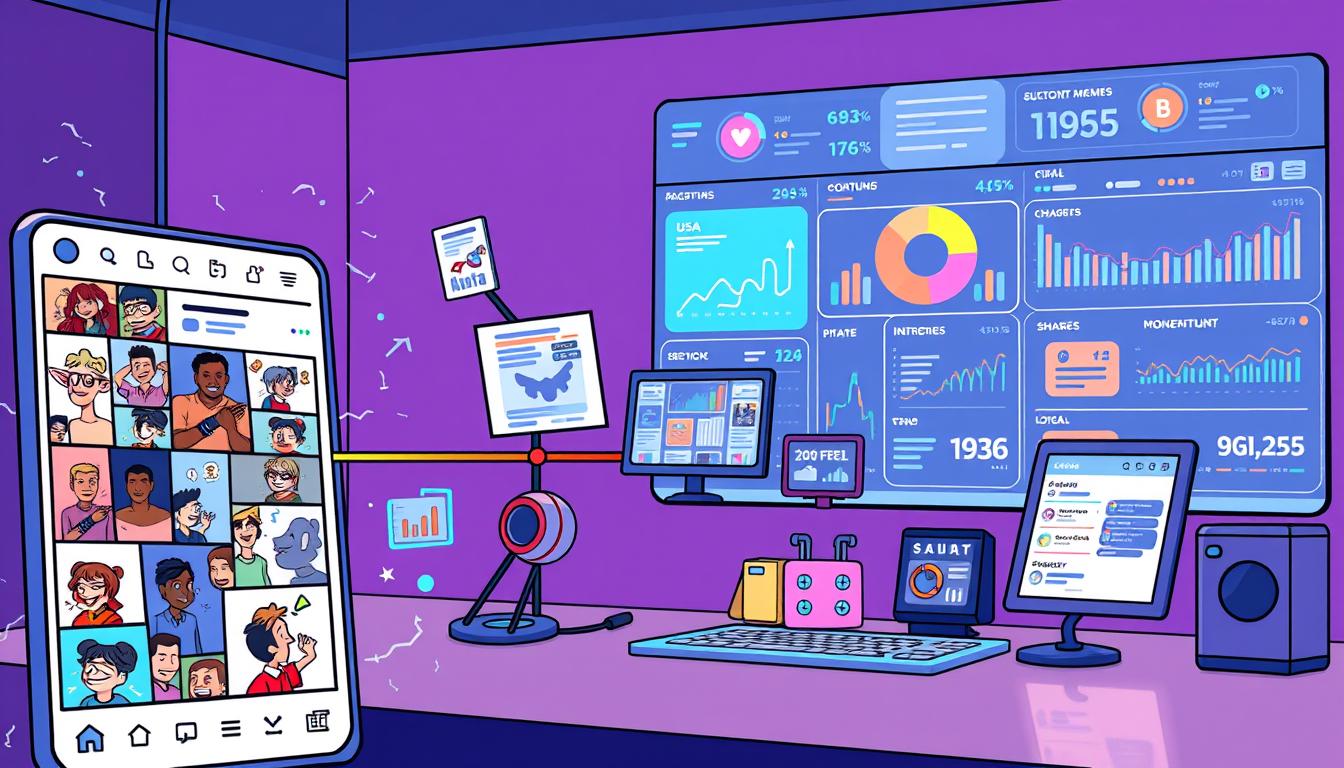
Logging to Google Sheets or Airtable, plus Slack or Discord alerts, gives teams a live performance feed. That data lets creators test themes, tune CTAs, and improve engagement quickly.
- Define intent: practical steps, not theory.
- Opportunity: meme-first storytelling fits social media rhythms.
- Advantage: a dependable pipeline lifts frequency and visibility.
| Feature | Benefit | Outcome |
|---|---|---|
| Automated generation | Faster ideation and captions | More posts per week |
| Reliability controls | Retries, validation, timeouts | Fewer failed publishes |
| Performance logging | Sheets/Airtable + alerts | Data-driven optimization |
Define your niche, audience, and brand voice before you generate a single meme
Start with a crisp niche and audience outline before a single creative asset is made. This reduces wasted effort and sets measurable goals.
Pick a niche where problems are obvious and shareable: fitness setbacks, startup chaos, pet quirks, or workplace fails. These topics make humor accessible and broadly relatable.
Translate core problems into everyday situations. For example, “limited storage” becomes “can’t save an important file.” “Remote work chaos” becomes “Zoom call interrupted by barking dogs.” These snapshots map directly to visual formats.
- Align tone and humor: list what’s fair game and what’s off-limits to protect brand trust.
- Build an audience profile: capture top frustrations, motivations, and common phrasing for native captions.
- Establish voice guidelines: vocabulary, formality, and boundaries so captions stay consistent.
- Protect brand safety: document filters and watermark plans for attribution.
Validate quickly: publish a few variations per situation, measure engagement, then scale formats that perform best.
Build your AI meme workflow stack: MagicHour, OpenAI, Late, and n8n
A clear technical stack makes frequent posting predictable and measurable. This section outlines practical setup steps and reliability checks that keep a pipeline humming on a 6/12/24-hour cadence.
MagicHour: verify email, create the mhk_live_ API key, add credits, and choose topics that match your niche—fitness, startup life, pets, gaming, or broader humor.
OpenAI (GPT-4): confirm account billing, create a secret key, and verify GPT-4 access. Test prompt presets for professional, casual, and educational captions with hashtag and CTA rules.
Late: sign up at GetLate.dev, connect an Instagram Business or Creator profile, generate an API key, and note Profile ID plus Instagram Account ID. Always post a manual test before automation.
n8n: import the JSON workflow and add HTTP Header Auth for MagicHour and Late. Set the OpenAI credential, configure profileId/accountId/timezone, and adjust the schedule trigger for preferred hours.
- Validation checks before each handoff.
- 2–3 retries and timeout protection for HTTP calls.
- Central logging to Google Sheets or Airtable with Slack/Discord alerts.
- Document API keys, IDs, timezones, and error handling rules for teammates.
Result: a dependable workflow that automates generation, caption crafting, scheduling, and monitoring—freeing the team to focus on creative strategy and marketing experiments.
Create viral content on repeat: prompts, templates, and content pillars
A repeatable creative system turns everyday frustrations into high-share posts. The goal is a compact playbook that teams can follow without guessing. Keep each step testable and measurable.
Problem-to-situation framework
Map a clear pain to a familiar scene. Start by defining the problem, list top pains, and pick ones that are easy to recognize.
- Define the problem.
- List top painful problems your audience has.
- Pick popular, simple problems.
- Match each problem to real-life situations.
- Create posts from template repositories.
- Distribute with a watermark or logo.
Plug-and-play caption prompts
Maintain three prompt libraries: professional, casual, and educational. Each should include hashtag ranges and CTAs—save, share, tag a friend.
Content pillars and seasonal themes
Build 3–4 pillars: daily struggles, industry in-jokes, wins and how-to moments. Rotate them and layer seasonal themes—holidays, cultural events, monthly trends.
“Test small, keep winners, and retire what underperforms.”
| Style | Hashtags | CTA |
|---|---|---|
| Professional | 3–5 | Save or share |
| Casual | 6–8 | Tag a friend |
| Educational | 3–5 | Visit link in bio |
Smart scheduling and consistency: 12-hour runs, best times, and batching
Scheduling with intention makes steady growth predictable. The recommended baseline is a twice-daily run: set n8n to 12 hours for balanced frequency and quality.
Cadence decisions depend on audience habits. The n8n workflow supports 6, 12, 24, or 168 hours; select 6–12 hours for high-engagement niches or 24 hours for slower feeds.
Batch creation accelerates production. Generate 5–10 posts in one session, let the scheduler place them at optimal times, and keep a week-long backlog for safety.
- Align timezone settings in Late so local peaks hit mornings (9–11 AM) and evenings (7–9 PM).
- After image generation, wait ~20 seconds, run a Check Image step, then create captions and schedule posts five minutes later.
- Log outcomes and review execution weekly to improve performance and retry counts where failures cluster.
| Setting | Recommended Value | Why it matters |
|---|---|---|
| n8n interval | 12 hours | Balances reach and content quality |
| Batch size | 5–10 posts | Reduces last-minute work; improves consistency |
| Post buffer | 5 minutes | Accounts for delays; ensures asset readiness |
| Timezone | Local audience | Boosts engagement by matching peak times |
Repurpose, remix, and reuse: turn past winners into fresh posts
A winning post can become three distinct pieces that reach new audiences.
Start by exporting top performers and feeding one into a rewrite prompt: “Give me three new versions of this post, written in a slightly different style.” Request a short list, a funny observation, and a heartfelt angle. This method preserves the core idea while creating clear variants.
Schedule those variants with a bulk tool such as Publer at peak times. That can produce a week of content in roughly twenty minutes.
- Identify winners: export analytics and pick repeatable setups.
- Prompt tactically: ask for three stylistic rewrites while keeping brand boundaries.
- Run A/B tests: change hooks, hashtag sets, and CTAs across near-identical creatives.
- Stagger publication: space remixes over weeks so new audiences see them.
Keep branding consistent—watermarks, tone guidelines, and caption limits—so remixes reinforce recognition. Cross-post adapted formats per platform constraints and close the loop by promoting top variants to Stories or other channels.
| Variant | Purpose | Expected Outcome | Time to Create |
|---|---|---|---|
| Short list | Quick, skimmable value | Higher saves and shares | 5 minutes |
| Observational | Relatable humor | Better comments | 7 minutes |
| Heartfelt | Emotional connection | Stronger follows | 8 minutes |
Analyze what’s working: algorithm-friendly tactics and performance tracking
Turn each post into a data point and let evidence guide creative choices. Start with a light logging layer that captures inputs, outputs, and final status after every publish.
Set up logging and dashboards
Instrument the pipeline: append every run to Google Sheets or Airtable. This makes optimization evidence-based and repeatable.
Create alerts: send Slack or Discord notifications on successes and failures. Short alerts cut mean time to fix.
Measure what matters
Pull Instagram metrics—reach, likes, comments, shares—and attach them to each creative and caption. Audit engagement by hour and topic.
Segment results by posting time, template, and topic. Then shift the scheduler toward the statistically stronger windows over a 30-day window.
Benchmark and adapt
Paste high-performing examples into a summarization model to reveal tone, structure, and joke archetypes. Adapt those patterns while keeping the brand voice intact.
Test tactics in short sprints: vary one factor, measure lift, then scale winners.
| Metric | Why it matters | Action |
|---|---|---|
| Reach | Shows audience exposure | Adjust post hour |
| Likes & Comments | Measures resonance | Prioritize similar topics |
| Saves & Shares | Signals lasting value | Repurpose winners |
Engage at scale without sounding robotic
Fast, human replies deepen connections; a planned bank of responses preserves that warmth at scale.
Collect common comment types — praise, questions, corrections, jokes, and critiques. For each type, generate five friendly reply variations and store them in a central spreadsheet or CMS for quick access.
Train a custom model on your tone by supplying real captions, approved phrases, and brand rules. This creates rapid, on-voice replies that creators can personalize before posting.
- Build a reply bank: multiple templates for praise, questions, and critiques.
- Use the model as an assistant: short, context-aware lines that save time.
- Integrate CTAs sparingly: prompt a save, share, or link in bio without overselling.
- Preserve human touch: address names, mention specifics, and add brief personal notes.
- Triage high-impact threads first and monitor sentiment to inform future captions.
“Keep a living playbook of do’s and don’ts; pin helpful comments and reward community contributors.”
use, ai, to, run, viral, meme, pages, and, monetize, traffic
Map every caption so that interested viewers know the next step in seconds.
Connect content to revenue: traffic flows, CTAs, and landing pages
Keep the path short and mobile-first: post → profile → link-in-bio → landing page. Each step must match the joke’s promise and load quickly on phones.
Design CTAs that match tone: ask for a save, share, or a tag for reach; offer a light click for offers. Tie soft CTAs to curated pages that capture emails or present one clear offer.
Track conversions alongside engagement to prioritize profitable memes
Append UTMs to every link and log clicks alongside engagement metrics. This links creative performance with real outcomes and reveals which posts drive sign-ups or sales.
Measure what matters: capture CTR, leads, and conversion rate in the central sheet. Spotlight posts that deliver strong engagement and measurable revenue impact.
- Map traffic flows and keep transitions natural and on‑brand.
- Segment offers by pillar—educational memes for products; humor-first posts for low-friction affiliate offers.
- Build simple funnels: top meme → soft CTA → fast-loading page that converts.
- Test hooks and pricing with A/B splits; iterate based on performance data.
| Step | Goal | Metric |
|---|---|---|
| Caption CTA | Drive clicks | CTR |
| Landing page | Capture leads | Conversion rate |
| Follow-up | Nurture buyers | Revenue per lead |
Pro tip: once the system proves results, package the workflow as a service for other creators or small business owners.
Monetization strategies for meme pages: from attention to income
Convert attention into reliable revenue streams with practical strategies that respect audience trust. The goal is simple: turn humor-driven reach into offers that fit the brand and reward creators.
Align affiliate picks with audience taste. Promote products that feel natural in a joke and keep credibility intact. Document guardrails so promotions match tone and never undermine product quality.
Digital products, subscriptions, and paid communities
Package templates, prompt libraries, and niche playbooks as short, useful products. Bundle with quick tutorials or behind-the-scenes videos.
Launch a subscription for weekly templates or a paid community for trend alerts and benchmarks. Recurring fees create predictable income while deepening brand loyalty.
Sponsorships and branded content without losing authenticity
Set clear rules: same humor, consistent visuals, and transparent disclosure. Treat sponsored posts like editorial pieces—match voice and keep the joke native.
“Document before-and-after reach and engagement to show sponsors how brand-led humor drives recall.”
Services: productize your workflow for brands and creators
Offer setup packages: prompt libraries, scheduling calendars, and monthly reporting. Price with proof—deliverables plus performance metrics—and charge based on outcomes.
- Cross-platform leverage: adapt top performers for other social media platforms and negotiate multi-platform placement.
- Maintain brand trust: decline mismatched offers and favor partners your audience would recommend.
- Iterate offerings: refine packages as data reveals what drives consistent revenue without diluting goodwill.
| Option | Deliverable | Expected Outcome |
|---|---|---|
| Affiliate bundles | Curated links & CTAs | Low-friction conversions |
| Digital packs | Templates + tutorials | Immediate sales |
| Sponsorships | Branded creative | Paid reach with brand safety |
Case studies: brands like Wendy’s, Netflix (Stranger Things), Denny’s, Groupon, and Old Spice show how humor builds recall at scale. The Late-based workflow scales across platforms and readies expansion to TikTok, X, and LinkedIn.
Troubleshooting and risk management: keep your workflow bulletproof
A resilient pipeline treats errors as signals, not setbacks. This section outlines fast diagnostics, repeatable fixes, and safety checks so publishing remains reliable.
Common failures and fixes
- Meme generation failed — confirm MagicHour credits and API token (Bearer mhk_live_…). Extend the wait time if images need extra processing.
- Caption generation timeout — check billing and GPT-4 access; fall back to a lighter model temporarily if needed.
- Instagram posting failed — verify the account is Business/Creator, Late credentials, and correct profile/account IDs.
Reliability tactics
- Validate each node and add 2–3 HTTP retries with meaningful error messages.
- Set global timeouts to avoid hangs; log the exact failure point for root‑cause work.
- Create standard operating steps: escalation, credential checklists, and rollback plans.
Brand safety and legal care
Keep references current, run a final human scan for edgy humor, and prefer generated or licensed templates. Add watermarks and consult fair use guidance when uncertain.
| Problem | Quick Fix | Prevention Step |
|---|---|---|
| Meme generation failed | Confirm credits & token; increase wait | Monitor credits; add retry logic |
| Caption timeout | Check billing; switch model | Fallback model + timeout protection |
| Posting issues | Verify Business account & Late creds | Weekly credential audits |
“Log recurring issues weekly and notify teams via Slack or Discord with next steps and estimated resolution time.”
Scaling playbook: multi-platform expansion and content diversification
A replicable pipeline lets teams deliver tailored posts at local peak hours. The Late-based system is multi-platform ready, with a roadmap that includes TikTok, X, and LinkedIn.
Duplicate by pillar and timezone: clone a workflow for each theme—morning motivation, midday humor, evening entertainment, weekend lifestyle. Then clone those flows per major region so posts land during local peaks.
Expand formats for short video and vertical creative on TikTok. Adjust tone and hooks for X and LinkedIn. Centralize metrics so decisions are evidence-driven.
- Standardize analytics: fetch performance across platforms and pillars.
- Introduce A/B systems: caption variants, post times, template choices.
- Automate moderation with reply banks and sentiment checks; keep human oversight.
“Route winners into an evergreen library and retire dated templates.”
| Action | Goal | Impact |
|---|---|---|
| Duplicate workflow | Segmented relevance | Higher local engagement |
| Platform adapt | Channel fit | Better algorithm performance |
| Analytics + A/B | Evidence-based scaling | Faster optimization |
Conclusion
Conclusion: A compact system of clear rules, steady cadence, and constant measurement turns ideas into predictable results.
Over 30 days, an automated stack can publish 60+ memes, lift follower growth by 15–25%, improve engagement 40–60%, and save about 42 hours per month.
Define a niche, set pillars, and schedule posts at 6, 12, or 24-hour intervals. Add validation, retries, and timeout protection for near‑zero errors, and log outcomes in Sheets or Airtable with Slack alerts.
Bottom line, this playbook ties creative discipline to automation: measure reach, refine captions, map content to clear CTAs, and scale across media while protecting brand voice and audience trust.
FAQ
What’s the fastest way to start making money with AI-powered meme content?
Begin by defining a clear niche and audience, then set up a simple workflow: meme generation tool, captioning with GPT-4, and a scheduler like Late. Focus on shareable pain points, batch 5–10 posts, and route engaged users to a monetization funnel—affiliate links, a micro-course, or a landing page with a clear CTA. Track conversions alongside engagement to prioritize profitable posts.
How do I pick a niche that actually scales?
Choose topics with frequent, relatable problems and obvious humor angles—tech burnout, remote work quirks, indie game dev, creator economy. Map audience pains into short situations that invite shares and saves. Validate with quick tests: 6–12 hour posting cadence, measure reach and comments, then double down on winning pillars.
Which stack components are essential for a reliable automated workflow?
A proven stack includes an image generator (for example, MagicHour), GPT-4 for captions, a scheduler with API access such as Late, and an automation engine like n8n for triggers, retries, and logging. Add Google Sheets or Airtable for tracking and Slack or Discord alerts for issues. This balances speed, control, and auditability.
How should I craft captions that convert without losing humor?
Use concise frameworks: hook, relatable line, light CTA. Maintain a consistent brand voice—professional playful, casual wise, or educational witty—and A/B test tone and hashtag mixes. Prompt presets in GPT-4 that specify length, emoji rules, and CTA type speed up caption production while preserving personality.
What posting cadence works best: every 6–12 hours or once per day?
It depends on audience density and platform. High-engagement niches benefit from every 6–12 hours; niche professional audiences may prefer daily. Start with twice-daily tests, monitor reach and comment growth, then optimize. Consistency and batching matter more than raw frequency.
How can I repurpose past winners without looking repetitive?
Transform top performers into formats: listicles, observational spins, heartfelt variations, or short clips for Reels and TikTok. Change captions, swap headers, or update visuals with seasonal overlays. Keep core insight but vary angles to sustain engagement and reduce fatigue.
What metrics should I track to know what’s working?
Monitor reach, likes, comments, shares, saves, and link clicks. Track conversion metrics—landing page signups or affiliate sales—alongside engagement. Use dashboards (Airtable, Google Sheets) and alerts for sudden drops. Correlate posting time, caption style, and content pillar with outcomes.
Can I scale engagement while keeping responses authentic?
Yes. Pre-write friendly reply variations and train a custom GPT on your brand voice for DM and comment responses. Route complex conversations to human handlers. Automation should speed replies, not replace nuance—use tone controls and validation to stay human.
What common errors break automated posting and how do I prevent them?
Typical failures include generation errors, caption timeouts, API rate limits, and bad profile IDs. Prevent with retries, validation checks, timedouts, and logging in n8n or similar. Add alerts for posting failures and fallback content to keep cadence intact.
How do I keep content safe and avoid copyright or brand risk?
Enforce brand safety by vetting references, avoiding protected imagery, and favoring original templates. Apply fair-use checks and a review step for sensitive topics. Maintain an approvals list and a simple grievance response flow to minimize reputational risk.
Which monetization methods perform best for meme-focused audiences?
Affiliate offers and partnerships that align with niche humor perform well, alongside digital products, subscriptions, and paid communities. Sponsorships and branded posts work when transparency and authenticity remain. Services—selling your workflow to creators or agencies—can be high-value.
How do I expand to multiple platforms without losing efficiency?
Duplicate core workflows per content pillar and adapt formats per platform—short video for TikTok and Reels, image-carousels for Instagram, text threads for X. Reuse assets, schedule per timezone, and centralize analytics to run A/B tests across channels.
What role does creative testing play in long-term growth?
Continuous A/B testing of captions, hashtags, and visual styles uncovers what resonates. Treat each test as a data point: log hypotheses, run short experiments, then scale winners. This disciplined approach drives sustained reach and improves ROI over time.