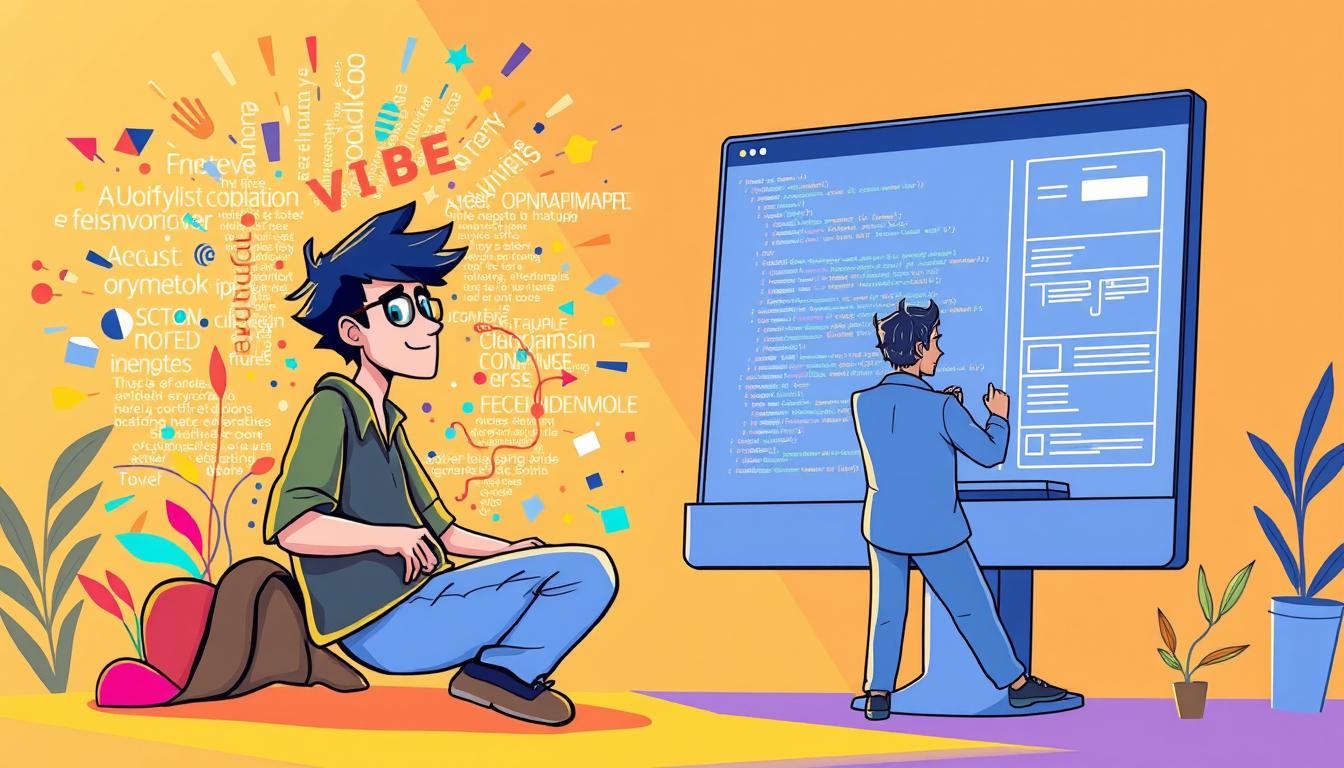
There are moments when a developer sits back and feels the thrill of rapid creation — a prototype that appears in hours, not weeks. That rush can be powerful, but it can also blind teams to long-term risks.
The industry now contrasts free-form “vibe coding” with disciplined, AI-assisted engineering. Leaders have warned that shipping unreviewed AI output invites reliability, security, and maintenance problems.
This introduction frames a practical guide: how the two approaches shape a project’s trajectory, trade-offs in time and structure, and the systems thinking needed to avoid costly surprises.
Readers will find a mentor-like, actionable perspective that balances speed and rigor. For background reporting and community anecdotes that sparked this discussion, see a detailed workflow analysis at vibe coding as a software engineer.
Key Takeaways
- Vibe coding favors rapid exploration; engineering prioritizes long-term reliability.
- AI can amplify both speed and risk—human review and design matter.
- Systems thinking and clear structure reduce production surprises.
- Teams should match approach to project goals and user trust needs.
- Practical guardrails let teams blend experimentation with disciplined delivery.
TL;DR: What separates vibe coding from UI engineering in real projects
A project’s stakes usually decide whether fast exploration or structured delivery is the better path. Quick, prompt-driven construction shines when teams need momentum and visible output fast. It fuels spikes, prototypes, and weekend experiments where trial and error beat formal process.
Speed and exploration vs. structure and longevity
Fast exploration uses high-level prompts and rapid iterations. Developers accept AI suggestions to validate ideas quickly. That way lets teams learn fast and ship demos that prove concepts.
Structured delivery ties AI to design docs, tests, and reviews. Humans remain accountable for architecture and each line of code. This process reduces surprises in security and performance over time.
Where each approach wins—and where it breaks
- Best for momentum: quick prototypes and early validation.
- Best for trust: production features with SLAs and compliance.
- Common failure: prototype code passes simple checks but fails at scale.
- Mitigation: short design, focused tests, and clear ownership before merge.
| Criterion | Rapid prototype | Disciplined delivery |
|---|---|---|
| Primary goal | Validate ideas fast | Stable, maintainable product |
| Typical controls | Light review, fast iterations | Design docs, TDD, code review |
| Risk profile | Higher security & performance gaps | Lower operational surprises |
What is vibe coding?
Vibe coding is a fast, conversational approach that favors discovery over durability. Teams describe intent at a high level, run short prompts, and accept the model’s suggestions to produce visible output quickly.
High-level prompts, rapid iteration, and “forget the code exists” flow
“Fully giving in to vibes,” Andrej Karpathy wrote — a style where teams often forget the code exists and focus on results.
In practice, the flow treats the AI as a fast collaborator: state intent, take suggested code, and iterate. The loop is short: small prompt, quick run, visible change. That yields momentum and demoable features in hours.
Best-fit scenarios: prototypes, MVPs, spikes, and weekend projects
Use cases include throwaway scripts, internal tools, and early app prototypes where speed matters more than long-term maintainability.
- Ideal when the work is disposable and the goal is validation.
- Developers report wins converting configs and automations quickly with Claude-like models.
- Risks: minimal tests, hidden defaults, and accumulating “trust debt” when authors can’t explain generated code.
Responsible practitioners set boundaries: declare throwaway scope, keep diffs small, validate outputs, and discard experimental branches. For a practical toolset and workflow examples, see a detailed guide on vibe coding tools.
What is UI engineering?
UI engineering makes design systems, accessibility, performance budgets, and maintainability non-negotiable from day one.
The approach treats frontend work as product-grade software. Teams codify design tokens, spacing, and accessible components so the interface scales without fragile rewrites.
Design, accessibility, performance, and maintainability as first-class
Design patterns and a shared source of truth prevent UX drift. Consistent tokens speed new features and reduce visual bugs.
Accessibility is built in: components ship with keyboard and screen-reader support. That lowers remediation cost later.
Performance is intentional: bundle budgets, lazy loading, and planned data-fetch strategies avoid surprise regressions.
AI-assisted engineering inside a structured SDLC
AI acts as a copilot within an explicit process: technical specs, TDD, strict code review, and CI/CD. Humans remain responsible for architecture and every line of code.
“Augmenting a sound process—not skipping it—can sustain speed gains near 30% while keeping security and scalability intact.”
| Focus | Practices | Outcome |
|---|---|---|
| Design systems | Tokens, component library, visual tests | Consistent UX, faster feature delivery |
| Security | Threat models, secure defaults, review checklists | Fewer production incidents |
| Process | Specs, TDD, CI/CD, code review | Early risk detection, predictable releases |
- Engineers choose when to accept or rewrite AI output so code fits the project structure.
- Strong cultures codify patterns and practices so teams move faster with less firefighting.
vibe coding vs UI engineering
Momentum breeds prototypes; constraints produce maintainable systems—and each needs different guardrails.
Goals and constraints: momentum or reliability
The core trade-off is simple: one approach maximizes speed for demos and the other prioritizes correctness for production software.
Rapid work delivers visible output fast. That helps validation and investor demos.
Disciplined work enforces design tokens, reuse, and naming so future development is easier.
Ownership and review: human-in-control or autopilot
Ownership separates the two. In disciplined workflows, humans direct architecture and verify each line of code.
In contrast, loose workflows let AI run with minimal oversight—risking large PRs no one can explain.
Outcomes: demoable output or production-grade software
Short-term wins create demoable output that looks right. Long-term wins yield robust features that scale.
“AI can accelerate work—but it must sit inside a strong process to avoid trust debt.”
| Dimension | Fast prototype | Disciplined delivery |
|---|---|---|
| Primary goal | Momentum and learning | Reliability and maintainability |
| Ownership | Minimal review | Human-led review & tests |
| Typical risk | Ad hoc logic and drift | Integration and scale safety |
- Teams can switch modes: explore, then harden and document what stays.
- ai-assisted development succeeds when it augments a strong process, not replaces it.
Workflows and context: from improvisation to orchestration
A reliable workflow ties intent, tests, and repo context together before any agent generates code.
Spec-driven development, test plans, and code reviews
Start with a spec and acceptance tests. That brief reduces hallucinations and gives a clear yardstick for success.
Test-first prompts show how the model interprets intent. Generated tests expose ambiguity early and save time later.
Code reviews stay central: smaller diffs, focused commit messages, and shared checklists make review efficient and meaningful.
Embedding context: repo-aware agents, reuse of utilities, and patterns
Developers feed agents repository context: directories, utilities, and shared patterns so changes align with existing structure.
Point agents to a source-of-truth utility and forbid duplicates. Reuse prevents drift and preserves architectural coherence.
- Orchestrated workflows begin with specs and acceptance tests.
- Repo-aware models reuse components, ship tests, and respect patterns.
- Performance and security checks in CI create feedback loops for both team and tool.
| Stage | Input | Outcome |
|---|---|---|
| Spec | Acceptance criteria, examples | Clear brief for agents and humans |
| Context | Repo paths, utilities, patterns | Consistent, integrated changes |
| Review | Tests, PR summaries, small diffs | Faster, safer merges |
Risks of vibe coding at scale
Rapid, ad-hoc development that looks right in demos often hides critical failures when traffic and real data arrive.
Security gaps: auth logic, input sanitization, and secrets exposure
Security mistakes are common: API keys left in a file, inverted permission checks, or missing input sanitization.
Those gaps let attackers bypass authorization paths or read secrets. The reputational and financial result can be severe.
Performance surprises under real workloads and data volumes
Queries that pass tests can stall in production. Naive caching and untested database access produce poor performance under load.
Teams see increased latency and outages when systems face larger datasets than the tests used.
Maintainability debt: opaque code, scattered middleware, brittle glue
Opaque code and scattered logic create brittle software. Small changes ripple across files and force rewrites.
Organizations inherit trust debt: senior engineers must reverse-engineer AI decisions to fix issues and restore predictability.
- Missing tests and unclear ownership let regressions slip through.
- Production telemetry often reveals flaws late—turning incidents into reactive fire drills.
- The short-term speed gain can become long-term drag on velocity and morale.
Real-world failure modes teams reported
A case pattern emerged from CTO reports: quick wins that mask brittle systems until traffic spikes expose them.
Performance meltdown
One incident: an AI-generated query passed unit tests but throttled production under real data and load. The query was syntactically correct yet inefficient.
The result: a week-long outage, repeated rollbacks, and senior developers in triage for days.
Security lapse
An inverted truthy check in an AI-produced auth flow let deactivated users keep admin access. No one owned the logic deeply, so the issue slipped into production.
“Things compiled and tests passed—until an auth shortcut opened admin rights,” a CTO said.
Complexity spiral
Teams reported an auth feature assembled from scattered middleware and glue code. When requirements changed, extension required full rewrites.
Documentation gaps meant no single person could explain the code; morale and time suffered.
- Common factors: missing context, absent guardrails, superficial verification.
- Pragmatic takeaway: require smaller scopes for AI changes, test-first prompts, and mandatory review by the subsystem owner.
| Failure mode | Root cause | Impact |
|---|---|---|
| Performance | Inefficient query on production data | Week-long outage, high latency |
| Security | Inverted logic in auth check | Unauthorized admin access, urgent patching |
| Maintainability | Scattered middleware and opaque glue | Full rewrite, senior time lost |
Developer roles are changing: from author to orchestrator
Developers now shift from writing every line to designing the rules that make agents reliable teammates.
This role focuses on intent, constraints, and the shared utilities that keep a codebase coherent. Small, reviewable changes reduce surprises and spread ownership.
Think in systems, not tickets
Systems thinking means prioritizing abstractions, shared utilities, and timely refactors over one-off fixes. Teams that adopt this view cut future complexity and speed up new work.
Codify rules and protect structure
Set naming rules, directory boundaries, and protected areas so agents write like team members. Structure prevents duplication and preserves intent.
Direct agents to the source of truth
Point tools and prompts to canonical utilities. Encourage agents to reuse and improve shared code rather than duplicate it.
Stay aligned as changes accelerate
“Small diffs, clear PR summaries, and architecture notes keep drift visible and fixable.”
- Embed test-first prompts to define behavior before coding.
- Use PR-summary tools to keep developers aware of architectural change.
- Make ownership explicit so practices scale with speed.
| Role | Focus | Outcome |
|---|---|---|
| Orchestrator | Intent, constraints, shared utilities | Consistent design and fewer surprises |
| Agent | Repeatable tasks and boilerplate | Faster delivery with guided reuse |
| Reviewer | Small diffs, tests, PR notes | Maintained structure and quality |
Prompt engineering makes or breaks AI-assisted development
Prompt strategy determines whether AI accelerates delivery or creates fragile surprises. Teams that plan roles, stack choices, and clear boundaries get predictable results. Poorly framed requests produce noisy output and rework.

Clear intent, constraints, and stepwise tasks reduce hallucinations
Define intent, acceptance criteria, and the target file before asking the model to act. Break large work into small tasks to avoid long, brittle generations.
Ask for tests first: generated tests reveal misunderstandings early and save time during review.
Better prompts, better code: examples from UI and app flows
A vague prompt like “Build a login form” yields inconsistent results. A precise prompt — “React login form with email/password, basic validation, plain CSS, no libs” — produces cleaner, reviewable code and reduces token waste.
| Policy | Why it helps | Outcome |
|---|---|---|
| Scope files | Constrain edits to specific file paths | Smaller diffs, safer merges |
| Stepwise tasks | Split features into tests then code | Fewer hallucinations |
| Use popular stacks | Models know common patterns | Higher-quality output |
- Provide references: point the tool at utilities so the model reuses existing code.
- Favor popular frameworks and limit the model to one tech choice per task.
- Treat prompt engineering as a durable skill—clarity from the orchestrator yields dependable coding results.
Clear prompts turn large language models into predictable teammates; ambiguity turns them into noise.
Tools, models, and patterns that help UI engineering scale
Teams that pair the right tools with clear patterns scale frontend work without repeated firefights.
Use models as copilots to generate boilerplate, initial tests, and scaffolds. Teams report ~30% speed gains when LLMs produce repeatable code and tests, but human review remains mandatory.
Favor popular stacks and documented patterns
Choose ecosystems like React, Next.js, Tailwind, and shadcn/ui. Models perform better with familiar stacks; outputs are cleaner and easier to maintain.
Practical practices to keep work coherent
- Constrain edits to specific files; keep diffs small.
- Automate quality gates: lint, types, unit and integration tests, and security scans.
- Integrate repo-aware tools that read systems and suggest consistent changes.
- Ask models to detect duplication and propose refactors as part of continuous improvement.
| Focus | Why it helps | Result |
|---|---|---|
| Copilot models | Boilerplate & tests | Faster delivery with review |
| Patterns | Consistent names & structure | Lower maintenance cost |
| PR summaries | Protect architectural intent | Safer merges as the app grows |
“The right combination of tools, patterns, and human oversight lets ai-assisted development scale without sacrificing quality.”
Frontend and database specifics: performance, UX, and data integrity
Frontend performance and database hygiene are common fault lines when prototypes meet real users. Teams must treat the client and the data layer as a single system, not separate tasks.
UI concerns: accessibility, state, and design system reuse
Accessible components are non-negotiable: keyboard paths, labels, and contrast save hours of remediation.
Keep state predictable. Prefer explicit patterns and shared hooks so behavior stays consistent as the app grows.
Reuse design primitives: design tokens and component libraries prevent visual drift and reduce rework.
Data concerns: query efficiency, migrations, and production telemetry
Database discipline avoids the classic meltdown: queries that pass tests but fail under real load.
Index strategy, explain plans, and careful migrations stop slowdowns before they cascade.
Instrument everything: APM, logs, and query tracing reveal hotspots so teams can act before users notice.
- Client performance: code-splitting, image optimization, and minimal render work coordinated with backend fetch strategies.
- Security spans the UI: guard protected routes, validate inputs, and never leak secrets in bundles.
- When prompting a model, specify design tokens, state choices, and preferred hooks so generated code aligns with your stack.
| Focus | Practice | Outcome |
|---|---|---|
| Frontend | Accessible components, shared state hooks | Stable UX |
| Database | Indexed queries, safe migrations | Predictable performance |
| Telemetry | APM & tracing | Fast detection of regressions |
“Treat AI output as a draft: require tests, performance checks, and an owner before merging.”
Finally, development teams should codify performance budgets and accessibility checklists into CI. Writing code that respects the design system and data utilities keeps the app resilient as velocity rises.
Decision guide: when to vibe, when to engineer
Deciding whether to prototype fast or lock in structure begins by mapping risk to real users and business impact. Teams should measure the blast radius: who is affected if logic fails, how costly a rollback will be, and how much time the software must remain stable.
https://www.youtube.com/watch?v=LEHVII0ItBk
Use cases, risk tolerance, and stakeholder impact
Choose vibe coding for low-risk projects, internal tools, or early prototypes where speed and learning matter more than longevity.
Opt for UI engineering when features touch customers, regulators, or payments—cases with high stakeholder impact demand rigorous process.
Guardrails: TDD by default, mandatory code review, security checks
Require tests first: TDD uncovers bad assumptions early. Make code review and automated security scans mandatory every time.
Time-box exploration: allow short bursts of rapid work, then harden the code once feasibility is proven to avoid trust debt.
| Decision axis | When to prototype | When to harden |
|---|---|---|
| Risk | Low blast radius; internal | High blast radius; user-facing |
| Time | Short experiments | Long-lived product |
| Controls | Quick review, revert plan | TDD, reviews, security scans |
Rule of thumb: map intent and risk first—then pick the approach that protects users and minimizes future rewrites.
Conclusion
Teams that pair human oversight with fast experimentation get the best of both speed and reliability.
Vibe coding is a powerful accelerator for exploration, but dependable software comes from deliberate practice. The sustainable way is orchestration: clear intent, guardrails, and human review guiding a model toward useful code.
Structure is not bureaucracy—it’s the method teams use to avoid issues that show up at scale. Treat AI as a tool that amplifies process; without process, even a strong model can produce fragile output.
Small, reviewable changes, strong prompts, and tests-first habits yield better results. Decide the approach by risk and impact, blend modes thoughtfully, and keep humans in control to deliver faster, safer development.
FAQ
What is the core difference between vibe coding and UI engineering?
Vibe coding emphasizes rapid exploration, high-level prompts, and fast iterations to validate ideas. UI engineering prioritizes design systems, accessibility, performance, and maintainability to deliver production-grade software. One is optimized for momentum and demos; the other for reliability, testing, and long-term ownership.
When should a team choose fast exploratory work over a structured engineering approach?
Choose fast exploration for prototypes, MVPs, spikes, and weekend projects where speed and learning matter more than long-term support. Opt for structured engineering when stakeholder impact, security, performance, and maintainability are primary concerns—especially for customer-facing products or regulated systems.
How do prompts and prompt engineering affect AI-assisted development?
Clear intent, constraints, and stepwise tasks reduce hallucinations and produce more accurate outputs. Better prompts yield better code, tests, and documentation. Prompt engineering becomes a core part of the workflow: define scope, expected interfaces, and edge cases before asking a model to generate work.
What common failure modes appear when teams scale vibe-style practices?
Teams report performance meltdowns from unoptimized queries, security lapses like inverted checks or exposed secrets, and maintainability debt caused by opaque, brittle glue code. These issues surface when short-term speed replaces design reviews, testing, and architectural oversight.
How can teams embed context so AI tools produce reusable, safe code?
Use repo-aware agents, shared utilities, and well-documented patterns. Codify naming conventions, directory structure, and protected areas. Ensure models have access to relevant docs, tests, and CI checks so generated output aligns with the team’s source of truth.
What risks should teams address around security and data when using AI to generate code?
Address auth logic, input sanitization, secrets management, and permission models up front. Add automated security scans, mandatory human review for sensitive flows, and runtime telemetry to detect anomalies before they reach production.
Which workflows help reconcile rapid iteration with long-term quality?
Combine spec-driven development, test plans, and rigorous code reviews with short feedback loops. Use feature flags, TDD by default, and incremental refactors. This mix preserves momentum while preventing a complexity spiral.
What role should developers play as AI tools become more capable?
Developers shift from sole authors to orchestrators: they design abstractions, curate patterns, and enforce boundaries. Responsibilities include reviewing model outputs, directing reuse of the canonical utilities, and maintaining architectural awareness to prevent drift.
How do frontend and database concerns differ when using model-generated code?
Frontend priorities include accessibility, state management, and design system reuse; generated UI must be testable and performant. Database concerns focus on query efficiency, migrations, and data integrity; generated SQL or ORM code must be validated against production workloads and telemetry.
Which tools and patterns improve the quality of AI-assisted engineering?
Use LLMs as copilots for boilerplate, tests, and initial implementations while relying on established stacks and popular components. Pair generation with linters, static analysis, CI gates, and observability so automated output meets team standards.
How should teams decide whether to "vibe" or "engineer" a feature?
Consider use case, risk tolerance, user impact, and time horizon. Use vibe-style work for learning and prototyping; require full engineering practices for production features with security, compliance, or scale requirements. Apply guardrails—mandatory reviews, security checks, and test coverage—based on risk.
Can AI replace code reviews and architectural decisions?
No. AI accelerates routine tasks and suggests patterns, but human judgment remains essential for architecture, security, and stakeholder trade-offs. Reviews should combine automated checks with expert oversight to ensure intent and correctness.